Mechanical Musical Instrument
A posthumous organette patent with a lift-away reed-board and rewind gearing
Reed organ played by perforated paper music-sheet
♫ How it works
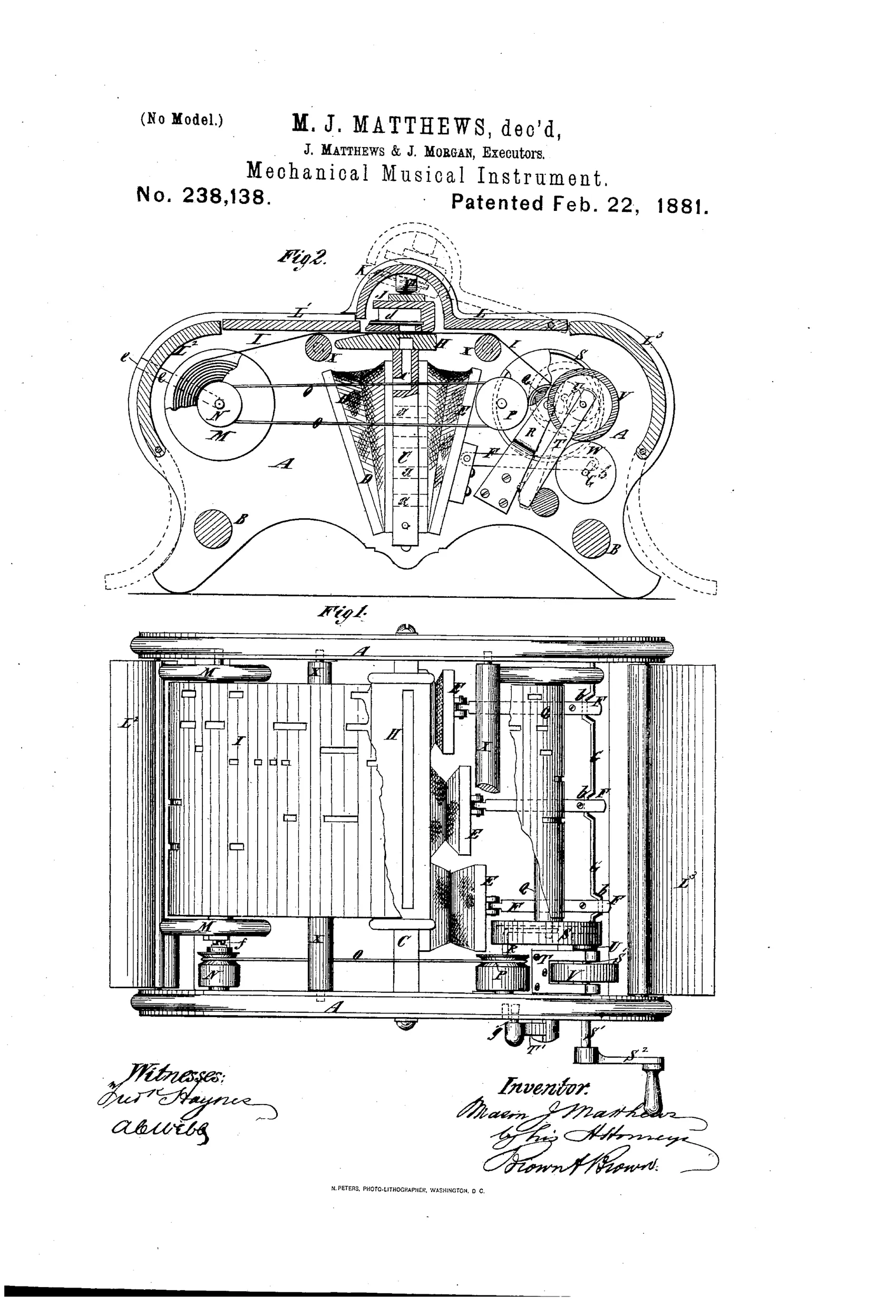
A perforated music-sheet travels between a rest H and a pivoted, dome-shaped reed-board chamber J/K, with the sheet's holes controlling air passage through reed-ducts to sound the reeds. Suction bellows E, driven off a shaft G by pitmen and cranks, draw air through a wind-chest C and receiver D to actuate the reeds. A swinging driving-shaft carrying wheels U and V can be shifted forward to engage a take-up roller (via wheel S) for slow forward play, or engage pulley P to rapidly rewind the sheet onto the music-roller M. Arc-shaped cover sections (L2, L3) pivot open to give access to the music-roller and take-up roller for changing or rewinding the sheet.
♫ What was claimed
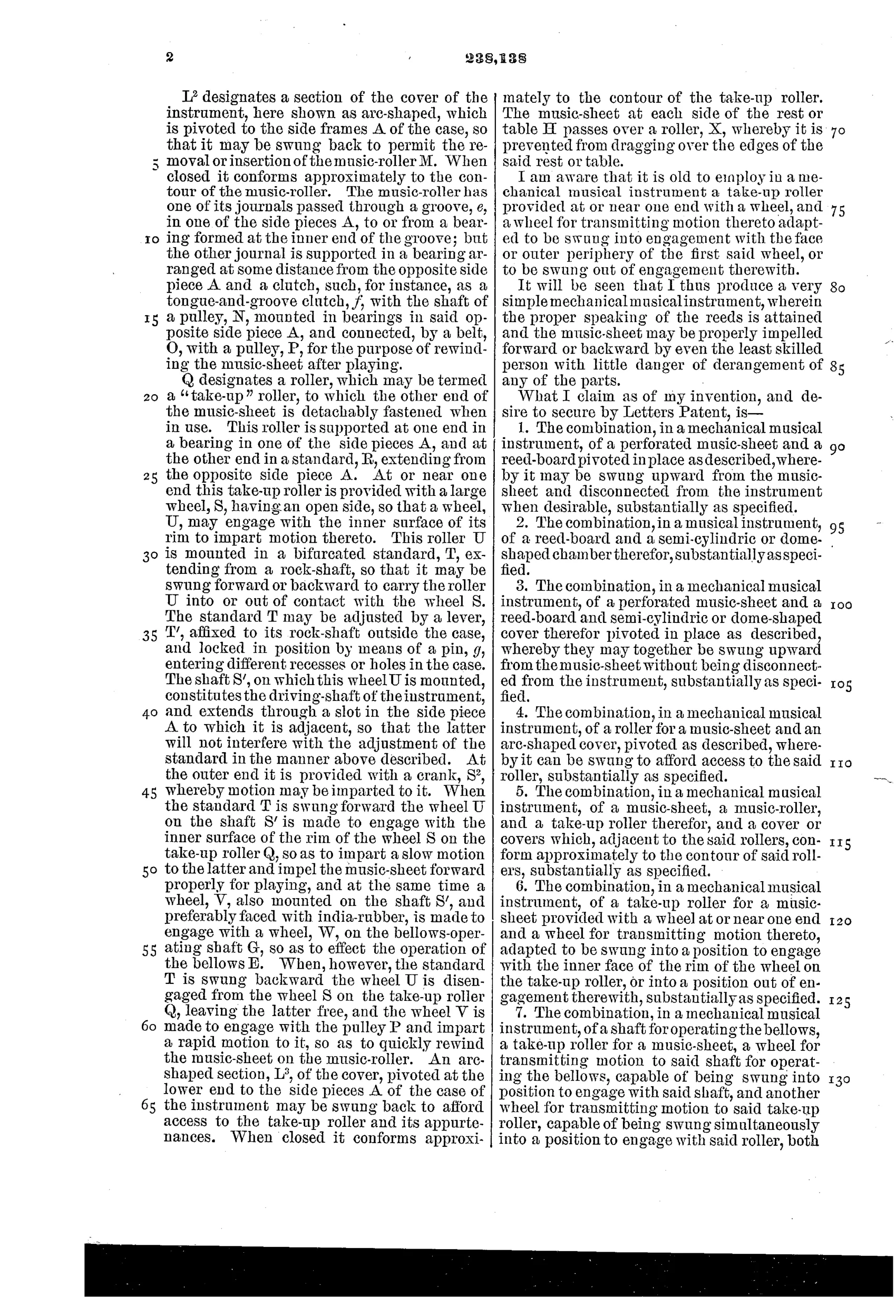
“1. The combination, in a mechanical musical instrument, of a perforated music-sheet and a reed-board pivoted in place as described, whereby it may be swung upward from the music-sheet and disconnected from the instrument when desirable, substantially as specified.”
In plain English: A pivoted reed-board that can be lifted away from the perforated music-sheet and detached from the instrument when needed.
♫ In the inventor’s words
“It will be seen that I thus produce a very simple mechanical musical instrument, wherein the proper speaking of the reeds is attained and the music-sheet may be properly impelled forward or backward by even the least skilled person with little danger of derangement of any of the parts.”— Mason J. Matthews, from the specification
Fate unknown
Matthews' organette patents fed Boston's roller-organ trade, but no instrument specifically embodying this pivoted reed-board design is documented; a marked example would settle it.
♫ Commentary
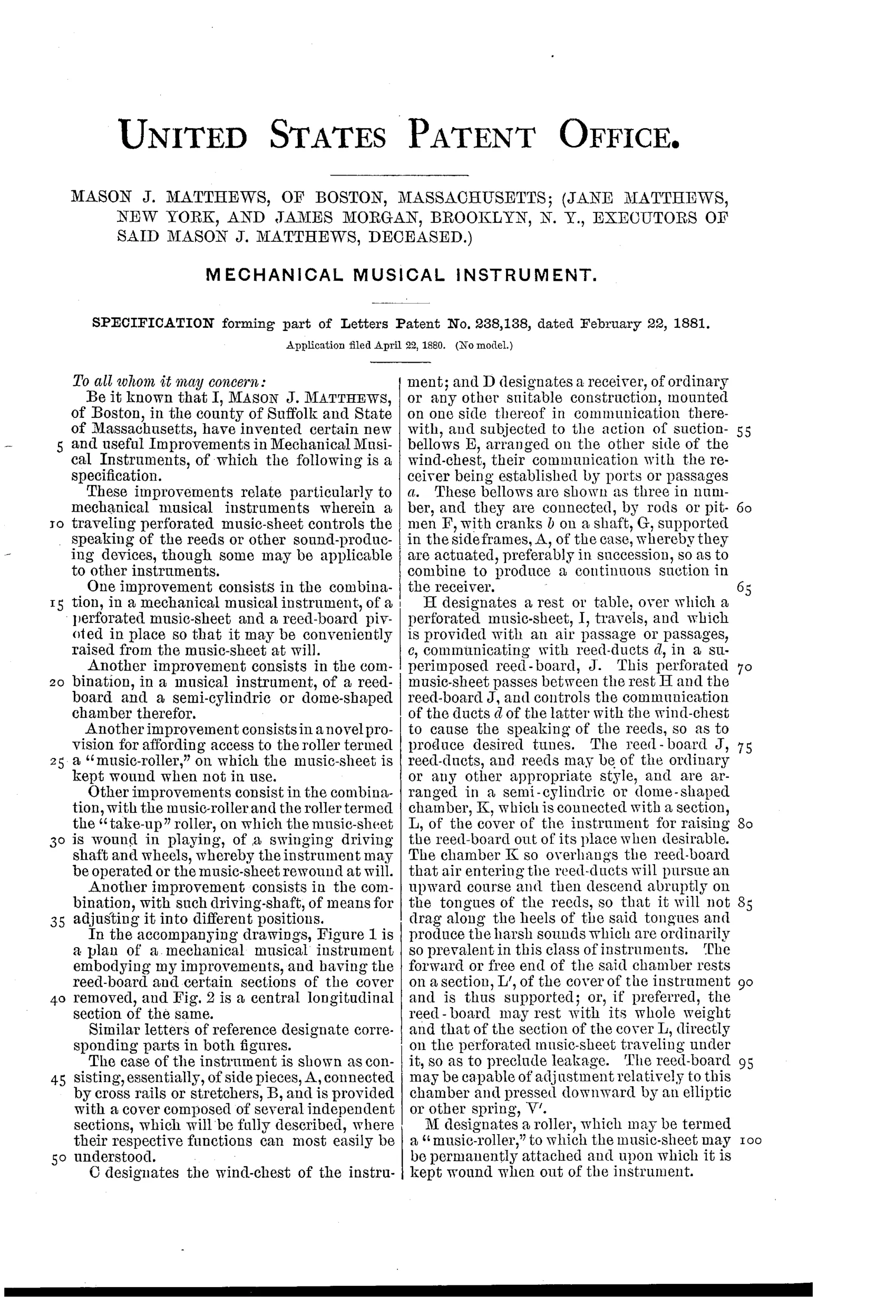
The heading tells a small story before the drawing does: "M. J. Matthews, dec'd" — Mason J. Matthews died between filing in April 1880 and issue in February 1881, and his executors carried it through. Boston in these years was a hive of organette work, small suction-reed instruments playing perforated paper, and Matthews was one of the names attached to that trade. This is squarely one of those machines, patented in the brief window before disc music boxes and then the phonograph crowded organettes out.
The mechanical heart is the first claim: the dome-shaped reed-board chamber is pivoted so it swings up off the paper and can be detached entirely. Anyone who has fought a jammed or torn organette sheet will see the point immediately — the paper is the fragile, user-handled part, and giving "the least skilled person" clear access to it without tools is honest, practical design. The swinging drive shaft is the other nice touch: shift it one way and wheel S engages the take-up roller for slow playing speed; shift it the other and pulley P engages for a fast rewind back onto the music-roller. One shaft, two speeds, two directions, no separate mechanism.
Fig. 2's arc-shaped cover sections that pivot open over the rollers show Matthews thinking about the whole user experience, not just the pneumatics. It's a refinement in a crowded field, but a thoughtful one.
Commentary by Claude, The Talking Machine Patent Archive’s resident enthusiast