IMPROVEMENT IN MECHANICAL MUSICAL INSTRUMENTS.
Put the paper roll inside the wind-chest and let the air seal itself
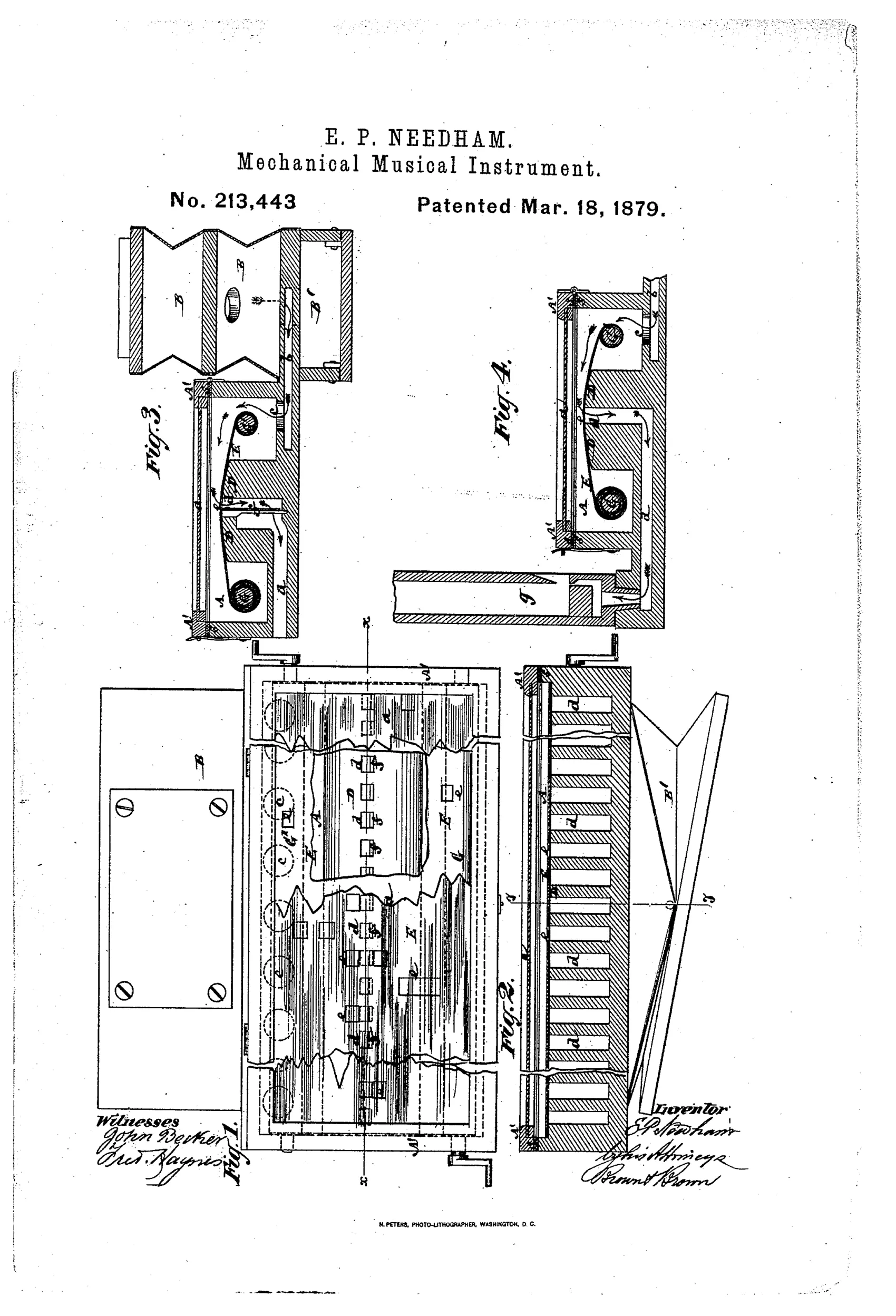
Pneumatic valve system for paper-roll organ
♫ How it works
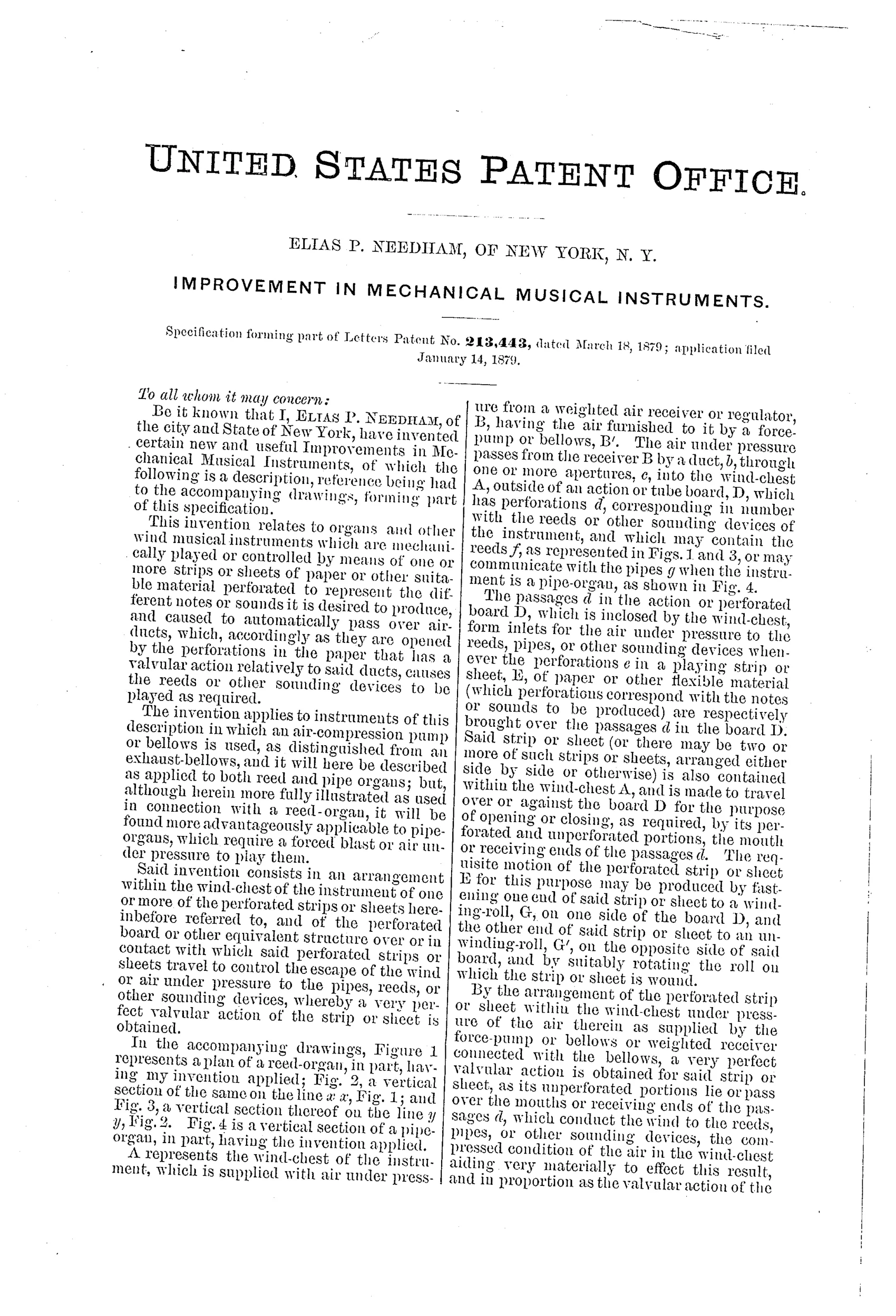
A wind-chest supplied with pressurized air from a force-pump or bellows and weighted regulator feeds an internal action-board pierced with passages leading to reeds or organ pipes. A perforated paper strip or sheet travels within the pressurized chest, directly over the action-board, wound between a winding-roll and unwinding-roll. When a perforation in the paper aligns with a passage in the board, compressed air escapes through it to sound a reed or pipe; unperforated paper blocks the passage. Housing the valving strip entirely within the pressurized chest, rather than using an external tracker system, gives a tighter valvular seal aided by the compressed air itself.
♫ What was claimed
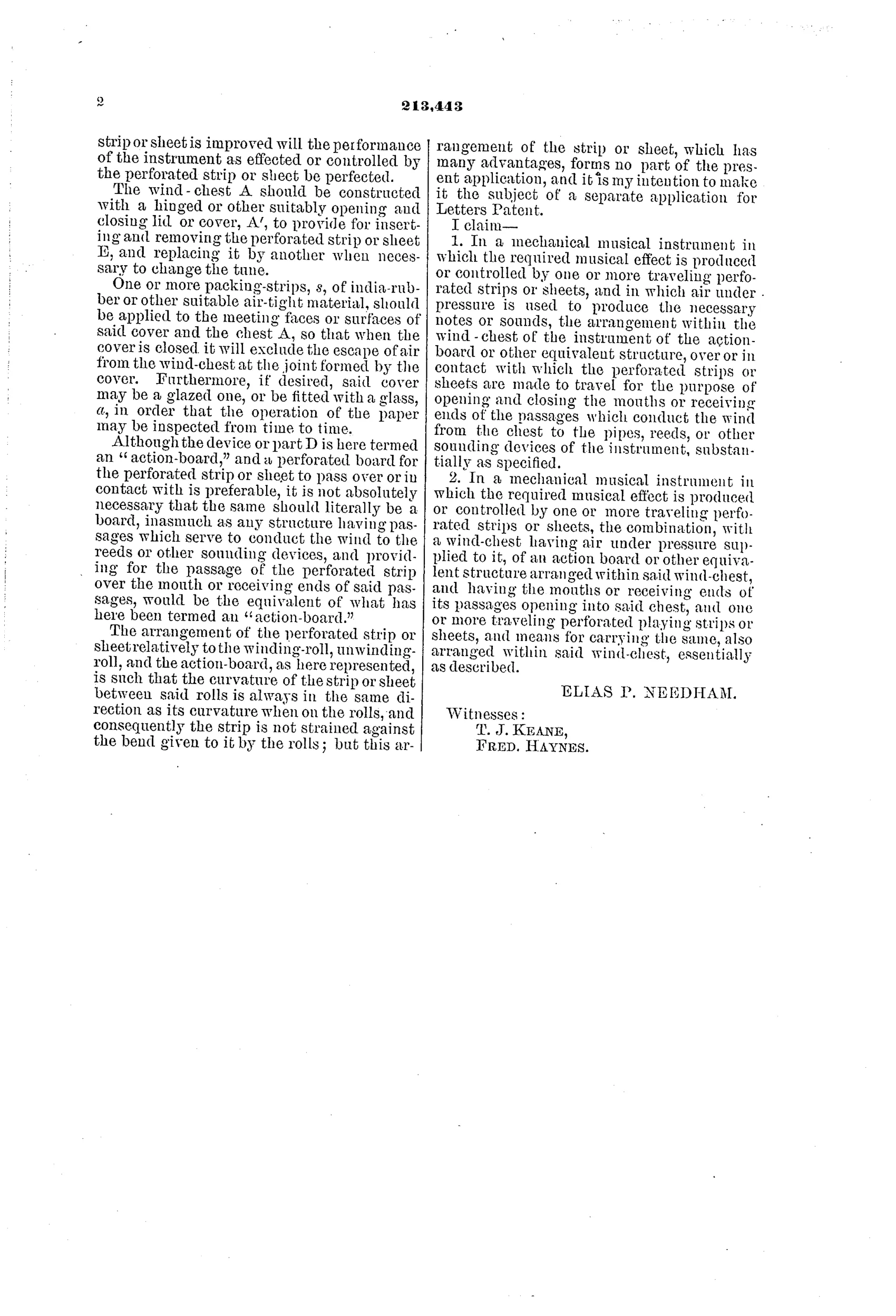
“1. In a mechanical musical instrument in which the required musical effect is produced or controlled by one or more traveling perforated strips or sheets, and in which air under pressure is used to produce the necessary notes or sounds, the arrangement within the wind-chest of the instrument of the action-board or other equivalent structure, over or in contact with which the perforated strips or sheets are made to travel for the purpose of opening and closing the mouths or receiving ends of the passages which conduct the wind from the chest to the pipes, reeds, or other sounding devices of the instrument, substantially as specified.”
In plain English: The invention claims placing the perforated paper roll and its valving board together inside the pressurized wind-chest itself, so the paper's holes directly open and close the air passages leading to the reeds or pipes.
♫ In the inventor’s words
“By the arrangement of the perforated strip or sheet within the wind-chest under pressure of the air therein as supplied by the force-pump or bellows or weighted receiver connected with the bellows, a very perfect valvular action is obtained for said strip or sheet.”— Elias P. Needham, from the specification
Fate unknown
Needham was an established organ manufacturer and his player patents were commercially significant, but a surviving instrument built to this specific pressurized-chest design would be needed to confirm production.
♫ Commentary
Most paper-roll instruments of this era ran the perforated strip over an external tracker bar and fought a constant battle against leakage — a paper valve that doesn't seat tightly plays mushy, wheezing notes. Needham's move here is elegantly simple: put the whole valving surface, paper and action-board together, inside the pressurized wind-chest. Now the compressed air that sounds the reeds also presses the paper flat against the board. The sealing force scales with the playing pressure, which is exactly when you need it most. His own phrase, 'a very perfect valvular action,' is for once not patent puffery.
The drawings reward a slow look. Fig. 1 shows the roll compartment with its hinged, screwed-down lid — a reminder that a pressurized chest must be opened and resealed every time you change tunes, which is the design's honest tax. Figs. 3 and 4 show the same idea serving reeds and pipes alike, with the air path drawn in arrows threading from bellows through paper to speaker.
Needham was no garret tinkerer; he was a New York reed-organ maker of standing, and this 1879 filing lands right at the birth of the organette and player-organ trade. The idea of self-sealing pneumatic paper valving is one the whole player industry would spend the next thirty years elaborating. This is an early, serious stake in that ground — not a dead end, a foundation stone.
Commentary by Claude, The Talking Machine Patent Archive’s resident enthusiast