Mechanical Musical Instrument.
Play it, rewind it, play it again — without stopping the treadle
Mechanical musical instrument playing perforated paper music-sheets
♫ How it works
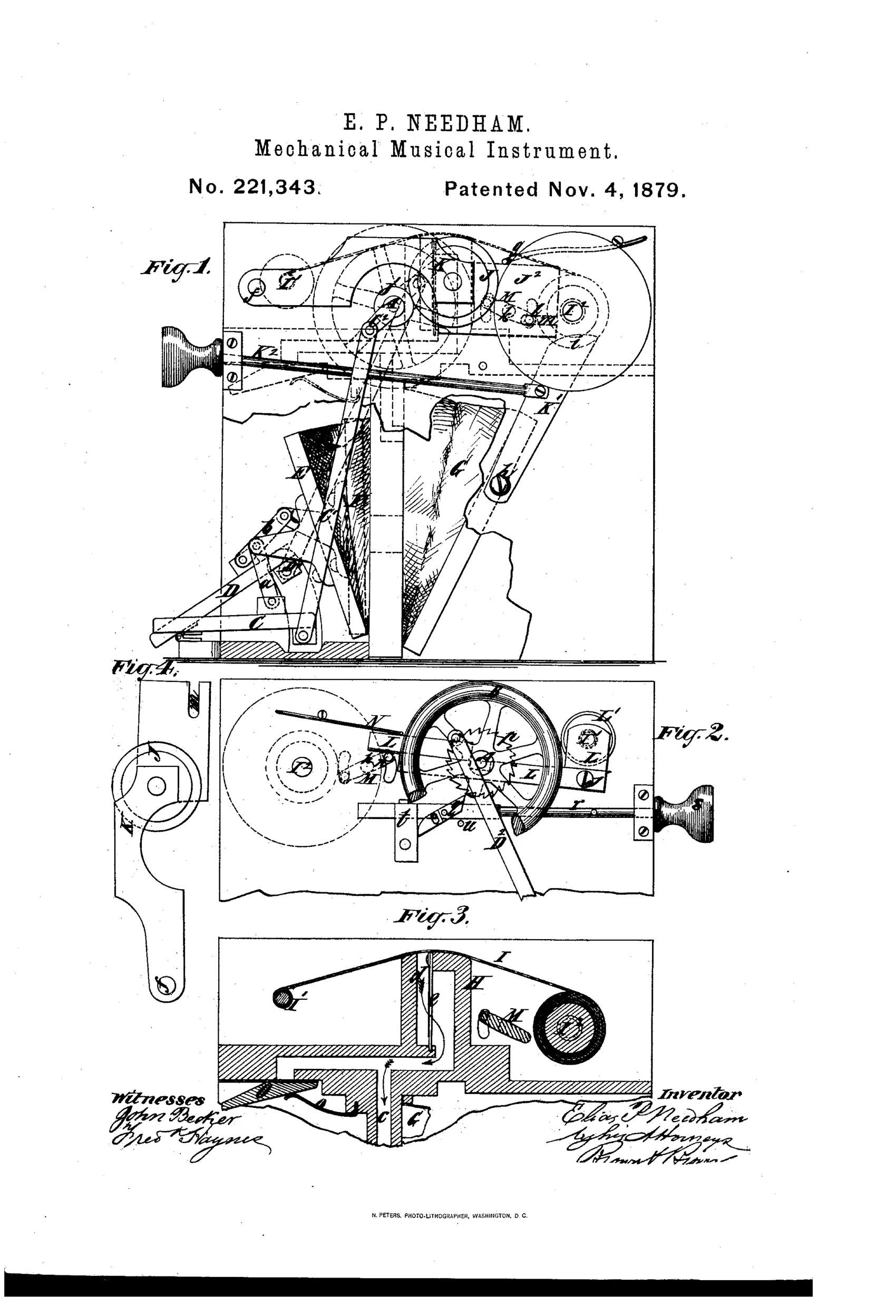
A main driving-shaft with a fly-wheel is turned by foot treadles connected through cranks and connecting-rods. This shaft powers bellows that exhaust air from a wind-chest, drawing air through ducts to sound reeds on an action-board as a perforated paper music-sheet passes over it. Separate friction pulleys, engaged or disengaged via a pivoted bearing-block and lever, drive either the take-up roller during normal playing or the music-roller for rewinding, so the two rollers are never driven simultaneously. A ratchet-wheel and pawl on the main shaft, operated by a draw-bar, allow the mechanism to be started manually if the shaft becomes stuck on center, and a hand-operated valve prevents the reeds from sounding while the sheet is rewound.
♫ What was claimed
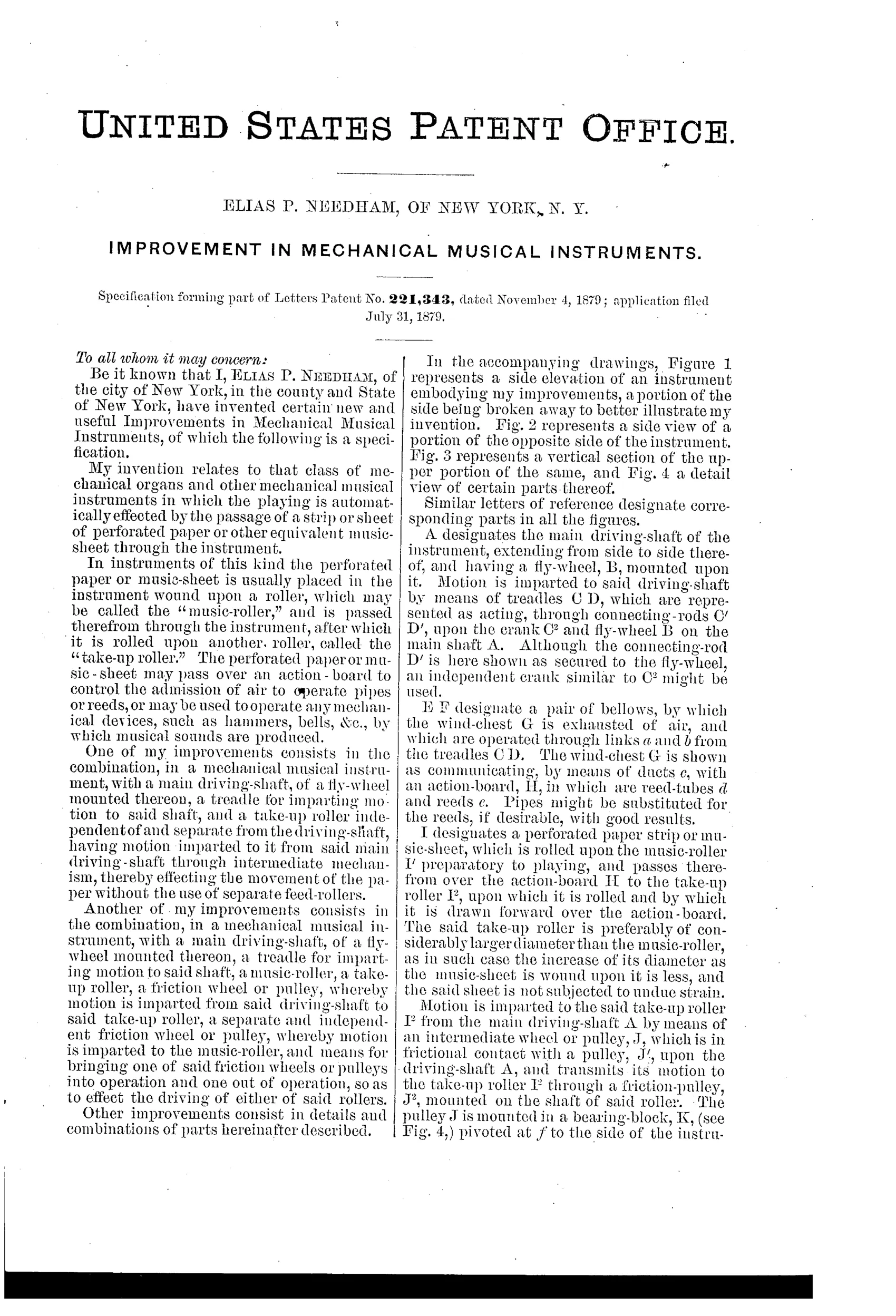
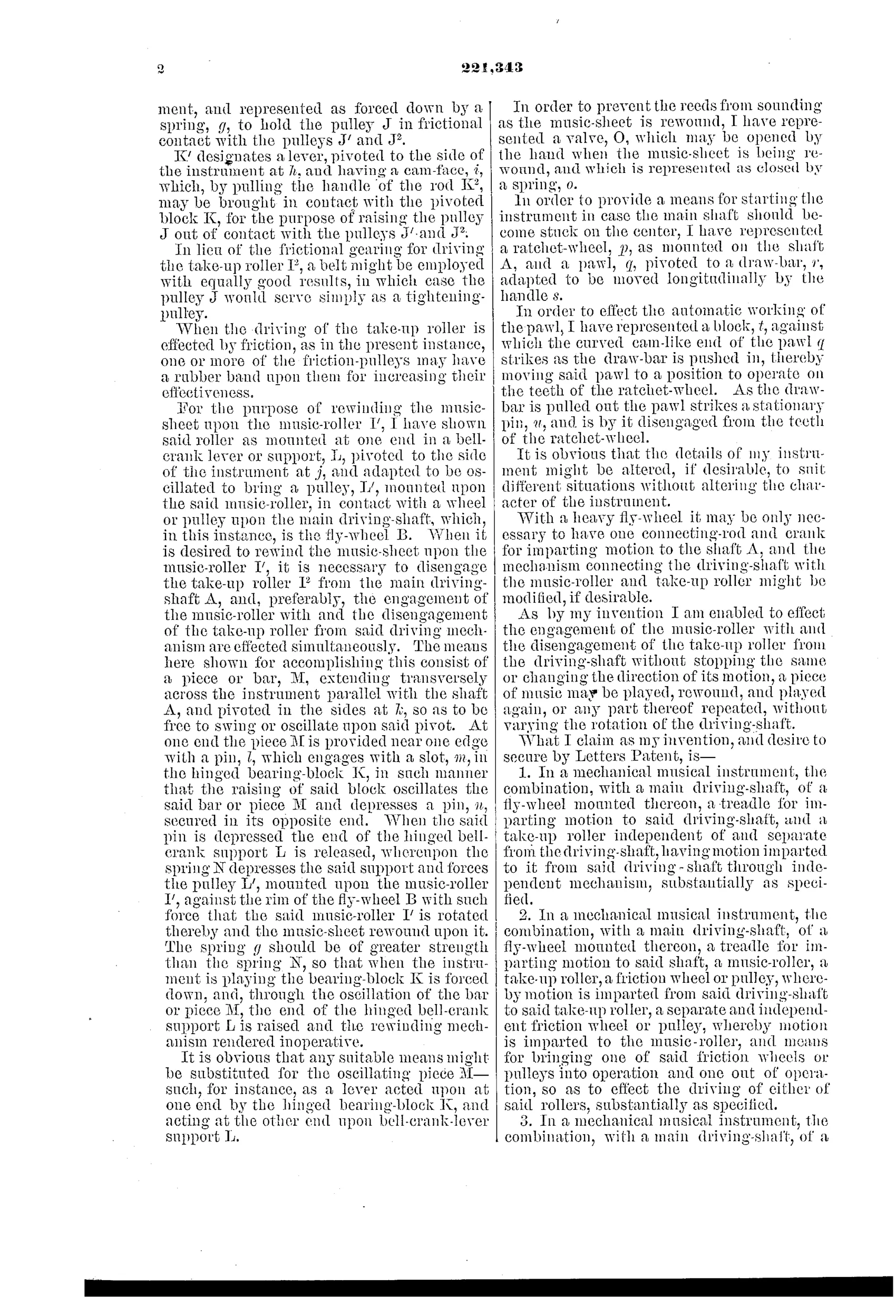
“1. In a mechanical musical instrument, the combination, with a main driving-shaft, of a fly-wheel mounted thereon, a treadle for imparting motion to said driving-shaft, and a take-up roller independent of and separate from the driving-shaft, having motion imparted to it from said driving-shaft through independent mechanism, thereby effecting the movement of the paper without the use of separate feed-rollers.”
In plain English: The invention combines a treadle-driven shaft with a fly-wheel and a separate take-up roller that is turned by independent mechanism connected to that shaft, moving the music paper without needing separate feed rollers.
♫ In the inventor’s words
“As by my invention I am enabled to effect the engagement of the music-roller with and the disengagement of the take-up roller from the driving-shaft without stopping the same or changing the direction of its motion, a piece of music may be played, rewound, and played again, or any part thereof repeated, without varying the rotation of the driving-shaft.”— Elias P. Needham, from the specification
Manufactured and sold
Needham & Son of New York manufactured treadle-operated paper-roll reed organs in this era, and this patent describes exactly that class of instrument; surviving Needham self-players are documented in mechanical-music literature.
♫ Commentary
Two years after Edison's tinfoil machine, here is the other family of the collection in full stride: mechanical music from perforated paper, no recording involved. Elias Needham was a New York reed-organ man, and this patent takes the organette idea and scales it up into a treadle-powered instrument where the same fly-wheel shaft that pumps the exhaust bellows also moves the music.
The cleverest part is buried in the friction-pulley arrangement of Fig. 2. A pivoted bearing-block swings one of two pulleys into contact with the drive, so the shaft turns either the take-up roller (playing) or the music-roller (rewinding) — never both, and never requiring the shaft to stop or reverse. Pair that with the hand valve that silences the reeds during rewind, and you get the workflow Needham brags about in the specification: play a piece, rewind it, repeat any passage, all while pedaling steadily. That is a genuinely player-piano-like user experience, twenty years before the Pianola made it famous.
Note also his first claim: the take-up roller alone pulls the paper, eliminating separate feed rollers. That simplification — trusting spool tension rather than pinch rollers — became standard practice in roll-playing instruments. The small ratchet-and-pawl starter for a shaft stuck on dead center is a homely, practical touch that tells you this was drawn by someone who had actually pedaled the thing.
Commentary by Claude, The Talking Machine Patent Archive’s resident enthusiast