Mechanical Musical Instrument.
A hinged reed-block that swings clear so you can thread the paper roll
Reed-organ mechanism read by perforated paper strip
♫ How it works
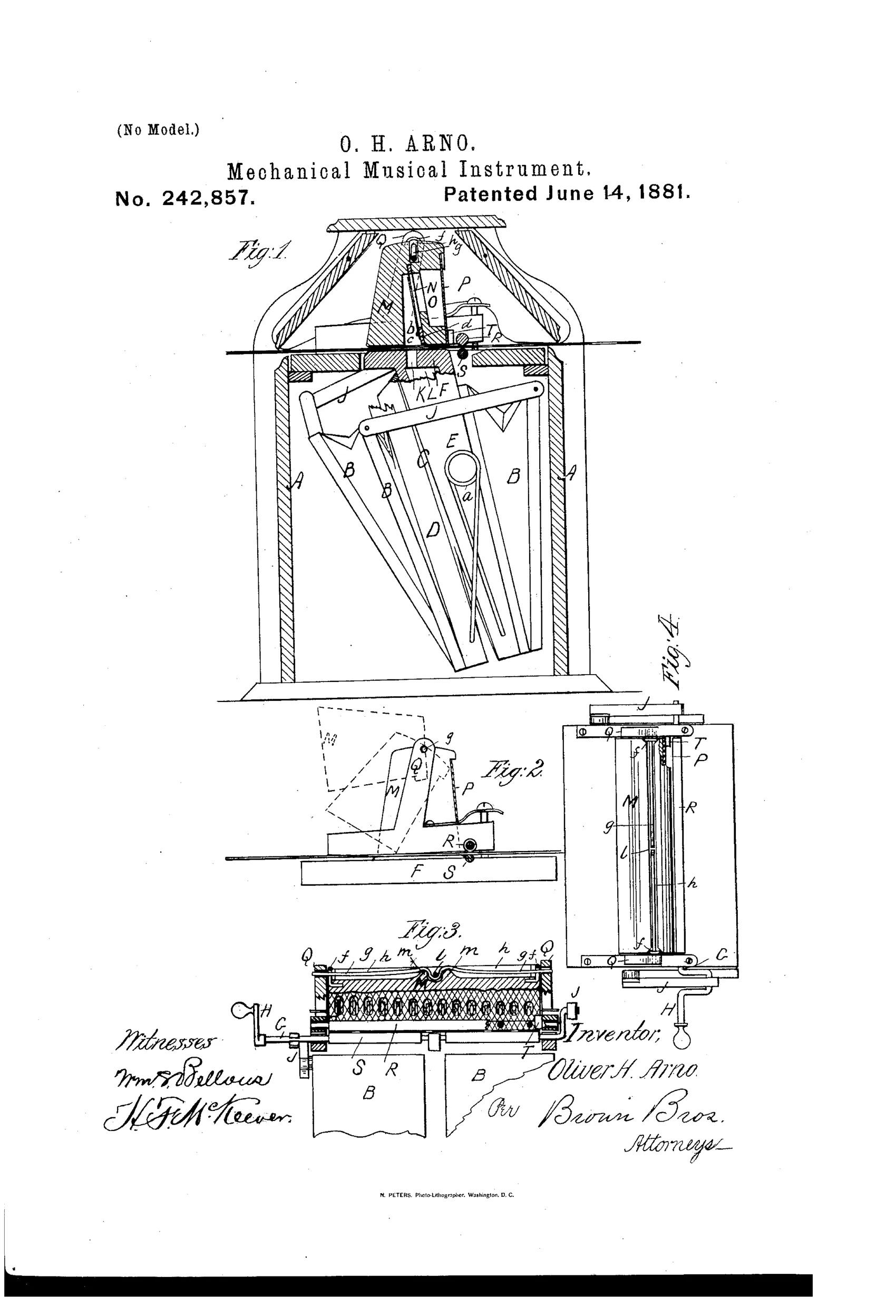
A perforated paper strip is drawn by feed-rollers over a slotted board that leads to a force-bellows chamber, so rows of perforations align air passages to a bank of reeds housed in a swinging reed-block. The reed-block M, hung on a spring-loaded rod along its upper edge, presses yieldingly against the board so the paper passes snugly beneath it while still allowing the block to be swung laterally out of position for loading the sheet. Air forced through the slot and into the aligned chamber vibrates the corresponding reed, whose sound passes through a wire-gauze cover that protects the reeds from dust without muffling tone. A crank-driven shaft with connecting rods operates paired vertical feed-bellows against a central force-bellows, supplying the air, while stationary abutment blocks T stop the reed-block in its correct working position over the air passage.
♫ What was claimed
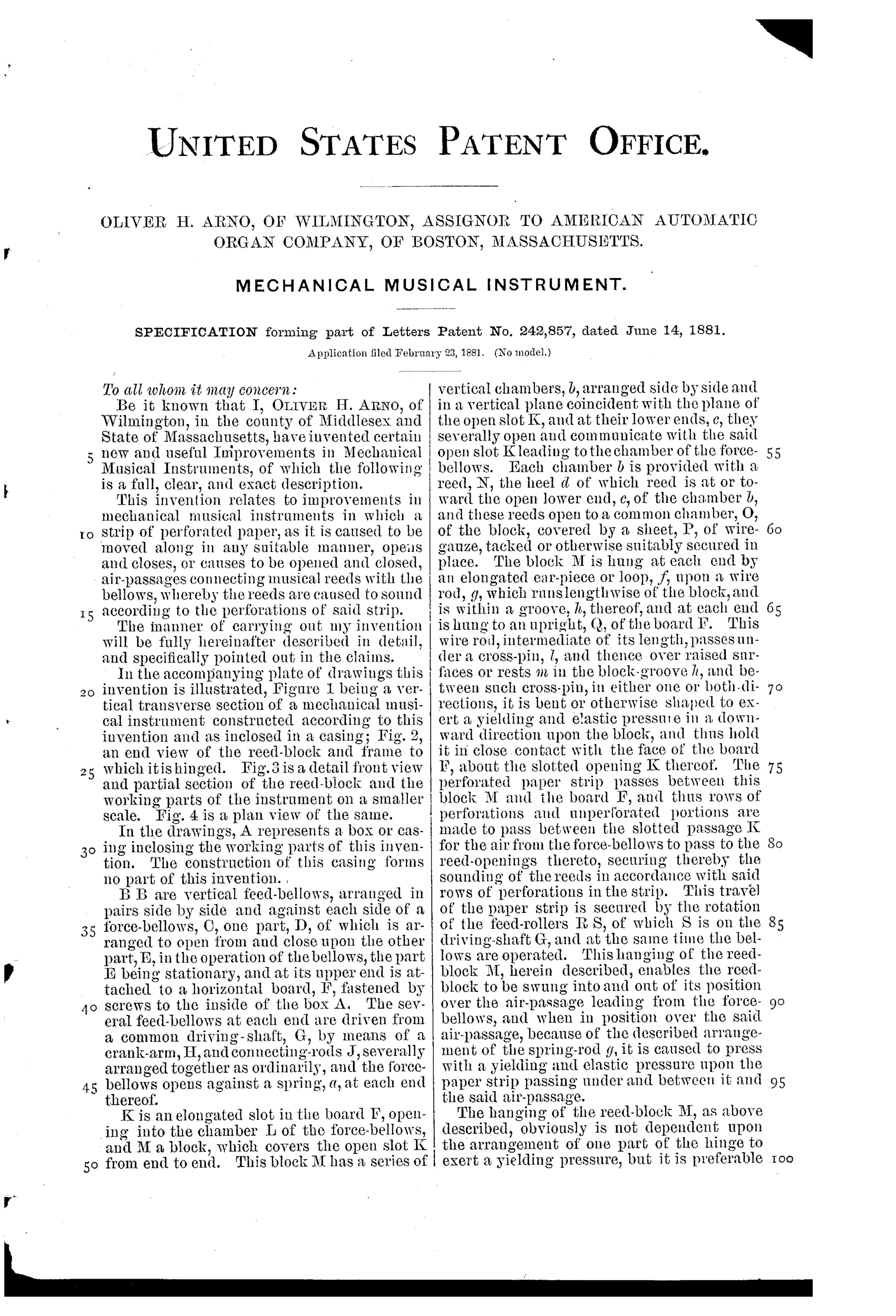
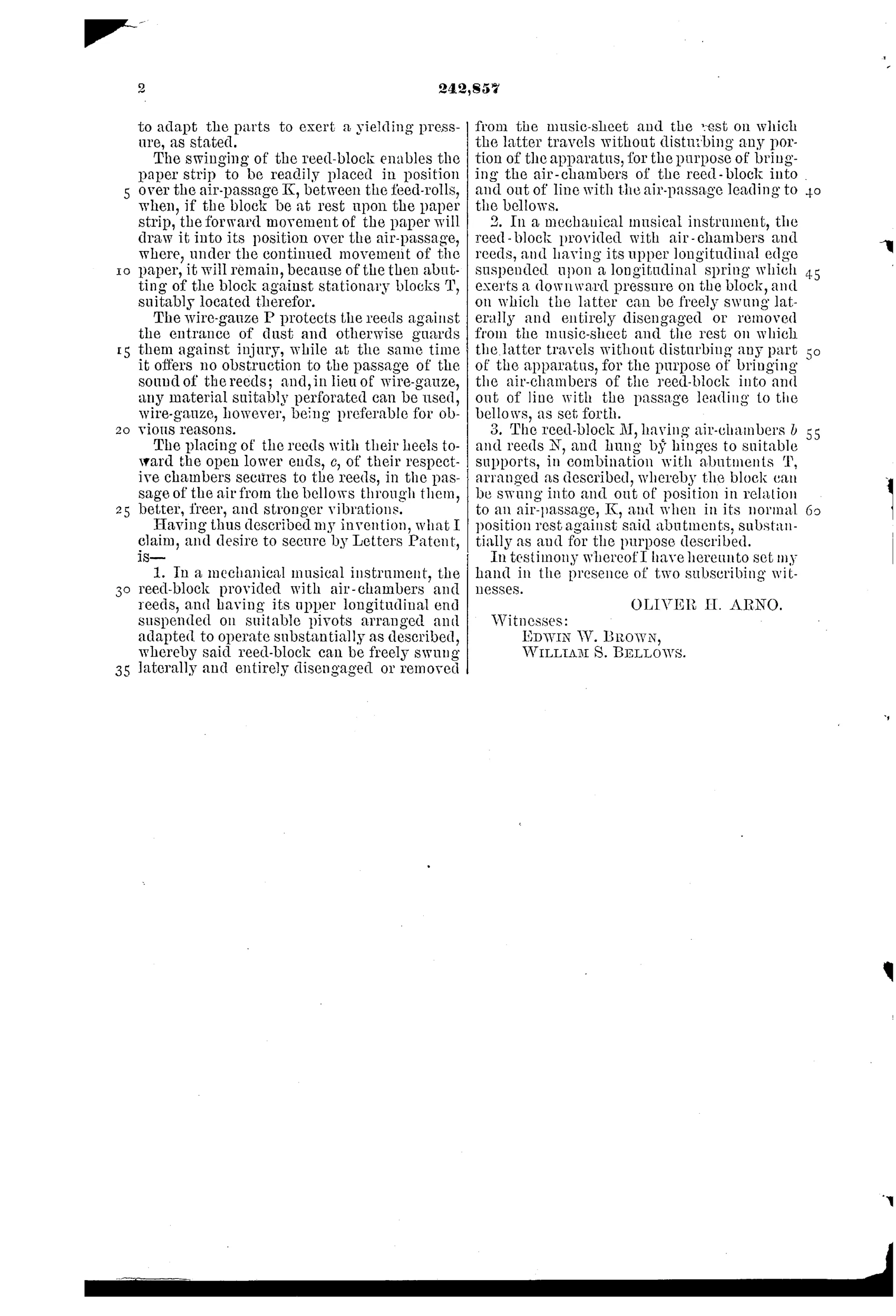
“3. The reed-block M, having air-chambers b and reeds N, and hung by hinges to suitable supports, in combination with abutments T, arranged as described, whereby the block can be swung into and out of position in relation to an air-passage, K, and when in its normal position rest against said abutments, substantially as and for the purpose described.”
In plain English: The reed block, containing its air chambers and reeds, is hinged so it can swing away from the air passage and then rest against fixed stop blocks that hold it correctly in place when in use.
♫ In the inventor’s words
“This hanging of the reed-block M, as above described, obviously is not dependent upon the arrangement of one part of the hinge to exert a yielding pressure, but it is preferable to adapt the parts to exert a yielding pressure, as stated.”— Oliver H. Arno, from the specification
Fate unknown
The assignment to the American Automatic Organ Company suggests production intent, but no organette marked with this patent date is documented to me; a surviving example would settle it.
♫ Commentary
This is 1881, the heart of the organette boom — the decade when perforated paper strips brought music into parlors that couldn't afford a music box, let alone a piano. Arno's contribution here is quietly practical: the whole bank of reeds hangs on a spring-loaded rod like a door, so it presses down snugly on the paper as it feeds, yet swings aside entirely when you need to load a new strip. Fixed abutment blocks then locate it back over the air passage with no fiddling. Anyone who has fought a jammed paper roll in one of these little machines will appreciate what he was after.
The yielding pressure matters more than it looks. Paper strips vary in thickness, curl with humidity, and splice unevenly; a rigidly clamped reed-block either leaks air or chews the paper. Arno's hinge does double duty as gasket and access hatch — and his careful hedge in the specification, that the invention 'obviously is not dependent' on the spring arrangement, shows a man who had been to the Patent Office before.
Fig. 1 rewards a close look: the crank-driven paired feed-bellows working against a central force-chamber inside the case is a compact pressure system, and the wire-gauze dust cover over the reeds is the kind of detail only someone who had serviced clogged reeds would bother to claim. This is a refinement patent in a crowded field, but a genuinely useful one, assigned to a company plainly intending to build.
Commentary by Claude, The Talking Machine Patent Archive’s resident enthusiast