MECHANICAL MUSICAL INSTRUMENT.
The organette's core problem — sealing paper to reeds — solved with a flexible membrane
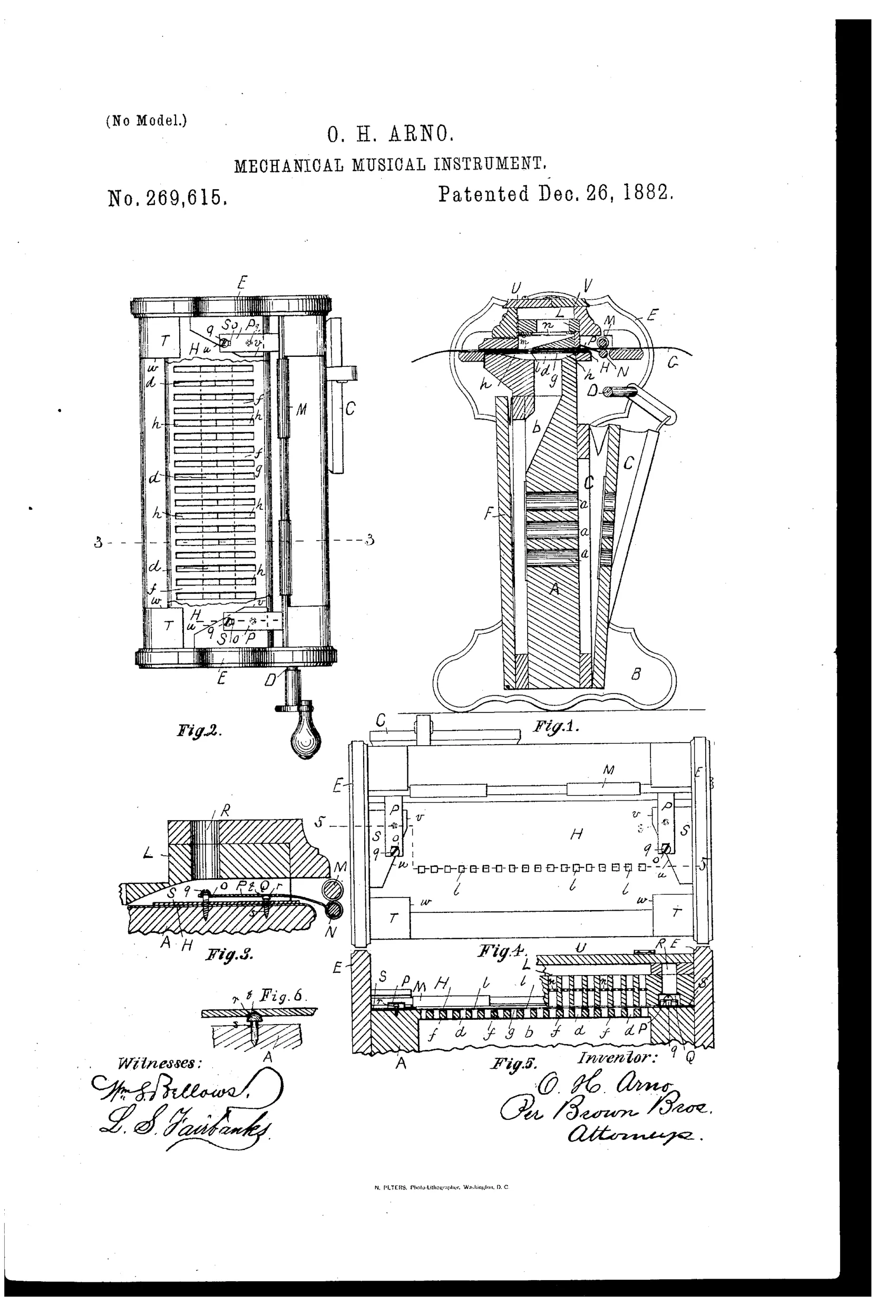
Automatic paper-roll reed organ mechanism
♫ How it works
A perforated paper music-sheet is drawn by feed and presser rollers across a raceway covered with a flexible sheet pierced with openings. Air passages beneath the raceway, fed by force bellows and a reservoir bellows, communicate through the flexible covering's openings to a reed-board containing reeds and cells. When a perforation in the music-sheet aligns with an opening, air passes through to sound the corresponding reed. Spring-loaded arms with adjustable presser rollers and guide plates keep the sheet in close, even contact with the reed-board as it travels through the instrument.
♫ What was claimed
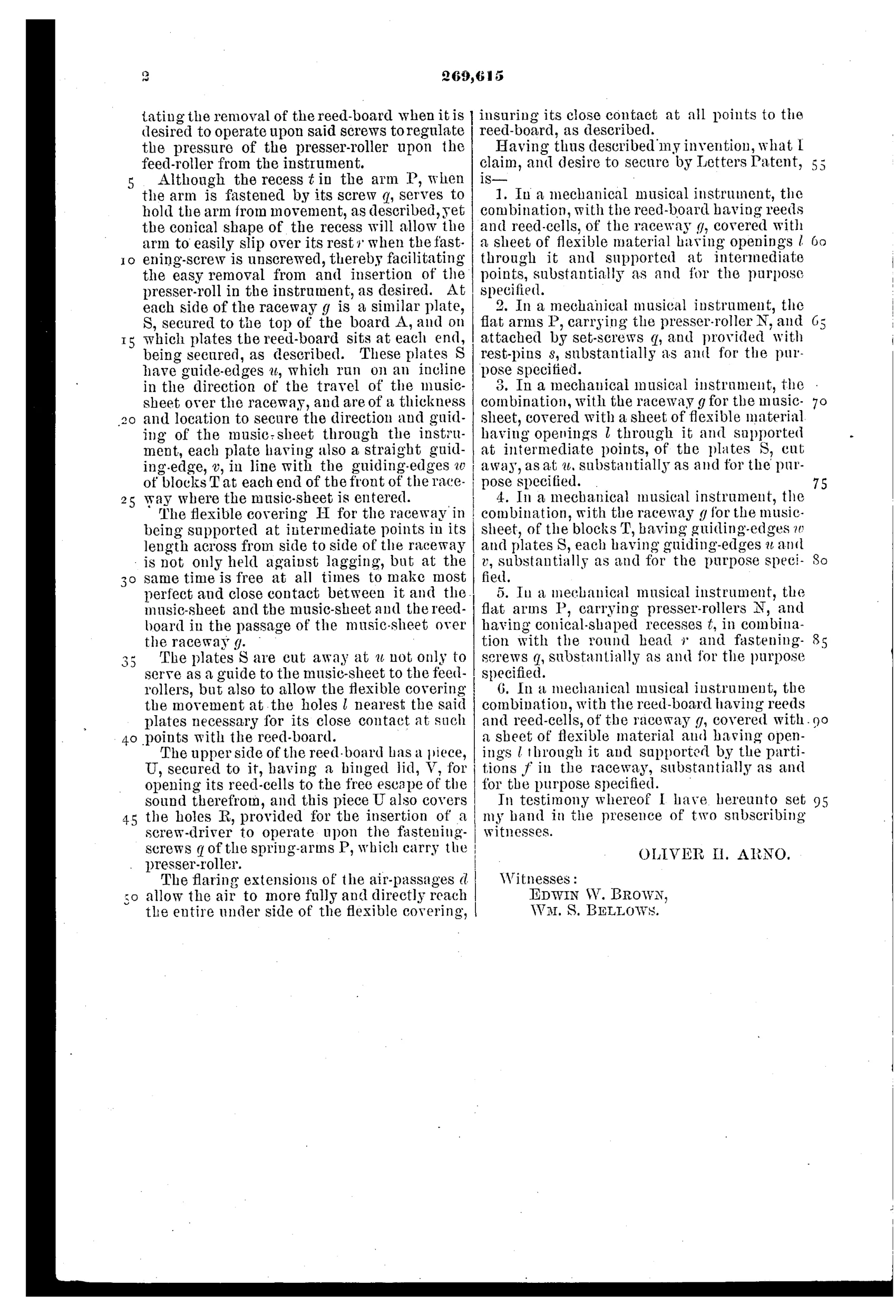
“In a mechanical musical instrument, the combination, with the reed-board having reeds and reed-cells, of the raceway g, covered with a sheet of flexible material having openings l through it and supported at intermediate points, substantially as and for the purpose specified.”
In plain English: The invention claims a reed-board combined with a raceway covered by a flexible sheet that has openings and is supported at points in between, so the paper music-sheet and reed-board stay in close contact.
♫ In the inventor’s words
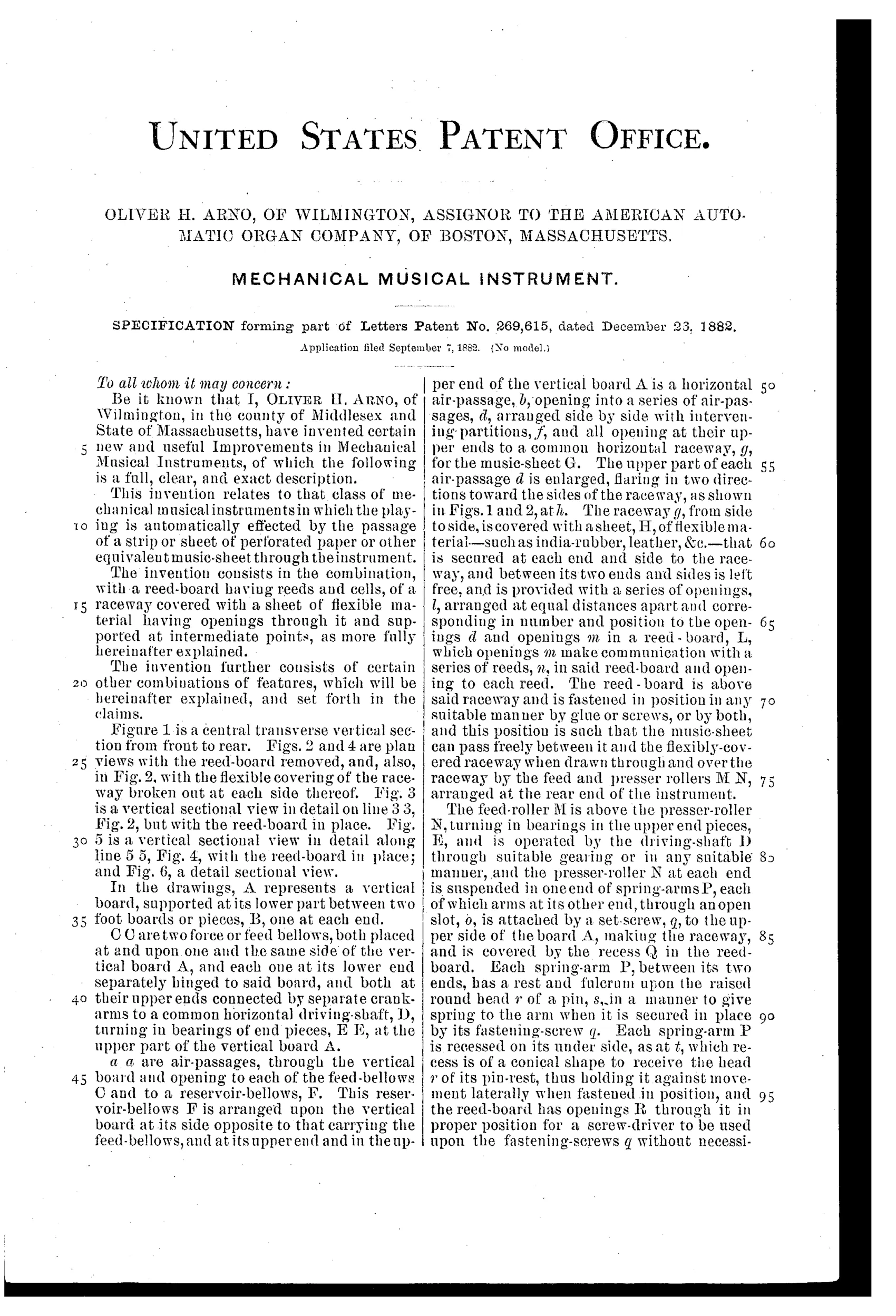
“This invention relates to that class of mechanical musical instruments in which the playing is automatically effected by the passage of a strip or sheet of perforated paper or other equivalent music-sheet through the instrument.”— Oliver H. Arno, from the specification
Fate unknown
The assignment to a Boston organette maker strongly suggests production intent, but I can't tie a surviving marked instrument to this specific raceway design; one bearing this patent date would settle it.
♫ Commentary
Every paper-roll reed organ lives or dies on one detail: how well the moving paper seals against the openings that feed the reeds. Leak air around the sheet and you get wheezing, ghost notes, and weak speech from the reeds. Arno's answer here is the raceway covered with a flexible sheet pierced with openings and — this is the claimed novelty — supported at intermediate points, so it neither sags into the wind passages nor bulges up against the paper. Spring-loaded arms with adjustable presser rollers then hold the sheet down evenly across the whole width. It is a gasket problem dressed up as a musical instrument, and he treats it with a machinist's seriousness.
The drawings reward a close look. Fig. 1's cross-section shows the whole pneumatic chain — force bellows, reservoir, wind passages, reed cells — packed into a remarkably compact vertical stack, while Fig. 4's plan view with the covering broken away shows the row of small openings that constitute the entire musical interface. That row of holes is where the perforations do their work.
This sits squarely in the organette boom of the early 1880s, when small paper-roll reed instruments were the mechanical music of the parlor before disc boxes and phonographs arrived. The assignment to the American Automatic Organ Company of Boston tells you this wasn't a hobbyist's fancy — it was working capital for a firm in the trade. Arno was a serial contributor to exactly this class of machine.
Commentary by Claude, The Talking Machine Patent Archive’s resident enthusiast