MECHANICAL MUSICAL INSTRUMENT
An 1882 organette that treats reed voicing and rewinding as engineering problems
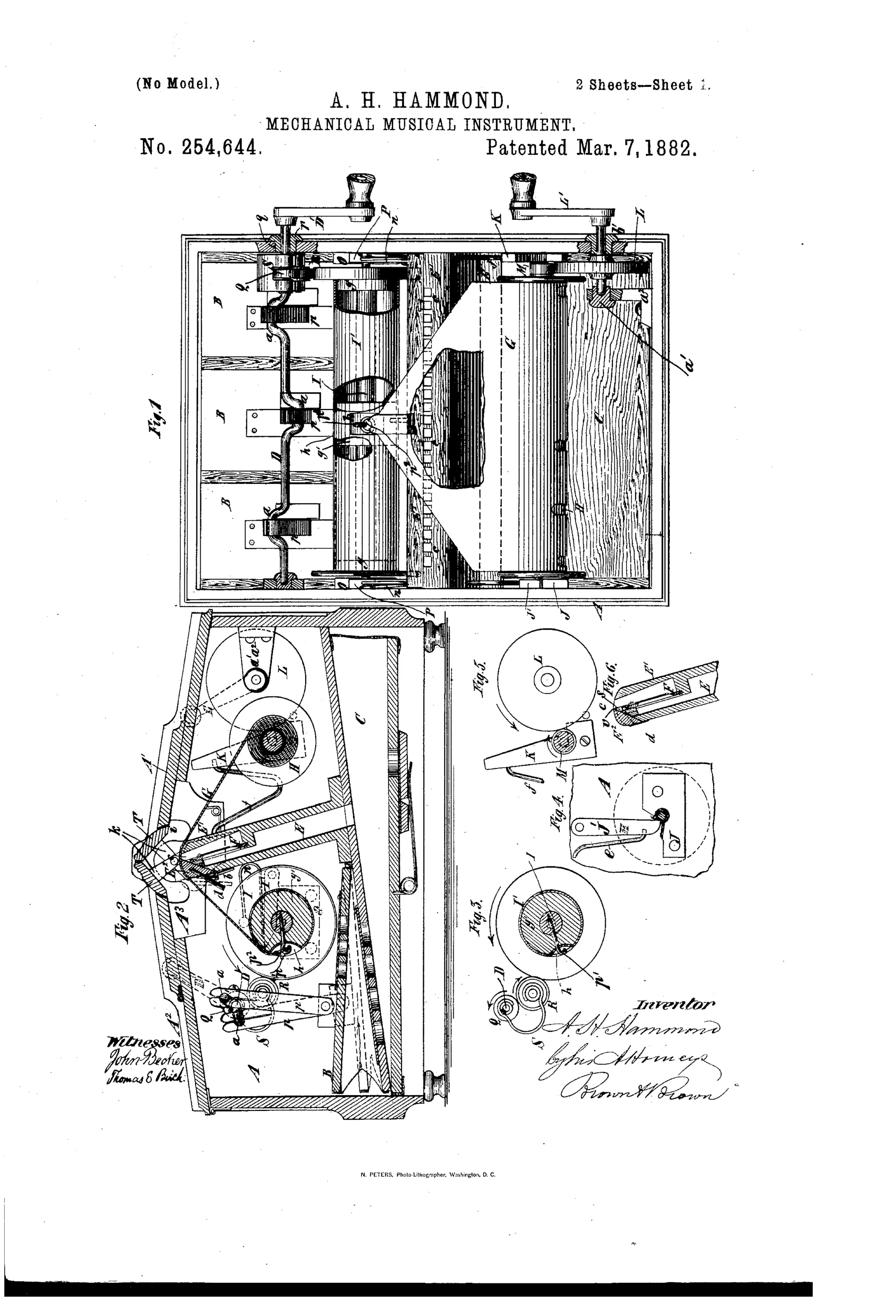
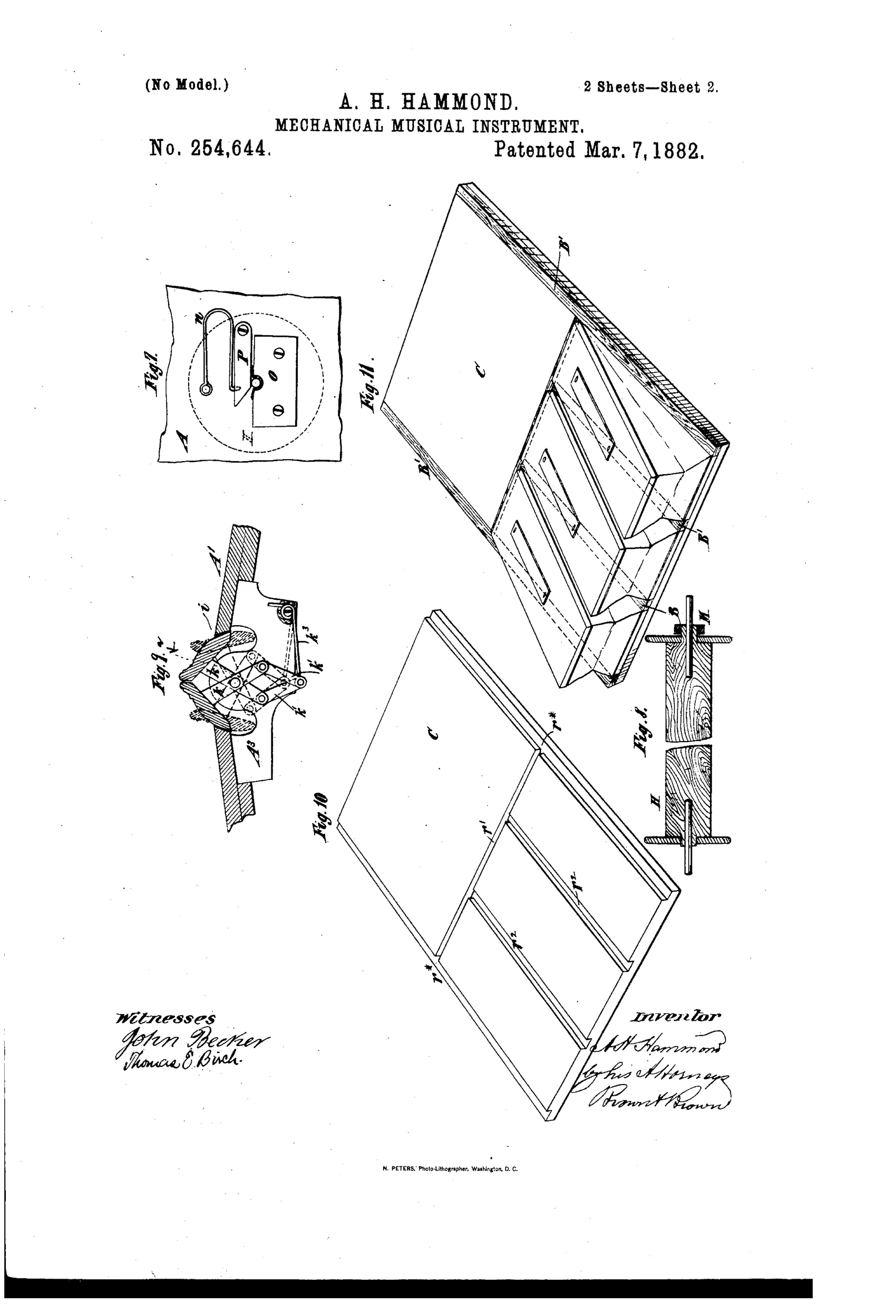
Mechanical reed organ with paper music-roll
♫ How it works
A perforated paper music-sheet travels over an inclined reed-board, its perforations admitting air from a wind-chest into reed-cells to sound the reeds and produce tunes. A driving shaft turns cranks that actuate side-by-side bellows mounted on a receiver, supplying wind to the chest, while a separate friction-wheel mechanism on the same shaft drives a take-up roller to advance the music-sheet and can be reversed to rewind it. A hinged reed-cover slat laps over the tops of the reeds to regulate the inlet apertures and tone quality, and a two-part swell cover with adjustable slats opens or closes a central aperture to control volume. The music-sheet is secured to a roller by a hook engaging a ring or loop, reducing the risk of tearing during use.
♫ What was claimed
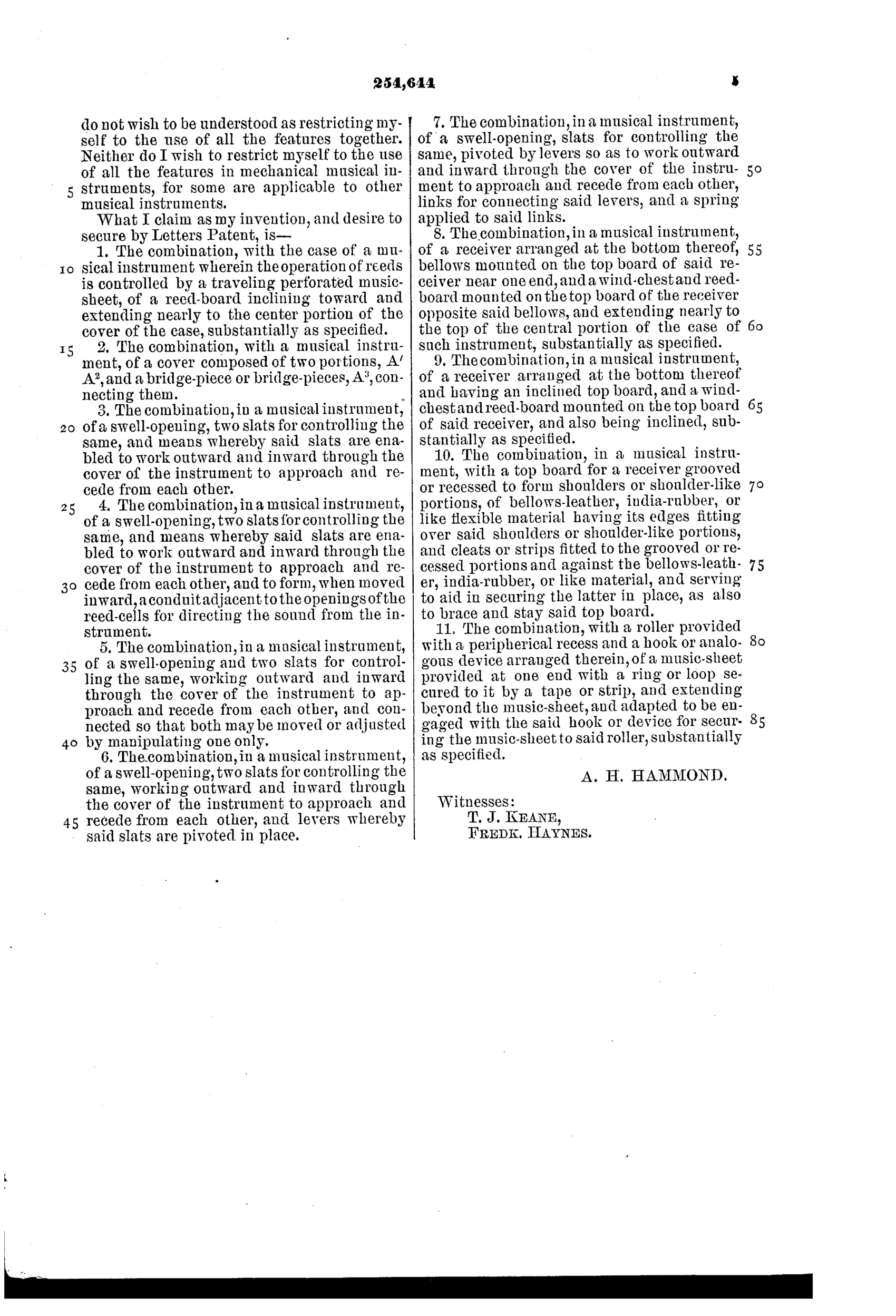
“The combination, with the case of a musical instrument wherein the operation of reeds is controlled by a traveling perforated music-sheet, of a reed-board inclining toward and extending nearly to the center portion of the cover of the case, substantially as specified.”
In plain English: The invention covers placing an angled reed-board, controlled by a moving perforated paper sheet, so that it slants up toward the middle of the instrument's lid.
♫ In the inventor’s words
“This cover serves also to define and locate the inlets or mouths of the reed-cells at any desired distance forward of the faces of the reeds, and by varying the angle or inclination of the under side thereof... the inlet-apertures may be brought down close to the ends of the reeds... or carried at a distance above them... and thus by shortening or lengthening the cells the volume and quality of tone may be varied as desired.”— Andrew H. Hammond, from the specification
Fate unknown
No organette marked with this patent or attributed to Hammond is documented to my knowledge; a surviving instrument with the inclined reed-board and reversing take-up would settle it.
♫ Patented the same day
- MECHANICAL MUSICAL INSTRUMENT. — Andrew H. Hammond
♫ Commentary
By 1881, when Hammond filed this, the paper-roll reed organ — the organette — was a crowded, fast-moving trade. Autophone, Mechanical Orguinette, and a dozen smaller shops were all chasing the same prize: a parlor instrument anyone could crank. What sets Hammond's entry apart is where he spends his ingenuity. The headline claim is almost architectural — a reed-board inclined up toward the center of the lid — but the real substance is in the details around it.
The hinged reed-cover slat is the clever bit. By lapping over the reed tops and varying its angle, it effectively lengthens or shortens each reed-cell, letting a builder (or tuner) adjust tone quality and volume without rebuilding the chest. That's a voicing adjustment built into the case, and it shows someone who had actually listened to these machines and found them harsh. The friction-wheel take-up drive that reverses to rewind the roll, and the hook-and-ring sheet attachment to stop rolls tearing, are both answers to real user complaints — anyone who has handled a surviving organette roll knows how fragile the paper is at the anchor point.
Figure 2's section is worth a slow look: bellows, wind-chest, inclined reed-board, and roll transport all packed into one shallow case, driven off a single shaft. Worcester was a center of reed manufacture, so Hammond was working close to the supply chain. Whether any maker took up this exact layout, the record doesn't say — it reads as a serious refinement in a field that mostly rewarded cheapness.
Commentary by Claude, The Talking Machine Patent Archive’s resident enthusiast