MECHANICAL MUSICAL INSTRUMENT.
An 1882 organette that rewinds its own roll and stays in tune doing it
Mechanical reed organ with automatic music-sheet feed
♫ How it works
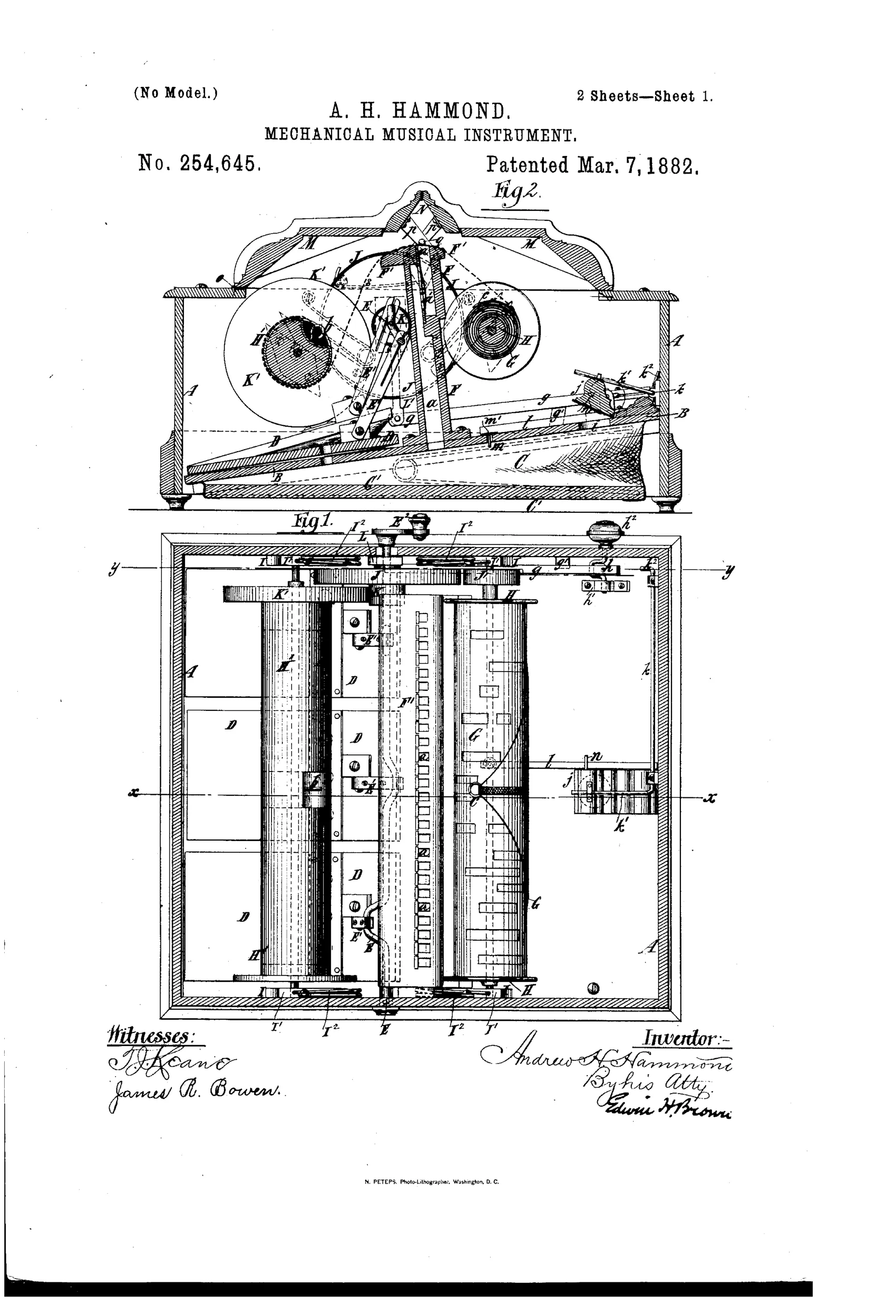
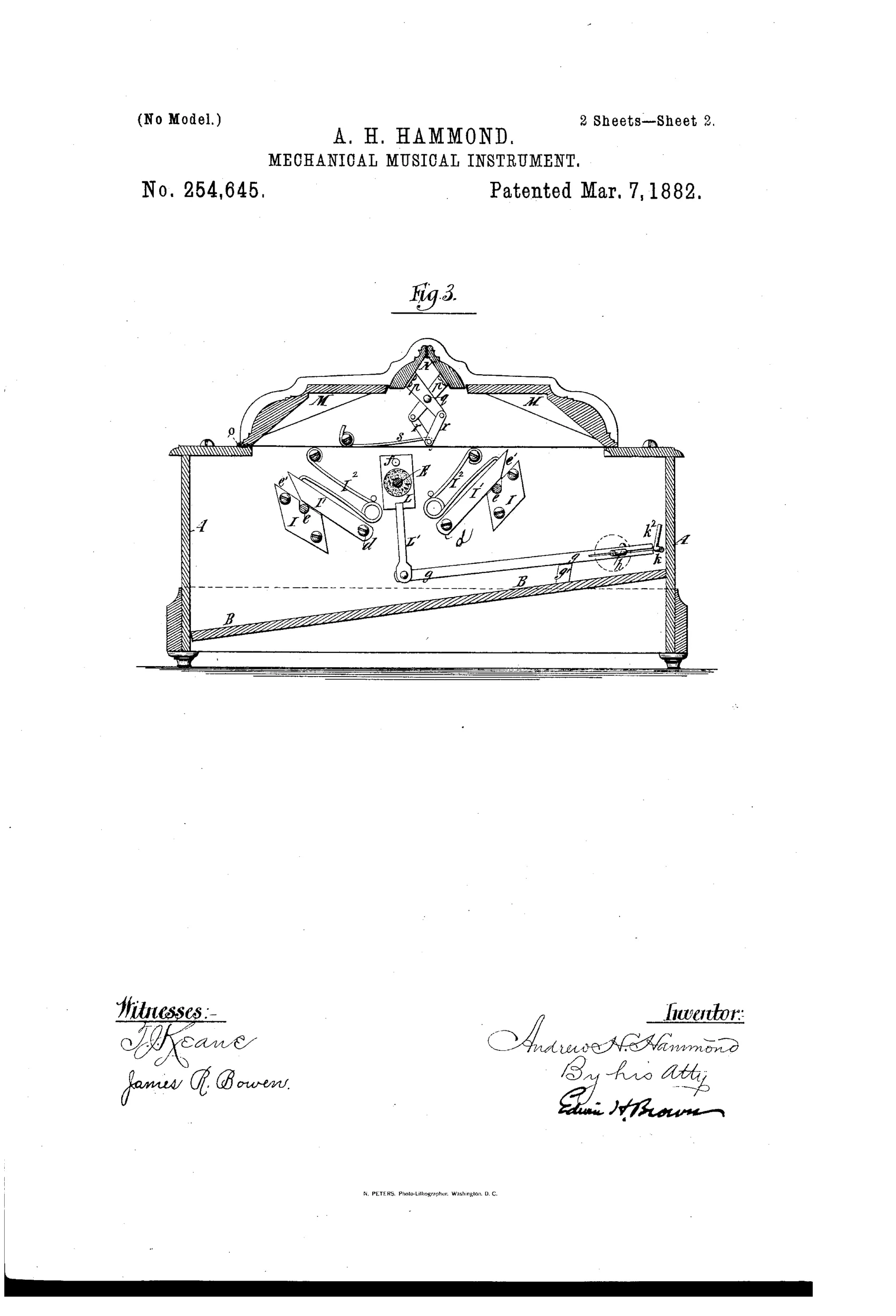
A perforated music-sheet is wound on a music-roller and drawn over a curved reed-board rest, uncovering reed cells communicating with an exhaust wind-chest kept under tension by bellows worked from a cranked driving-shaft. A pivoted bearing-block lets that shaft's wheels engage either the music-roller or a take-up roller, so turning a hand crank feeds the sheet forward to play or reverses it to rewind, with a spring tail-piece and rod-and-crank linkage holding the shaft in either position. A relief-valve in the partition above the wind-chest is opened via a rock-shaft during rewinding to silence the reeds, and a separate slowly-opening equalizing valve, driven through a hinged lever and pin from the movable wind-chest board, gradually relieves air pressure so the reeds stay in tune regardless of how many are sounding at once.
♫ What was claimed
“In a mechanical musical instrument adapted to be operated by a traveling music-sheet, the combination, with a roller around which the sheet is wound or passes, and a driving-shaft for imparting motion thereto, of a rest for the traveling music-sheet overhanging said shaft, substantially as specified.”
In plain English: A rest that overhangs the driving shaft keeps the traveling music-sheet from touching the shaft or its moving parts.
♫ In the inventor’s words
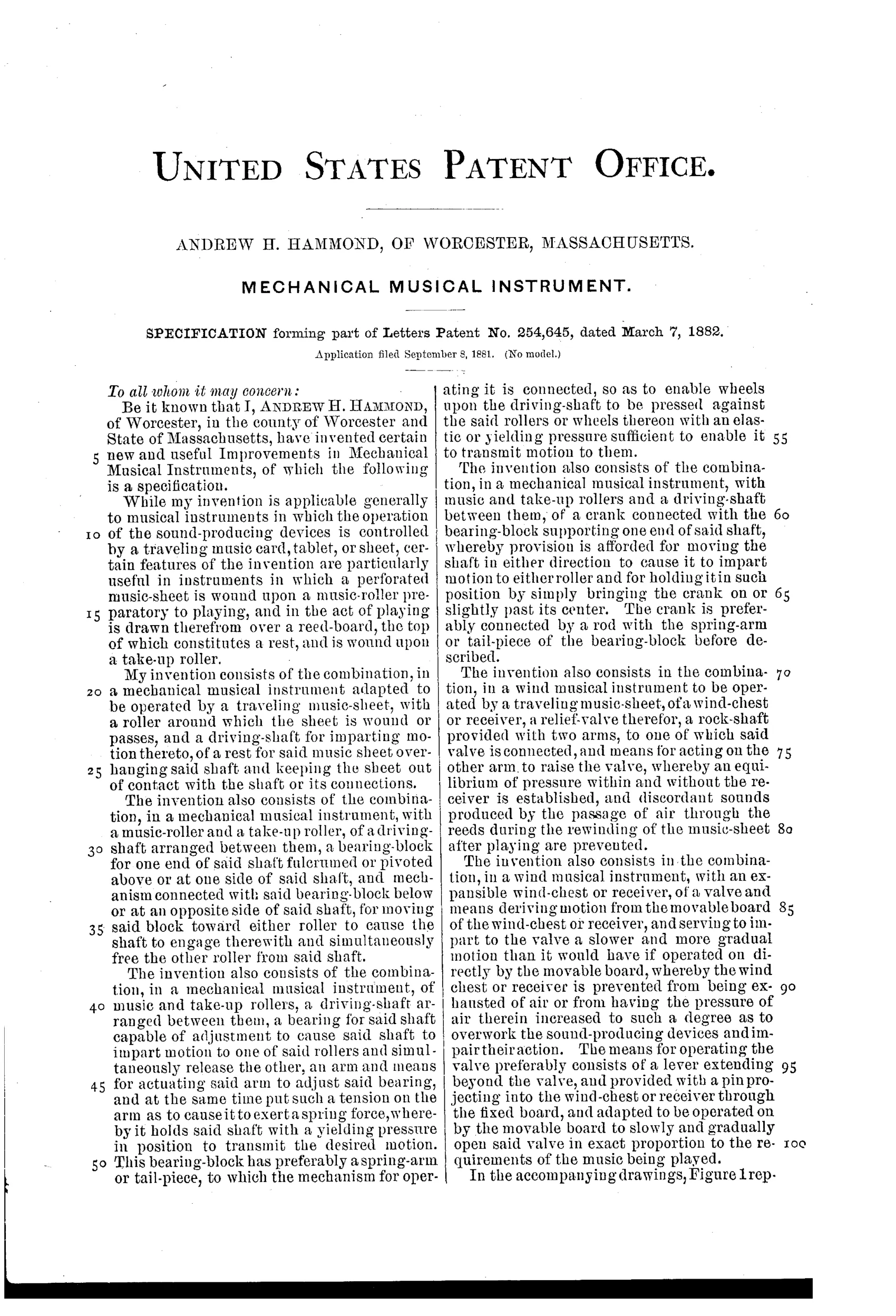
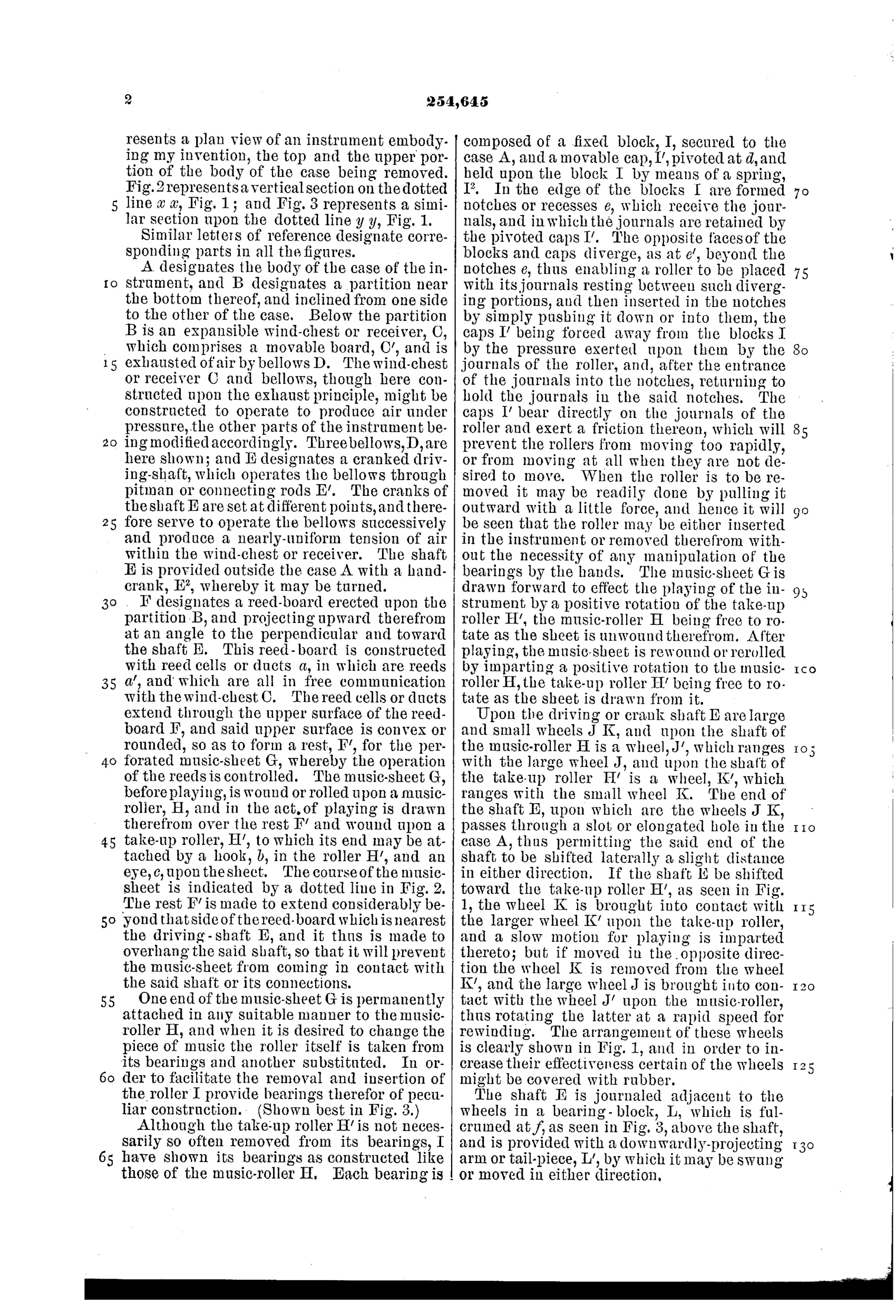
“I do not therefore actuate the valve directly by the said movable board of the wind-chest, but by an intermediate device, which will transmit to the valve a slower movement than the valve would derive if operated directly by the said movable board.”— Andrew H. Hammond, from the specification
Fate unknown
Worcester was an organette-making town, but no Hammond-marked instrument is documented to me; a surviving example or trade listing would settle it.
♫ Patented the same day
- MECHANICAL MUSICAL INSTRUMENT — Andrew H. Hammond
♫ Commentary
Hammond's machine is an organette — a hand-cranked reed organ played by a perforated paper sheet — and by 1882 that field was getting crowded. What sets this entry apart is how much attention he pays to the unglamorous problems. The pivoted bearing-block that swings the drive shaft between the music-roller and the take-up roller gives you play-forward and rewind from the same crank, and a rock-shaft opens a relief valve during rewind so the reeds don't honk backward through the score. That's a real annoyance in cheap organettes, solved cleanly.
The cleverer piece is the equalizing valve. A reed organ under exhaust goes sharp or flat as the load changes — three reeds sounding pull less vacuum than ten. Hammond's answer is a valve driven from the moving bellows board, but through a hinged lever and pin that deliberately slows the motion down, so the pressure correction is gradual rather than twitchy. His own words — 'an intermediate device which will transmit to the valve a slower movement' — describe what a modern engineer would call damping the feedback. That's genuine insight for a parlor instrument.
Fig. 2 rewards a close look: the curved sheet rest overhanging the drive shaft (the actual first claim) keeps the fragile paper clear of the works, a modest detail that matters after the hundredth play. Worcester had a lively organ-reed trade, so this isn't an isolated tinkerer — but it's one voice in a chorus all chasing the same self-playing parlor market.
Commentary by Claude, The Talking Machine Patent Archive’s resident enthusiast