KEY-BOARD ATTACHMENT FOR MUSICAL INSTRUMENTS
A hand-cranked piano player that reads paper with fingers, not air, in 1883
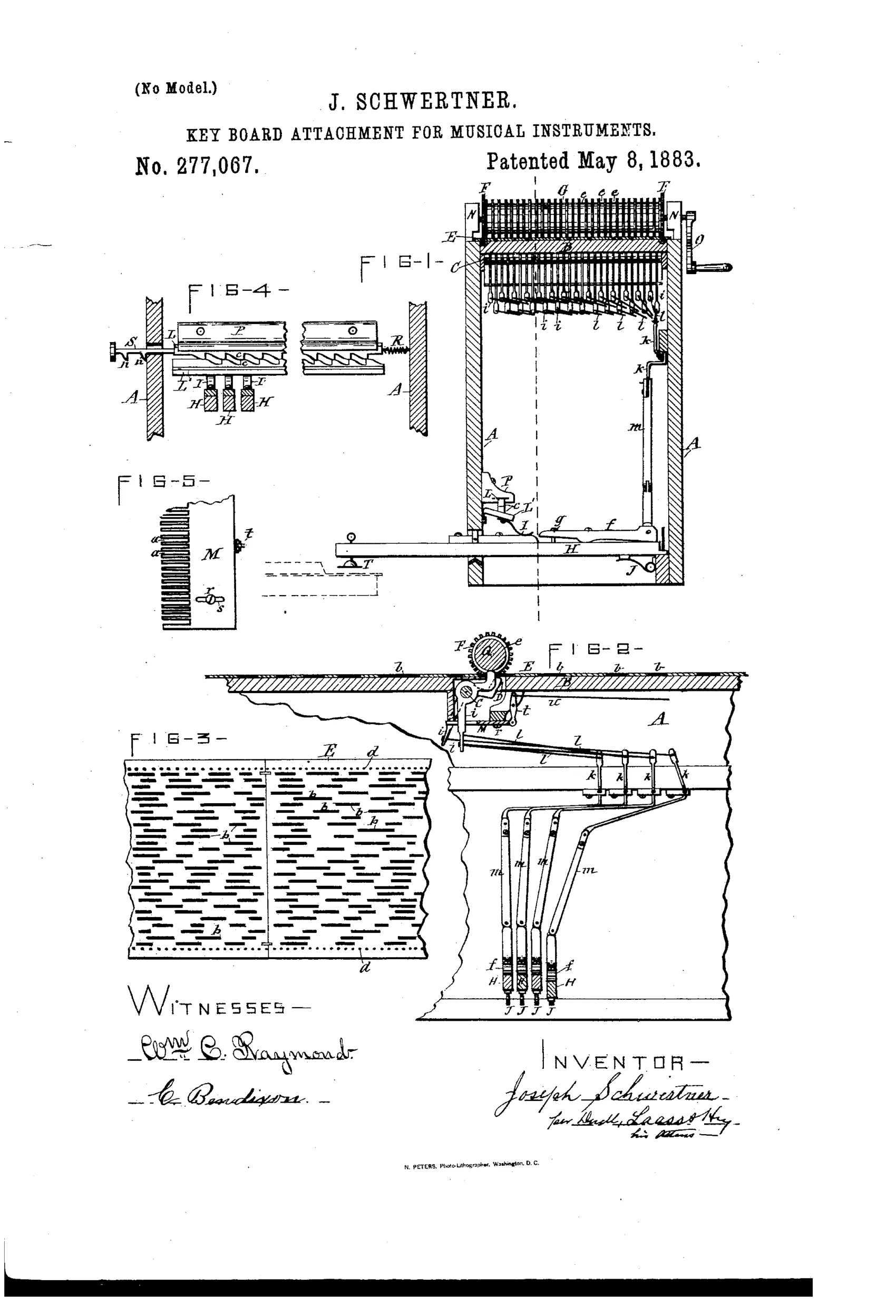
Automated player mechanism using perforated paper sheet
♫ How it works
A perforated sheet E is drawn beneath a grooved roller G by a hand crank O engaging rack perforations along the sheet's edges. Slots in the sheet, gaged to the length of the note desired, allow pivoted bell-crank levers i to swing upward through openings in the top plate and into circumferential grooves on the roller. This lever action is transmitted via connecting rods l to elbow-levers K and push-bars m, which press against spring-loaded hammers H pivoted intermediately of their length; when relieved of pitman pressure by the passing slot, the hammers strike downward onto the piano keys via a padded striker T. A plate M with slotted openings restrains the levers when no sheet is engaged, preventing all hammers from striking simultaneously.
♫ What was claimed
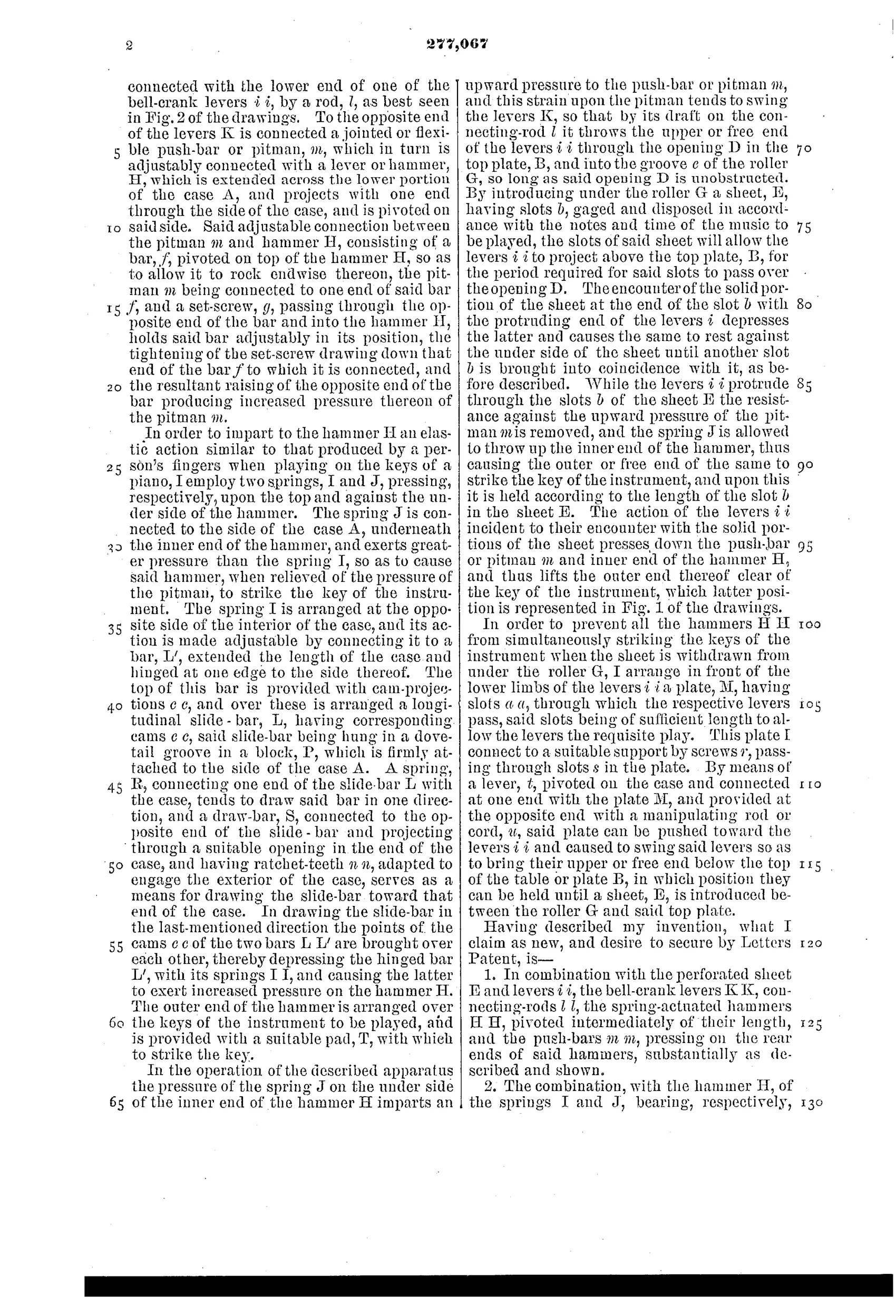
“In combination with the perforated sheet E and levers i i, the bell-crank levers K K, connecting-rods l l, the spring-actuated hammers H H, pivoted intermediately of their length, and the push-bars m m, pressing on the rear ends of said hammers, substantially as described and shown.”
In plain English: The invention combines a perforated music sheet, sensing levers, bell-crank connectors, and spring-loaded hammers pivoted at their middle to strike the piano keys.
♫ In the inventor’s words
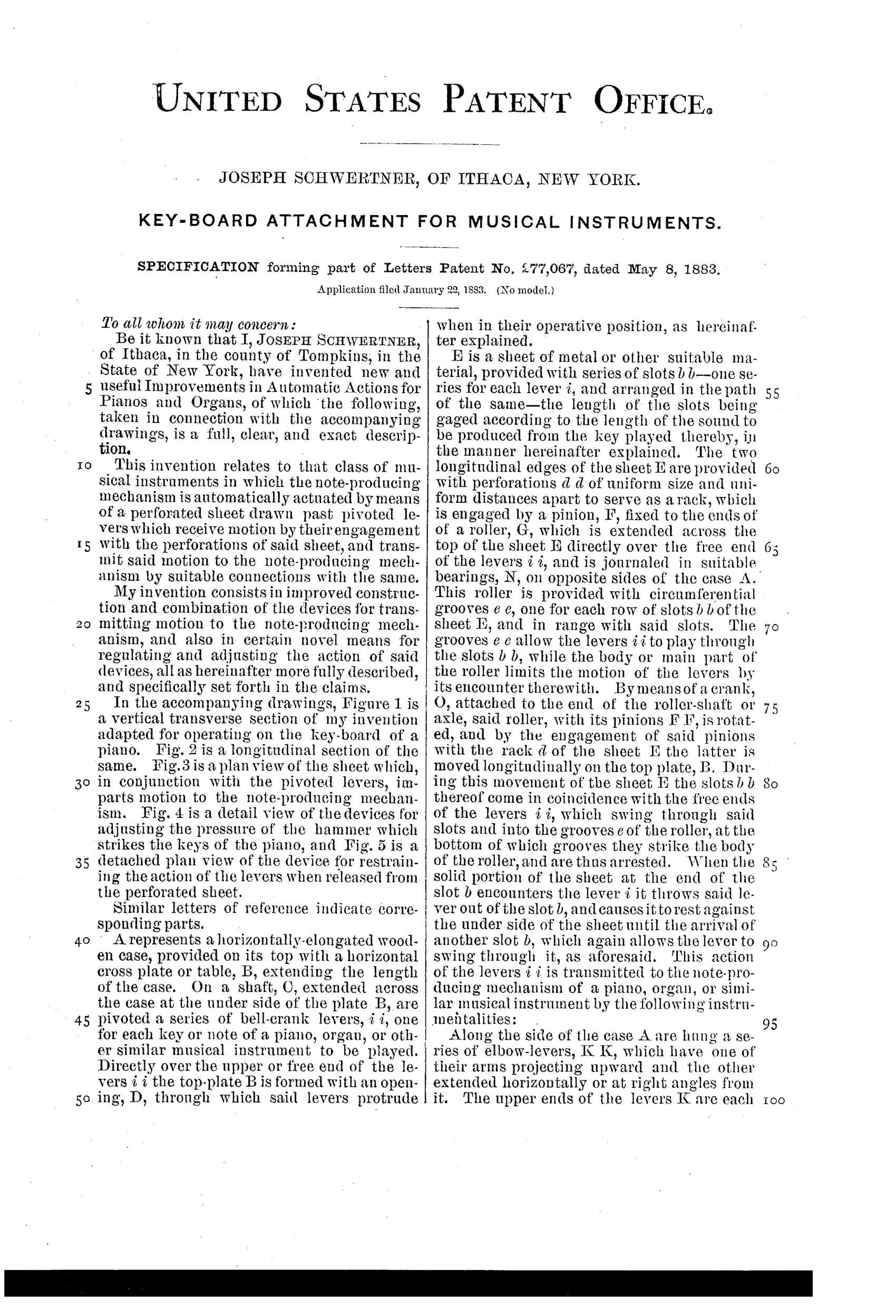
“This invention relates to that class of musical instruments in which the note-producing mechanism is automatically actuated by means of a perforated sheet drawn past pivoted levers which receive motion by their engagement with the perforations of said sheet, and transmit said motion to the note-producing mechanism by suitable connections with the same.”— Joseph Schwertner, from the specification
Paper patent — likely never produced
No manufactured example or maker is known, and mechanical-feeler paper players of this type were displaced by pneumatic actions before reaching real production.
♫ Commentary
Before the pneumatic player piano swept the field, inventors kept trying to make perforated paper do mechanical work directly, and Schwertner's attachment is a thorough example of the breed. A crank pulls the sheet under a grooved roller; wherever a slot passes, a pivoted feeler lever swings up into the roller groove, and that motion travels through connecting rods and bell-cranks down to hammers poised over the piano keys.
The genuinely interesting detail is inverted logic: the push-bars normally hold the spring-loaded hammers back, and a slot in the paper *releases* pressure, letting the hammer strike. That means the paper never has to transmit striking force — it only has to permit a lever to rise. It's the same insight that made pneumatic tracker bars viable a decade later: use the perforation as a valve, not a muscle. Fig. 5's slotted plate M is the other thoughtful touch, locking all the feelers down when no sheet is loaded so the whole rank of hammers doesn't crash at once.
Still, the paper does have to lift those feelers out of the way everywhere it isn't slotted, and dragging a long sheet against dozens of sprung levers by hand crank invites tearing, mistracking, and mushy repetition. Pneumatics solved exactly these problems, which is why mechanical-finger players like this one are a documented dead end — earnest, well-drawn, and superseded.
Commentary by Claude, The Talking Machine Patent Archive’s resident enthusiast