MECHANICAL MUSICAL INSTRUMENT
A crank in each hand, one fixed tune: the music box reduced to a toy
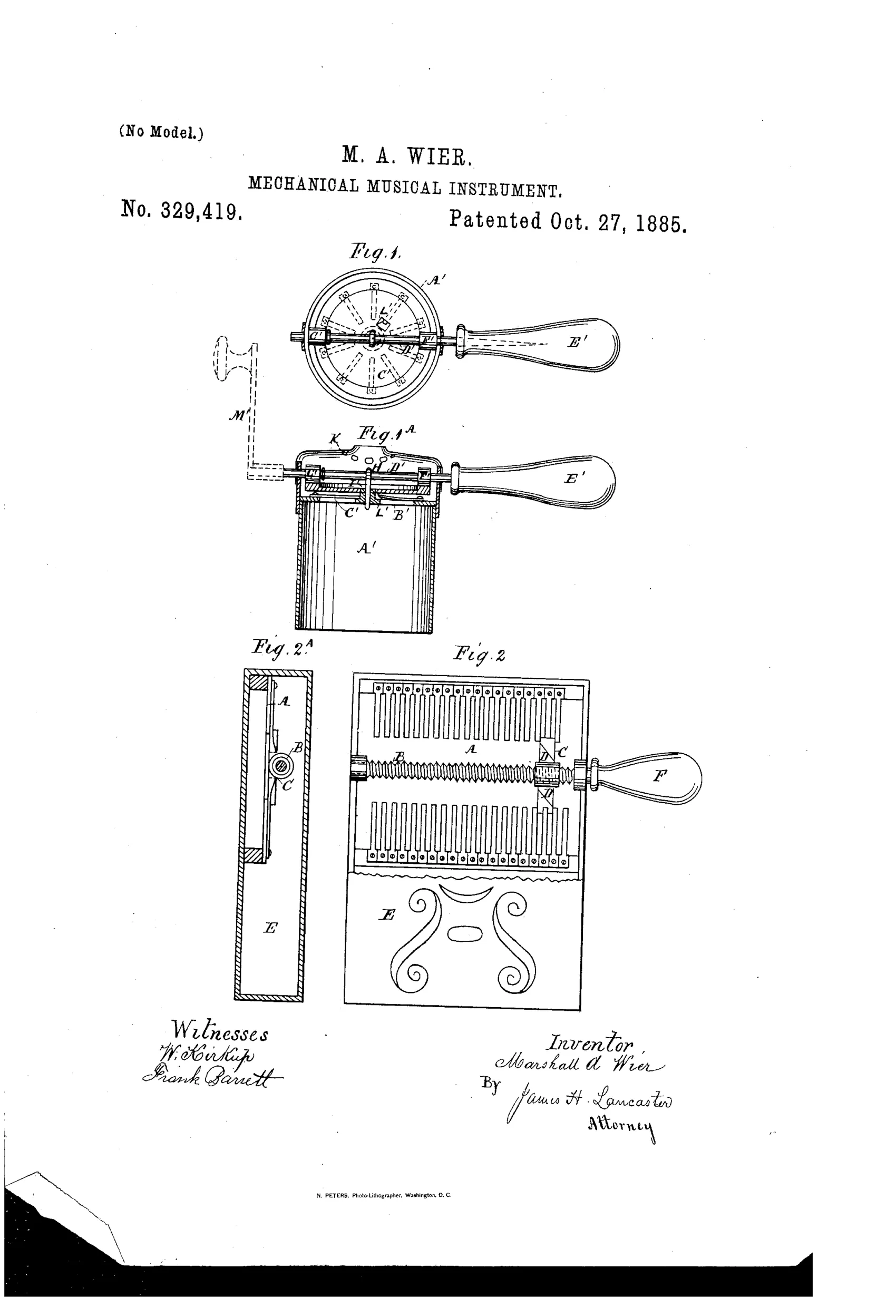
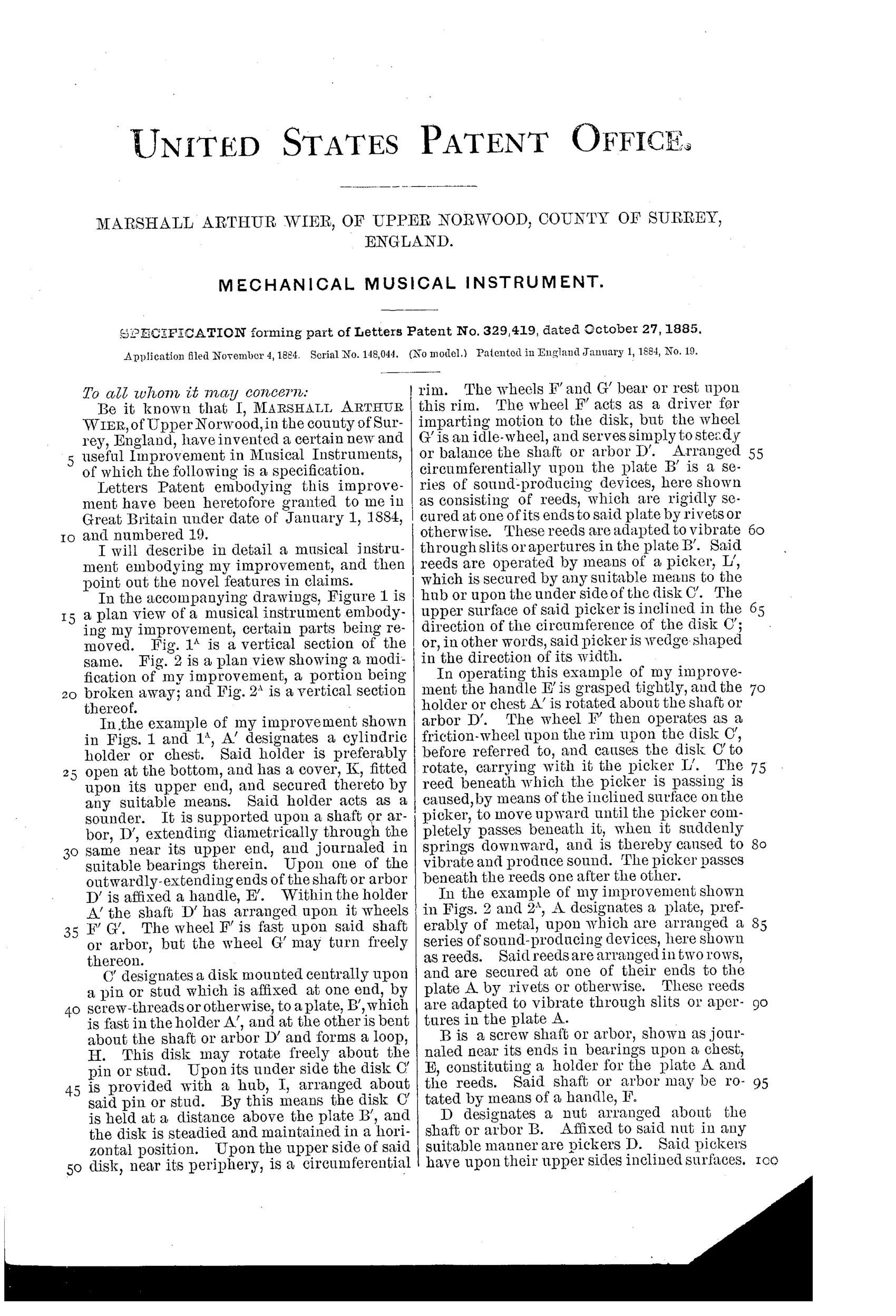
Hand-cranked mechanical musical instrument using vibrating reeds
♫ How it works
A rotating disc or holder carries a wedge-shaped picker that travels past a circular or linear arrangement of tuned reeds mounted on a plate. As the picker's inclined surface passes beneath each reed, it lifts the reed until it slips free and springs downward, producing vibration and sound. In one form a hand crank rotates a cylindrical chest via friction gearing (or optionally a worm and worm-wheel) to drive the disc bearing the picker. In an alternate form, a screw shaft and nut assembly moves pickers along two rows of reeds housed in a rectangular chest, allowing two tunes to be played depending on rotation direction.
♫ What was claimed
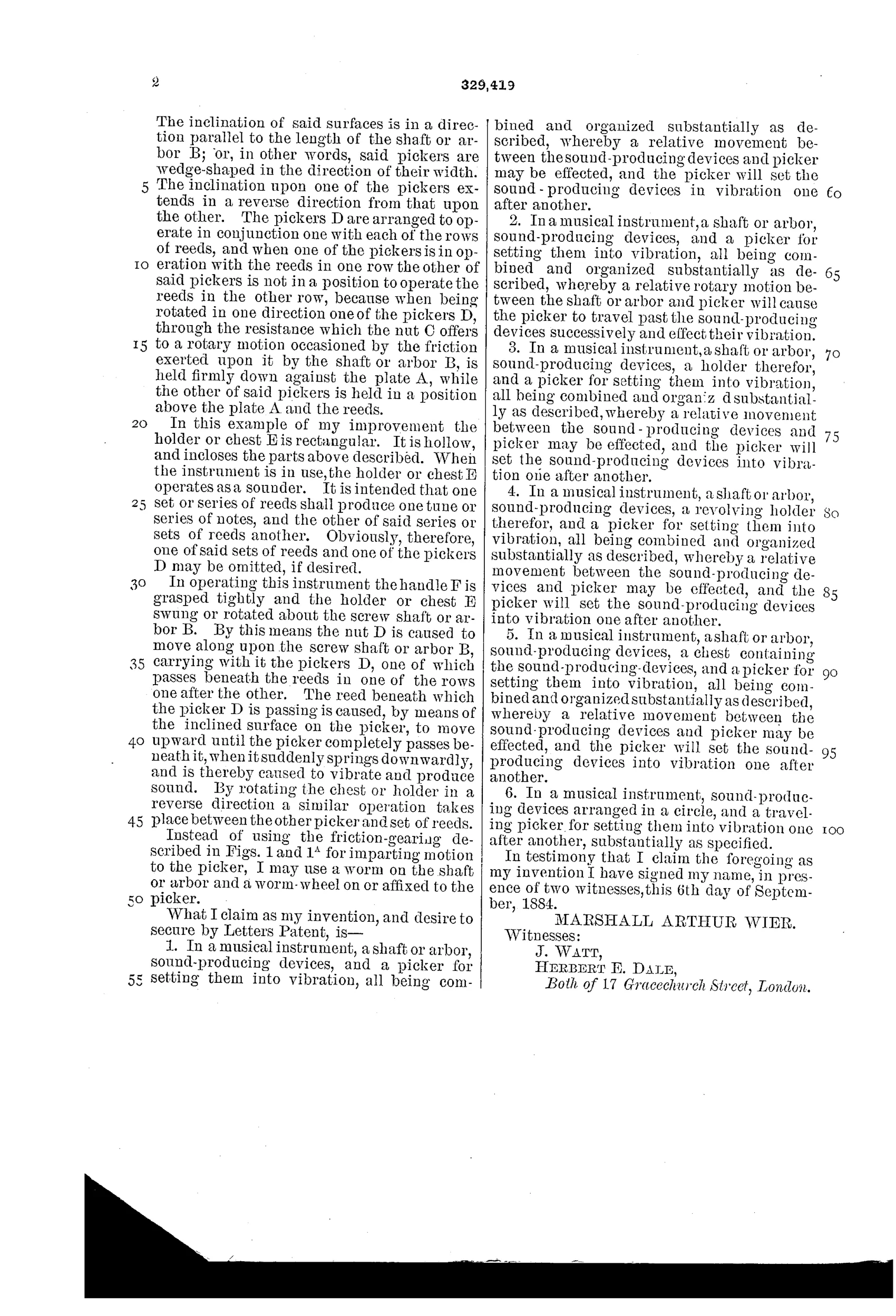
“1. In a musical instrument, a shaft or arbor, sound-producing devices, and a picker for setting them into vibration, all being combined and organized substantially as described, whereby a relative movement between the sound-producing devices and picker may be effected, and the picker will set the sound-producing devices in vibration one after another.”
In plain English: The invention covers a musical instrument with a shaft, reeds, and a picker arranged so that relative motion between them causes the reeds to vibrate one after another.
♫ In the inventor’s words
“By this means the nut D is caused to move along upon the screw shaft or arbor B, carrying with it the pickers D, one of which passes beneath the reeds in one of the rows one after the other.”— Marshall Arthur Wier, from the specification
Fate unknown
The design is cheap enough to have been made as a novelty, but no marked example or trade record is known to me; a surviving specimen would settle it.
♫ Patented the same day
- MECHANICAL MUSICAL INSTRUMENT. — Marshall Arthur Wier
♫ Commentary
Wier's idea is a music box stripped to its absolute minimum. Instead of a pinned cylinder carrying the tune past a fixed comb, he inverts the arrangement: the reeds stay put and a single wedge-shaped picker travels past them, lifting each reed until it slips off the incline and snaps into vibration. The consequence is severe — the instrument can only play the notes in the order the reeds are mounted. There is no program at all. The 'tune' is whatever scale or sequence the maker built into the reed plate, which puts this closer to a musical toy or a shopman's novelty than to a Swiss cylinder box.
The drawings are more interesting than the claim. Fig. 1 shows the circular form, held like an egg-beater with a wooden handle, the crank driving the picker disc through friction gearing — cheap, quiet, and forgiving of sloppy tolerances. Fig. 2 is the cleverer variant: a screw shaft carries a nut with two pickers past two rows of reeds, so cranking one way plays one sequence and reversing plays the other. Two 'tunes' from one mechanism, with the nut resetting itself as it plays.
In 1885 the trade was moving the opposite direction — toward interchangeable programs, organette strips, and soon the Regina disc. Wier's fixed-sequence picker was a dead end, but an honest and buildable one; every part here could be stamped or turned for pennies.
Commentary by Claude, The Talking Machine Patent Archive’s resident enthusiast