MECHANICAL MUSICAL INSTRUMENT.
A trumpet you blow while thumbing a paper tune drum past hidden reeds
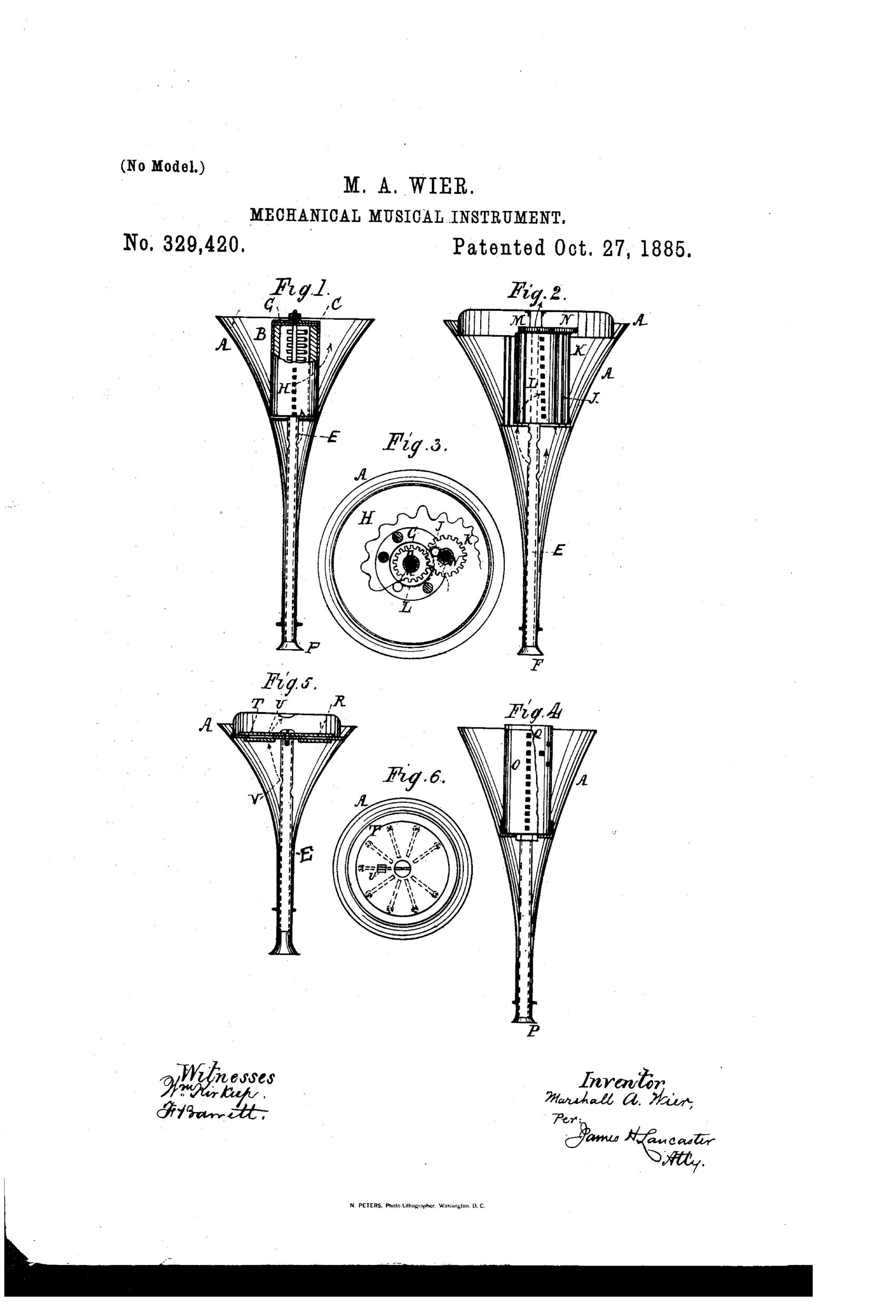
Mouth-blown mechanical instrument playing tunes via perforated tablet
♫ How it works
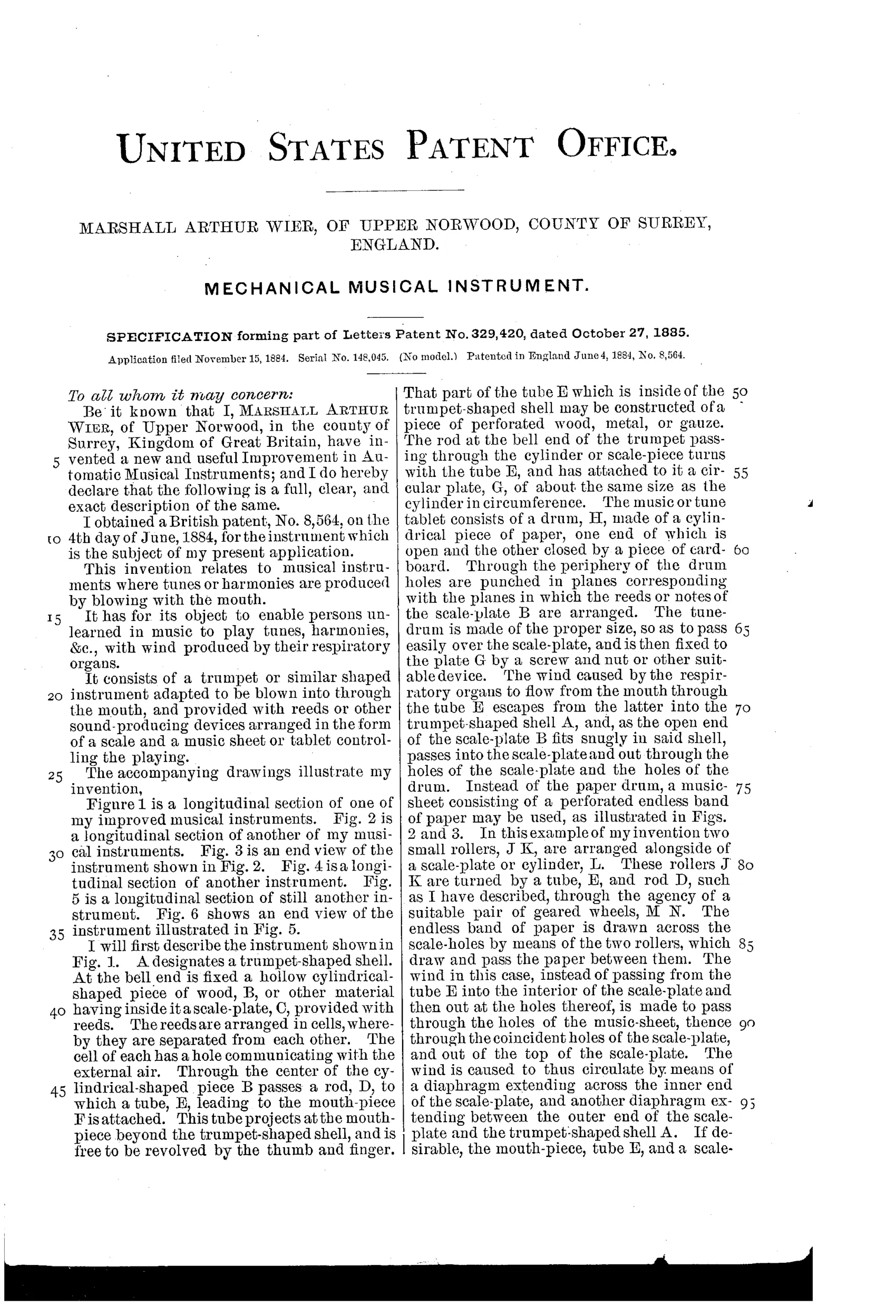
A trumpet-shaped shell holds a cylindrical scale-plate fitted with reeds arranged like a musical scale, each reed set in its own cell. A rotatable tube leads from a mouthpiece into the shell, allowing the player's breath to pass into the scale-plate and out through its reed holes. A perforated music tablet—paper drum, endless band, or disk—is fitted over or against the scale-plate so that only the holes coinciding with open perforations let air reach a reed. By rotating the tube (and thus the tablet) with the thumb and finger while blowing, the performer causes the correct reeds to sound in sequence, reproducing a tune without musical skill.
♫ What was claimed
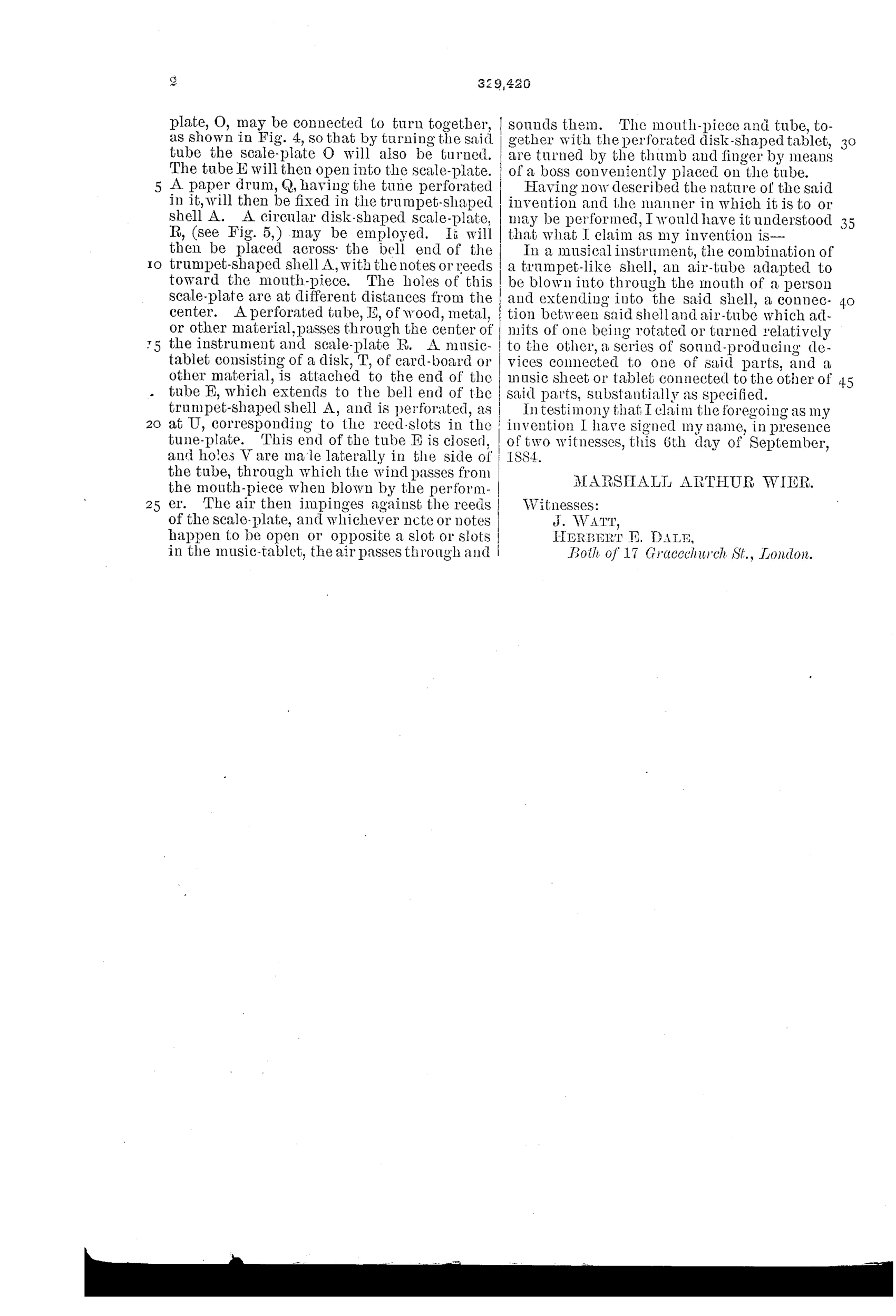
“In a musical instrument, the combination of a trumpet-like shell, an air-tube adapted to be blown into through the mouth of a person and extending into the said shell, a connection between said shell and air-tube which admits of one being rotated or turned relatively to the other, a series of sound-producing devices connected to one of said parts, and a music sheet or tablet connected to the other of said parts, substantially as specified.”
In plain English: The invention combines a trumpet-shaped shell with a breath tube that can rotate relative to it, where one part carries sound-making reeds and the other carries a perforated music sheet that controls which reeds sound.
♫ In the inventor’s words
“It has for its object to enable persons unlearned in music to play tunes, harmonies, &c., with wind produced by their respiratory organs.”— Marshall Arthur Wier, from the specification
Fate unknown
Mouth-blown perforated-tablet reed instruments were made by others, but no marked example of Wier's design is documented; a surviving specimen would settle it.
♫ Patented the same day
- MECHANICAL MUSICAL INSTRUMENT — Marshall Arthur Wier
♫ Commentary
Wier's instrument is an organette turned inside out and shrunk to hand size. Instead of a bellows and crank, your lungs supply the wind: breath enters through a rotatable mouthpiece tube, dead-ends against a cylindrical scale-plate studded with free reeds, and can only escape through whatever perforations in the paper tune drum happen to line up. Twist the tube with thumb and finger as you blow, and the tune plays itself. The trumpet shell is really a resonating megaphone for the reeds — the flare does no brasswork at all.
The drawing rewards a second look. Figures 2 and 3 show a more ambitious variant with rollers and an endless perforated band driven through gearing, and Figures 5 and 6 show a flat disk-shaped scale-plate with a radially perforated disk tablet — a breath-powered disc format sketched in 1884, several years before Lochmann and the Polyphon made the perforated disc the dominant medium of mechanical music. Wier wasn't thinking of that industry, but the geometry is sitting right there.
The honest question is playability. Sustaining steady breath pressure while smoothly rotating a paper drum at tempo, one-handed, is harder than cranking an organette, and paper tablets sealed against a curved plate leak. The idea itself was sound — mouth-blown roll-playing reed instruments did eventually reach market decades later — but as drawn this reads like a clever Victorian parlor novelty that would frustrate its owner by the third tune.
Commentary by Claude, The Talking Machine Patent Archive’s resident enthusiast