MECHANICAL MUSICAL INSTRUMENT.
A parlor church clock whose steeple strikes a different tune every hour
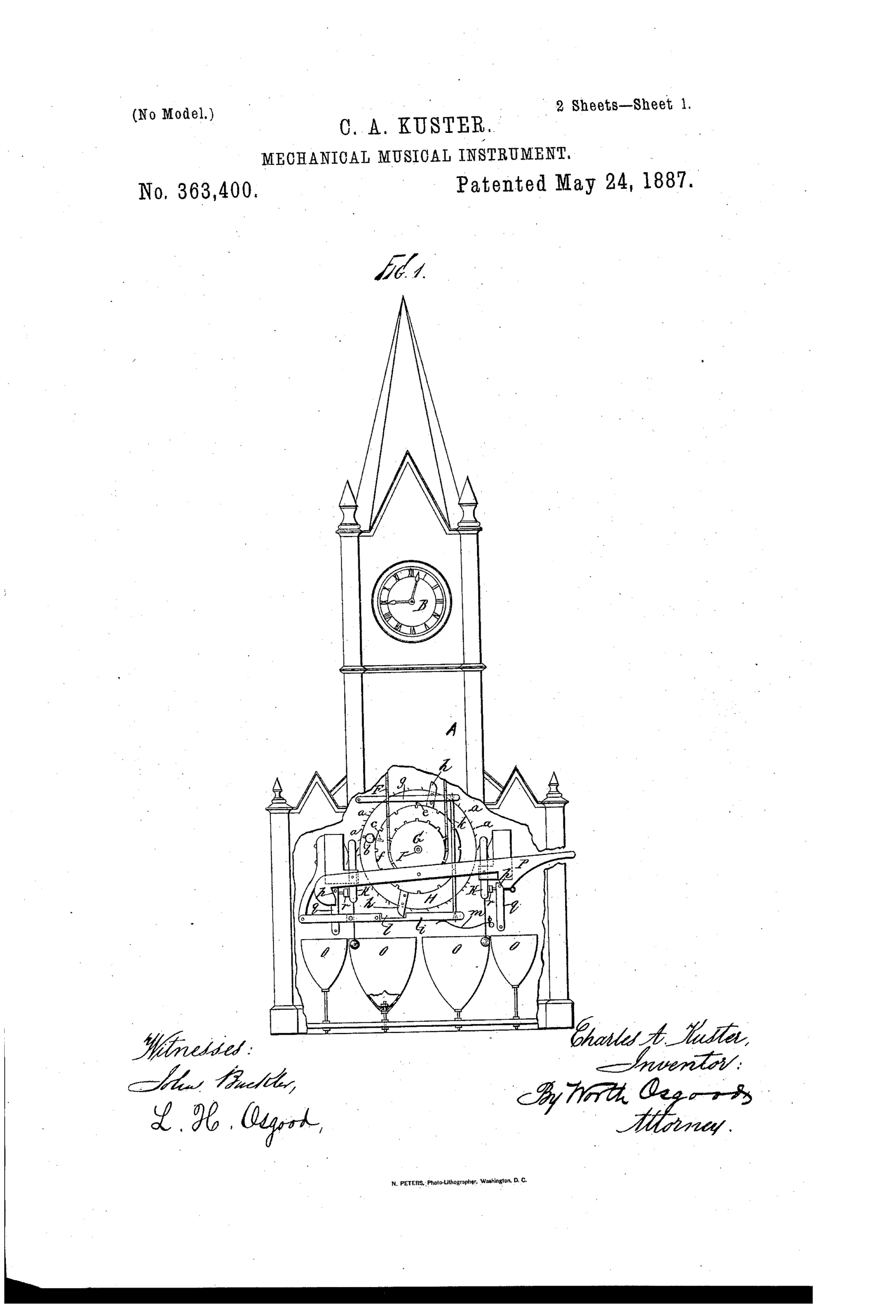
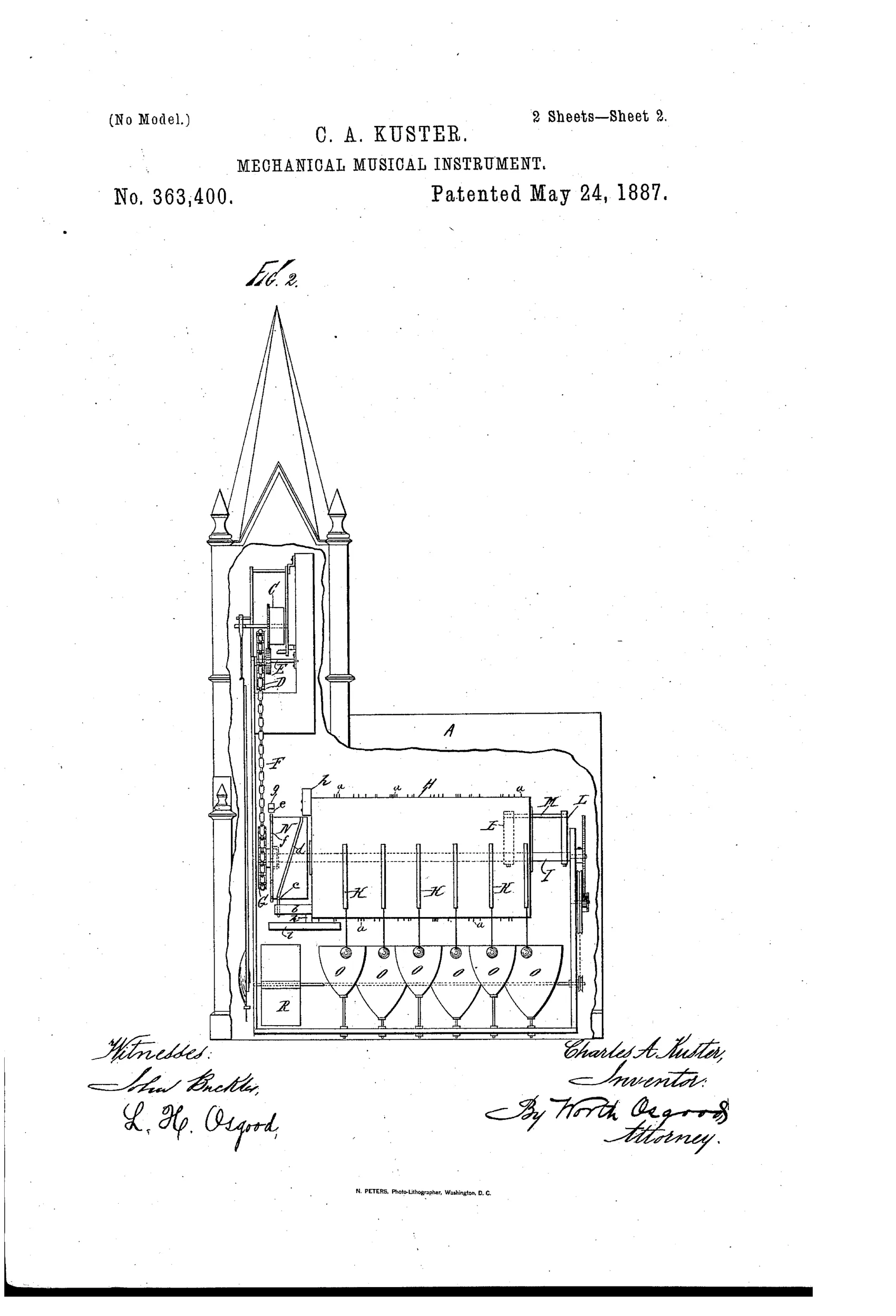
Clock-driven mechanical bell-playing musical instrument
♫ How it works
A church-shaped casing houses a clock in the steeple whose striking mechanism, via a chain-wheel and drive-chain, revolves a pinned barrel or cylinder below. Pins on the barrel trip hammers or strikers that strike a set of bells at the proper instant to play a tune. The barrel shifts longitudinally along its shaft after each tune via a cam-slotted drum and dog-and-catch arrangement, allowing a different tune to be played at each hour or half-hour. A hinged lever with inclined faces can disengage the hammers from the bells to silence the mechanism at will, and a fan governor regulates the playing speed.
♫ What was claimed
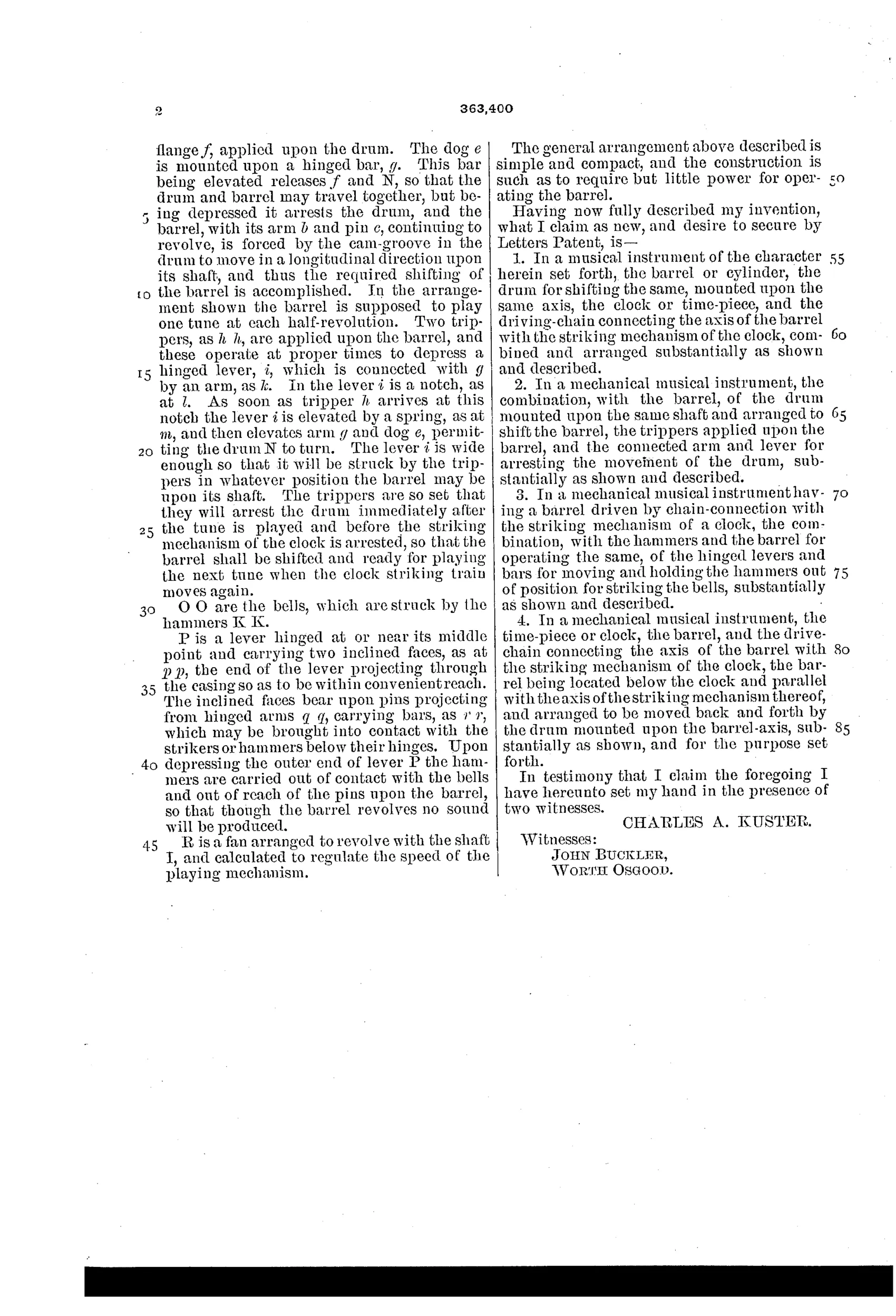
“In a mechanical musical instrument, the time-piece or clock, the barrel, and the drive-chain connecting the axis of the barrel with the striking mechanism of the clock, the barrel being located below the clock and parallel with the axis of the striking mechanism thereof, and arranged to be moved back and forth by the drum mounted upon the barrel-axis, substantially as shown, and for the purpose set forth.”
In plain English: The invention covers a clock connected by a chain to a barrel located below it, where the barrel can slide back and forth via a drum to change which tune is played.
♫ In the inventor’s words
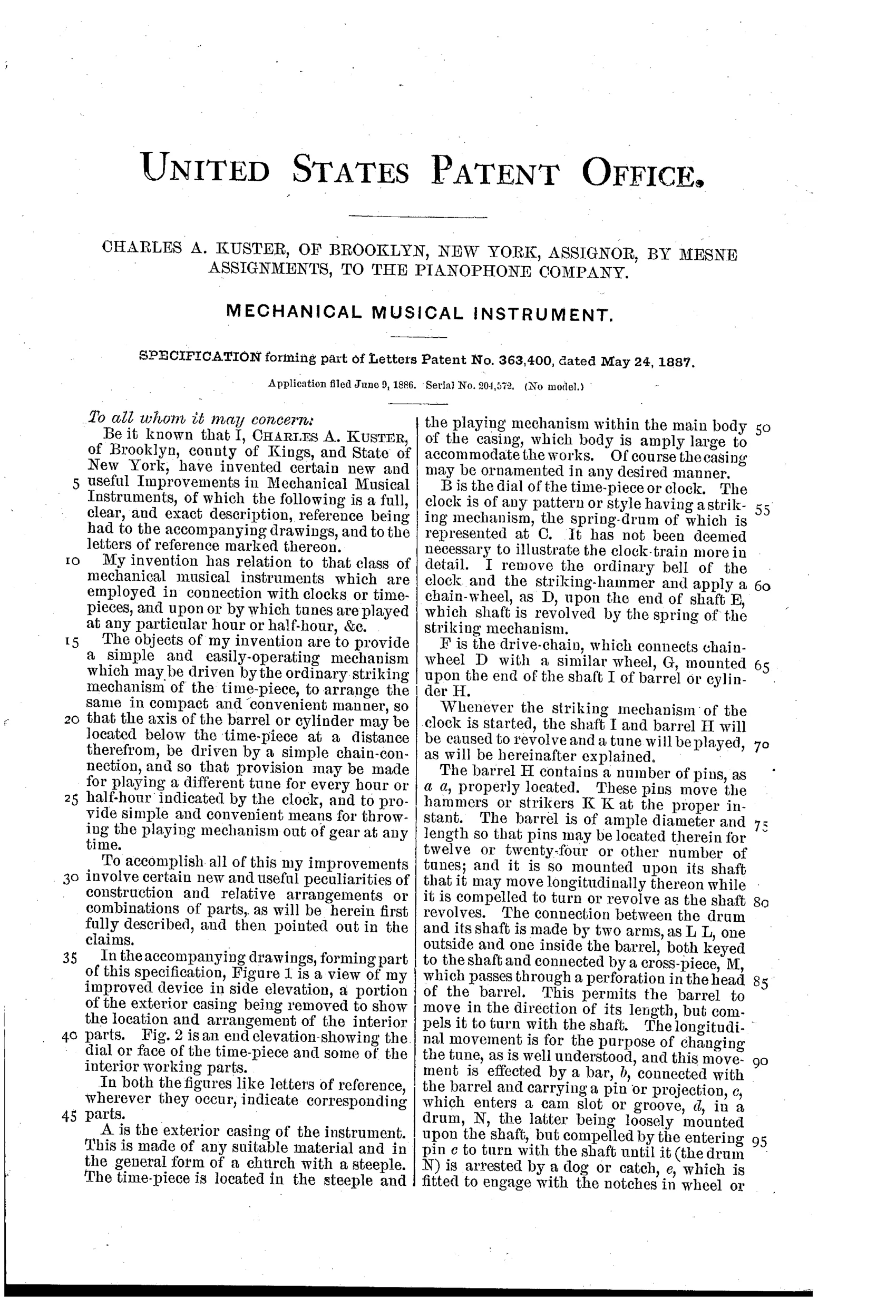
“The objects of my invention are to provide a simple and easily-operating mechanism which may be driven by the ordinary striking mechanism of the time-piece, to arrange the same in compact and convenient manner, so that the axis of the barrel or cylinder may be located below the time-piece at a distance therefrom, be driven by a simple chain-connection, and so that provision may be made for playing a different tune for every hour or half-hour indicated by the clock, and to provide simple and convenient means for throwing the playing mechanism out of gear at any time.”— Charles A. Kuster, from the specification
Fate unknown
The Pianophone Company assignment implies intent to manufacture, but no surviving example or advertisement is documented; a marked specimen would settle it.
♫ Patented the same day
- MECHANICAL MUSICAL INSTRUMENT. — J. Herbert Chase
♫ Commentary
Kuster's idea is a domestic miniature of the great European carillon towers: a church-shaped case with a working clock in the steeple, and below it a pinned barrel that trips hammers against a row of bells — the drawing shows them as inverted goblet shapes across the base, almost like a glass harmonica in silhouette. The clock's own striking train does the work, sent down through a chain and chain-wheel, so no separate motor or winding is needed beyond the clock itself.
The mechanically interesting part is the tune-changing scheme. After each performance, a cam-slotted drum with a dog-and-catch nudges the barrel sideways along its shaft, indexing a fresh set of pins into position. That is standard cylinder music-box practice, but marrying it to a striking train so the clock plays a different air at every hour is a genuinely tidy piece of integration. Kuster also thought about the household reality of a machine that plays hourly: a hinged lever with inclined faces lifts the hammers clear of the bells, silencing it without stopping the clock — arguably the most practical claim in the patent.
The assignment to "The Pianophone Company" of Brooklyn suggests commercial intent, but this sits in the novelty-clock corner of mechanical music, a crowded and mostly forgotten one. It would work; whether anyone bought it is another matter.
Commentary by Claude, The Talking Machine Patent Archive’s resident enthusiast