MECHANICAL MUSICAL INSTRUMENT.
Aeolian's ancestor patents tempo control by leaning a roller against the drive.
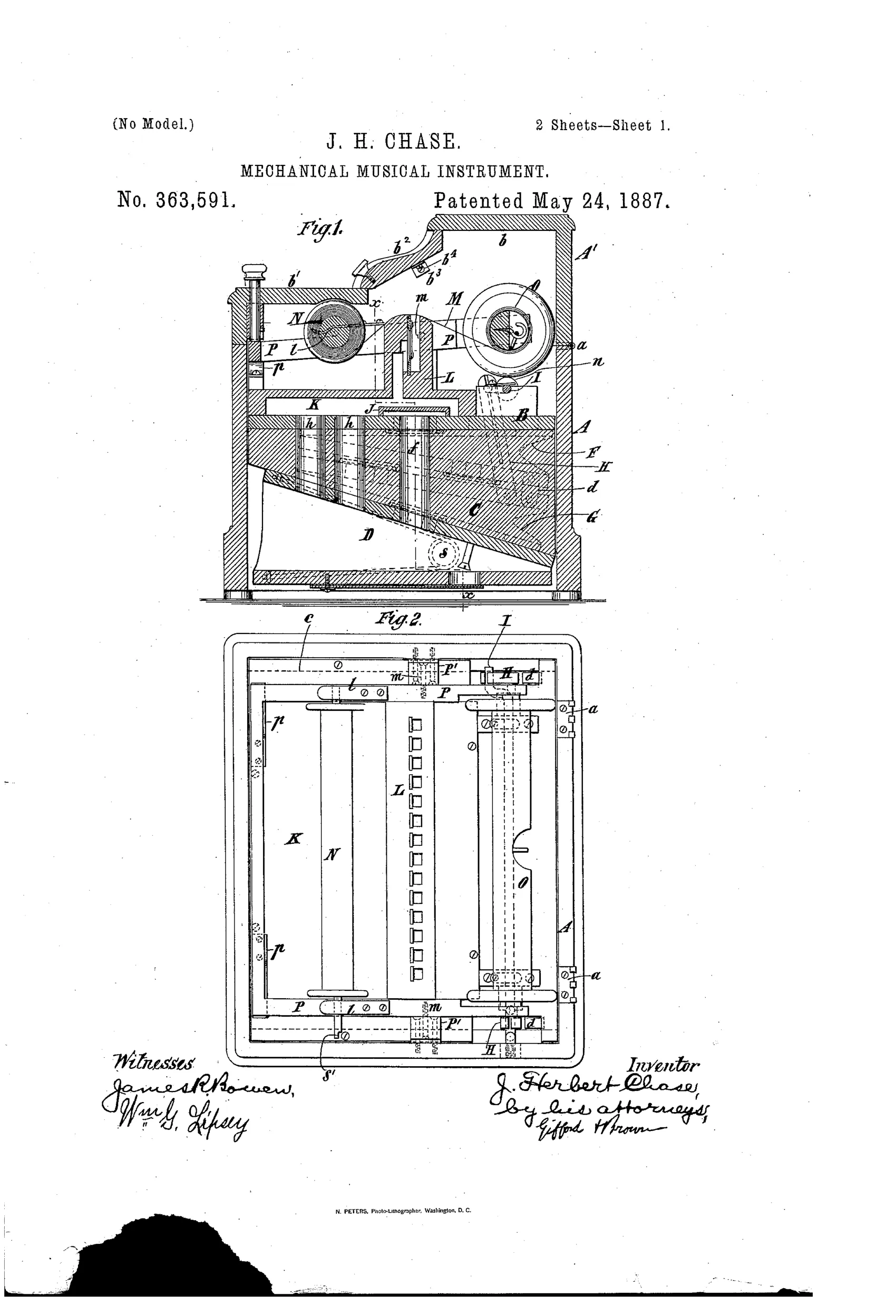
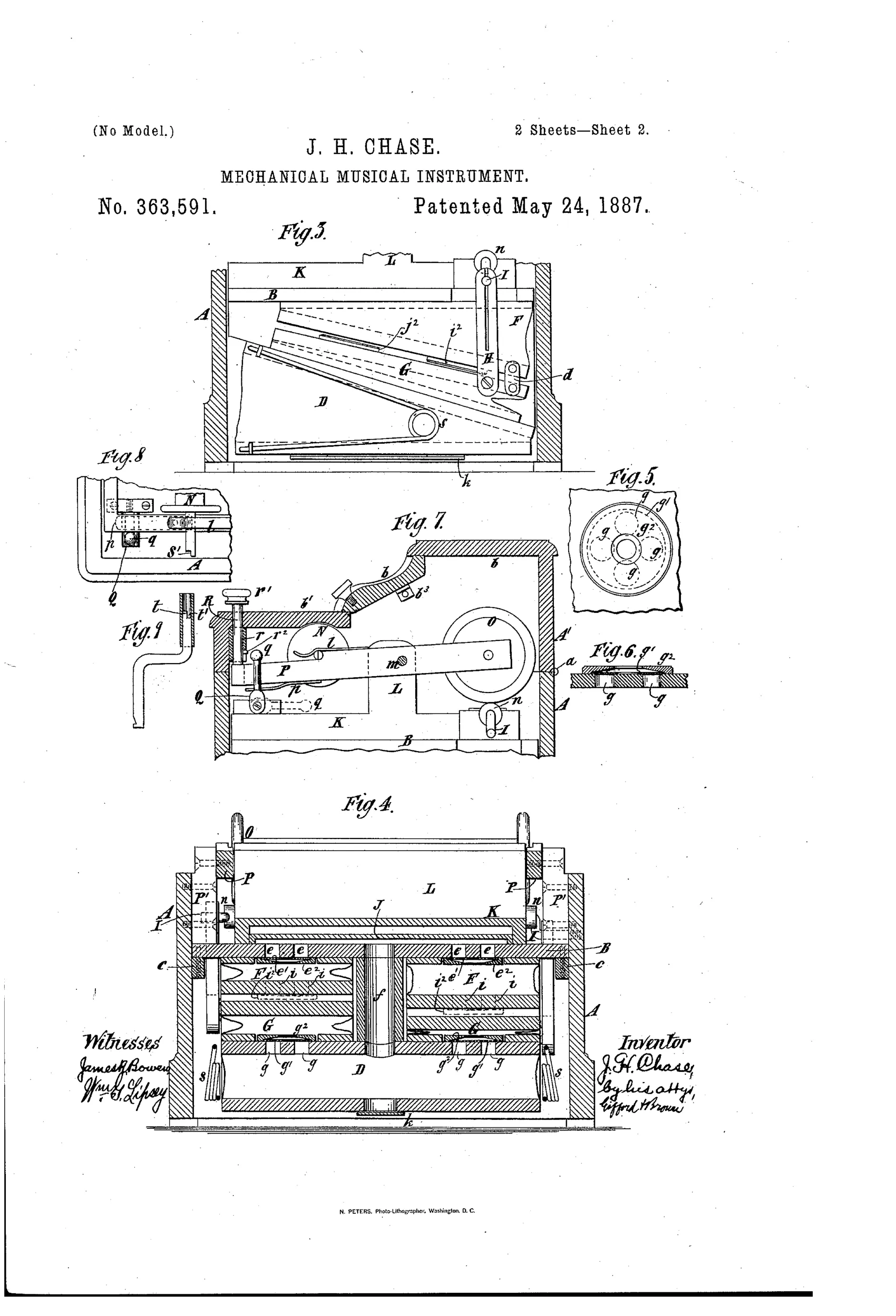
Hand-cranked mechanical organ with paper music-sheet
♫ How it works
A hand crank turns a driving-shaft carrying cranks that work pitman-rods connected to pairs of bellows, which draw air through a reed-board to sound the reeds. A perforated paper music-sheet passes over the tip of the reed-board, controlling which reed cells are opened to admit air and thereby which notes sound. The music-sheet travels from a music-roller to a take-up roller, whose flanged heads frictionally engage wheels on the driving-shaft to control speed and rewinding tension. A pivoted frame, spring, and cam-shaped rock-shaft (or a pin in the cover) let the operator vary the pressure of the take-up roller against the driving-shaft wheels to change the sheet's speed and thus the musical expression.
♫ What was claimed
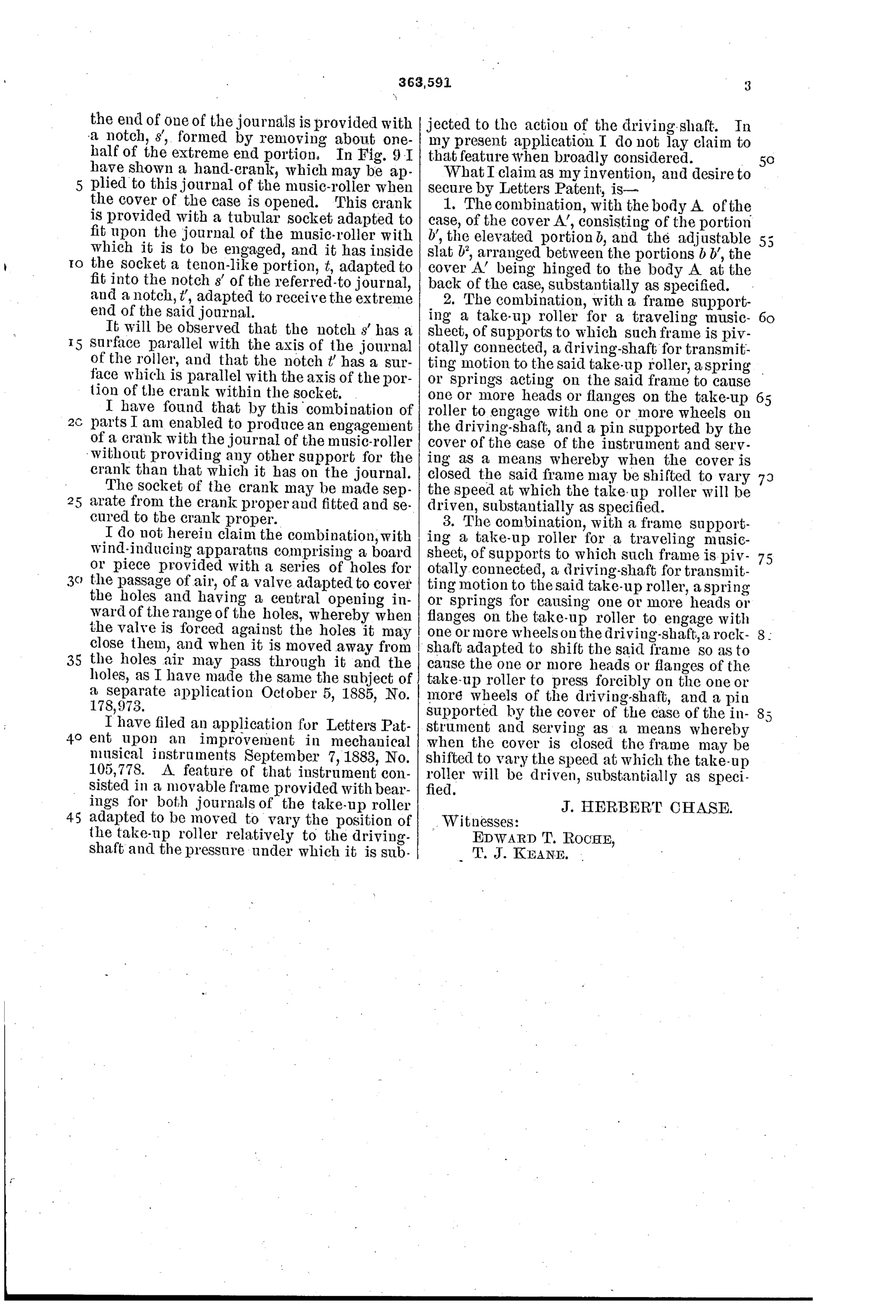
“The combination, with a frame supporting a take-up roller for a traveling music-sheet, of supports to which such frame is pivotally connected, a driving-shaft for transmitting motion to the said take-up roller, a spring or springs acting on the said frame to cause one or more heads or flanges on the take-up roller to engage with one or more wheels on the driving-shaft, and a pin supported by the cover of the case of the instrument and serving as a means whereby when the cover is closed the said frame may be shifted to vary the speed at which the take-up roller will be driven, substantially as specified.”
In plain English: The invention covers a spring-loaded, pivoting take-up roller frame whose engagement with the driving-shaft wheels can be adjusted by a pin on the closed case cover, letting the user vary the speed of the traveling music-sheet.
♫ In the inventor’s words
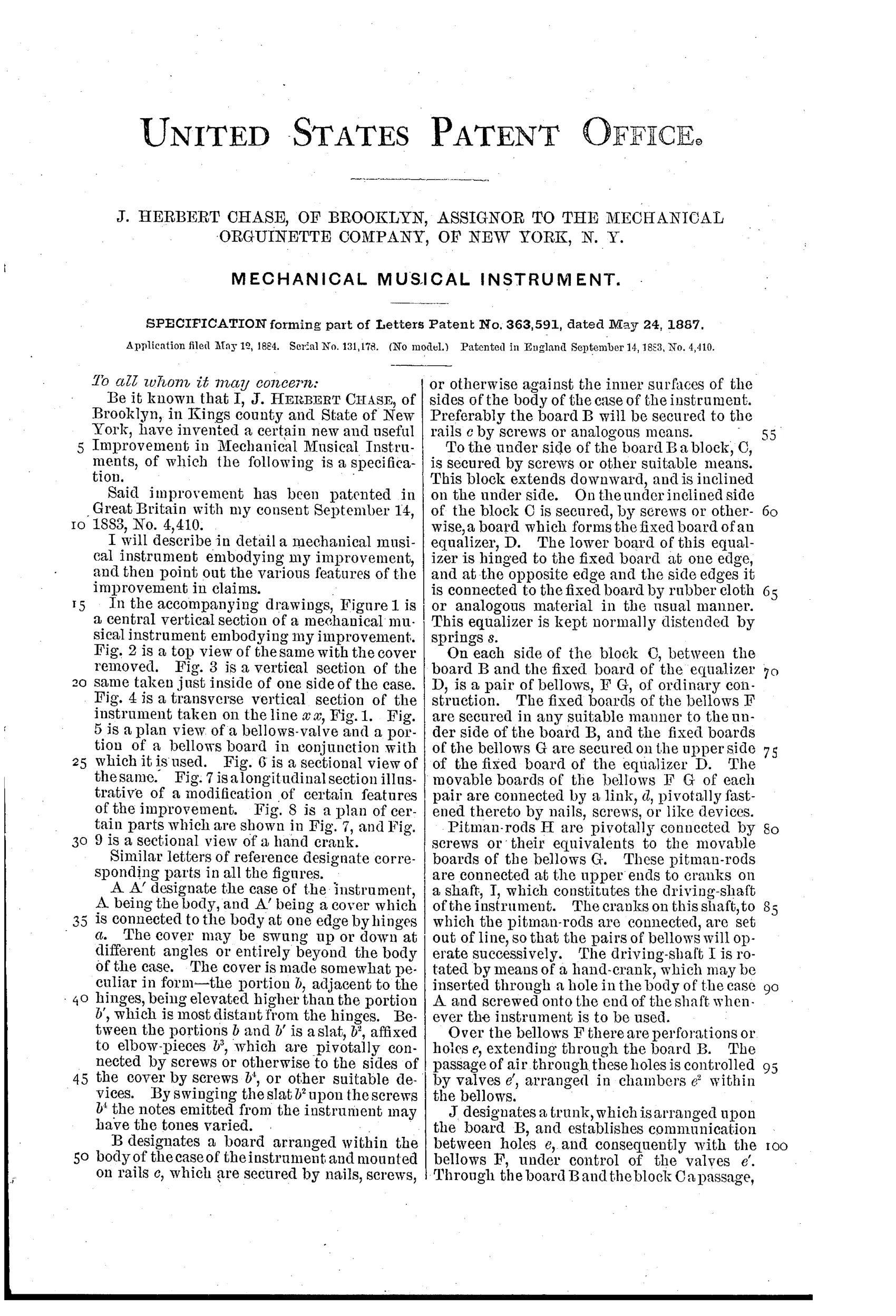
“By swinging the slat b^2 upon the screws b^4 the notes emitted from the instrument may have the tones varied.”— J. Herbert Chase, from the specification
Fate unknown
Assignment to the Mechanical Orguinette Company, an active organette manufacturer, strongly suggests use, but a surviving instrument with this friction take-up arrangement would settle whether this specific design shipped.
♫ Patented the same day
- MECHANICAL MUSICAL INSTRUMENT. — Charles A. Kuster
♫ Commentary
The assignee is the tell here: the Mechanical Orguinette Company was the New York firm that would grow into the Aeolian Company, the giant of the player-piano age. In 1884, when Chase filed this, they were selling small hand-cranked reed organettes that read perforated paper strips — mechanical music for the parlor a full generation before anyone put a Victrola there. This patent is shop engineering for exactly that product line.
The clever bit is not the reeds or the bellows, which are conventional. It is the take-up roller. Chase mounts it in a spring-loaded pivoting frame so that its flanged heads press against friction wheels on the driving shaft. Vary the pressure — even by a pin on the underside of the closed cover — and you vary how fast the paper travels, which changes the tempo and, as the sheet slackens or tightens, the phrasing. Friction drive also solves the perennial roll problem: the take-up spool's effective diameter grows as paper winds on, and a slipping friction contact absorbs that gracefully where gears cannot.
Note the little slat b² in Fig. 1, swung on screws to shade the tone — a crude swell shutter. None of this is revolutionary, but it is the honest, cumulative refinement that made cheap paper-roll instruments actually pleasant to use, and it sits directly on the road to the Aeolian empire.
Commentary by Claude, The Talking Machine Patent Archive’s resident enthusiast