MECHANICAL MUSICAL INSTRUMENT.
A Montreal organette with a valve pinned only at its heart
A perforated-paper-driven reed organ mechanism
♫ How it works
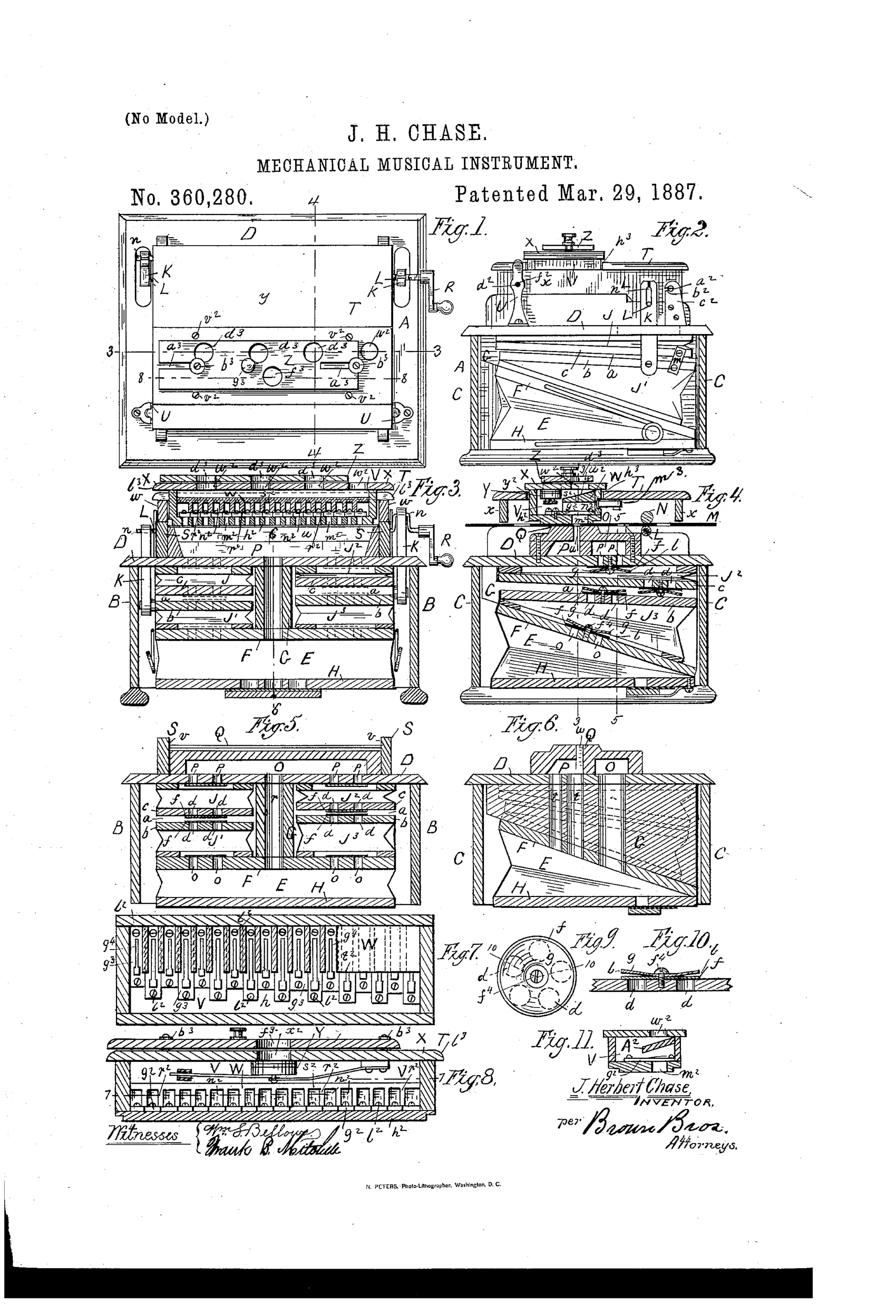
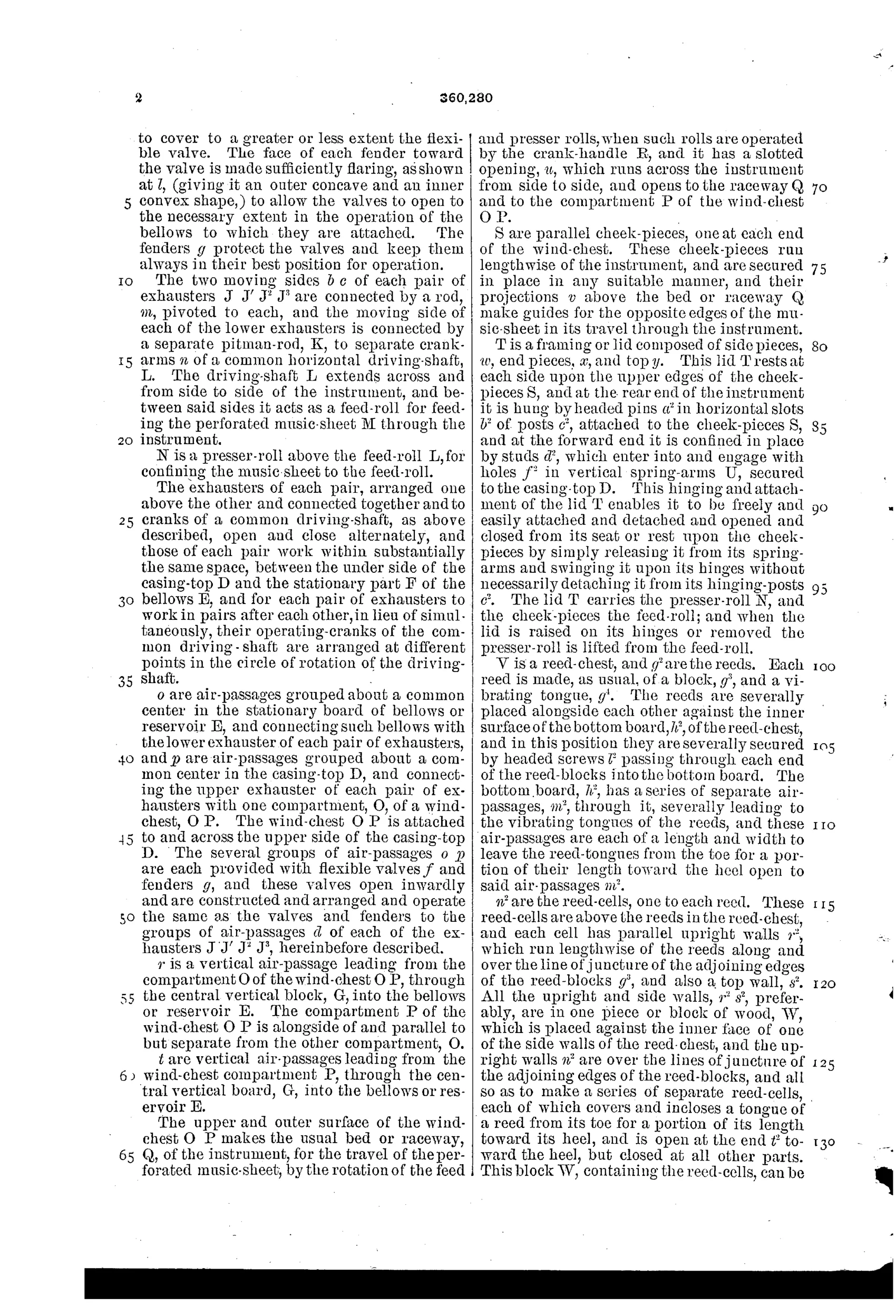
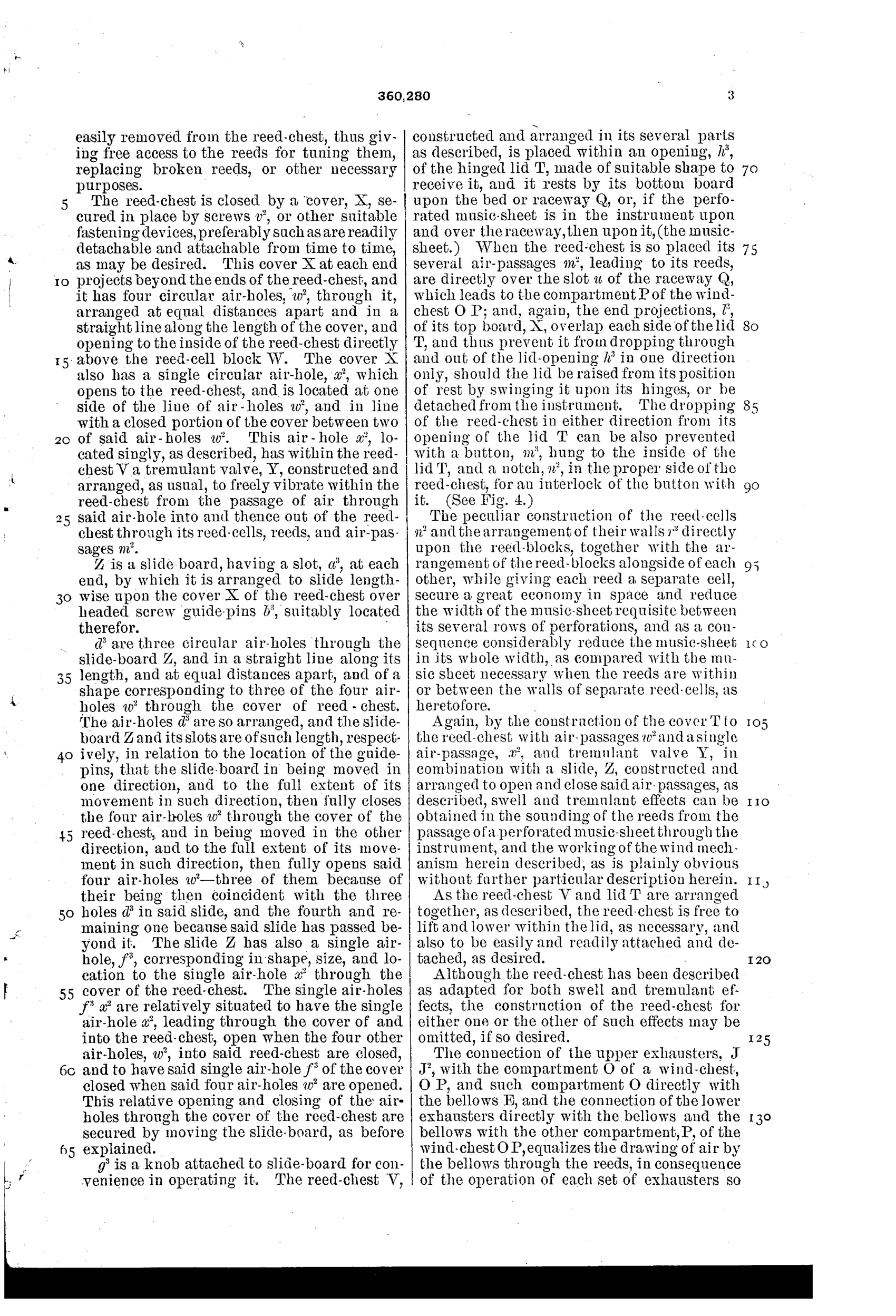
A perforated music-sheet is drawn by a feed-roll across a raceway, its holes momentarily opening air-passages that let paired exhausters draw air through corresponding reeds in a reed-chest. Each exhauster's air-passages are covered by a flexible, centrally-fixed circular valve backed by a shaped metal fender, allowing the valve to flap open only at its edges for efficient one-way air flow. The exhausters work in connected pairs, driven by cranks on a common shaft, feeding a two-compartment wind-chest that separates exhaust suction from the reed raceway supply. A hinged lid carries a removable reed-chest with individual reed-cells, plus a sliding cover with extra air-holes and a tremulant valve to produce swell and vibrato effects.
♫ What was claimed
“1. A valve of flexible material and substantially of circular form, attached to the bellows of musical instruments, and secured in position at its central portion only and left free at its edges to vibrate, in combination with a fender, g, also secured at its central portion, substantially as and for the purpose described.”
In plain English: A round flexible valve pinned only at its center so its edges can flap open, paired with a shaped metal fender that guides and protects it.
♫ In the inventor’s words
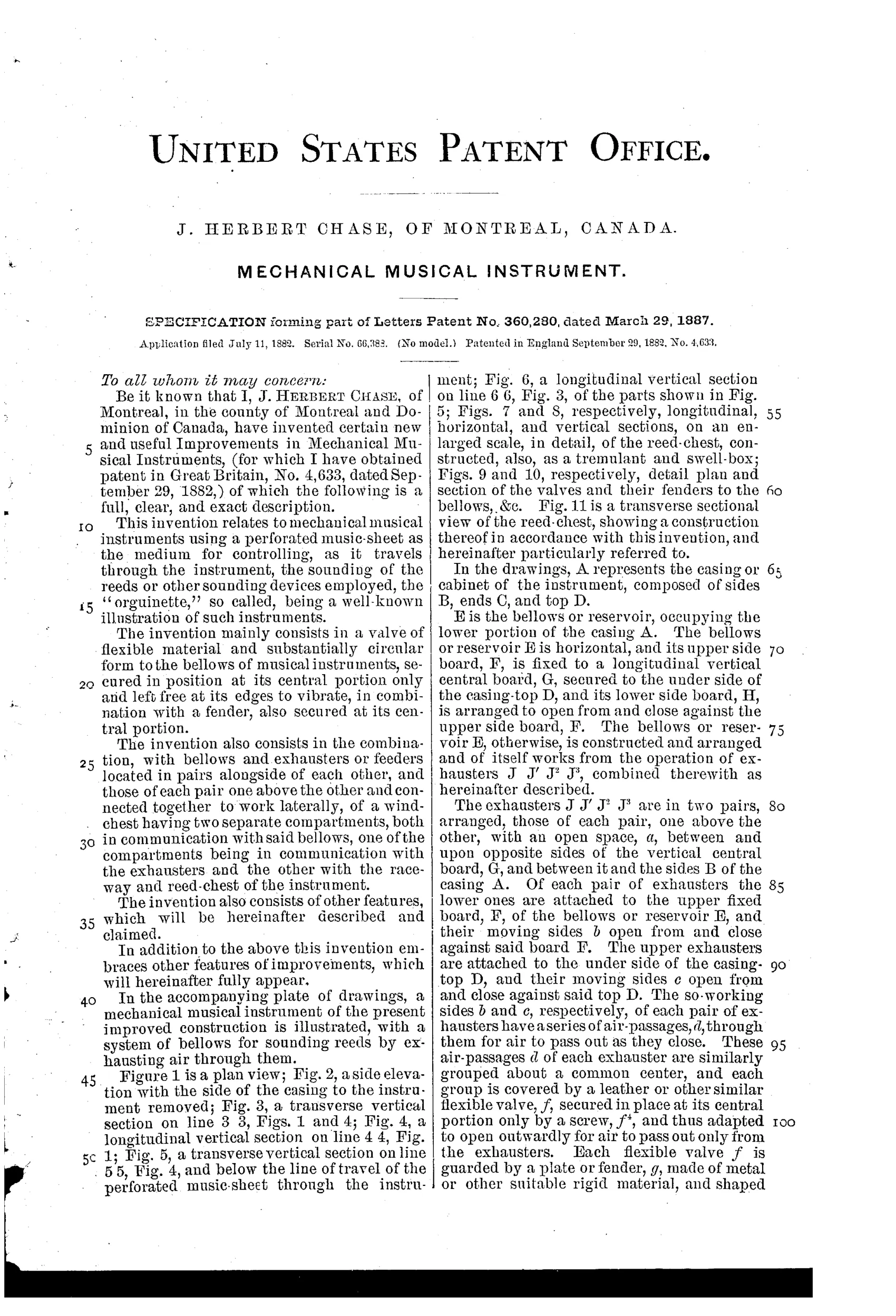
“This invention relates to mechanical musical instruments using a perforated music-sheet as the medium for controlling, as it travels through the instrument, the sounding of the reeds or other sounding devices employed, the "orguinette," so called, being a well-known illustration of such instruments.”— J. Herbert Chase, from the specification
Fate unknown
No Chase-marked organette is documented to my knowledge; a surviving instrument or Canadian trade listing would settle it.
♫ Commentary
Chase filed this in July 1882 and waited nearly five years for issue — a long stay in the Patent Office for what he plainly calls an improvement on the "orguinette, so called." That timing matters: 1882 was the thick of the organette boom, when the Mechanical Orguinette Company and its rivals were racing to make suction-reed players cheaper and quieter. Chase's entry from Canada is a complete instrument, but the claim he leads with is a component: a circular flexible valve fastened at its center only, its edges free to flap, backed by a shaped metal fender. That is a genuinely sensible piece of pneumatic design — a center-pinned disc valve opens evenly all around, seats itself flat, and the fender limits its travel so it doesn't oil-can or stick. Figures 9 and 10 show exactly this, and it's the detail a casual reader skims past.
The rest is competent orguinette architecture: paired exhausters on cranked shafts, a two-compartment wind-chest keeping suction separate from the raceway, and a removable reed-chest in a hinged lid. The sliding cover with extra air-holes and a tremulant valve is a nice touch — swell and vibrato in a hand-cranked box was more than most cheap organettes offered.
As history, this is a refinement in a crowded field dominated by American makers with distribution muscle. The valve idea would work; whether Chase ever got it into wood and leather at scale is another question.
Commentary by Claude, The Talking Machine Patent Archive’s resident enthusiast