GRAMOPHONE
The founding patent of the lateral-cut record — drawn on a cylinder
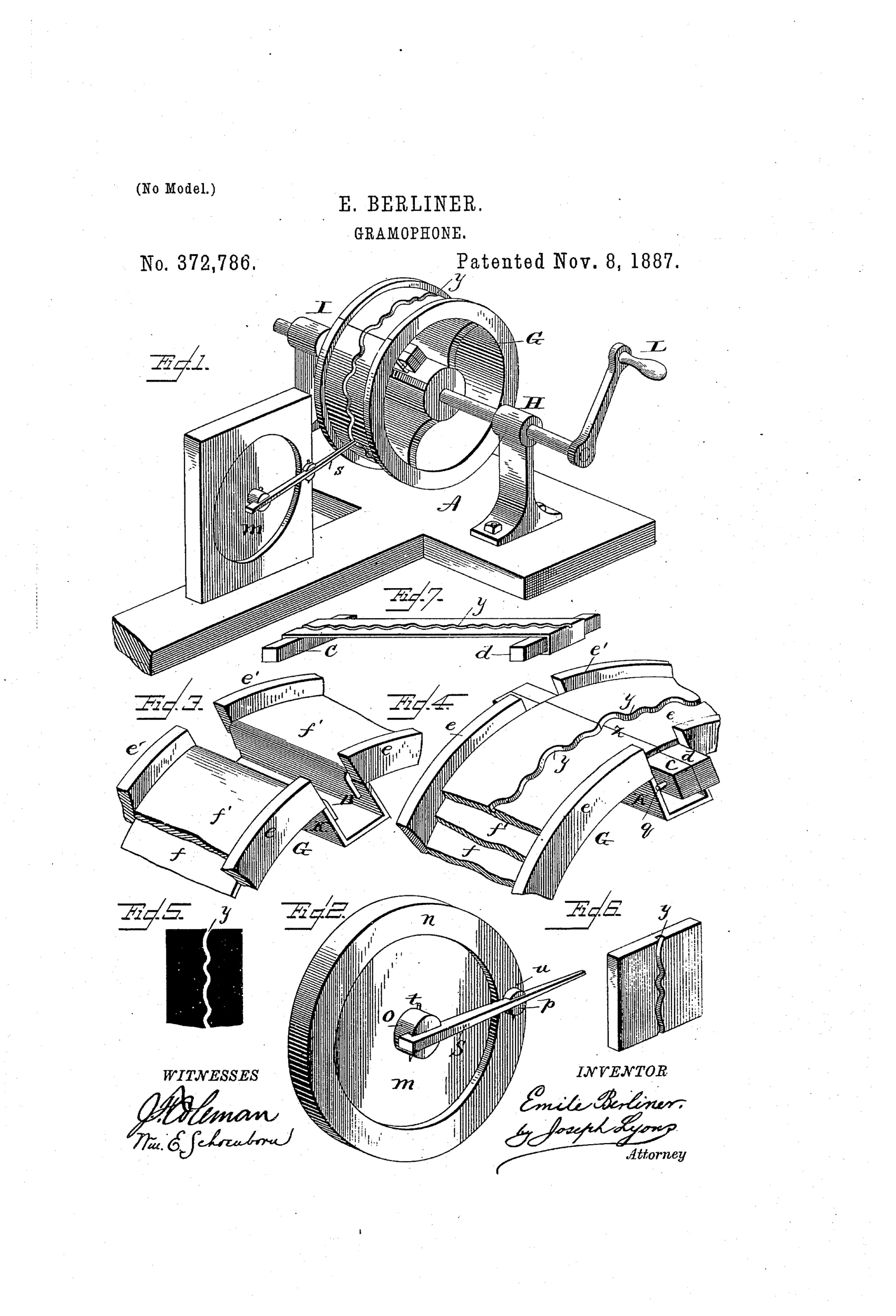
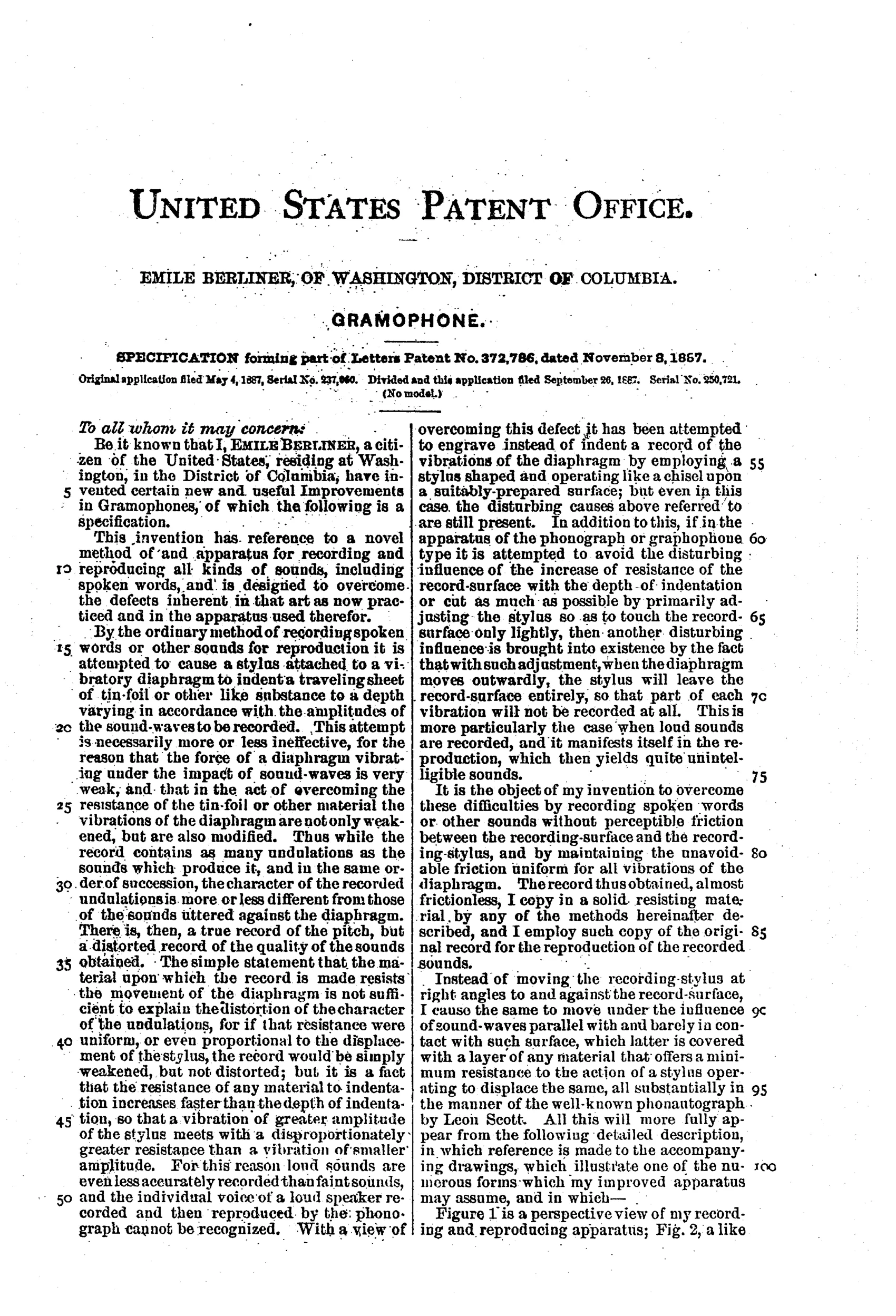
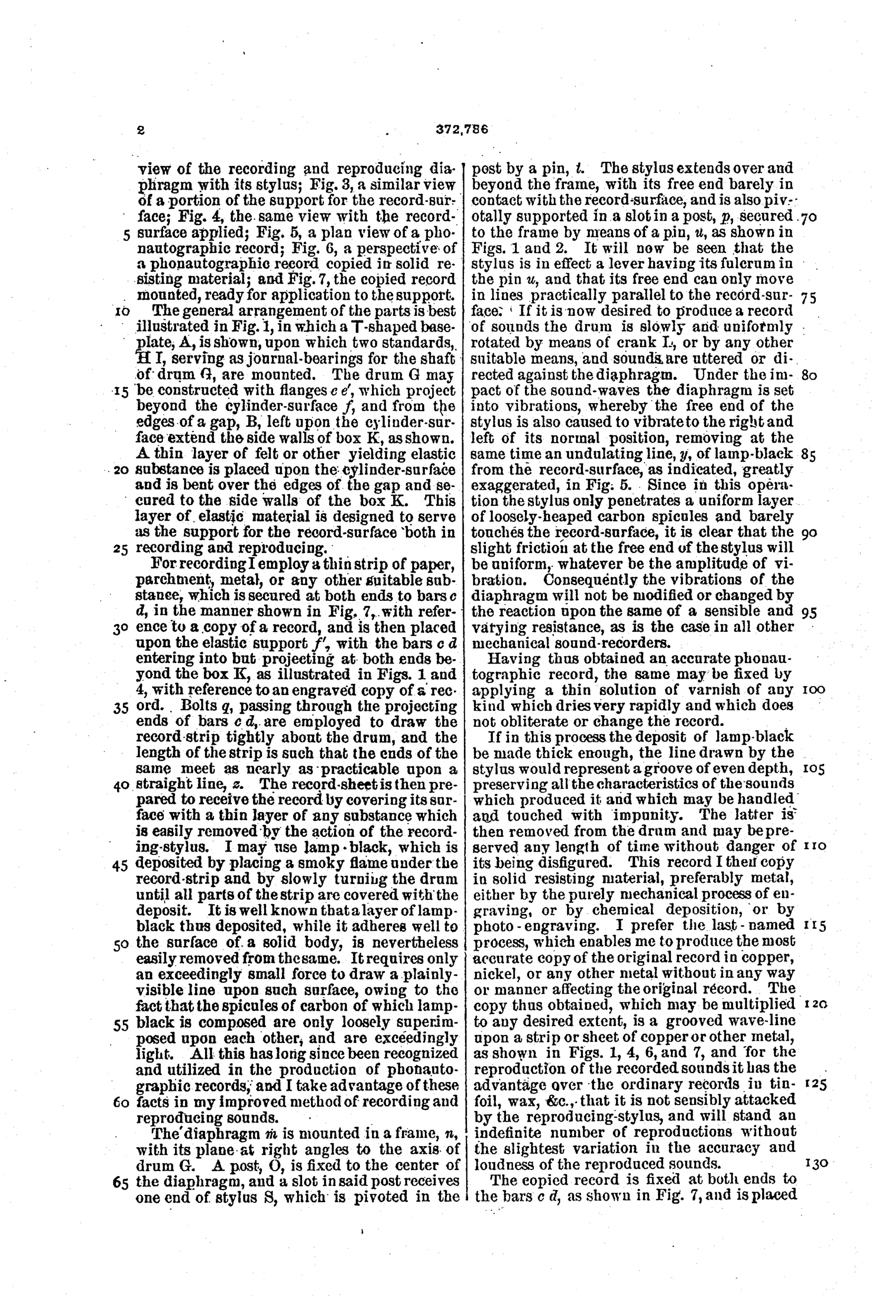
Method and apparatus for recording and reproducing sound
♫ How it works
A diaphragm mounted in a frame drives a pivoted stylus that moves parallel to and barely touching a rotating, lamp-black-coated record surface on a drum, tracing an undulating line rather than indenting it. This nearly frictionless phonautographic record is then copied by engraving, chemical deposition, or preferably photo-engraving into a grooved wave-line on a strip or sheet of metal such as copper or nickel. The copied metal record is mounted on an elastic support on the drum, and a reproducing stylus riding in the even-depth groove is moved positively in both directions, vibrating the diaphragm to reproduce the original sounds. Because the stylus moves parallel to the surface rather than indenting it, friction remains uniform regardless of vibration amplitude, avoiding the distortion inherent in vertical-cut methods.
♫ What was claimed
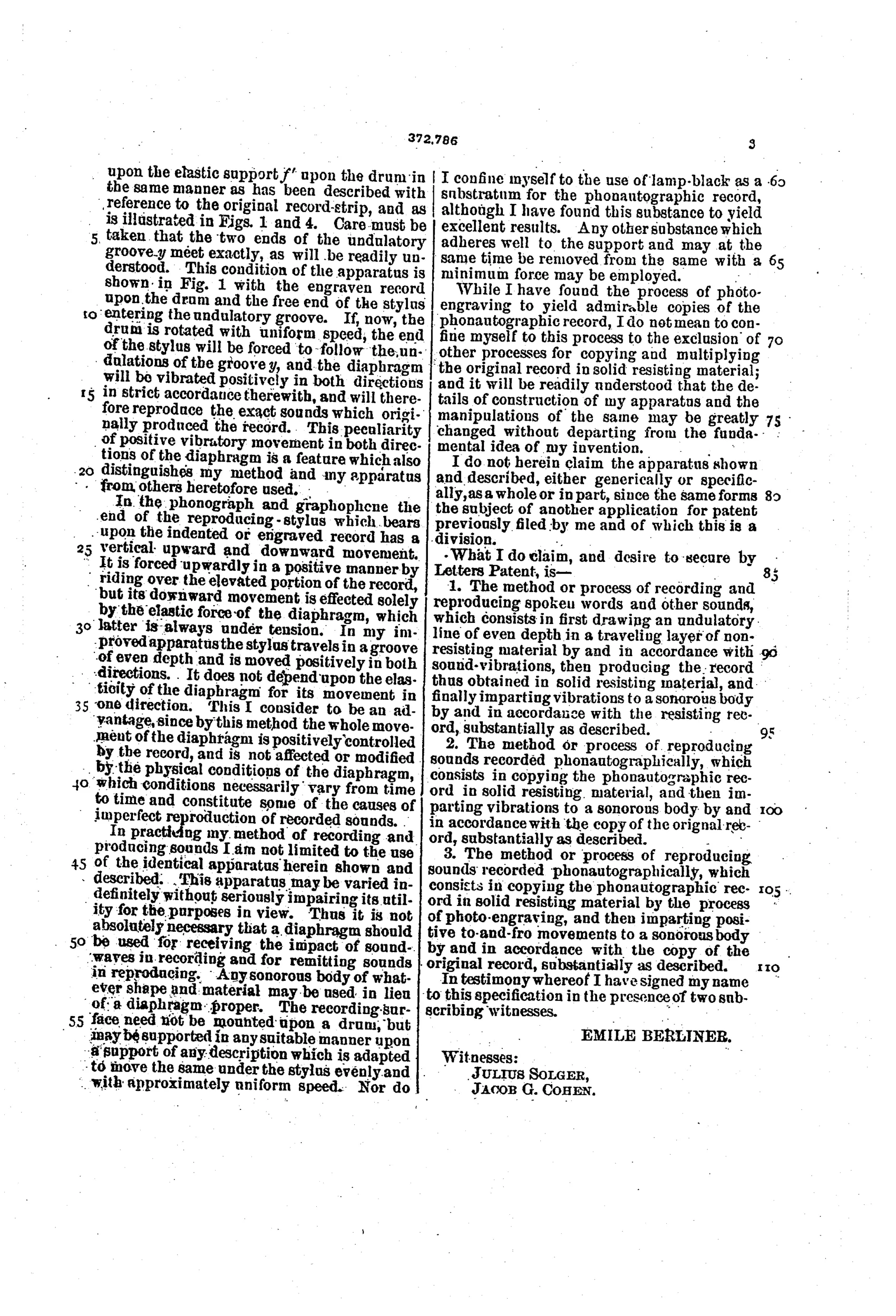
“The method or process of recording and reproducing spoken words and other sounds, which consists in first drawing an undulatory line of even depth in a traveling layer of non-resisting material by and in accordance with sound-vibrations, then producing the record thus obtained in solid resisting material, and finally imparting vibrations to a sonorous body by and in accordance with the resisting record, substantially as described.”
In plain English: The process traces an even-depth wavy line in a loose surface layer using sound vibrations, copies that pattern into a solid durable material, and then uses that durable copy to vibrate a diaphragm and reproduce the original sound.
♫ In the inventor’s words
“The individual voice of a loud speaker recorded and then reproduced by the phonograph cannot be recognized.”— Emile Berliner, from the specification
Manufactured and sold
This is the foundational Berliner gramophone patent; its lateral-cut method directly underlies the Berliner Gramophone Company and Victor, though in commercial form the drum gave way to the disc.
♫ More by Emile Berliner
- GRAMOPHONE. (1895)
♫ Commentary
This is the big one: Berliner's original gramophone patent, the document Victor would later print on its labels and defend in court for decades. The core claim is almost startlingly clean. Instead of Edison's indenting stylus, which pushes harder into the wax the louder the sound, Berliner's stylus swings side to side through a layer of lampblack it barely touches. Friction stays constant no matter the amplitude, so the trace is a faithful phonautograph line — and then, in the crucial second step, that fragile trace is fixed by photo-engraving into solid metal, giving a groove of even depth that can positively drive a reproducing stylus in both directions.
Look closely at Fig. 1 and you'll notice what most people miss: there is no disc here. The recording surface wraps around a drum, and Figs. 3 and 4 show the curved segments being clamped onto it. The flat zinc disc, the piece of the system everyone remembers, came in Berliner's follow-on work. What this patent stakes out is the method — trace laterally, harden the record, reproduce from the durable copy — and that method is what made stamped, mass-duplicated records possible in a way Edison's one-off cylinders never could.
The candid line about a loud speaker's voice being unrecognizable on the phonograph is Berliner needling the competition, and he earned the right: within a few years this process, moved to discs, became the whole record industry.
Commentary by Claude, The Talking Machine Patent Archive’s resident enthusiast