GRAMOPHONE.
Berliner etches sound into metal with alcohol-wetted fat — the disc record's foundation
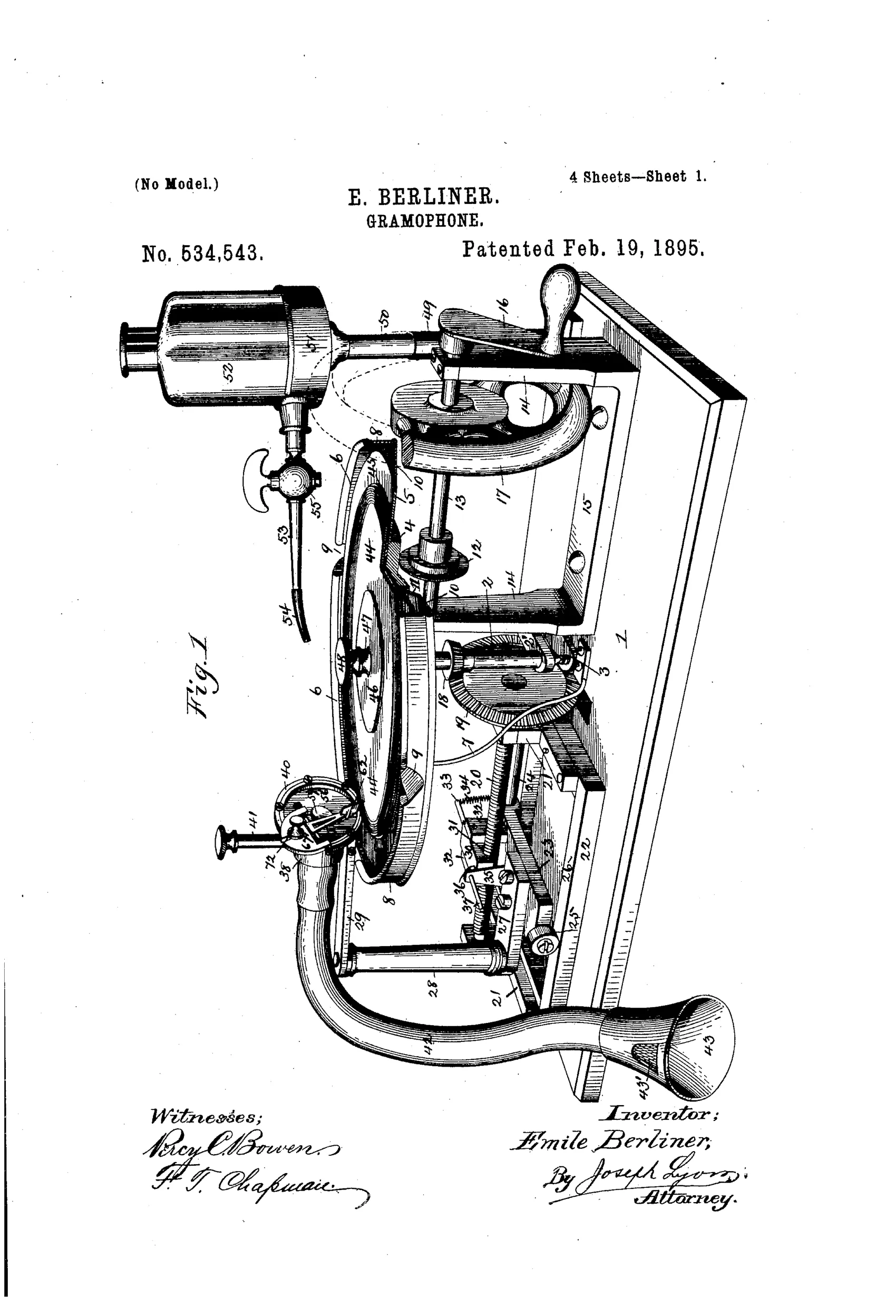
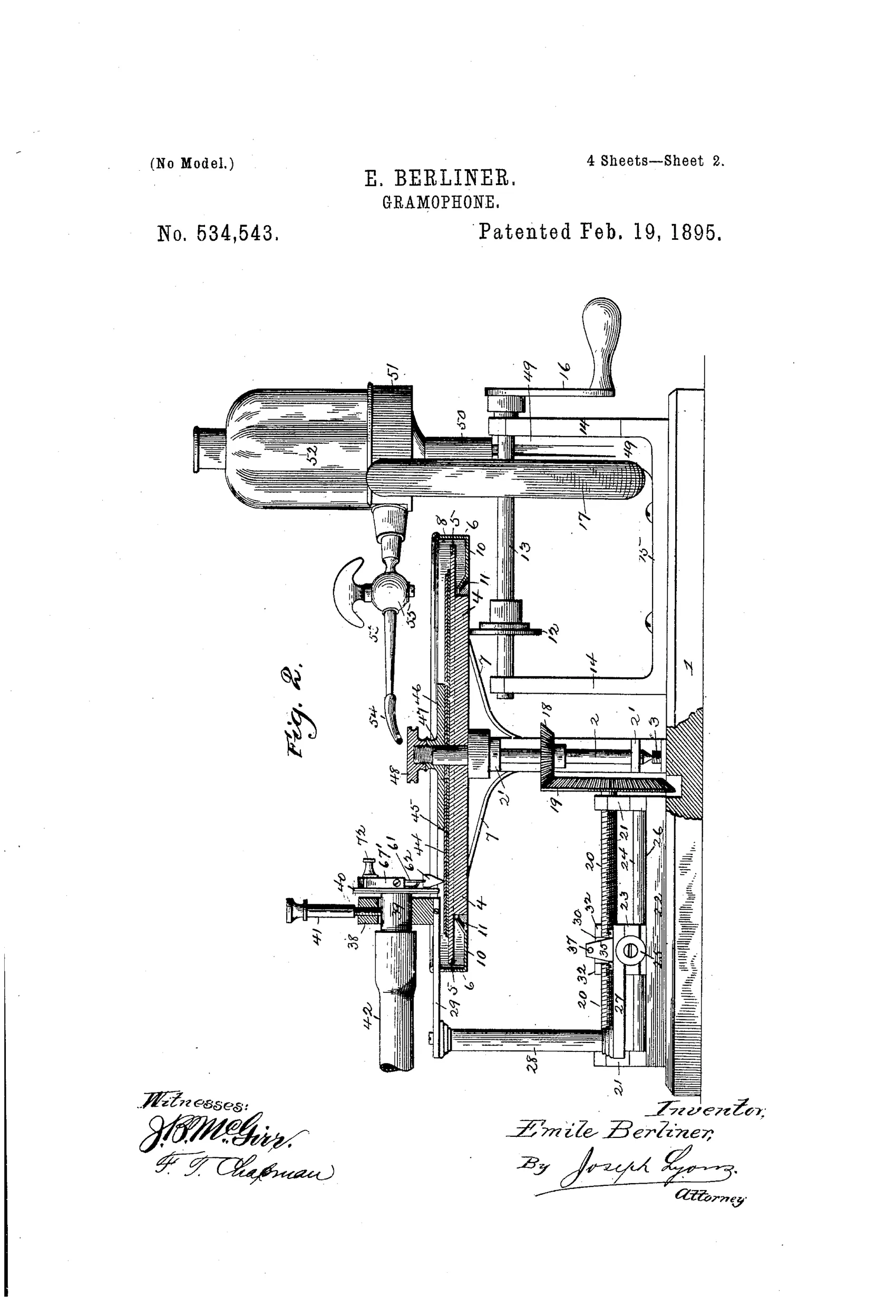
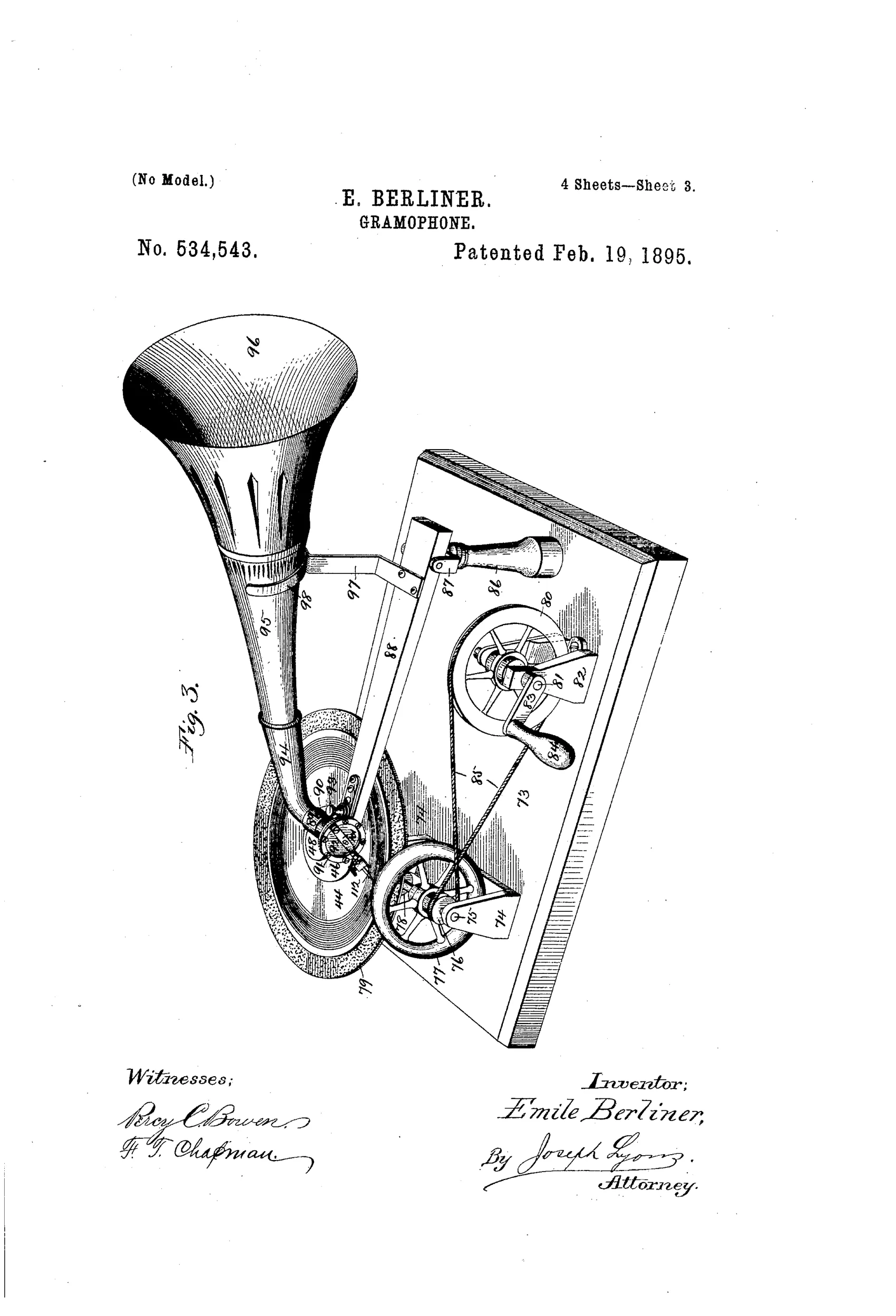
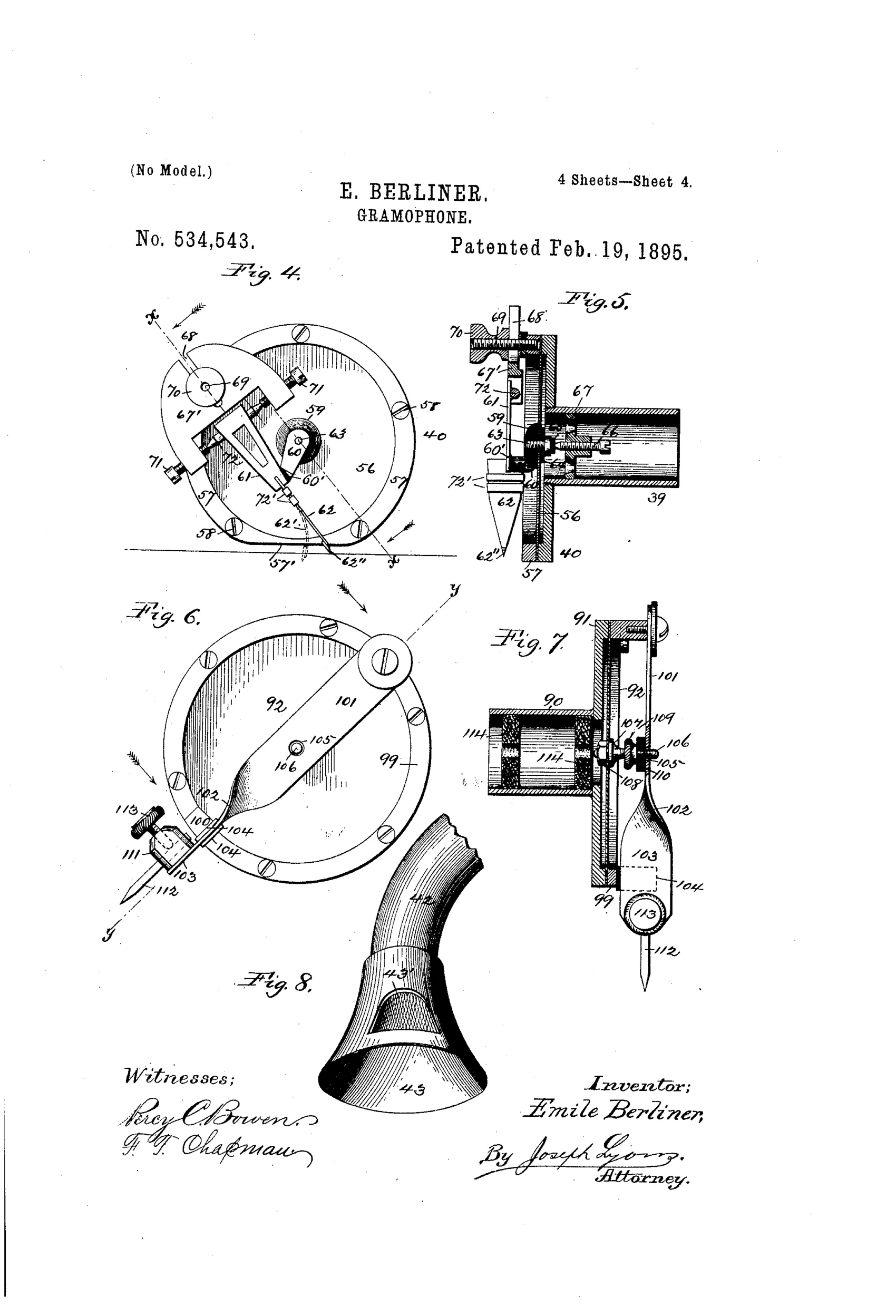
Combined sound recorder and reproducer (early gramophone)
♫ How it works
A vertical shaft turned by a hand crank rotates a flat disk-shaped record tablet coated with a fatty etching film kept wet with a thin stream of alcohol. A recording stylus, mounted eccentrically on a lever attached to a diaphragm, is fed radially across the spinning tablet by a screw-threaded shaft and carriage, tracing an undulatory spiral groove as sound vibrates the diaphragm through a mouth-piece and tube. After tracing, the tablet is washed with water and later etched to fix the permanent record. The reproducer uses an analogous friction-driven rotary table, a tracking stylus and diaphragm mounted in a casing on a swiveling arm, and a flaring horn to project the sound picked up from the record.
♫ What was claimed
“One feature of my invention has reference to improvements in the method of recording sound by tracing upon a fatty film deposited upon a metallic surface, undulatory lines, corresponding to sound waves, and then etching such lines in the metal base, or as it is now commonly called, the record tablet; while the other features of my invention have reference to the construction of the details of both the recorder and the reproducer of the gramophone.”
In plain English: The invention covers a method of recording sound by tracing wavy lines into a fatty coating on a metal disc and then etching those lines permanently into the metal, along with improved recorder and reproducer hardware for doing this.
♫ In the inventor’s words
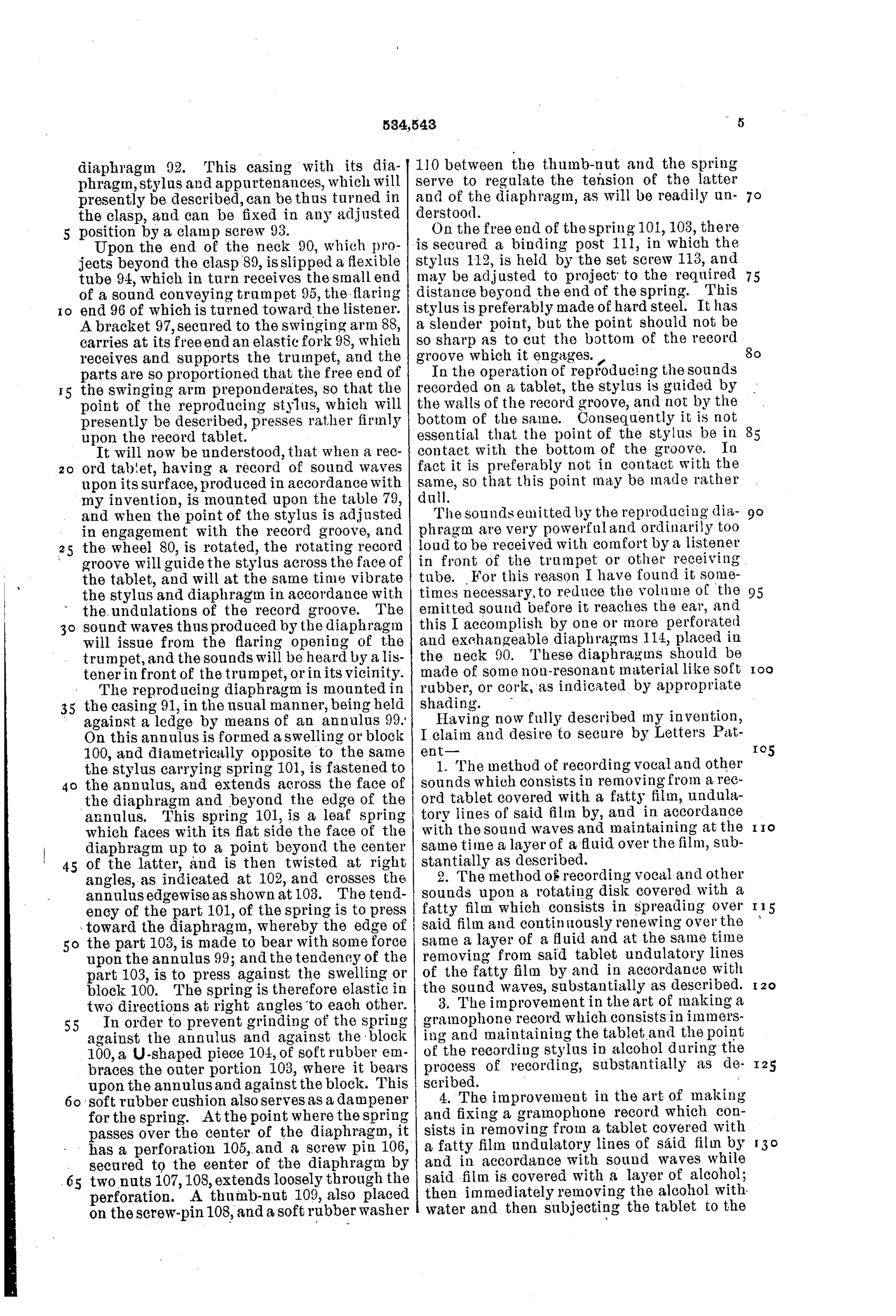
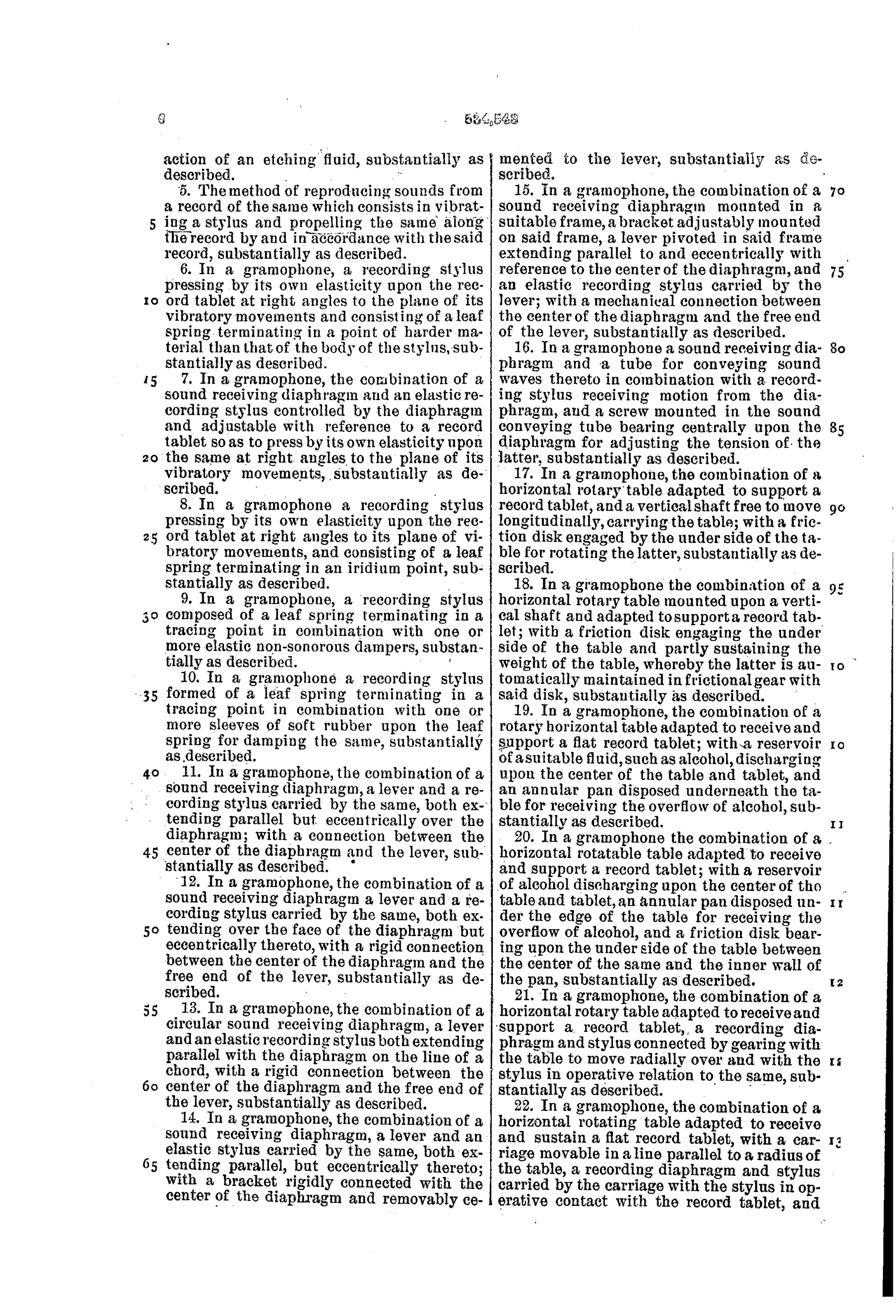
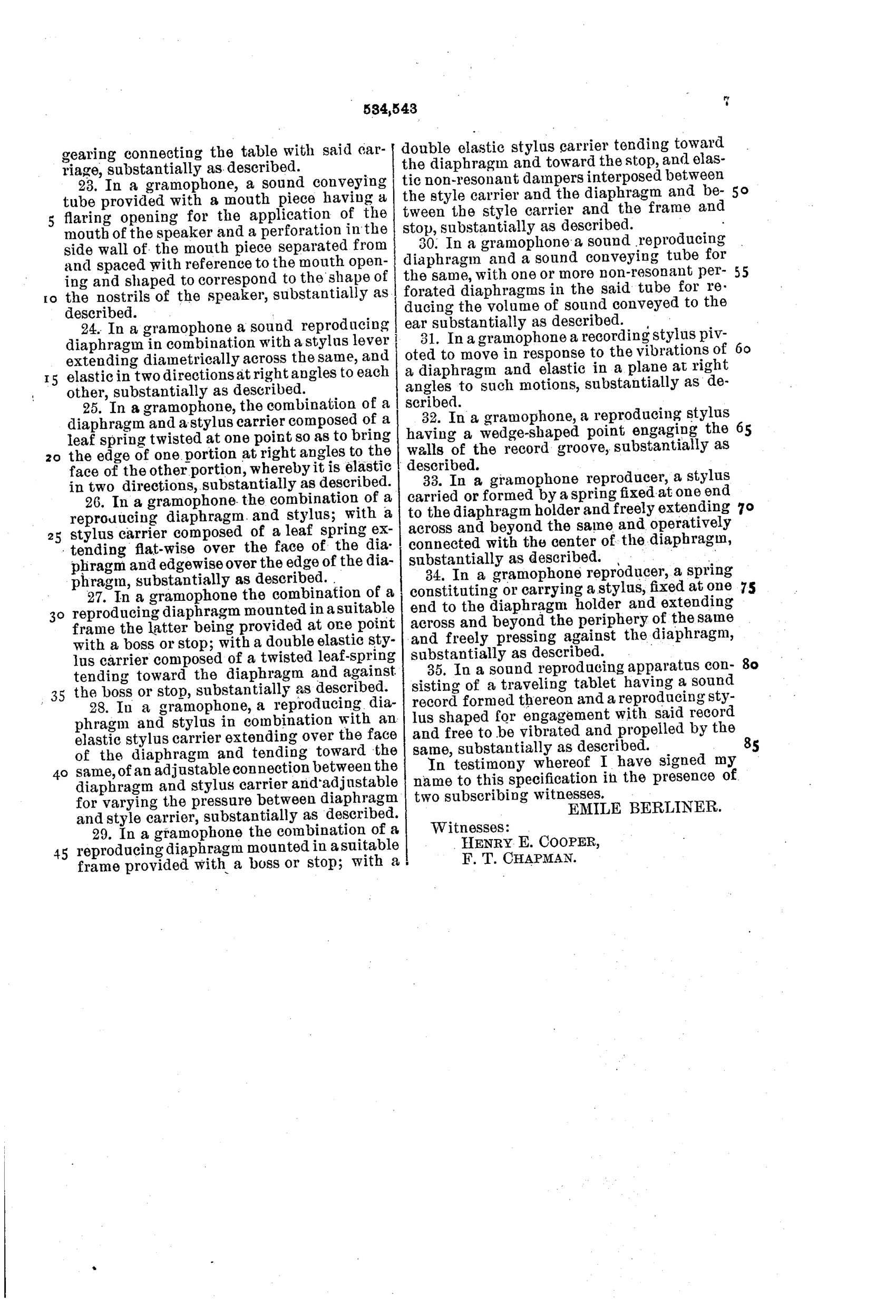
“so that when the mouth-piece is applied, the sounds uttered by the mouth enter the wide, flaring opening, while the sounds uttered by the nose enter the perforation 43'.”— Emile Berliner, from the specification
Manufactured and sold
Berliner's United States Gramophone Company and its successors built and sold gramophones and etched-master discs on this process; it is the direct ancestor of the Victor disc industry.
♫ More by Emile Berliner
- GRAMOPHONE (1887)
♫ Commentary
This is one of the load-bearing patents of the entire disc side of the hobby. Filed in 1892 and issued in 1895, it covers Berliner's mature process: trace the sound wave as a lateral spiral in a fatty film on a metal disc, keep the film workable with a thin trickle of alcohol during recording, then etch the trace permanently into the metal. That etched disc becomes a master from which stampings can be made — the whole logic of mass-produced records in embryo. Edison's cylinder was engraved directly; Berliner's disc was a printing plate.
The drawing rewards a slow look. The record turns on a vertical shaft driven by a hand crank and flywheel, while a screw-threaded shaft feeds the stylus carriage radially — the recorder, not the record, supplies the groove pitch, because there is no pre-cut spiral to guide anything. Note the reservoir feeding the disc: this was a wet chemical process at heart, closer to photoengraving than to machining. And Fig. 8's mouthpiece is a small delight — a flaring opening for the mouth plus a separate perforation to catch 'the sounds uttered by the nose,' which tells you how empirically Berliner was chasing intelligibility.
The hand-cranked reproducer shown here was clumsy — steady speed by hand is nearly impossible — but Eldridge Johnson's spring motor fixed that within a few years, and Victor grew from exactly this root.
Commentary by Claude, The Talking Machine Patent Archive’s resident enthusiast