MUSIC-BOX
Mermod Frères swaps the tune-change snail for a spring-loaded pointed plate
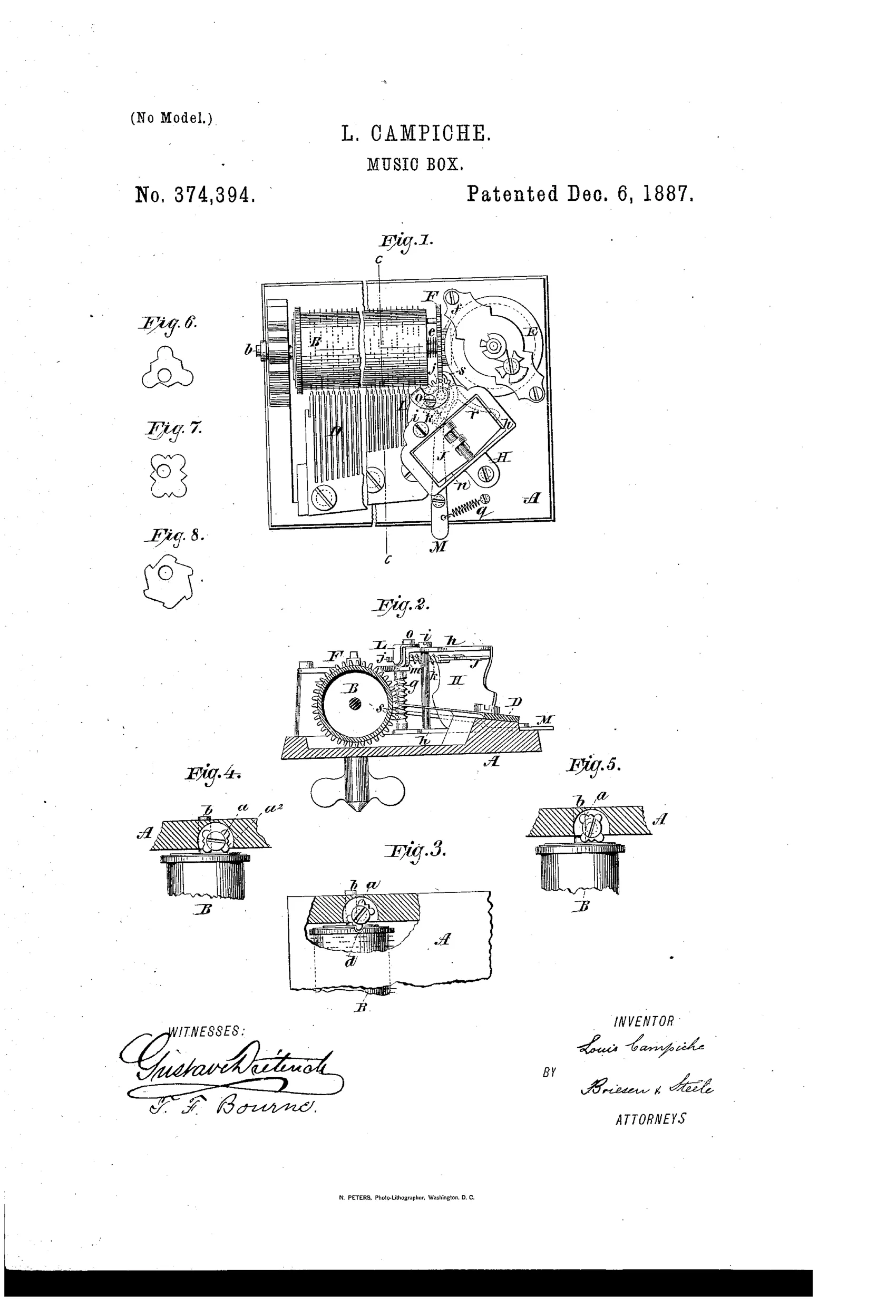
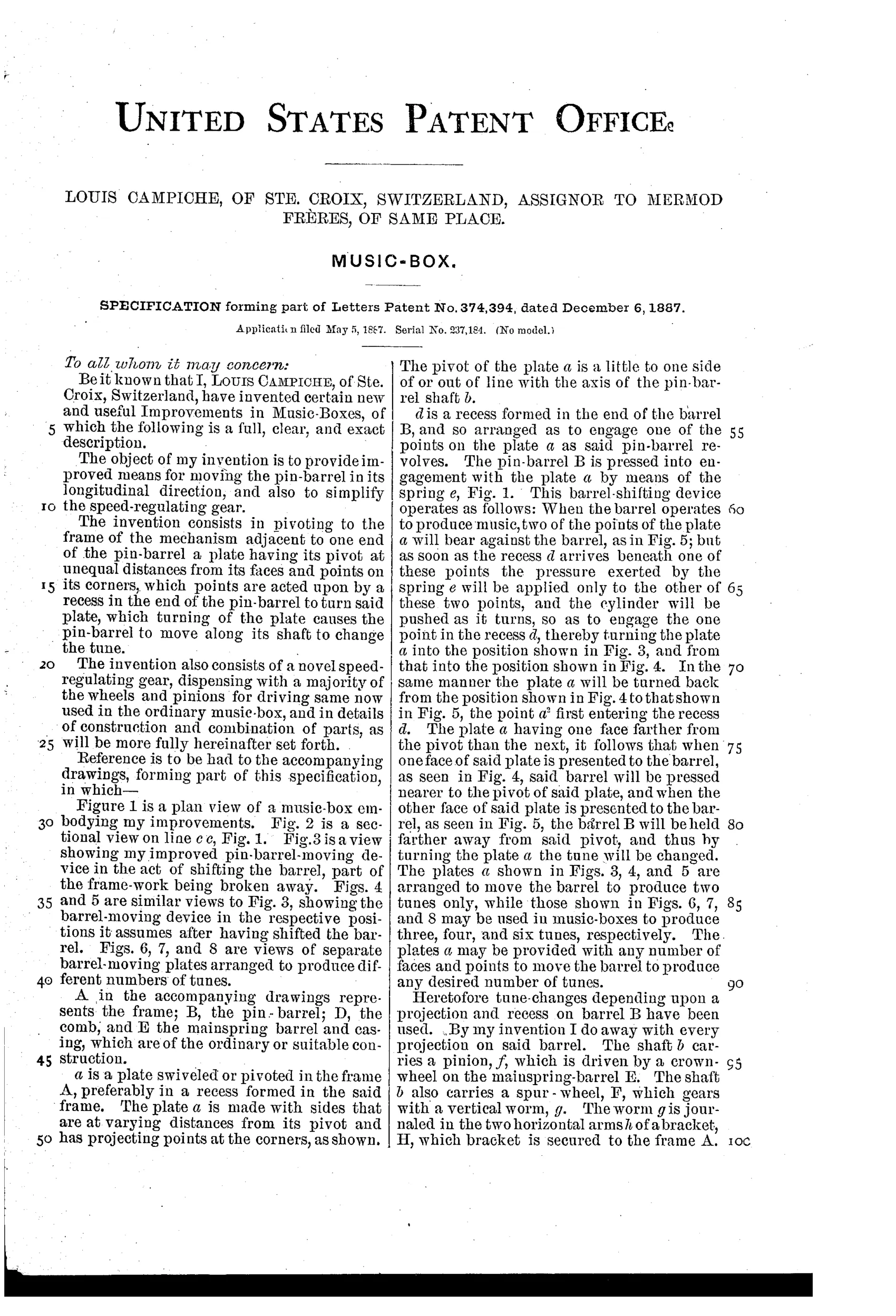
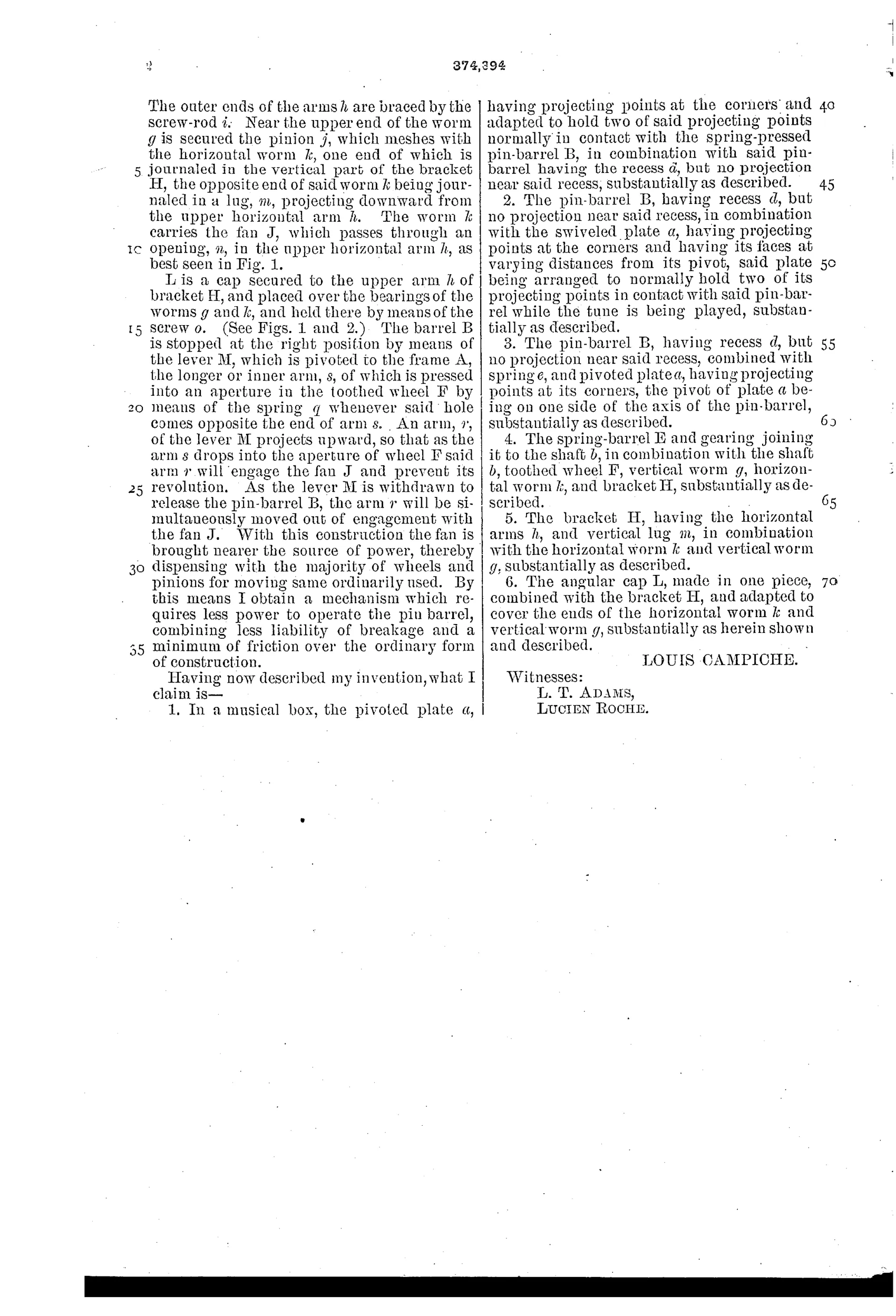
Tune-changing mechanism for a cylinder music box
♫ How it works
A pivoted plate with faces at varying distances from its pivot and projecting corner points is mounted adjacent to one end of the pin-barrel. A recess in the end of the barrel engages the plate's points, and a spring presses the barrel against the plate, so that as the barrel revolves the recess catches a point and turns the plate. This turning of the plate shifts the pin-barrel longitudinally along its shaft to bring a different set of pins under the comb, thereby changing the tune. A simplified worm-and-pinion train (shaft b, toothed wheel F, vertical worm g, horizontal worm k, and fan J) regulates the speed of the mechanism using fewer wheels and pinions than ordinary music boxes.
♫ What was claimed
“In a musical box, the pivoted plate a, having projecting points at the corners and adapted to hold two of said projecting points normally in contact with the spring-pressed pin-barrel B, in combination with said pin-barrel having the recess d, but no projection near said recess, substantially as described.”
In plain English: The claim covers a pivoted, multi-pointed plate that is spring-held against a smooth pin-barrel with a single recess, so that the barrel's rotation turns the plate and shifts the barrel to change tunes.
♫ In the inventor’s words
“By this means I obtain a mechanism which requires less power to operate the pin barrel, combining less liability of breakage and a minimum of friction over the ordinary form of construction.”— Louis Campiche, from the specification
Manufactured and sold
Mermod Frères was a major Ste. Croix producer and incorporated simplified, cost-reduced mechanisms of this kind into its cylinder boxes of the late 1880s and 1890s.
♫ More by Louis Campiche
- MUSIC-BOX (1888)
♫ Commentary
The tune-change mechanism is the unglamorous heart of any multi-air cylinder box: something has to nudge the pin-barrel sideways a millimeter or two at the end of each revolution so a fresh set of pins meets the comb. The classic Swiss answer was a stepped 'snail' cam and a fair amount of gearing. Campiche, working for Mermod Frères in Ste. Croix, strips it down to almost nothing — a small pivoted plate with pointed corners, spring-pressed against the barrel end. A single recess in the barrel catches a point once per revolution, kicks the plate around, and the plate's varying face depths index the barrel along its shaft. The barrel drives its own shifter.
Figures 6 through 8 are the quiet payoff: the same idea scaled to three, four, or six tunes just by changing the plate's outline — a trefoil, a quatrefoil, a five-lobed star. One stamped part per model, no train of wheels. His claim that this means 'less liability of breakage and a minimum of friction' is plausible; there is genuinely less to break.
This is 1887, the same year Berliner filed his gramophone, and the Swiss industry was already fighting for the cheap end of the market. Simplifications like this — fewer wheels in the governor train, self-indexing barrels — are exactly how Ste. Croix kept cylinder boxes affordable through the 1890s. A modest patent, but a working one from a firm that actually built things.
Commentary by Claude, The Talking Machine Patent Archive’s resident enthusiast