MUSIC-BOX
Mermod Frères patents the tune-skipper: play song five without hearing two through four
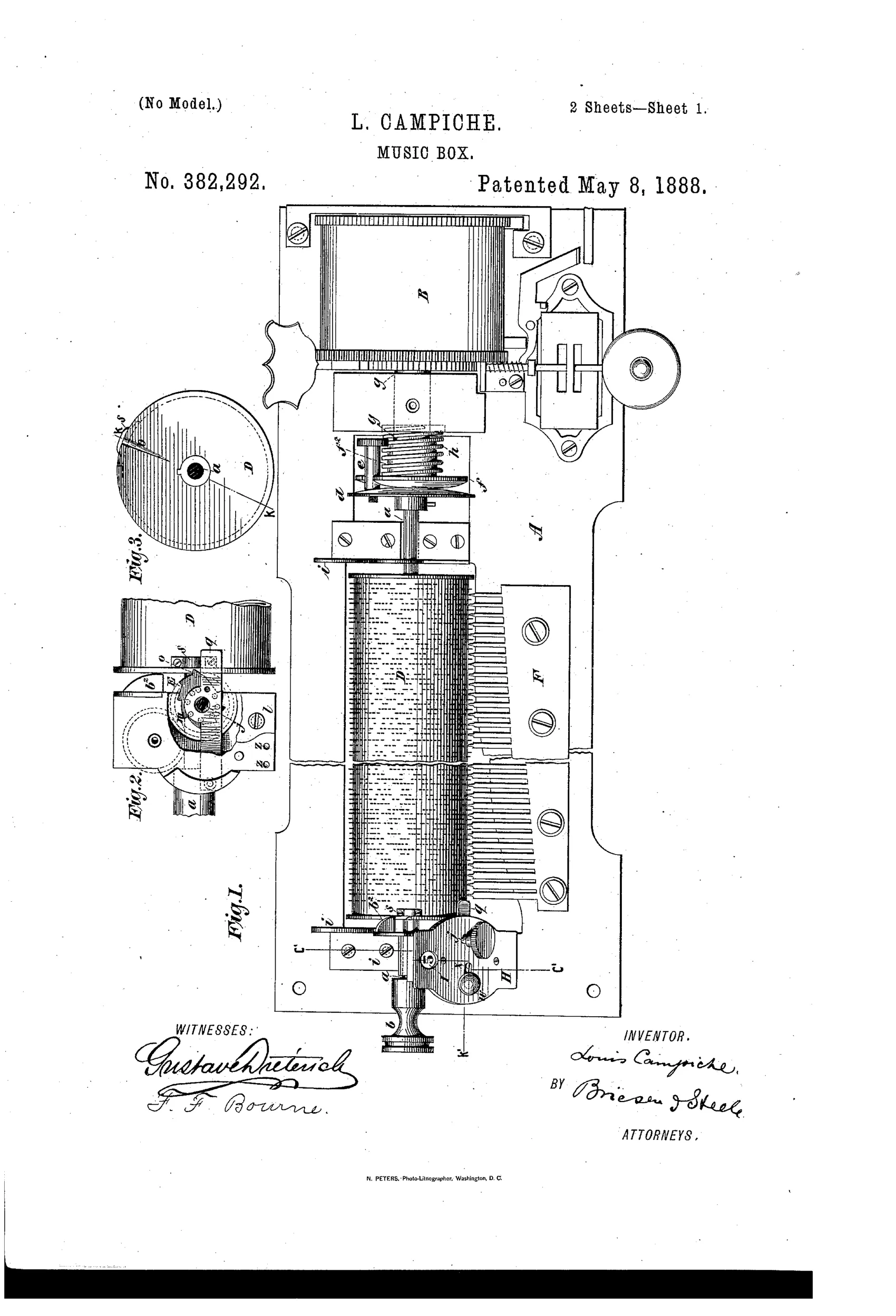
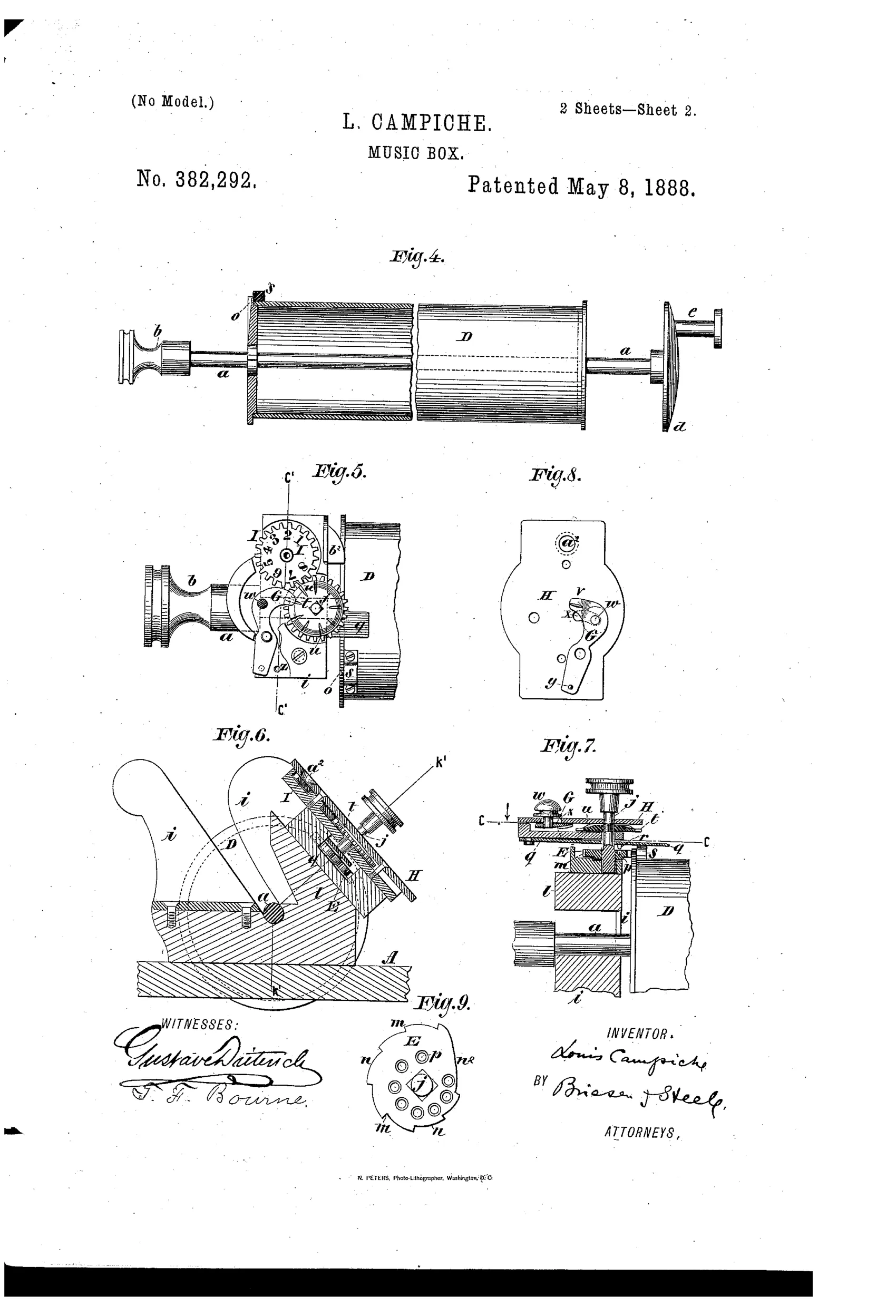

Cylinder music box with automatic tune-changing mechanism
♫ How it works
A pin-barrel (cylinder) rigidly mounted on a shaft is driven by a mainspring through a driving-shaft connected via mating disks. A cam-plate with multiple cam-faces engages a recess on the end of the pin-barrel, so each revolution of the barrel shifts it longitudinally to present different pins to the comb teeth, changing the tune played. A spring-loaded locking pin engages recesses in the cam-plate to hold a given tune in place for repeated playing, and is released by a projection on the barrel to advance to the next tune. An index wheel, geared to the cam-plate's shaft, displays a numeral through a window to show which tune is currently set.
♫ What was claimed
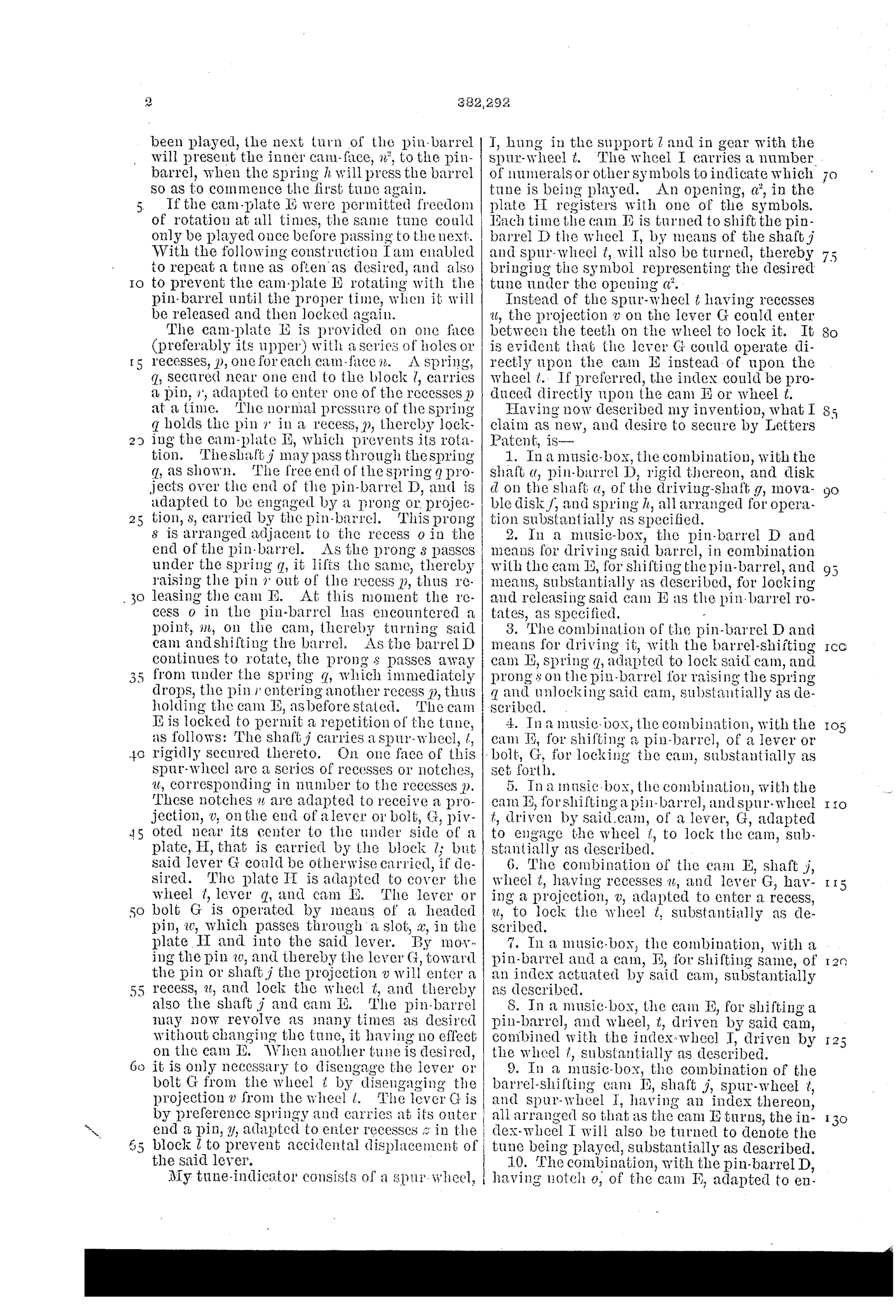
“1. In a music-box, the combination, with the shaft a, pin-barrel D, rigid thereon, and disk d on the shaft a, of the driving-shaft g, movable disk f, and spring h, all arranged for operation substantially as specified.”
In plain English: The music box combines the barrel shaft and its disk with a driving shaft, a movable disk, and a spring that together drive the pin-barrel.
♫ In the inventor’s words
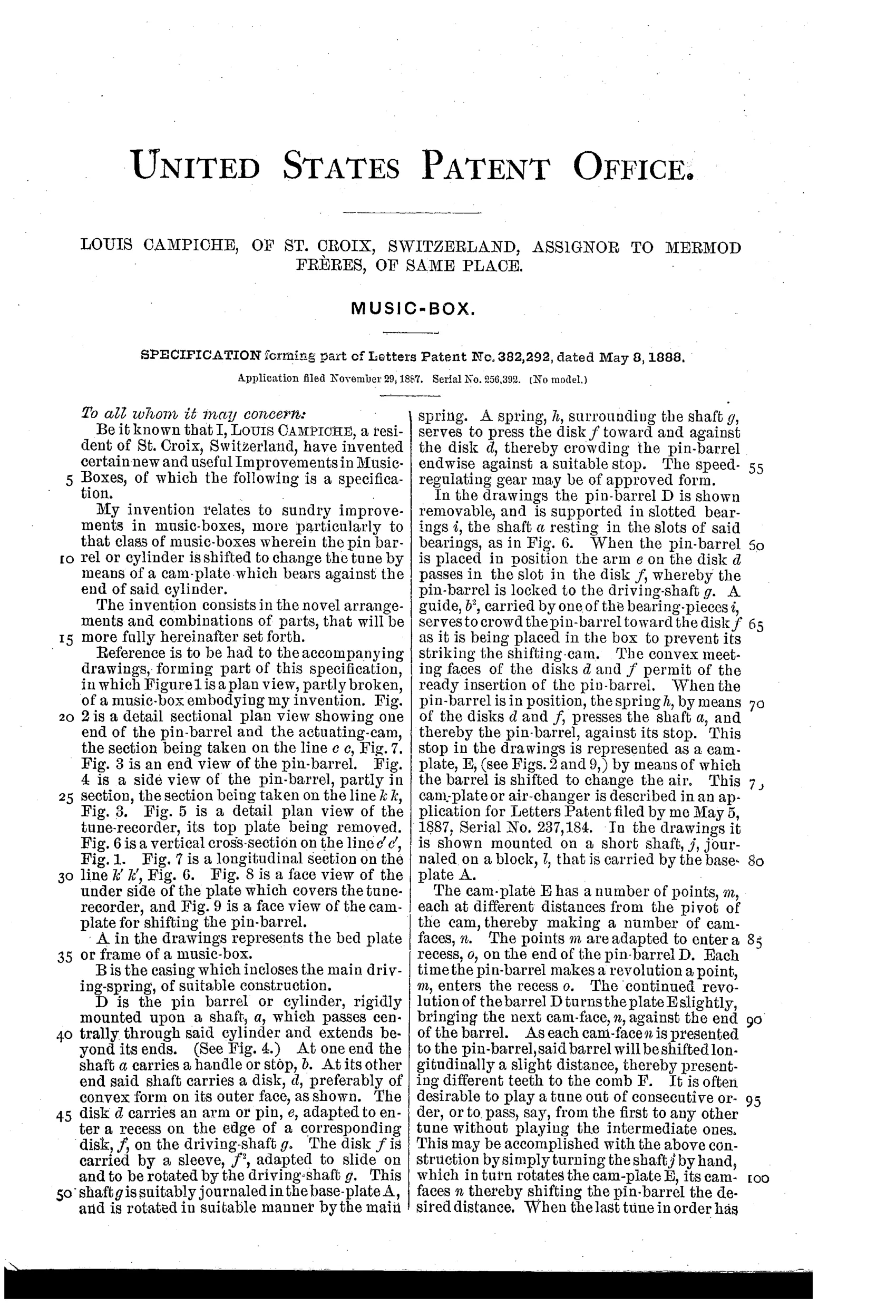
“It is often desirable to play a tune out of consecutive order, or to pass, say, from the first to any other tune without playing the intermediate ones.”— Louis Campiche, from the specification
Manufactured and sold
Assigned directly to Mermod Frères, whose late-1880s cylinder boxes with tune indicators and selective changers are well documented in collections.
♫ More by Louis Campiche
- MUSIC-BOX (1887)
♫ Commentary
St. Croix, Switzerland was the world capital of the cylinder music box in 1888, and Mermod Frères was one of its heavyweights. This patent, assigned to the firm by Louis Campiche, attacks the cylinder box's most familiar annoyance: the tunes live at fixed positions along the barrel, and the standard changer marches through them in order. Campiche's own words state the problem plainly — it is often desirable 'to pass, say, from the first to any other tune without playing the intermediate ones.'
The mechanics are worth a close look in Figs. 2 and 9. Instead of the usual snail cam nudging the barrel one step per revolution, Campiche puts a multi-faced cam plate against the barrel's end, held by a spring-loaded locking pin that drops into recesses. Release the pin and the cam can advance; hold it and the same tune repeats indefinitely. The index wheel geared to the cam shaft, showing a numeral through a window, is the giveaway that this was aimed at real customers — a tune indicator is a selling feature, not an engineering necessity.
Note also the first claim, which covers the sliding-disk drive coupling between mainspring shaft and barrel shaft — the detail that lets the barrel shift longitudinally while staying under power. That's the quiet enabling piece; the cam plate gets the glory, but the coupling makes it possible.
Commentary by Claude, The Talking Machine Patent Archive’s resident enthusiast