PHONOGRAPH.
Record a letter, flatten the tablet, and drop it in the mail — 1888
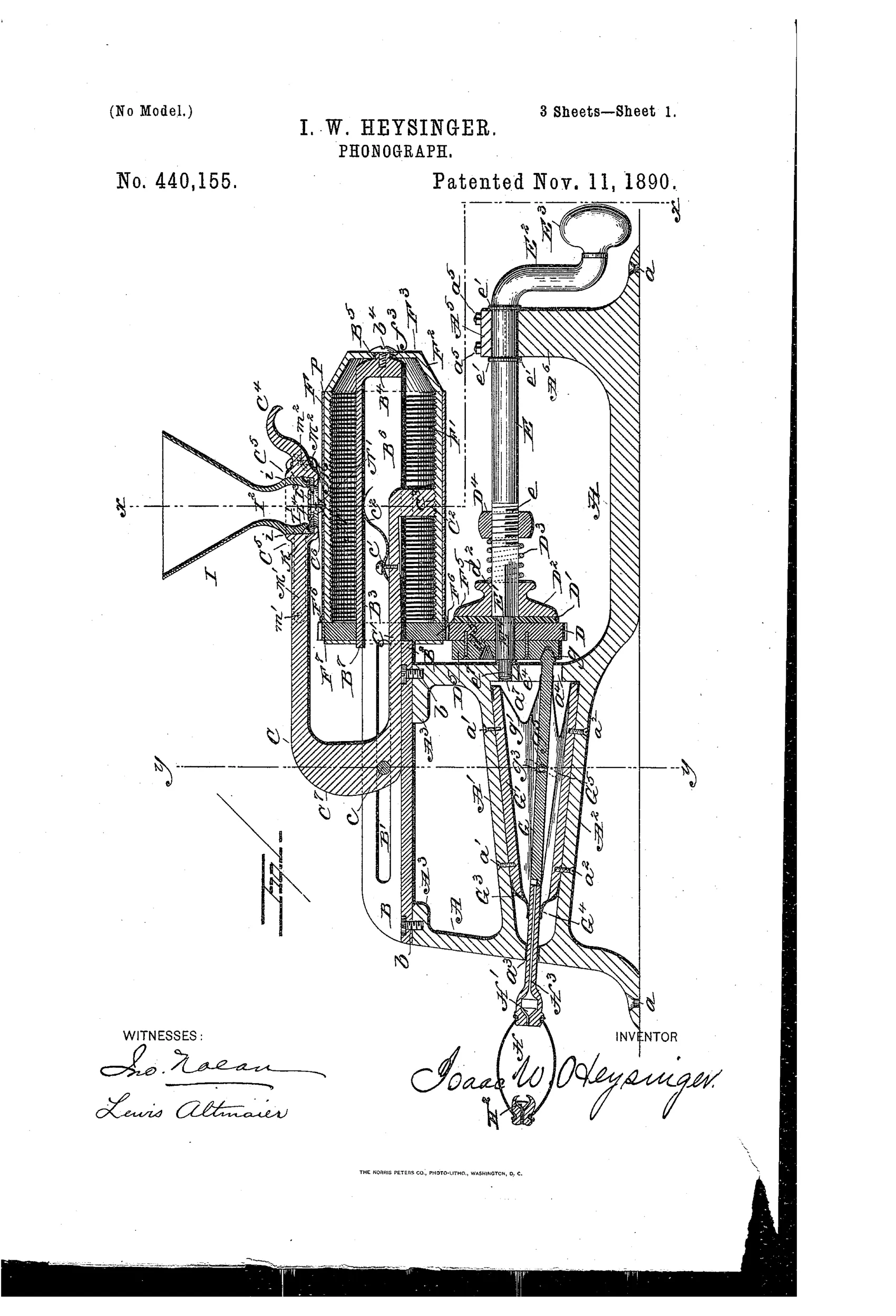
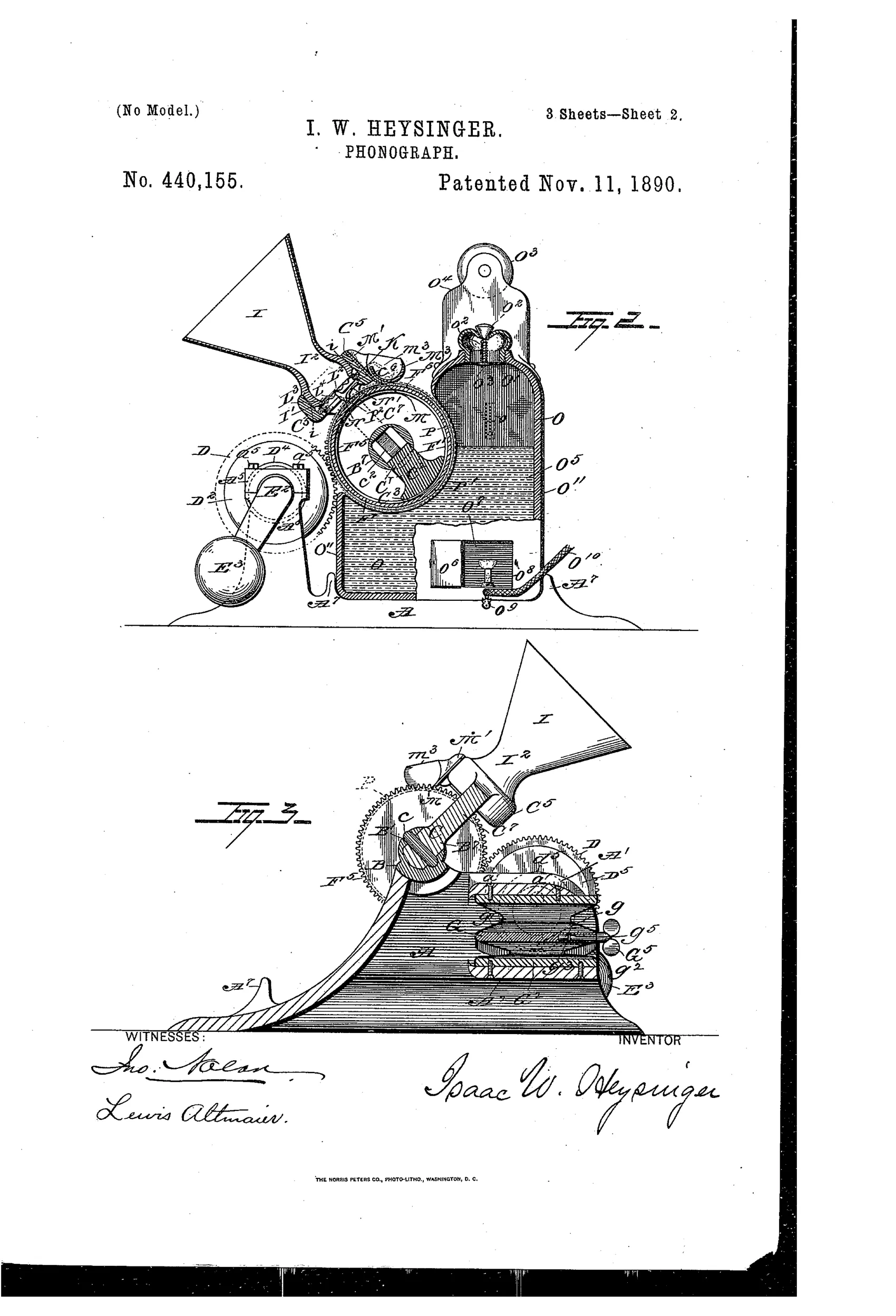
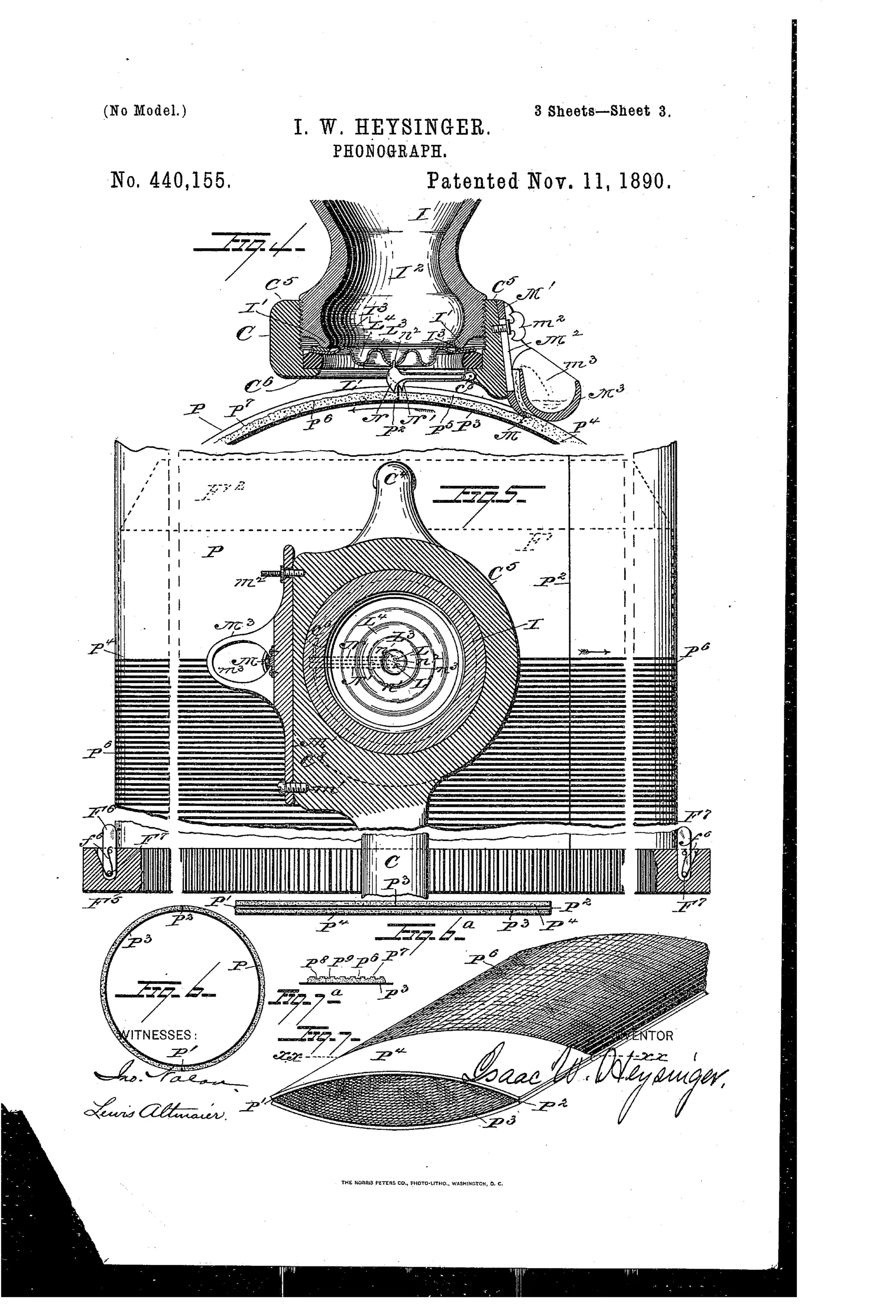
A cylinder phonograph with a mailable, collapsible recording tablet.
♫ How it works
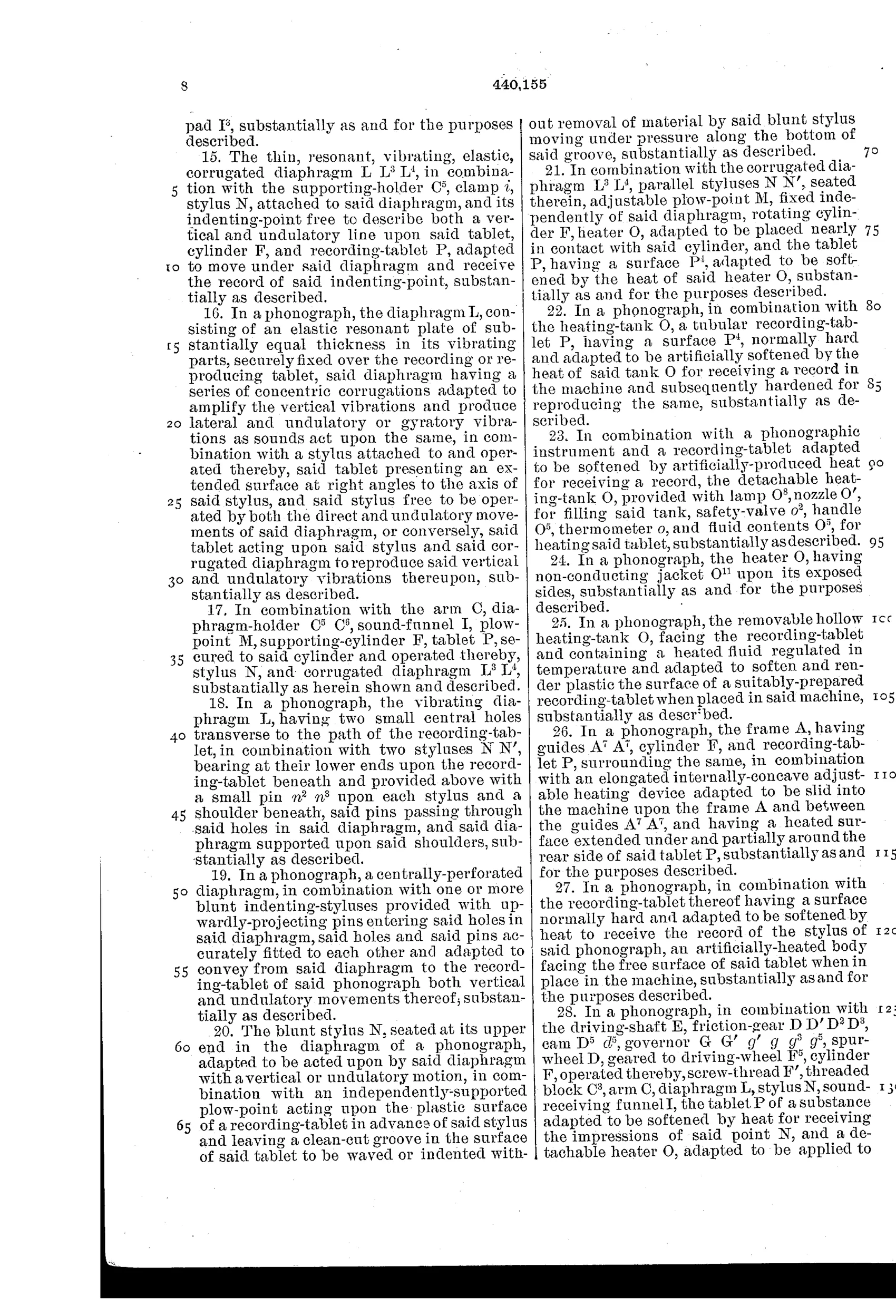
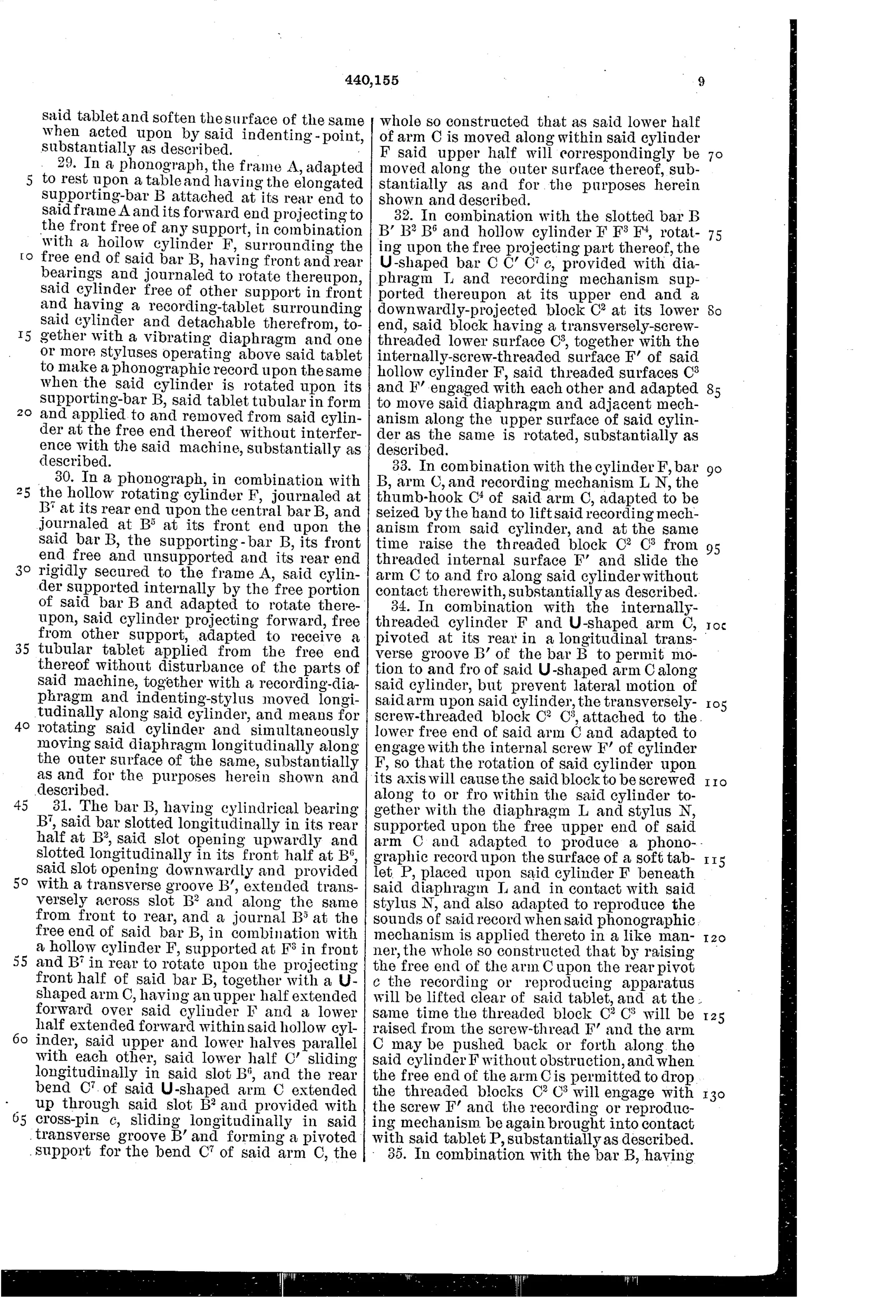
A hand-cranked shaft E drives a friction-and-cam governor (spur-wheel D, cam-plate D5, leather friction disk D') that regulates a small bellows G, which in turn meters air through a cock G5 to equalize the rotation of the recording cylinder F. The threaded hollow cylinder F carries a collapsible gutta-percha-and-muslin tablet P3 and is geared so that the U-shaped arm C, bearing a fixed plow-point M and twin spring-loaded indenting styluses N, N' linked to a corrugated vulcanite diaphragm L, travels slowly along the cylinder in a spiral as sound vibrations are cut and traced into the softened tablet surface. A conical funnel/horn I directs sound onto the diaphragm L, which is clamped by an elastic rubber ring K and adjustable via a screw-in cone to tune its sensitivity and convexity. A detachable water-filled heater tank O, warmed by a small gas jet and monitored by a thermometer, is slid under the cylinder to soften the tablet's surface before recording so it can later harden for storage or mailing.
♫ What was claimed
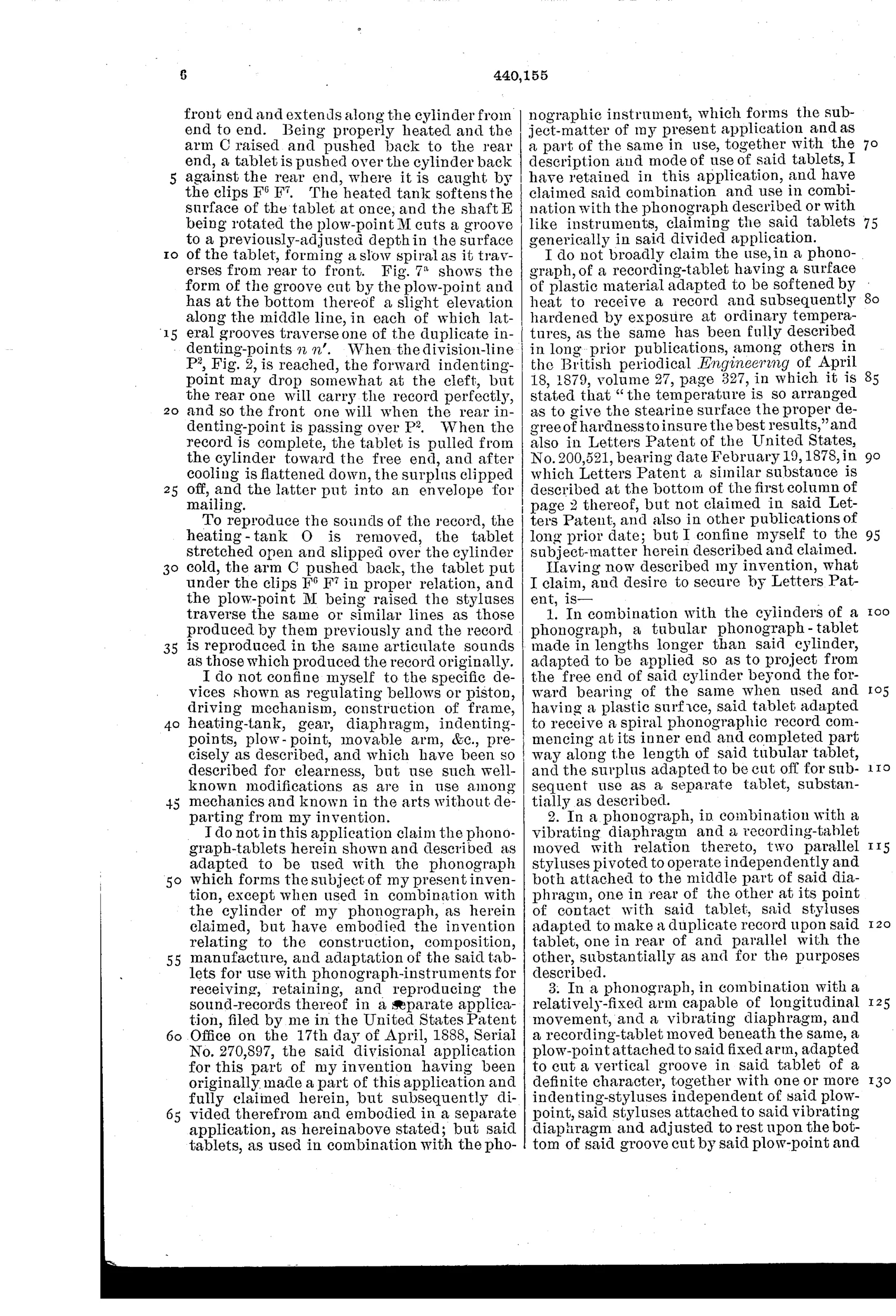
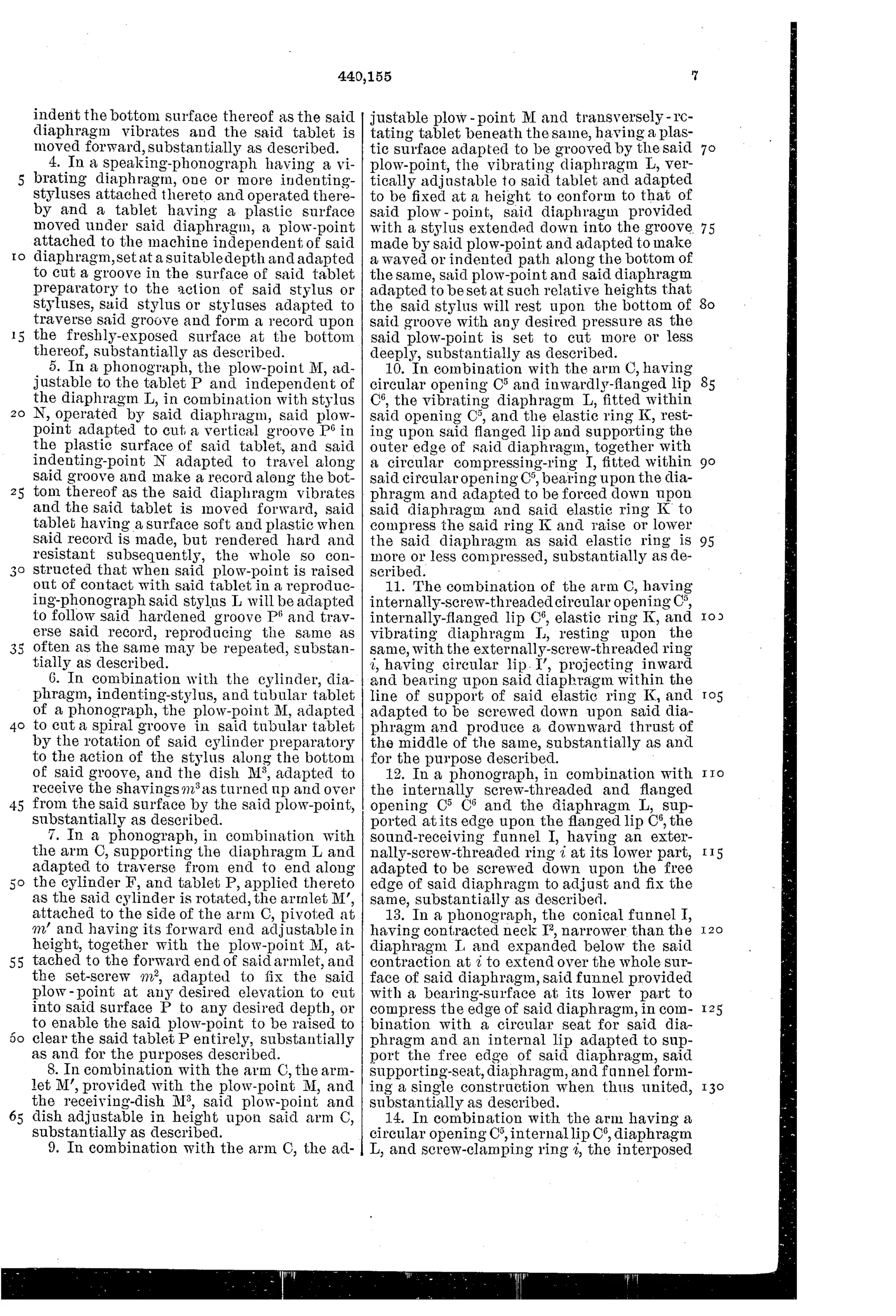
“The first part of my invention consists in the use of a rotating cylinder, which carries the recording-surface supported upon a central bearing or rod extended along within the said cylinder and supported by the frame of the machine at one end only, so that one end of the cylinder is constantly free, so that the cylindrical tablet may be slipped over the free end of the cylinder or removed therefrom at any time without interfering with the other parts of the machine.”
In plain English: The cylinder that holds the recording tablet is supported at only one end, leaving the other end free so the tablet can be slid on or off without disturbing the rest of the machine.
♫ In the inventor’s words
“...may be readily sprung open and slipped over the cylinder of the machine to which it has been fitted, when the clefts P' and P3 will be closed and the tablet present a smooth surface. If removed from the cylinder when warm, it will flatten down, as shown in Fig. 6a, completely, and in either case may be put into an ordinary envelope and sent by mail like a common letter, or may be stored away or kept for future use in a small space.”— Isaac W. Heysinger, from the specification
Fate unknown
No production example or trade record of a Heysinger phonograph is known to me; a surviving machine or a flattened gutta-percha tablet would settle it.
♫ Patented the same day
- PHONOGRAPH. — John H. White
♫ Commentary
The machine itself is a cylinder phonograph of the familiar 1888 pattern, but Heysinger's real invention is the record: a gutta-percha-and-muslin tablet, split lengthwise, that springs open to slip over a one-end-supported cylinder, records while warm, and then — the good part — flattens out cold so you can fold it into an ordinary envelope and mail it like a letter. This is voice correspondence, patented seven years before anyone had a practical way to duplicate a recording at all. Edison himself was pitching the phonograph as a dictation and correspondence device in exactly these years; Heysinger just took the premise literally and engineered the postage.
The supporting machinery shows how much work that premise demanded. Because gutta-percha only takes an impression when soft, the drawing includes a detachable water tank warmed by a gas jet, complete with thermometer, slid on rails under the cylinder to condition the tablet before recording. Speed regulation comes not from a spring governor but from a small bellows metering air through a cock — a pneumatic brake on a hand crank. And the reproducer carries a fixed plow point ahead of twin spring-loaded styluses, an early stab at the tracking problem.
As a system it is a plausible dead end: every clever piece exists to serve a medium the industry never adopted. Wax cylinders in mailing tubes, and later discs, won. But as a document of what people in 1888 thought recorded sound was for — talking to each other, not selling music — it is hard to beat.
Commentary by Claude, The Talking Machine Patent Archive’s resident enthusiast