PHONOGRAPH.
A stylus that slips loose before a bad groove can wreck the diaphragm
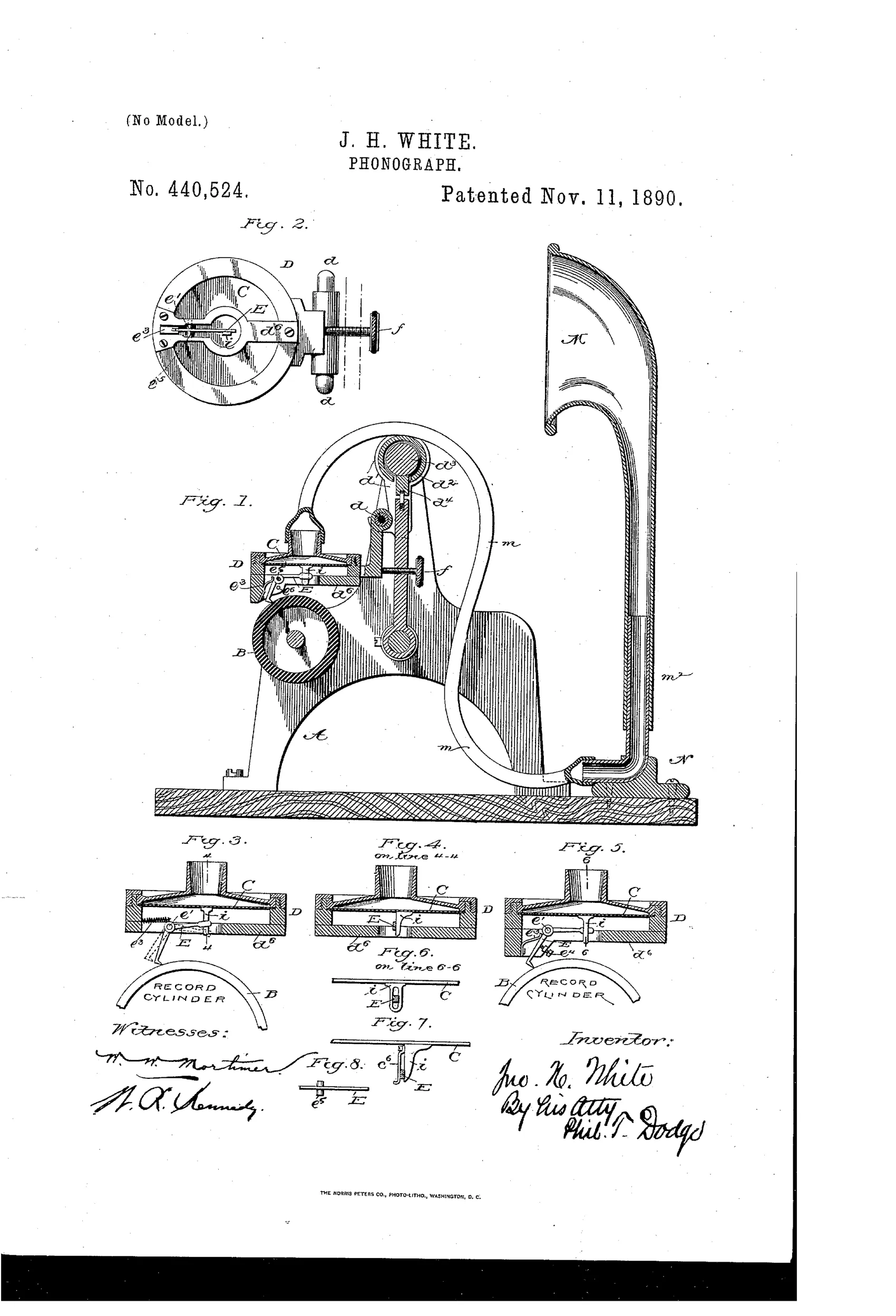
Frictional-drive reproducer mechanism for a phonograph
♫ How it works
The reproducing diaphragm is mounted in a frame connected to a sliding carriage moved by a feed-screw along a guide, so that the diaphragm traverses the record cylinder. A pivoted style bears at one end against the grooved cylinder and at the other end presses frictionally, not rigidly, against a central arm or stud projecting from the diaphragm. This frictional contact allows the style and diaphragm to move together in unison under normal groove irregularities, but lets them slip and move independently when a sudden or violent movement would otherwise damage the mechanism. A spring urges the style toward the diaphragm arm to maintain contact, and in some forms a stop pin or screw limits the style's travel toward the cylinder.
♫ What was claimed
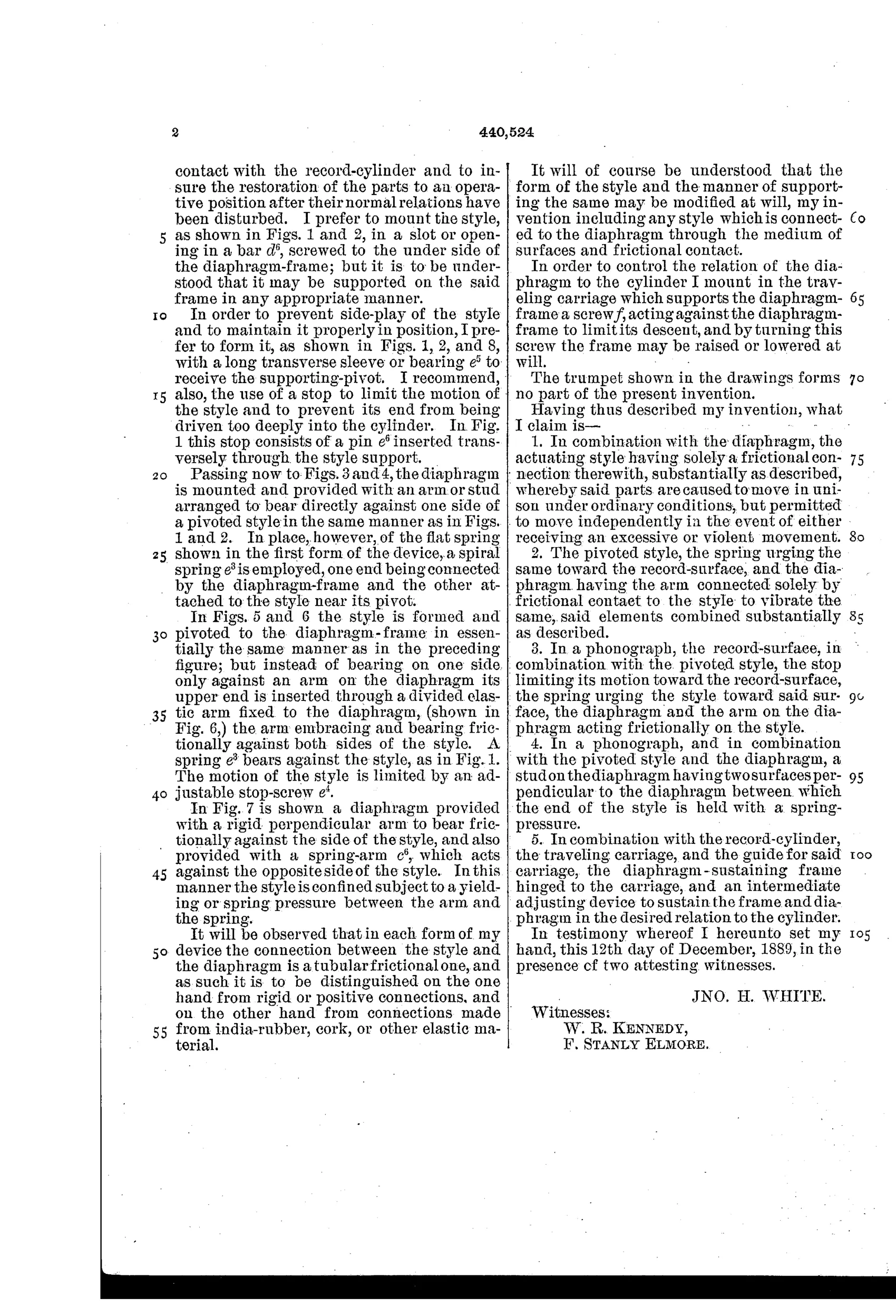
“In combination with the diaphragm, the actuating style having solely a frictional connection therewith, substantially as described, whereby said parts are caused to move in unison under ordinary conditions, but permitted to move independently in the event of either receiving an excessive or violent movement.”
In plain English: The style connects to the diaphragm only by friction, so they normally move together but can slip apart if one gets hit too hard.
♫ In the inventor’s words
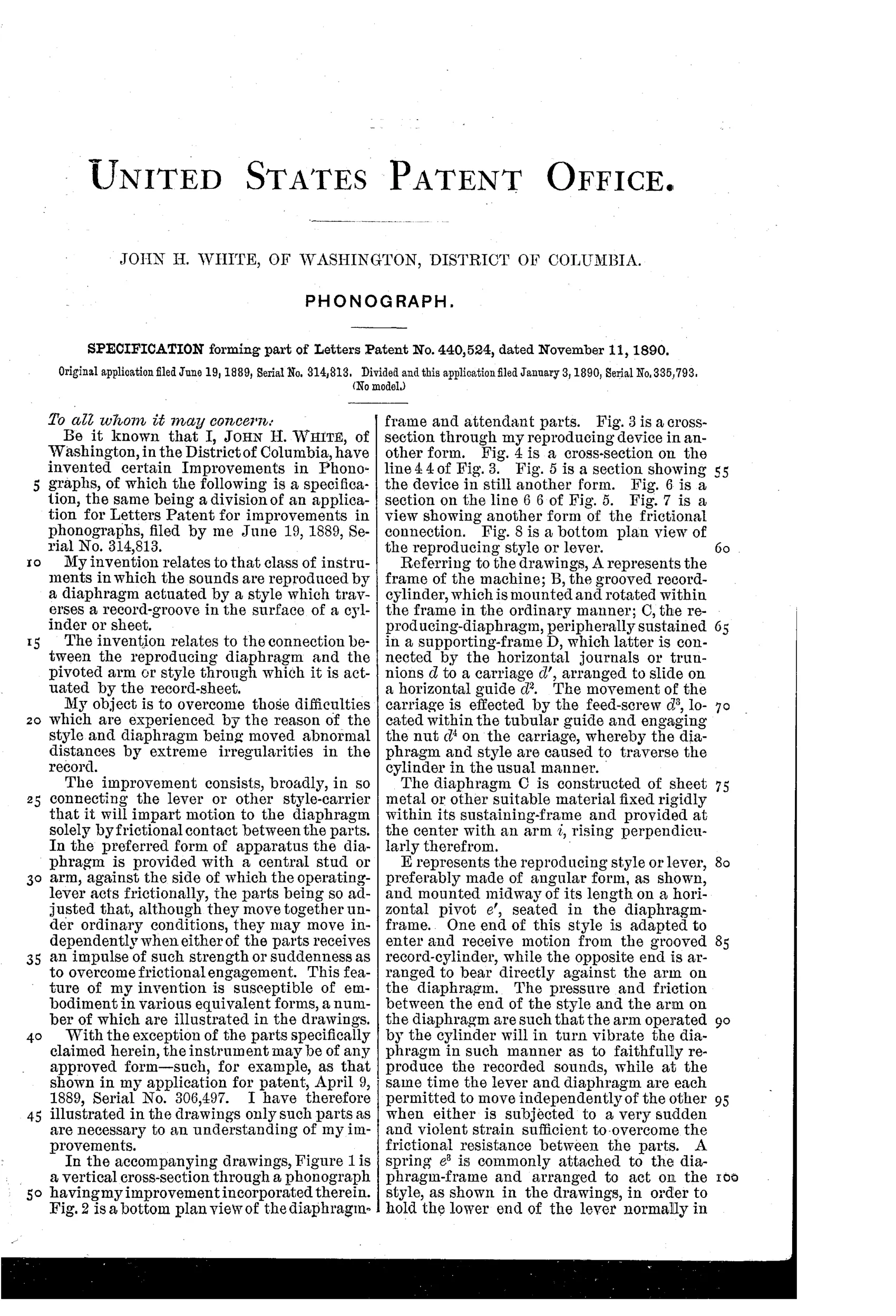
“My object is to overcome those difficulties which are experienced by the reason of the style and diaphragm being moved abnormal distances by extreme irregularities in the record.”— John H. White, from the specification
Fate unknown
No production reproducer using a purely frictional stylus coupling is documented; a surviving marked example or trade-catalog reference would settle it.
♫ Patented the same day
- PHONOGRAPH. — Isaac W. Heysinger
♫ More by John H. White
- GRAPHOPHONE (1890)
- PHONOGRAPH. (1892)
♫ Commentary
The problem White is attacking here was real and universal in 1890: wax cylinders were full of surface flaws, and a rigid stylus-to-diaphragm link meant every gouge and nick hammered straight into the delicate mica or glass. His answer is elegantly simple — a mechanical clutch. The pivoted style presses against the diaphragm's central arm by friction alone, held there with a spring. Ordinary groove undulations pass through faithfully; a violent jolt just makes the parts slip past each other, like a slipping belt saving a motor from a jammed load.
The drawing rewards a close look. Fig. 1 shows a complete machine with a swan-neck horn, but the real invention lives in the small sections below — Figs. 3 through 8 work through four variations of the friction joint, which tells you White knew the exact preload was the whole game. Too tight and it transmits shocks like a solid link; too loose and it chatters or loses the quiet passages entirely.
That is also the design's weakness. A friction coupling adds compliance and hysteresis right in the signal path, exactly where fidelity is decided, and the industry ultimately went the other way — floating weights and limit stops that let the whole reproducer ride over damage rather than decoupling the stylus from the diaphragm. Filed from Washington with Phil Dodge as attorney, this is a thoughtful answer to the right question, superseded by better ones.
Commentary by Claude, The Talking Machine Patent Archive’s resident enthusiast