PHONOGRAPH.
A Kansas inventor softens tar with a lamp to record sound on tape
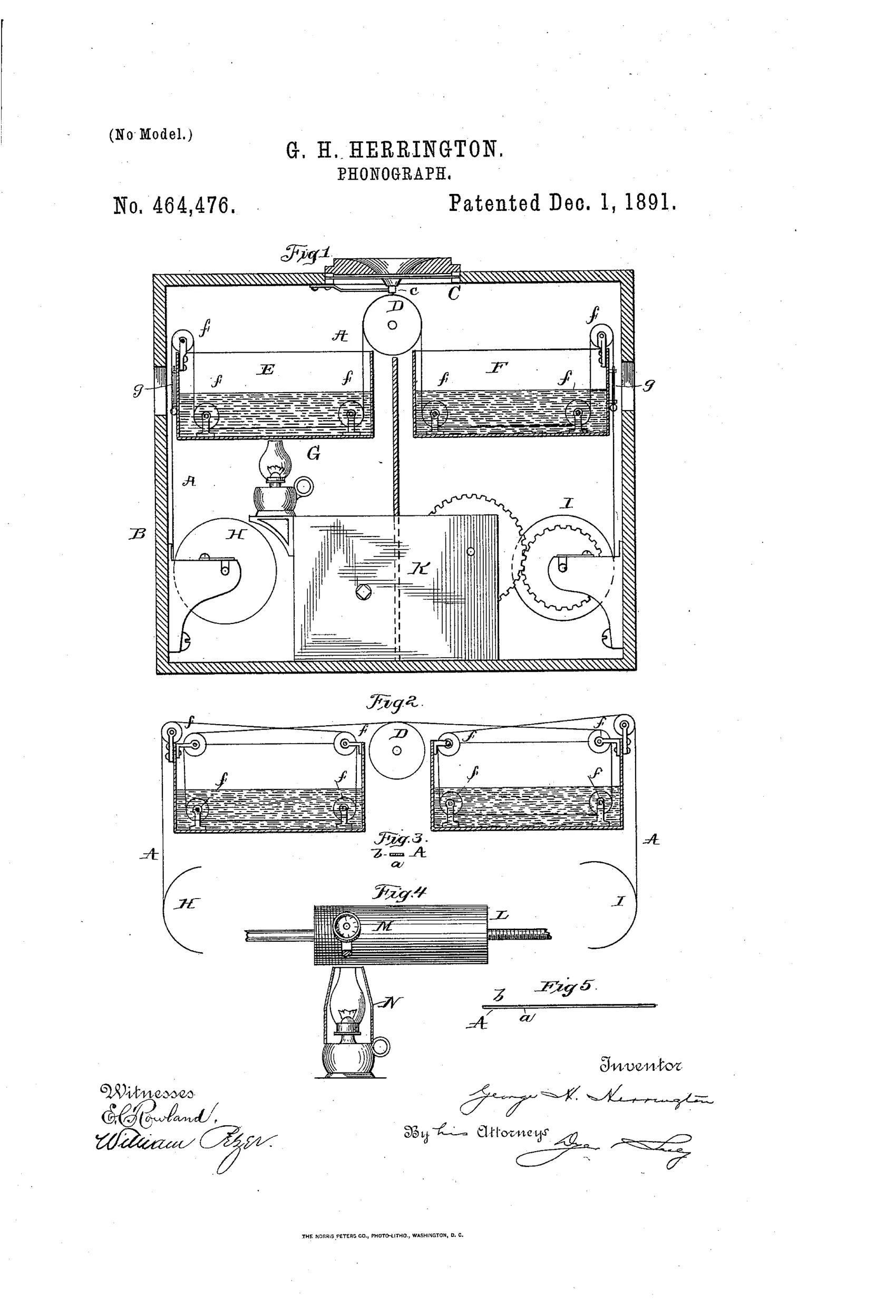
Heat-plastic recording strip apparatus for phonographs
♫ How it works
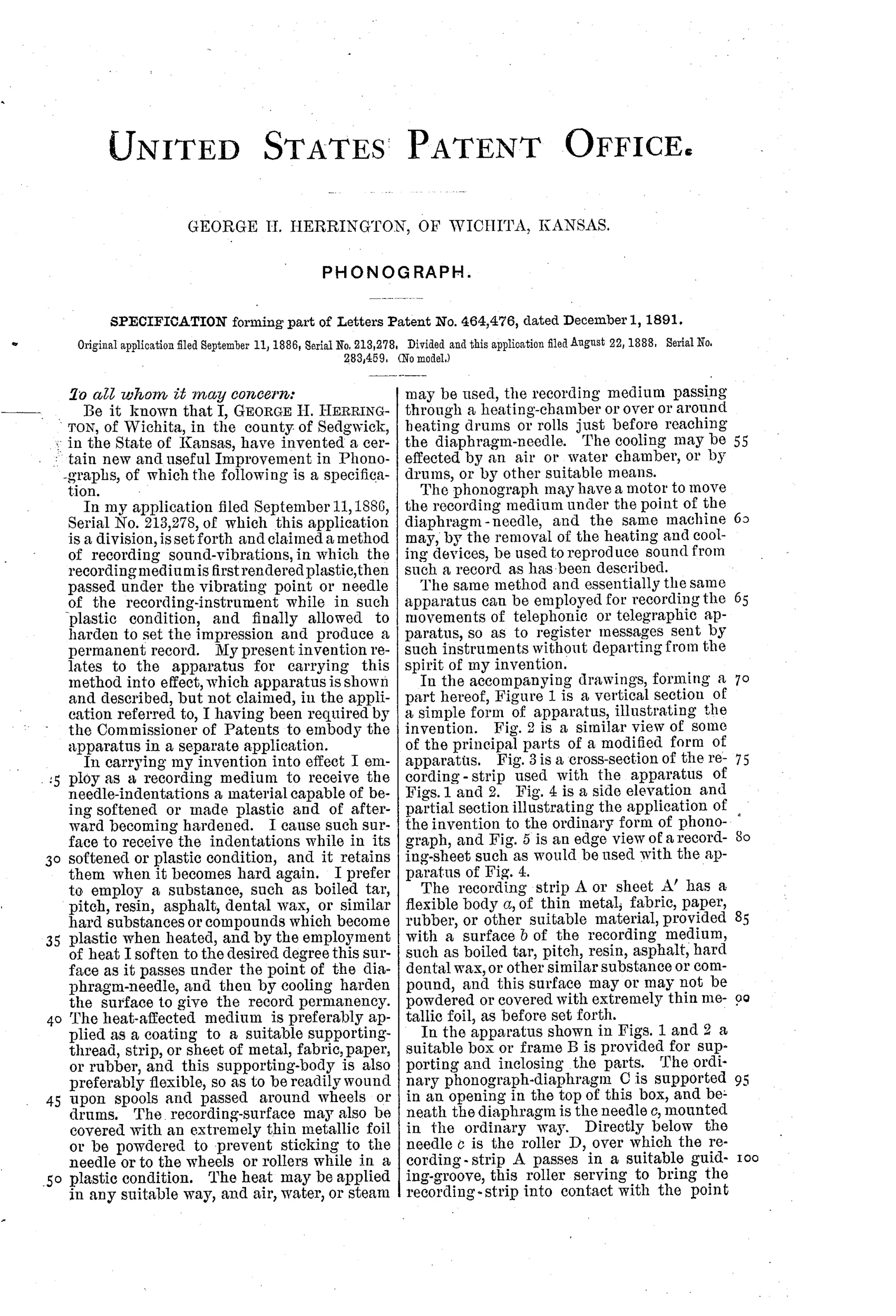
A phonograph diaphragm and needle press indentations into a traveling recording strip or sheet whose surface is made of a heat-plastic material such as tar, pitch, resin, or wax. The strip passes through a heating chamber just before reaching the needle so its surface becomes soft enough to receive sound-wave impressions, then passes through a cooling chamber to harden and permanently set the record. Rollers and guide wheels carry the strip through the heating chamber E and cooling chamber F, over a central roller D positioned beneath the diaphragm needle, with thermometers to monitor and regulate temperature. A motor drives the strip past the needle, and by removing the heating lamp the same apparatus can be used in reverse to reproduce the recorded sounds.
♫ What was claimed
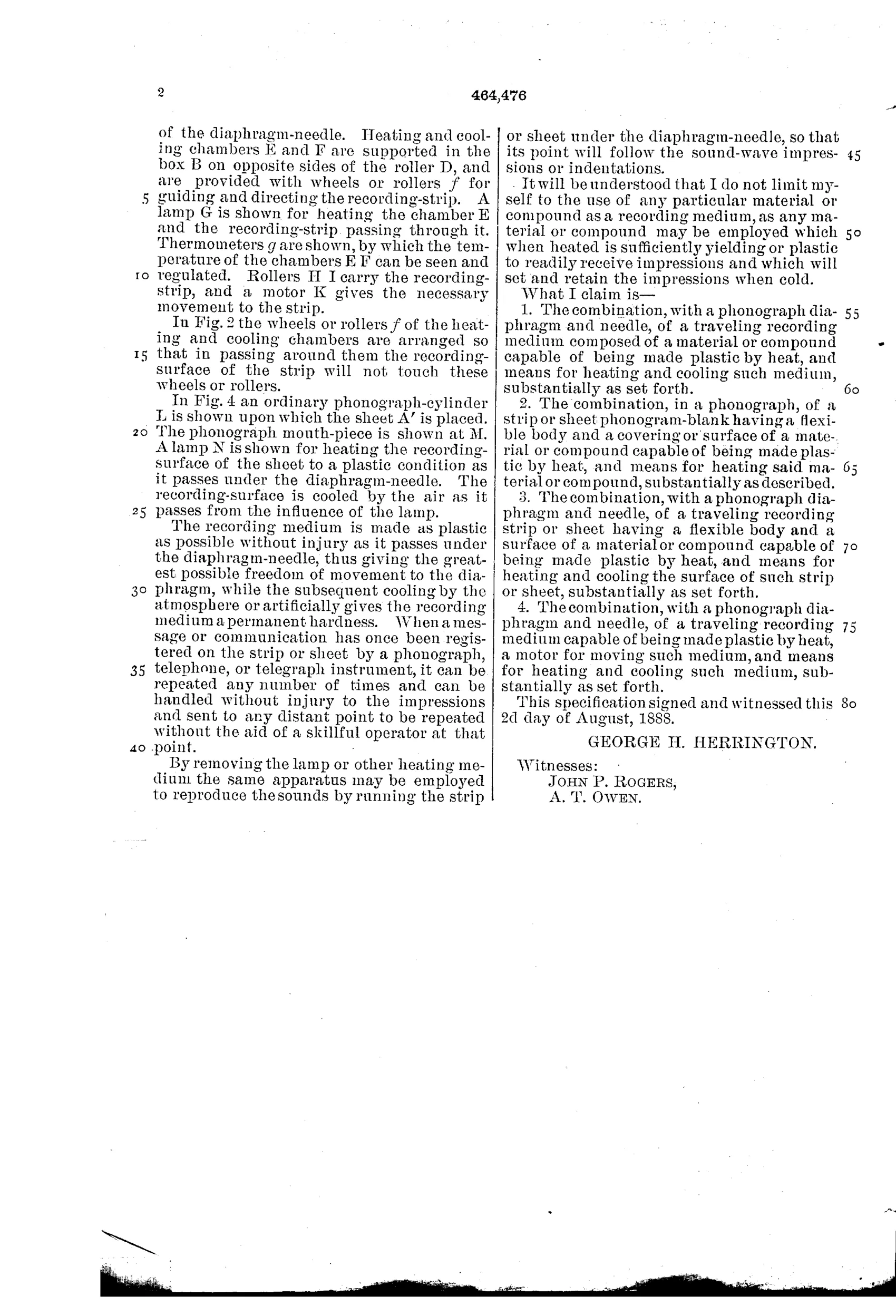
“The combination, with a phonograph diaphragm and needle, of a traveling recording medium composed of a material or compound capable of being made plastic by heat, and means for heating and cooling such medium, substantially as set forth.”
In plain English: The invention combines a phonograph diaphragm and needle with a moving recording medium that can be softened by heat and then cooled and hardened to keep the recorded impressions.
♫ In the inventor’s words
“When a message or communication has once been registered on the strip or sheet by a phonograph, telephone, or telegraph instrument, it can be repeated any number of times and can be handled without injury to the impressions and sent to any distant point to be repeated without the aid of a skillful operator at that point.”— George H. Herrington, from the specification
Paper patent — likely never produced
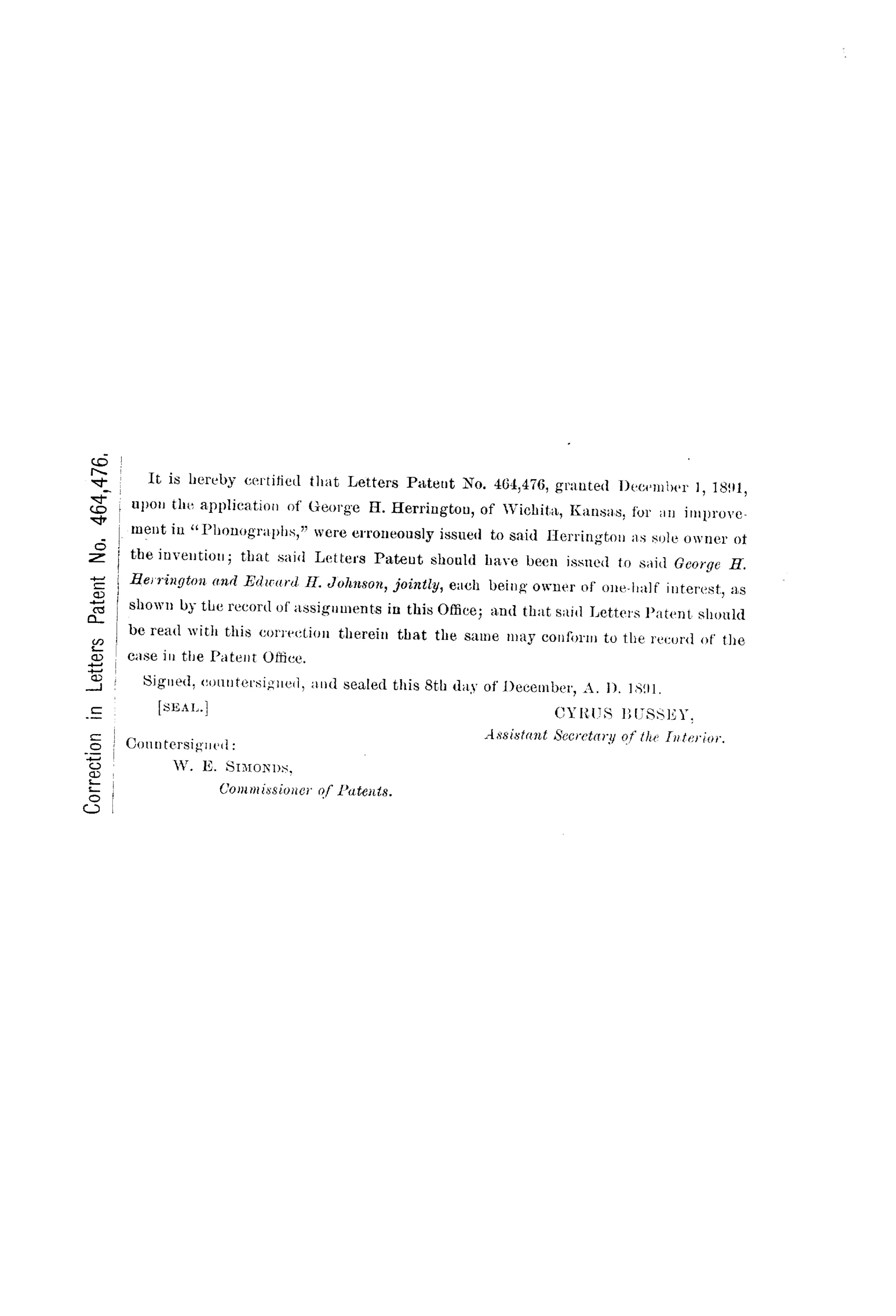
No commercial strip phonograph of this design is known; the lamp-heated tar medium was almost certainly never manufactured, though the Johnson assignment shows it was taken seriously as a patent property.
♫ More by George H. Herrington
- METHOD OF RECORDING SPEECH. (1888)
♫ Commentary
Filed in August 1888 — the very moment Edison was retooling his phonograph around wax — Herrington attacks the same problem from Wichita with a completely different geometry. Instead of a wax cylinder, he proposes a traveling strip coated in tar, pitch, resin, or wax. The strip runs through a heating chamber (warmed by an actual oil lamp, drawn with charming literalness in Figs. 1 and 4) so its surface goes soft, passes under the diaphragm needle at roller D to take the indentations, then runs through a cooling chamber to set them hard. Thermometers monitor both chambers. To play back, you simply remove the lamp and run the strip through again.
The format is the interesting part. A strip record that can be mailed 'to any distant point to be repeated without the aid of a skillful operator' is, in embryo, the logic of tape — a linear medium, duplicable and postable, decades before magnetic recording made it practical. The heat-softening trick also foreshadows real practice: thermoplastic media became central to record pressing, though nobody sane put an open flame inside a talking machine cabinet.
The execution is where it falls apart. Keeping a tar surface at exactly the right plasticity with a lamp and a thermometer, while the strip moves at recording speed, is a laboratory stunt, not a product. The assignment to Edward H. Johnson — Edison's longtime lieutenant — suggests someone in the inner circle found the idea worth owning, even if only defensively.
Commentary by Claude, The Talking Machine Patent Archive’s resident enthusiast