ATTACHMENT FOR MUSICAL INSTRUMENTS.
Playing the piano with springs and paper, three years before the pneumatic Pianola
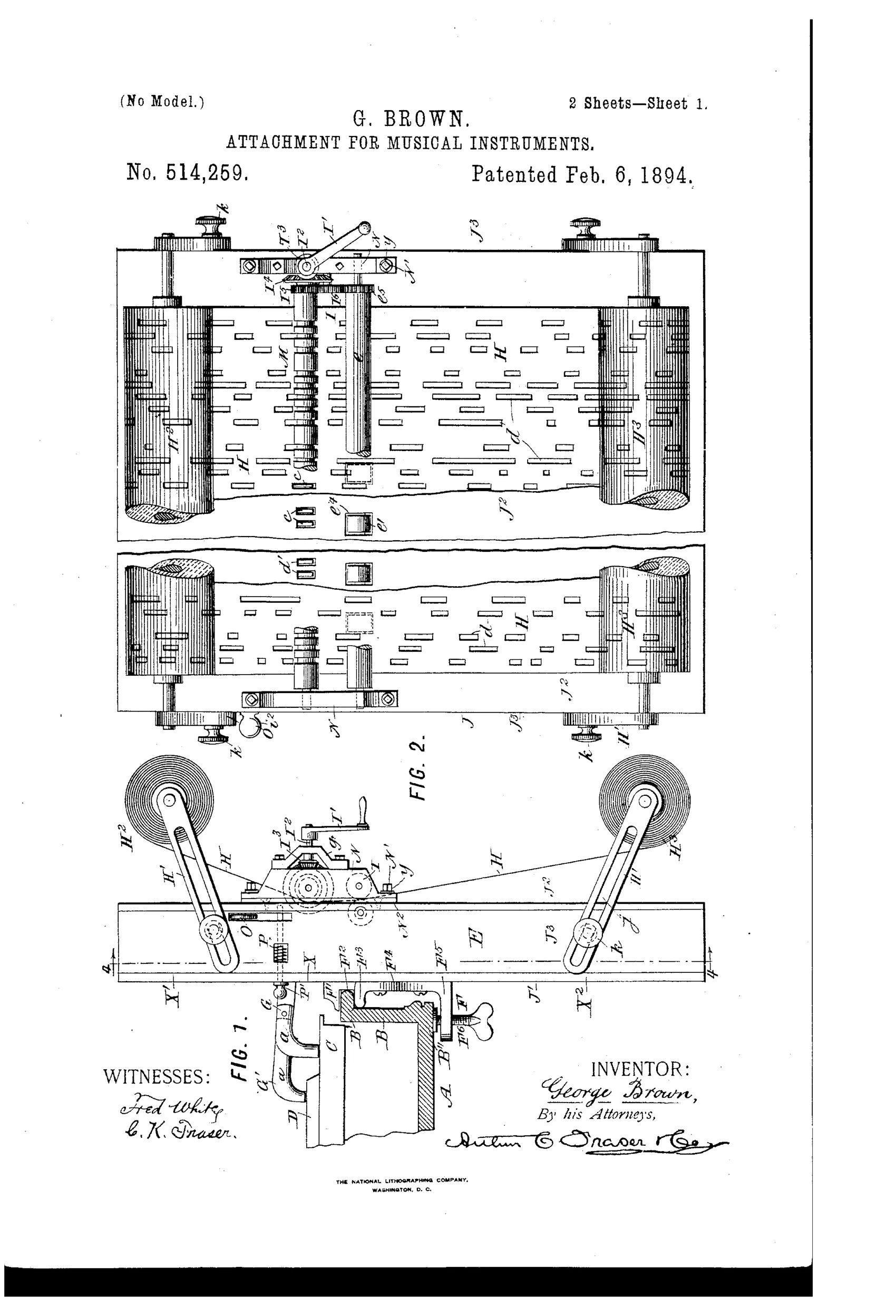
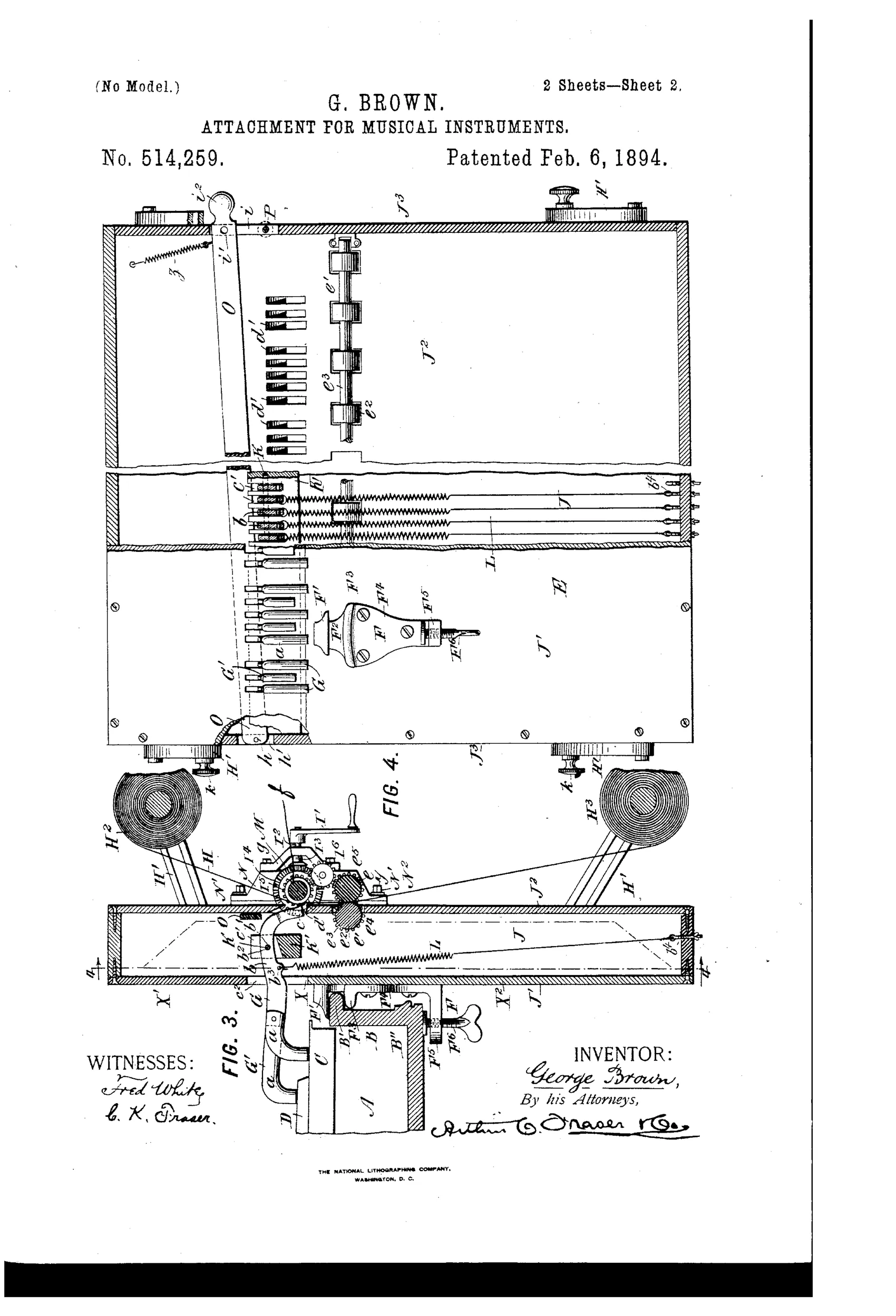
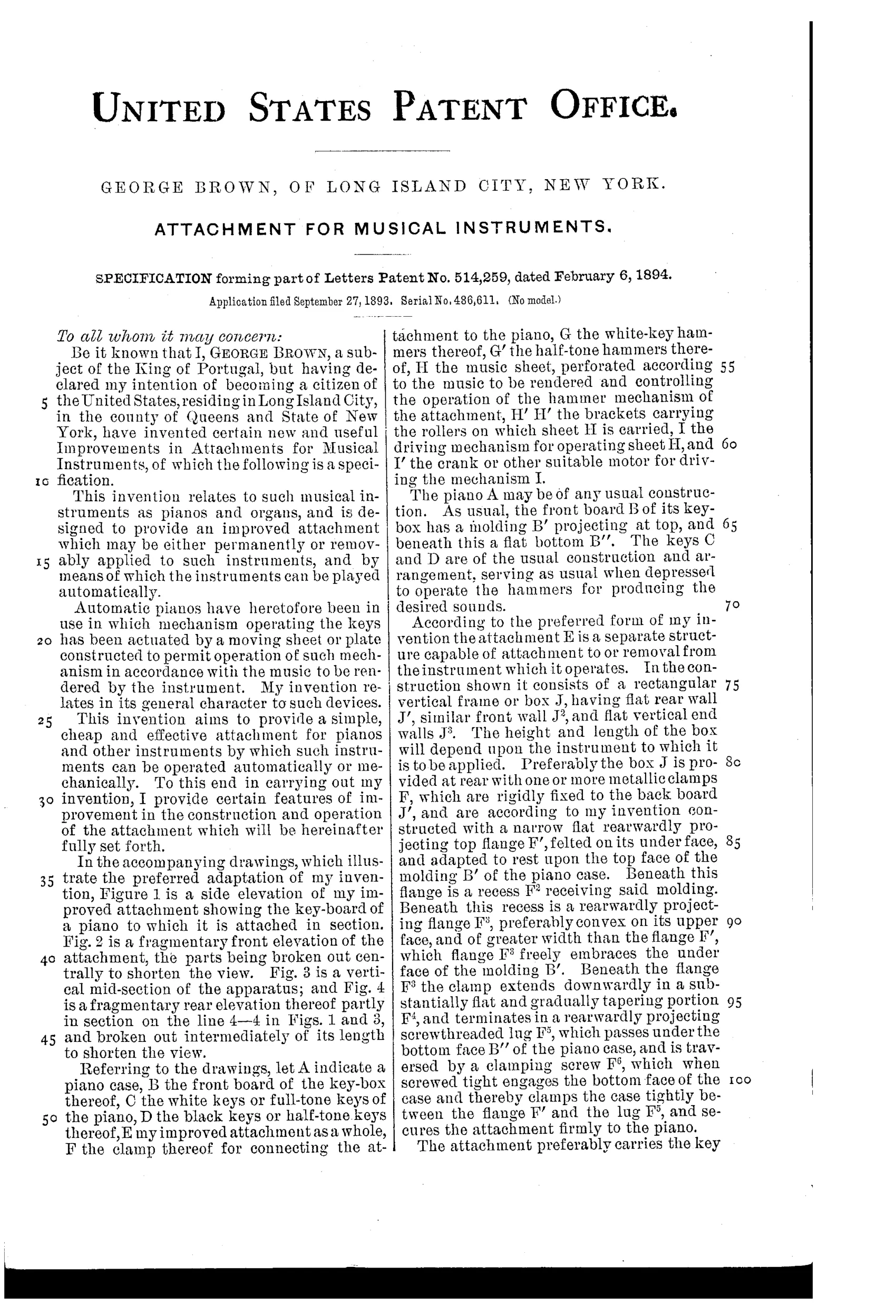
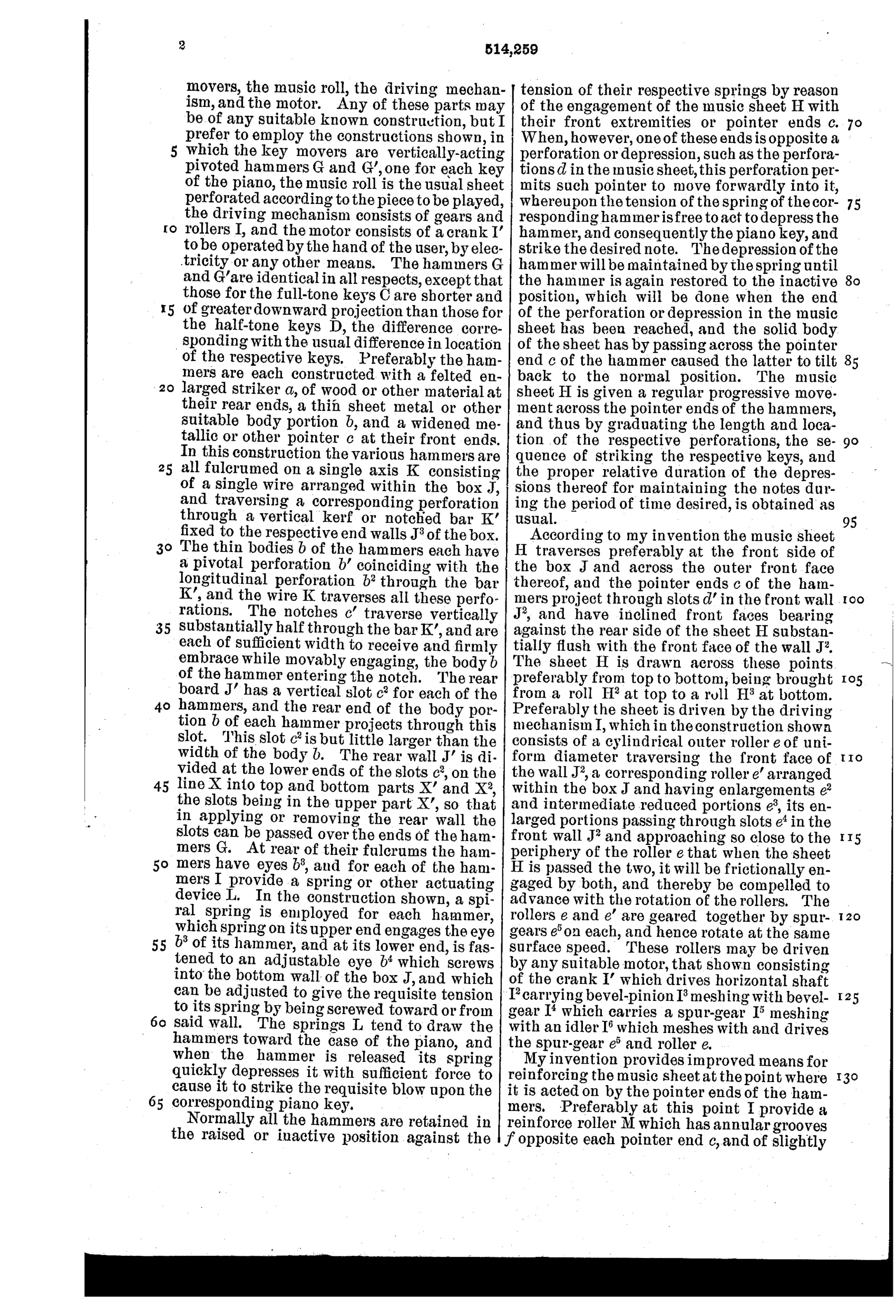
Automatic piano-playing attachment operated by perforated music sheet
♫ How it works
A separate box frame carrying pivoted spring-loaded hammers is clamped to the piano's keyboard, with each hammer's pointer end projecting through the frame's front wall to bear against a moving perforated music sheet. As the sheet is driven downward by geared rollers turned via a hand crank, its perforations allow individual hammer pointers to spring forward and depress the corresponding piano keys, striking notes according to the pattern of holes. A grooved reinforce roller opposite the hammer ends supports the sheet against the pressure of the springs, while a hinged throw-off bar can tilt all hammers back to free the sheet for removal or replacement.
♫ What was claimed
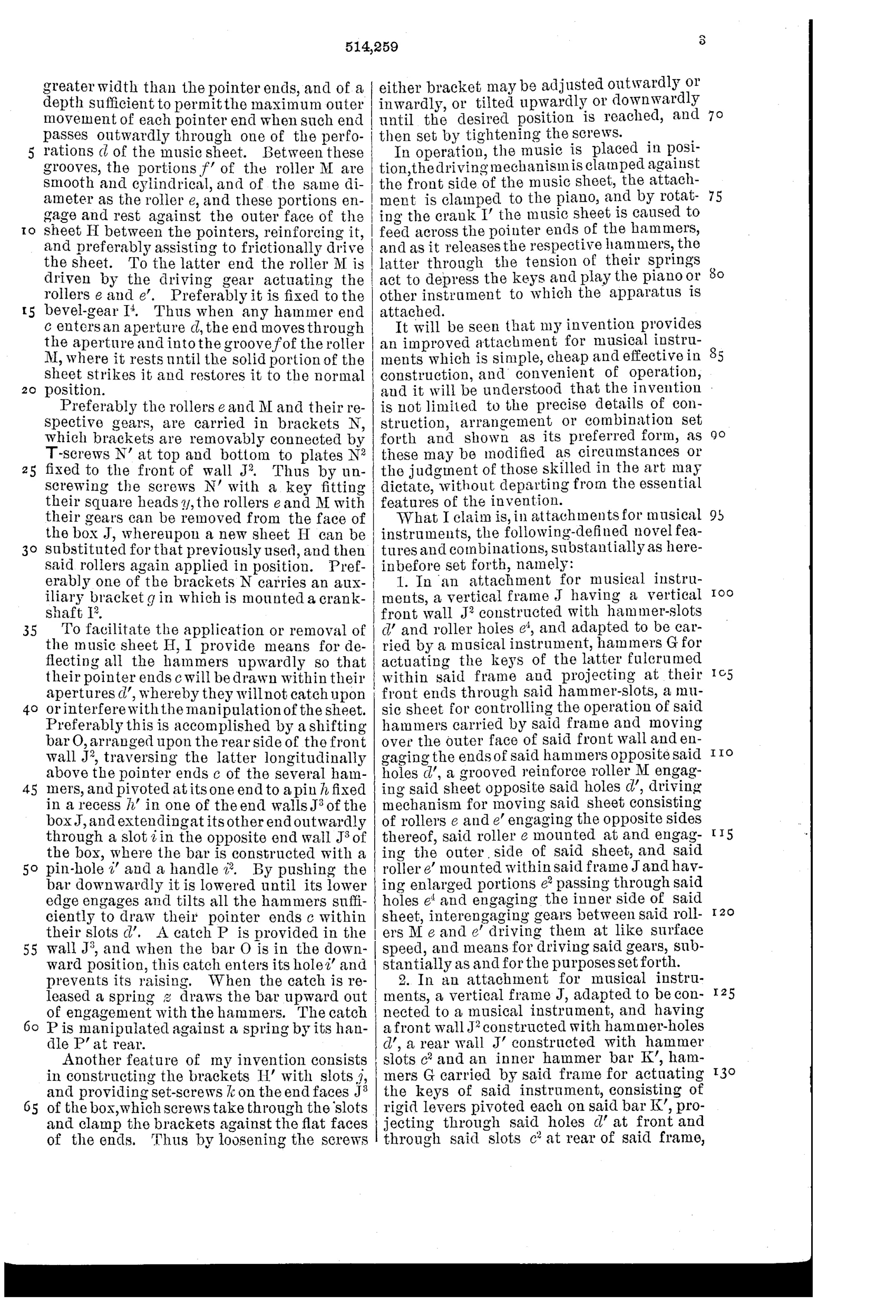
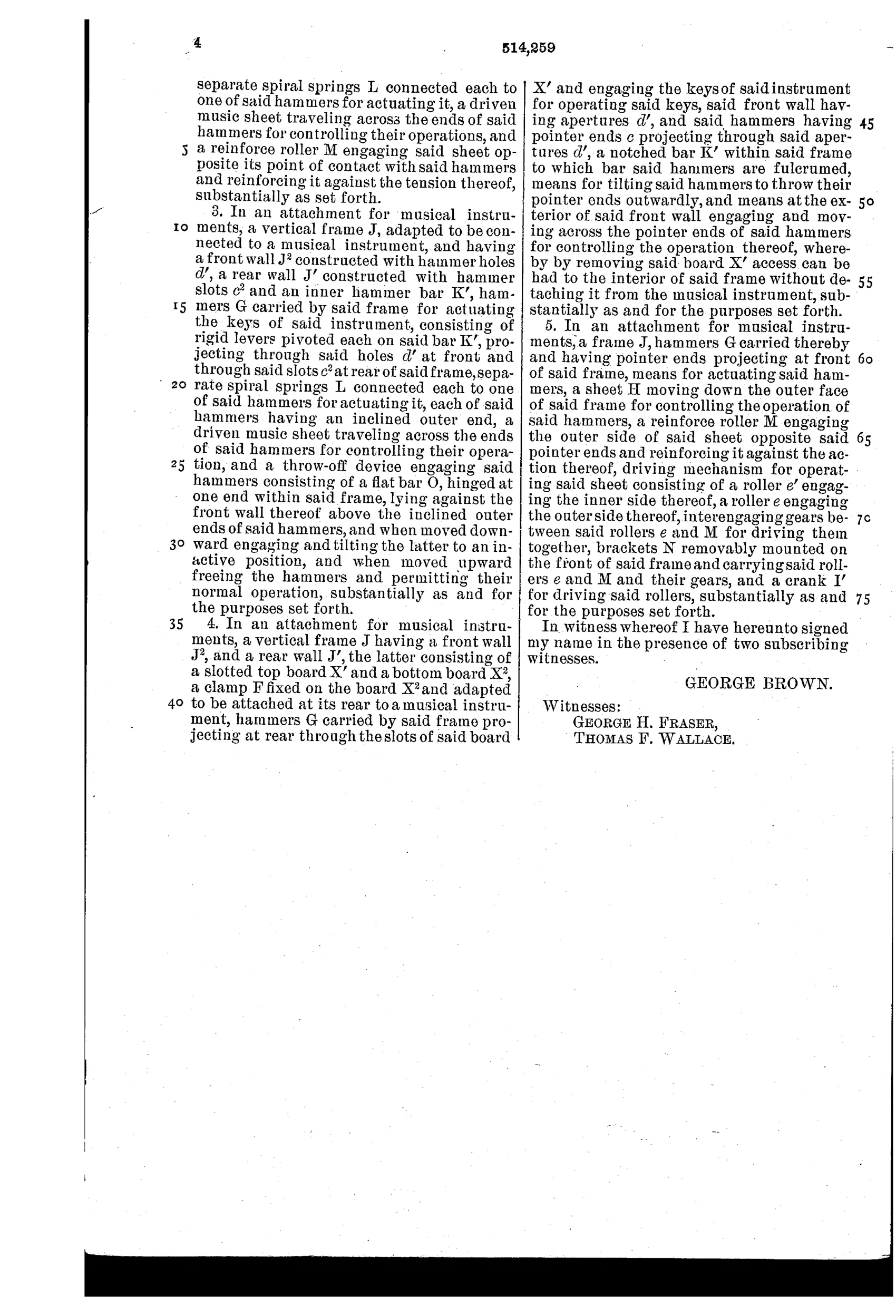
“In an attachment for musical instruments, a vertical frame J having a vertical front wall J^2 constructed with hammer-slots d' and roller holes e^4, and adapted to be carried by a musical instrument, hammers G for actuating the keys of the latter fulcrumed within said frame and projecting at their front ends through said hammer-slots, a music sheet for controlling the operation of said hammers carried by said frame and moving over the outer face of said front wall and engaging the ends of said hammers opposite said holes d', a grooved reinforce roller M engaging said sheet opposite said holes d', driving mechanism for moving said sheet consisting of rollers e and e' engaging the opposite sides thereof, said roller e mounted at and engaging the outer side of said sheet, and said roller e' mounted within said frame J and having enlarged portions e^2 passing through said holes e^4 and engaging the inner side of said sheet, interengaging gears between said rollers M e and e' driving them at like surface speed, and means for driving said gears, substantially as and for the purposes set forth.”
In plain English: A removable frame with spring-loaded key-striking hammers, a perforated paper roll that moves across their tips, and geared rollers (one grooved to reinforce the paper) that drive the sheet in sync to trigger the hammers and play the piano.
♫ In the inventor’s words
“It will be seen that my invention provides an improved attachment for musical instruments which is simple, cheap and effective in construction, and convenient of operation.”— George Brown, from the specification
Fate unknown
No production example or trade listing is known to me; a surviving marked attachment or period advertisement would settle it.
♫ Commentary
George Brown's attachment clamps a box of spring-loaded hammers over a piano keyboard and drags a perforated paper sheet past their pointed tips. Where a hole passes, a hammer snaps forward and presses its key. It is the player piano idea in its rawest possible form: no bellows, no tracker bar, no vacuum — just steel springs held back by paper.
That is also the design's problem, and to his credit Brown clearly saw it. The paper has to physically restrain a whole rank of loaded hammers, so he adds a grooved 'reinforce roller' backing the sheet exactly opposite the hammer tips, and gears it to run at the same surface speed as the feed rollers so the paper is supported without being scrubbed. The hinged throw-off bar that tilts every hammer clear for sheet changes is another thoughtful touch. But the fundamentals fight him: spring pressure strong enough to sound a piano key is pressure trying to punch through or snag every perforation edge, and every note plays at the same fixed force.
History settled the question quickly. Votey's pneumatic Pianola arrived in 1897 and made air, not springs, do the reading and the striking — gentle on the paper and graded in touch. Brown's machine sits on the mechanical side of that divide, a clever, honest attempt down the branch that didn't grow.
Commentary by Claude, The Talking Machine Patent Archive’s resident enthusiast