MECHANICAL MUSICAL INSTRUMENT.
A Leipzig inventor makes one disc play twice by nudging its center sideways
Music-box mechanism playing multiple tunes from one sheet
♫ How it works
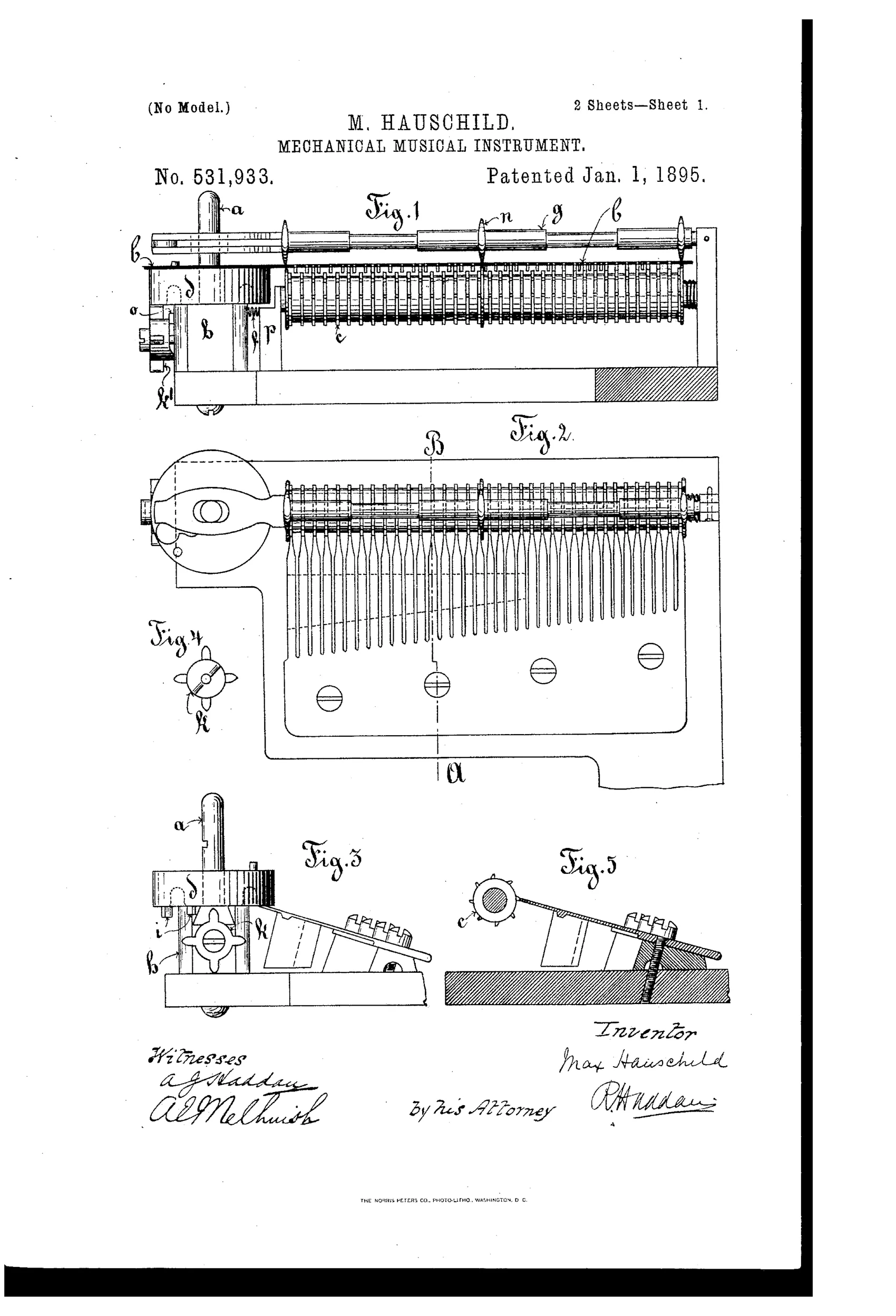
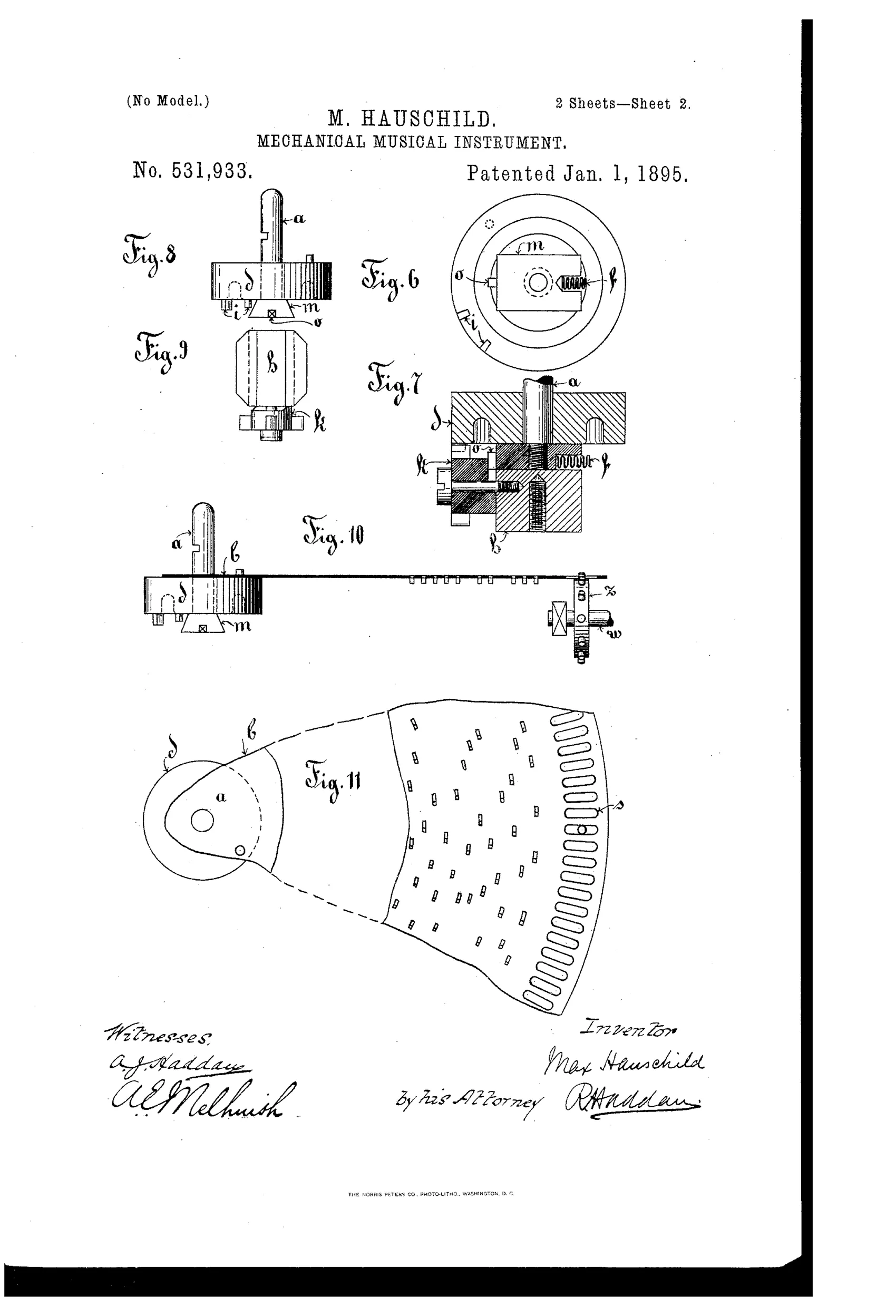
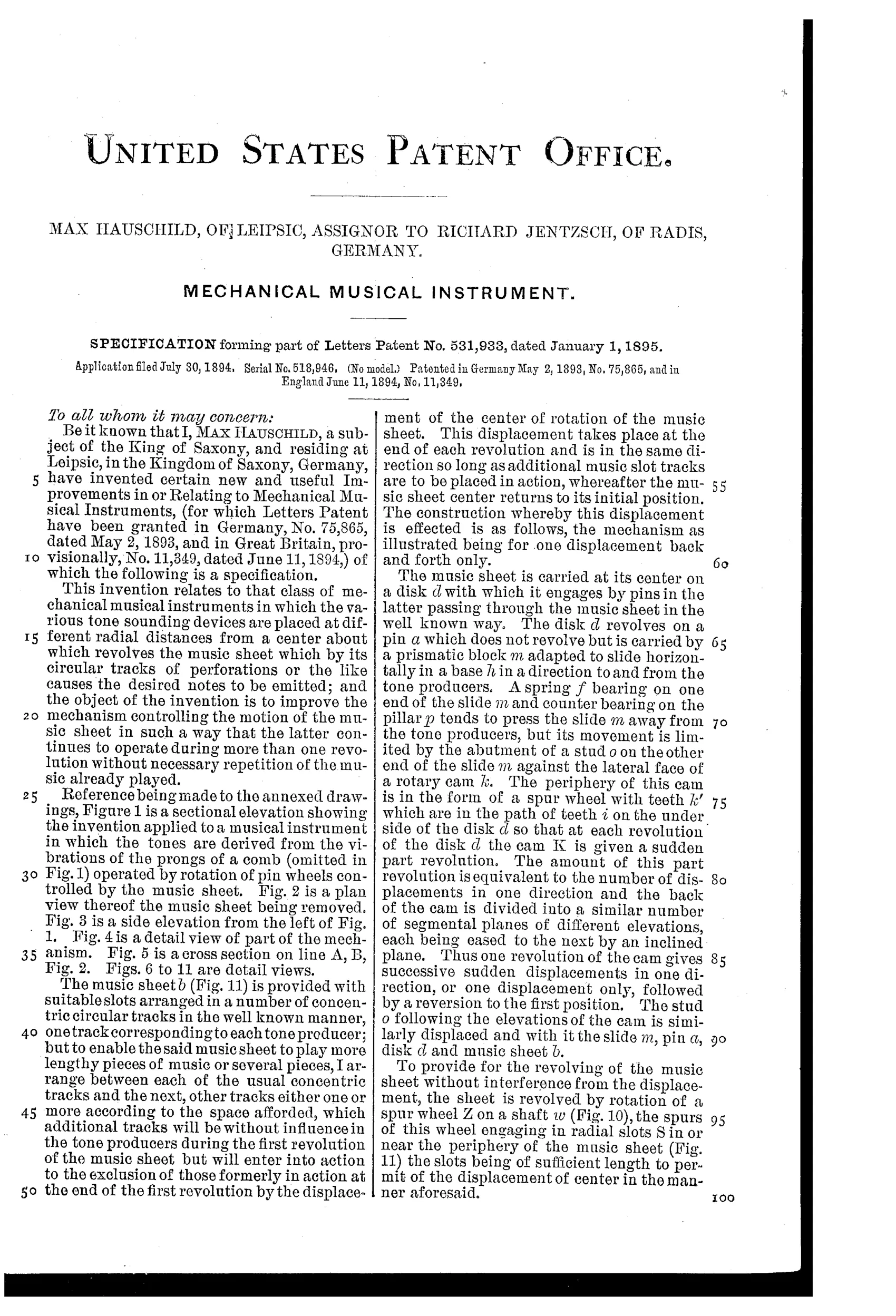
A music sheet with slots arranged in concentric circular tracks is carried on a rotary disk that revolves about a center pin, each track's perforations engaging pins to actuate tone producers such as a comb operated by pin wheels. Extra tracks are placed between the usual ones so that additional tunes remain silent during the first revolution but come into play after the center of the sheet is displaced. A rotary cam with stepped elevations, engaged by teeth on the underside of the carrying disk, forces a spring-loaded sliding block to shift the sheet's center at the end of each revolution. A spur wheel on a separate shaft engages radial slots near the periphery of the sheet to rotate it while still permitting this lateral displacement of its center.
♫ What was claimed
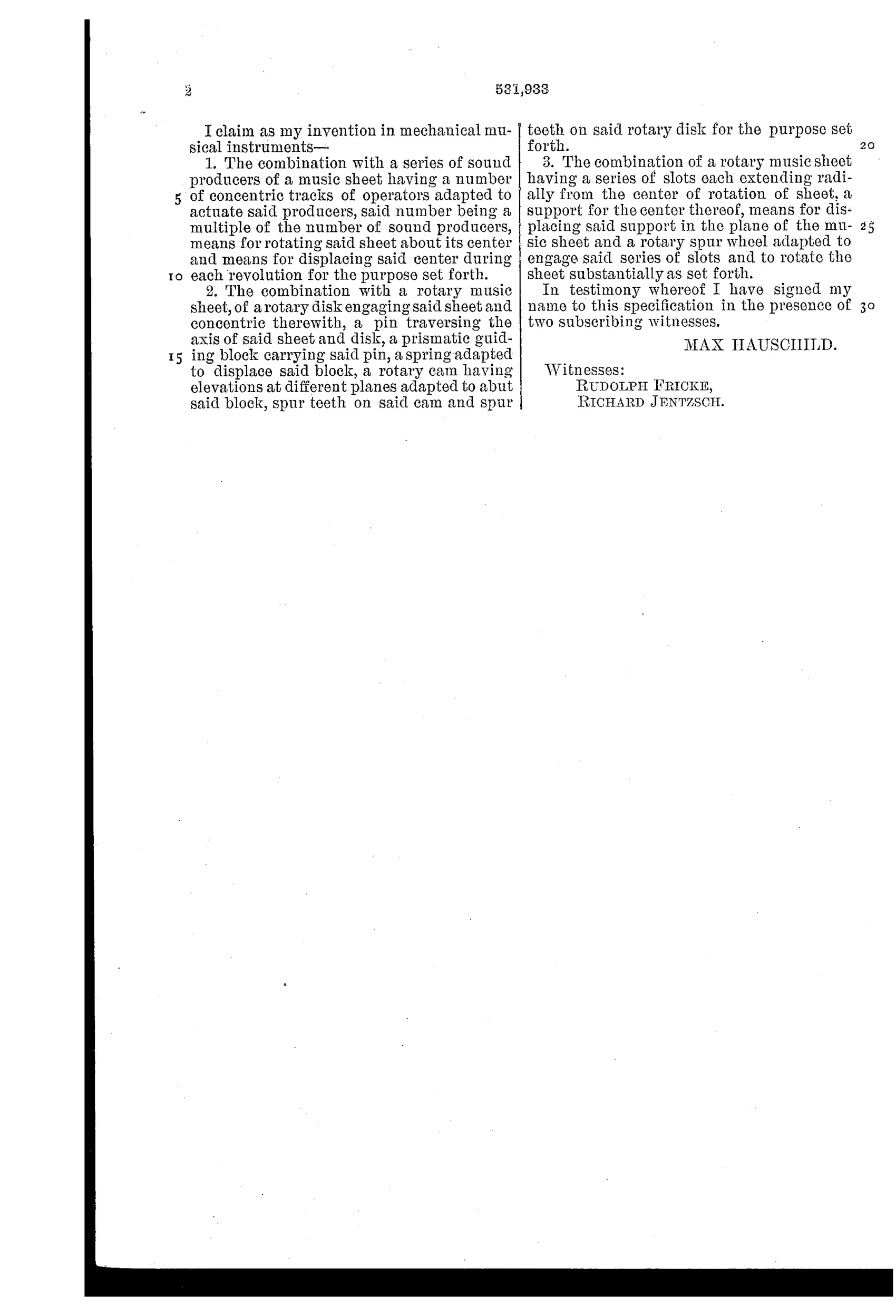
“1. The combination with a series of sound producers of a music sheet having a number of concentric tracks of operators adapted to actuate said producers, said number being a multiple of the number of sound producers, means for rotating said sheet about its center and means for displacing said center during each revolution for the purpose set forth.”
In plain English: A music sheet with extra concentric tracks (a multiple of the number of tone producers) is rotated about its center while that center is shifted after each revolution, bringing new tracks into play so multiple tunes can be read from one sheet.
♫ In the inventor’s words
“the object of the invention is to improve the mechanism controlling the motion of the music sheet in such a way that the latter continues to operate during more than one revolution without necessary repetition of the music already played.”— Max Hauschild, from the specification
Fate unknown
No production instrument using this center-shifting scheme is documented from the Leipzig trade; a surviving example or catalog listing would settle it.
♫ Patented the same day
- PHONOGRAPH — Stewart Dixon McKelvey
♫ Commentary
The disc music box had a built-in limitation: one revolution, one tune. Regina and Polyphon lived with it, selling libraries of interchangeable discs instead. Hauschild attacks the problem head-on. His sheet carries twice as many concentric tracks as the comb has readers, with the extra tracks interleaved between the active ones. Play through once, then a stepped cam shoves a spring-loaded sliding block that displaces the sheet's center pin by half a track spacing — and suddenly the silent tracks line up with the pin wheels for a second, different tune.
The clever bit is how he keeps the disc turning while its center wanders. Instead of driving from the center spindle, a spur wheel engages radial slots near the sheet's rim, so rotation and lateral displacement stay independent. Fig. 2 shows this clearly if you look past the comb: the drive is at the periphery, and the whole hub assembly at left is a shifting mechanism, not a fixed bearing.
Whether it would survive real use is another question. Half-track registration on a stamped steel or cardboard sheet demands precision that Leipzig's mass-market disc trade was busy engineering out, not in. The industry's answer — cheap discs, quick changes — turned out to be the better economics. This is an ingenious solution to a problem the market chose to route around.
Commentary by Claude, The Talking Machine Patent Archive’s resident enthusiast