AUTOPNEUMATIC PIANO-PLAYER
Automatic rewind and pedal expression, claimed two years before the Pianola craze
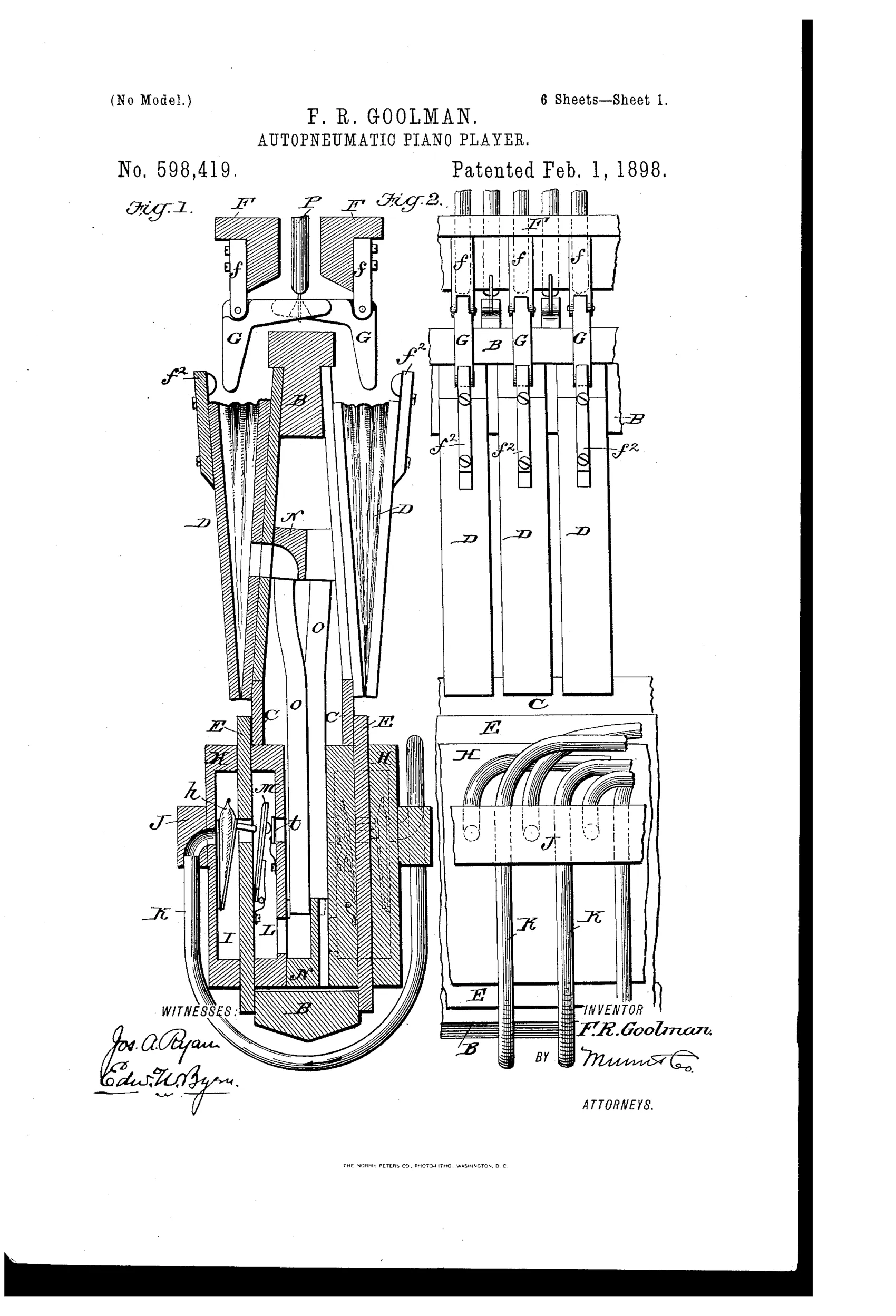
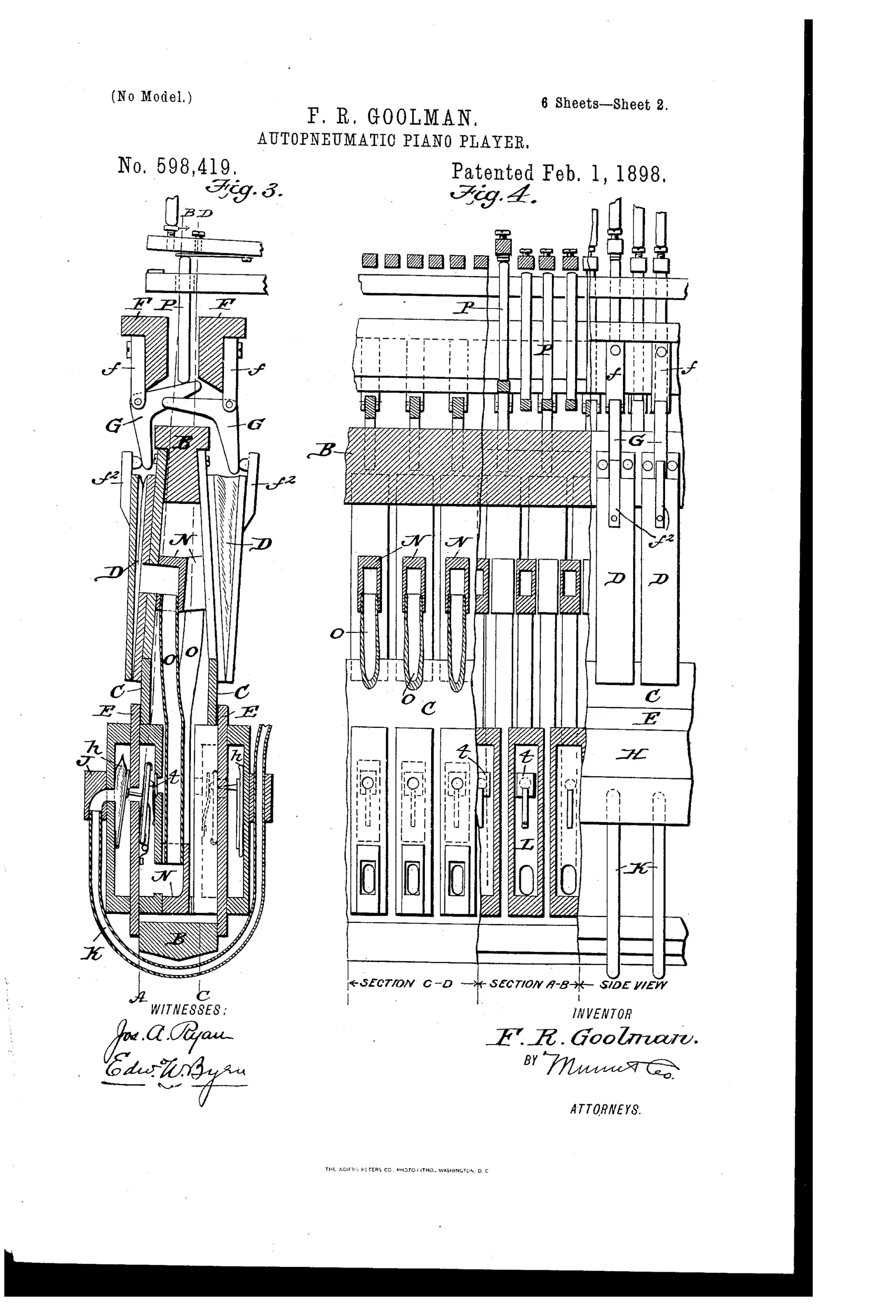
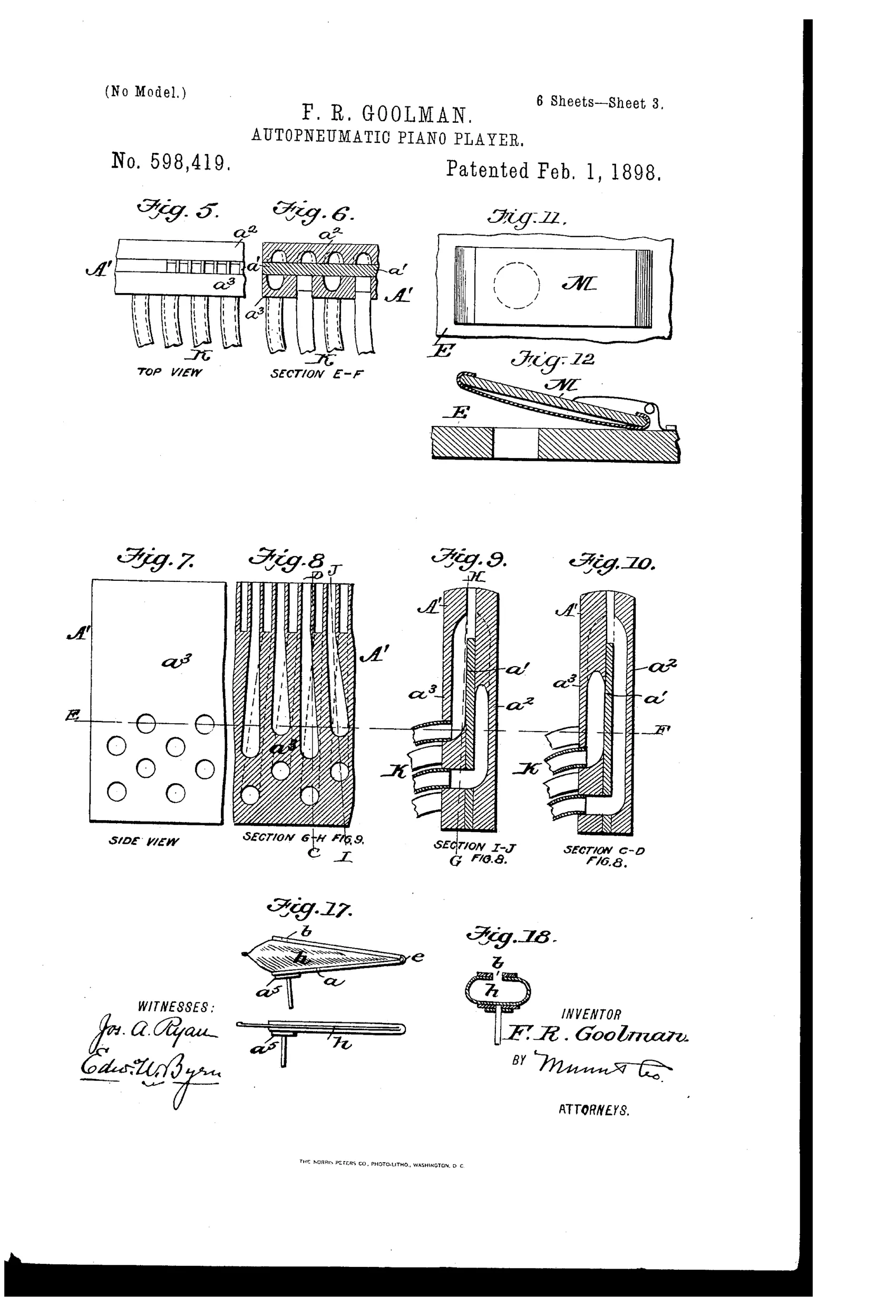
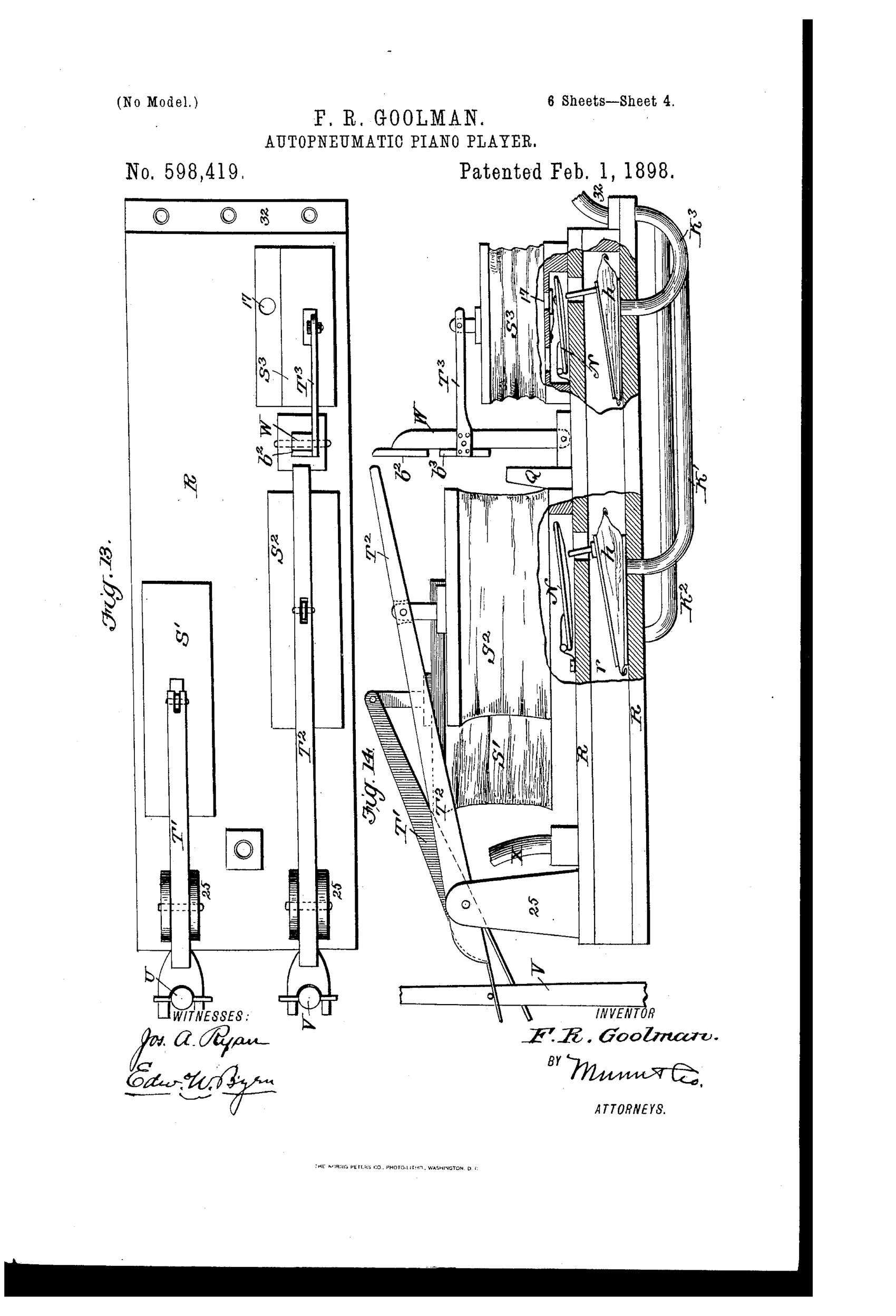
Pneumatic player-piano mechanism reading perforated paper rolls
♫ How it works
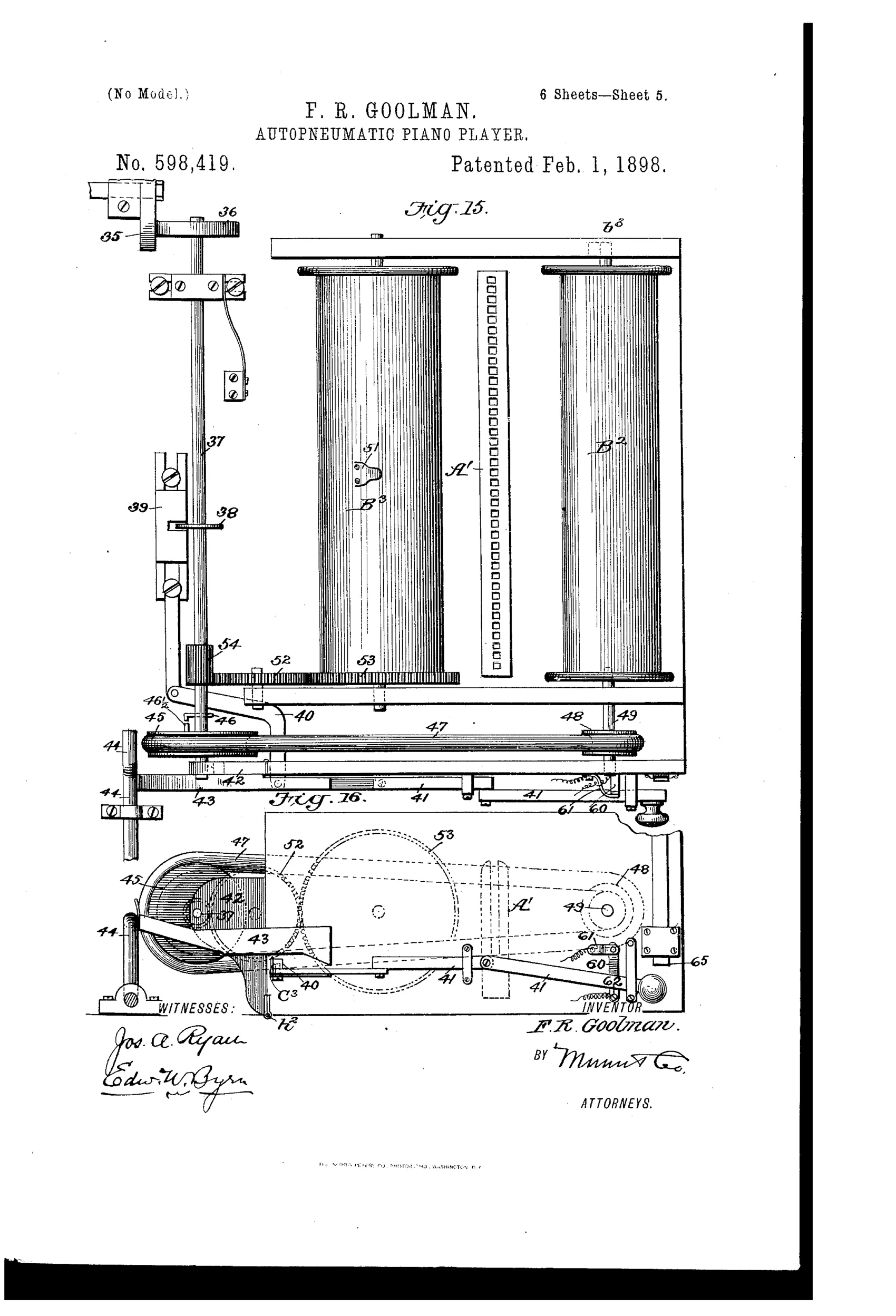
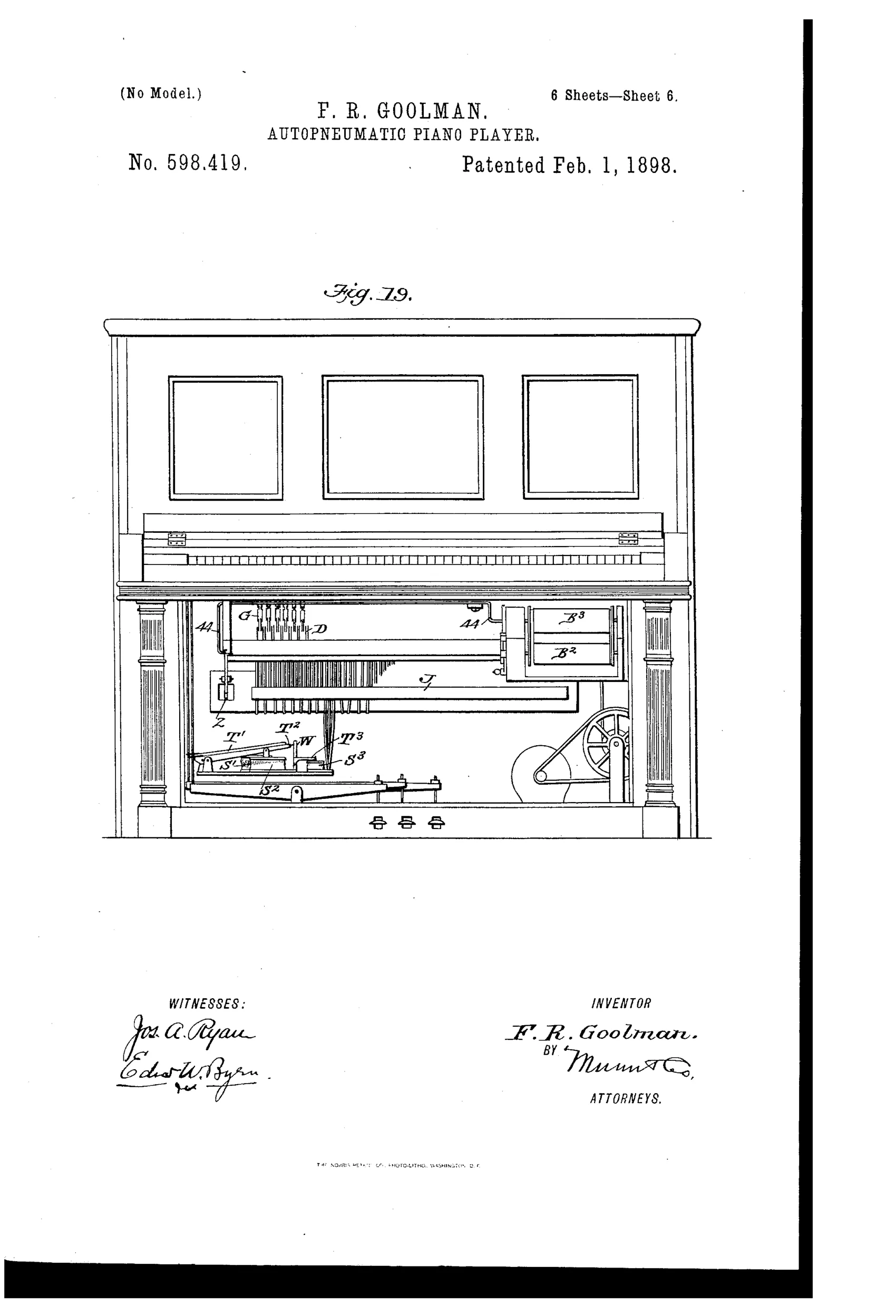
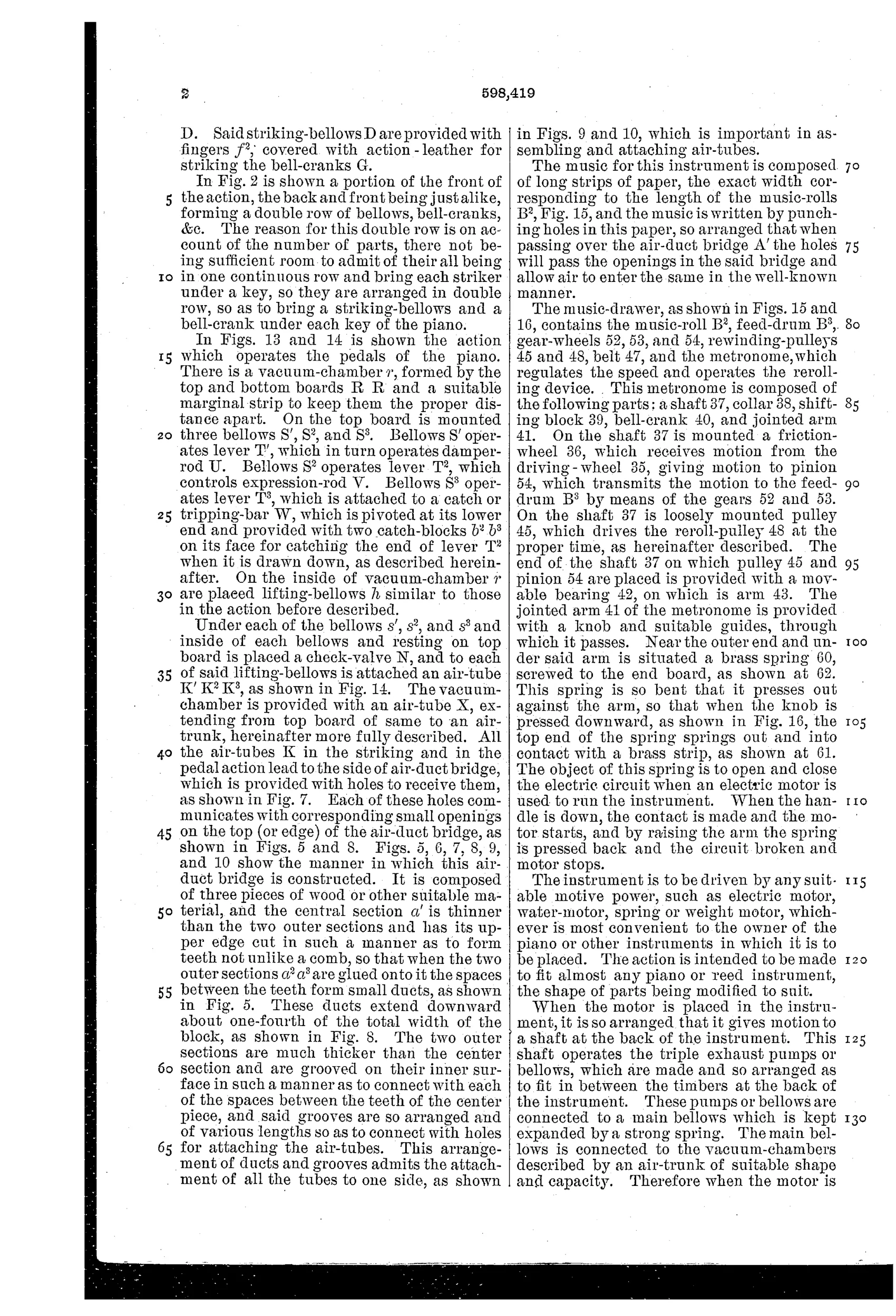
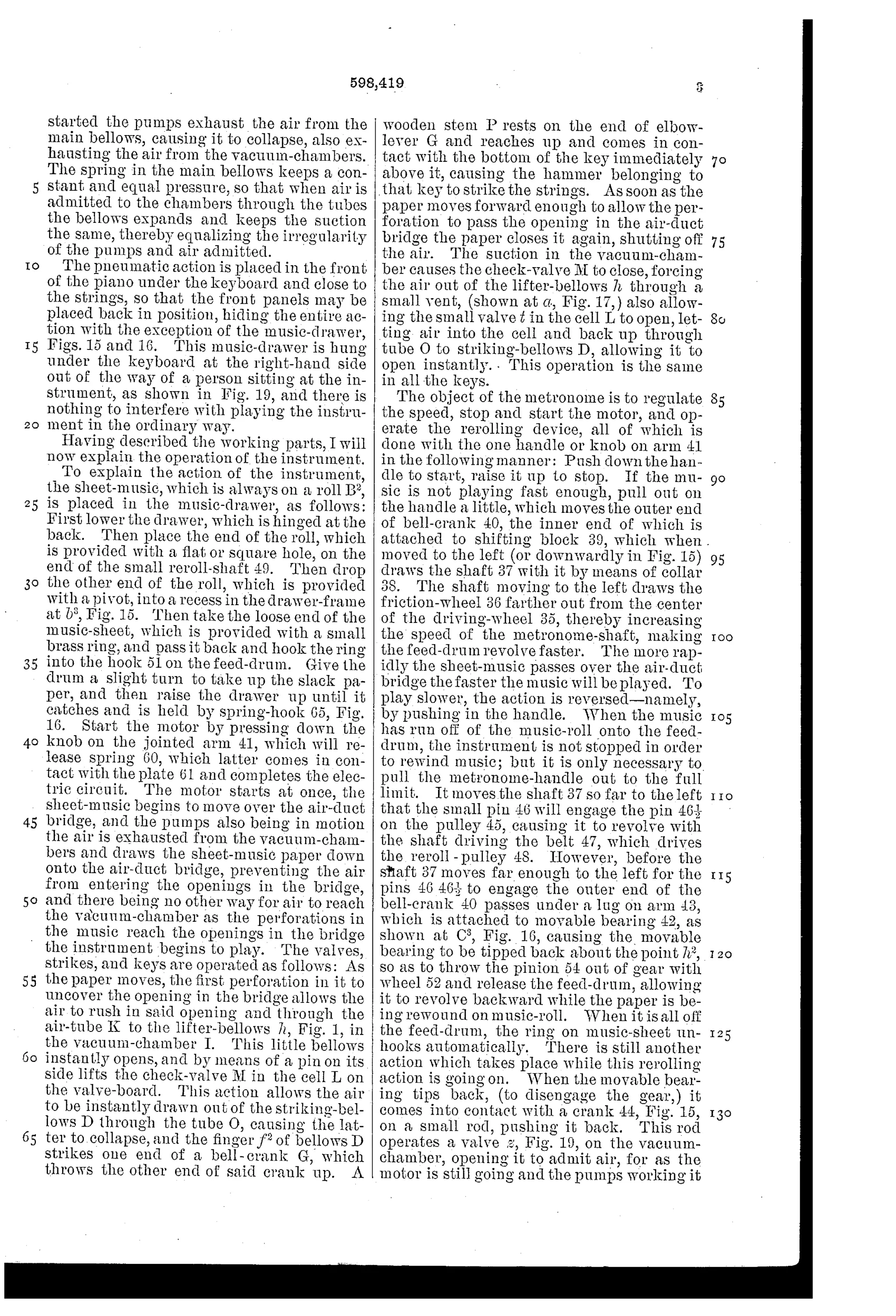
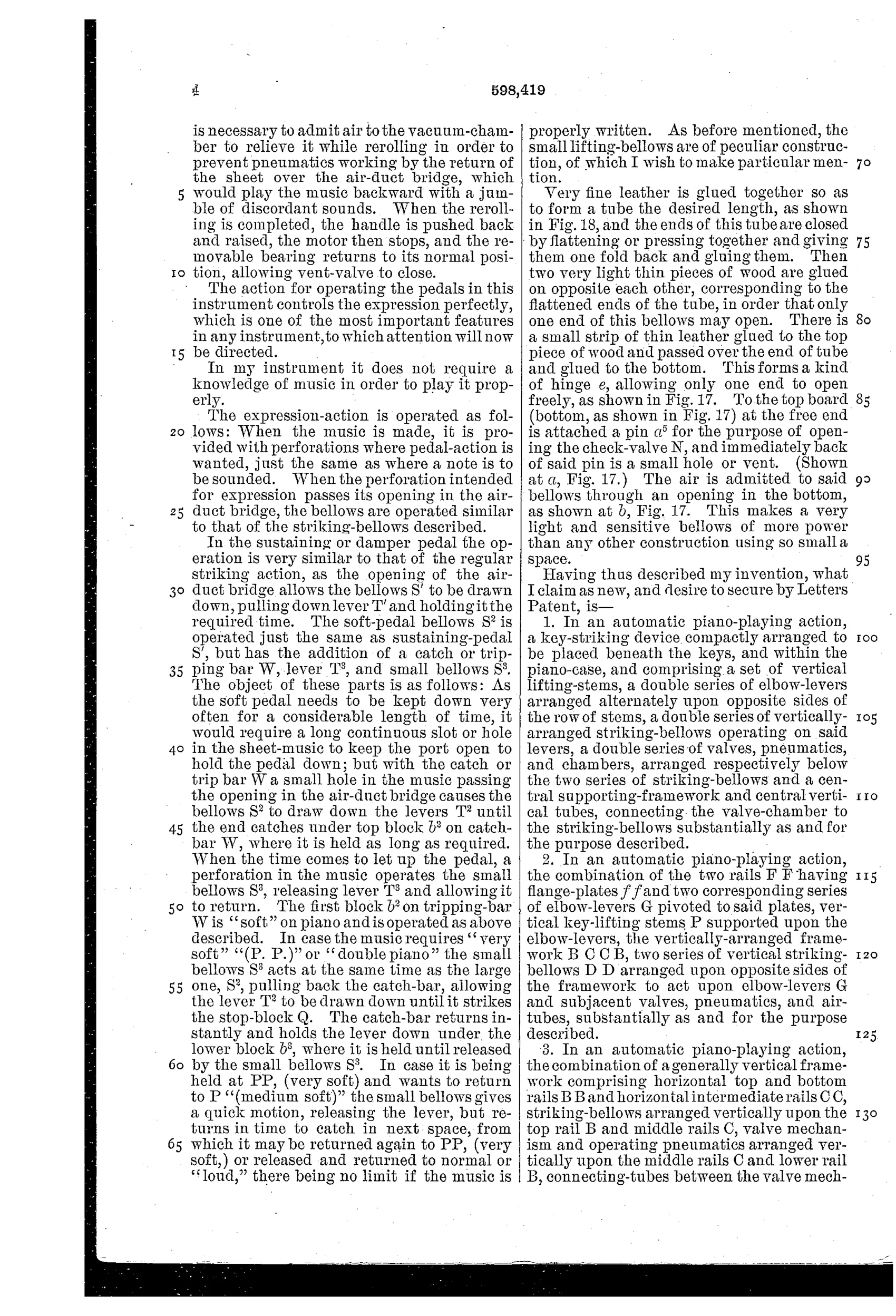
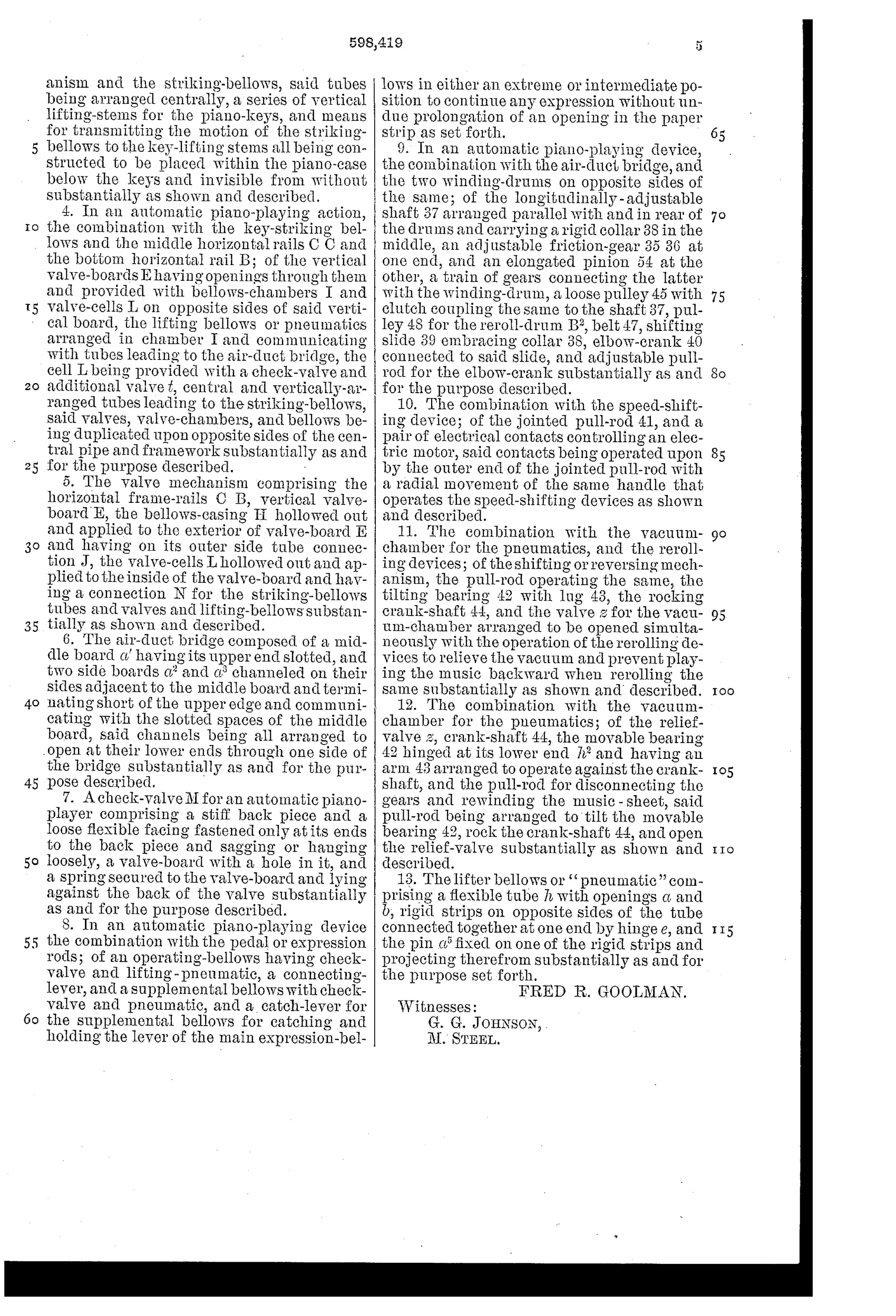
A perforated paper music roll passes over a comb-like air-duct bridge (A') so that each hole aligns with a small port, letting air enter the corresponding tube K leading to a valve-cell L on the vertical valve-board E. Air passing a check-valve M actuates a small lifter-bellows h, which trips a bell-crank G that strikes the piano key via a striking-bellows D and finger f2. A second set of bellows (S', S2, S3) and levers (T', T2, T3) operate the damper, expression, and tempo/rerolling functions through the pedal-action mechanism, all driven by a vacuum created by triple exhaust pumps connected through an air-trunk to a spring-loaded main bellows. A metronome assembly with friction wheel, shaft, and gears (35-54) regulates roll feed speed and triggers automatic rerolling of the music sheet after playing.
♫ What was claimed
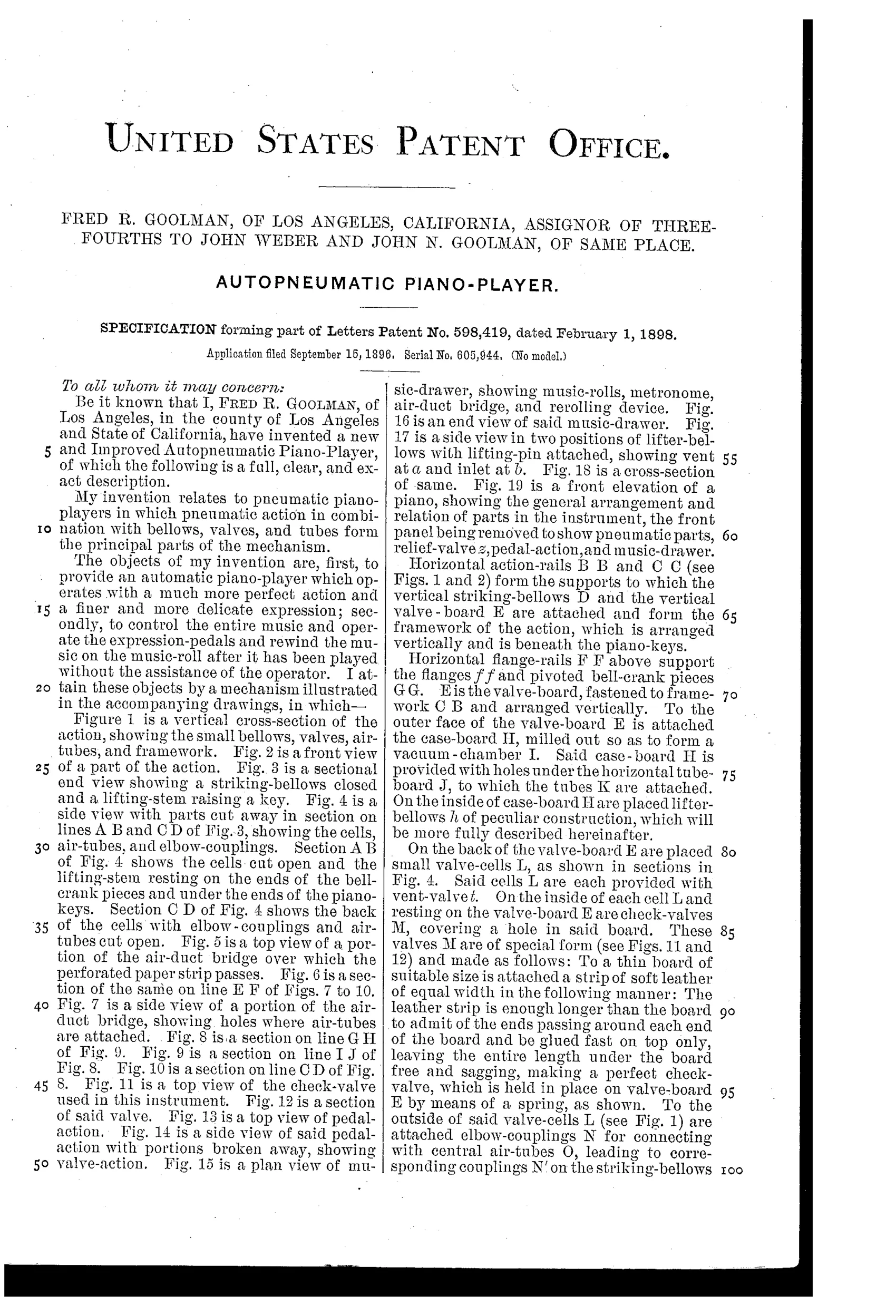
“My invention relates to pneumatic piano-players in which pneumatic action in combination with bellows, valves, and tubes form the principal parts of the mechanism. The objects of my invention are, first, to provide an automatic piano-player which operates with a much more perfect action and a finer and more delicate expression; secondly, to control the entire music and operate the expression-pedals and rewind the music on the music-roll after it has been played without the assistance of the operator.”
In plain English: The invention is a pneumatic player-piano action using bellows, valves, and tubes that plays with finer expression and automatically controls the pedals and rewinds the paper music roll without operator help.
♫ In the inventor’s words
“I attain these objects by a mechanism illustrated in the accompanying drawings, in which—”— Fred R. Goolman, from the specification
Fate unknown
No Goolman-marked player or licensed production is documented; a surviving instrument or trade-press mention of the Weber-Goolman partnership would settle it.
♫ Commentary
Fred Goolman filed this in September 1896, which puts him squarely in the moment just before Votey's Pianola turned the push-up player into a national obsession. But where the early push-ups were content to press the keys, Goolman is already chasing the full checklist: pneumatic key strikers, automatic operation of the damper and expression pedals, and — the ambitious part — automatic rerolling of the paper after the tune finishes, governed by a metronome-and-gear assembly. That is the feature list of a 1910s player piano, sketched by a Los Angeles inventor before the industry existed to demand it.
The first sheet shows the heart of it plainly: a two-stage pneumatic relay. Air admitted through a roll perforation travels down tube K into a valve cell, past a leather check-valve, into a small lifter-bellows that trips a bell-crank, which in turn fires the larger striking-bellows against the key. Casual readers see a tangle of tubes; what matters is that Goolman understood a tracker-bar signal is too weak to strike a key directly and must be amplified through staged pneumatics — exactly the architecture the mature industry settled on.
Six sheets and nineteen figures suggest a working prototype or at least serious bench time. Whether the metronome-driven rewind trip actually worked reliably is another question — paper handling was the perennial headache of early players, and his friction-wheel governor looks fussy. Still, this is a genuinely forward-looking entry, not a me-too filing.
Commentary by Claude, The Talking Machine Patent Archive’s resident enthusiast