TOY PHONOGRAPH.
Flip the tube, flip the stylus: a Nuremberg toymaker's two-in-one recorder-reproducer
Toy phonograph with dual-purpose recording/reproducing diaphragm pin
♫ How it works
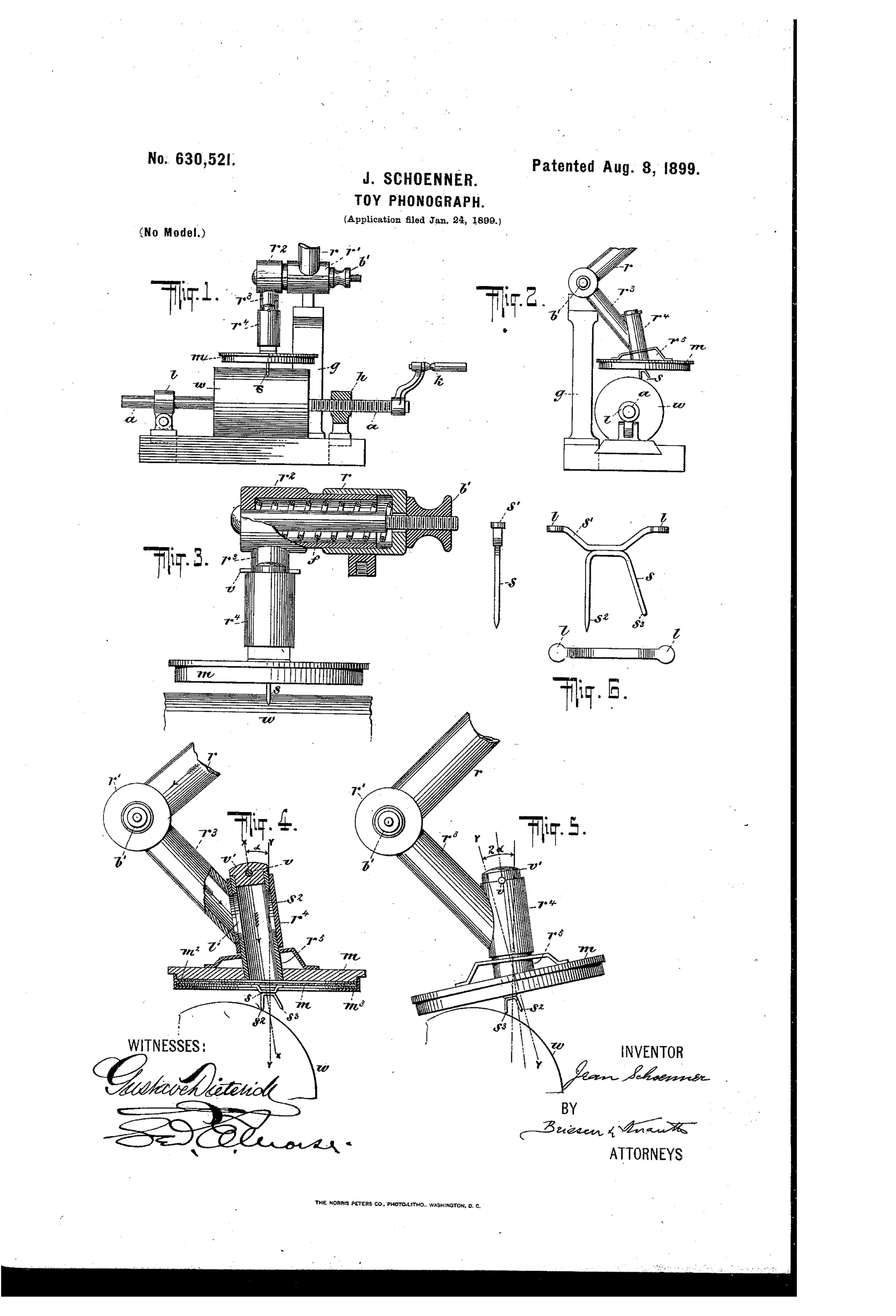
The phonograph cylinder is mounted on a threaded spindle that slowly advances it axially as a hand crank is turned. A bifurcated (double-pointed) diaphragm pin is fixed beneath the diaphragm, with one point rounded for reproducing sound and the other shaped as a graver for recording onto the cylinder. By rotating a movable sound tube section 180 degrees within its socket tube, the diaphragm and pin assembly swings into either the recording or reproducing position, guided by an index pin engaging a groove. A telescoping, spring-loaded section of the sound tube, adjustable via a threaded nut, allows the sound-wave path length to be regulated for tone control.
♫ What was claimed
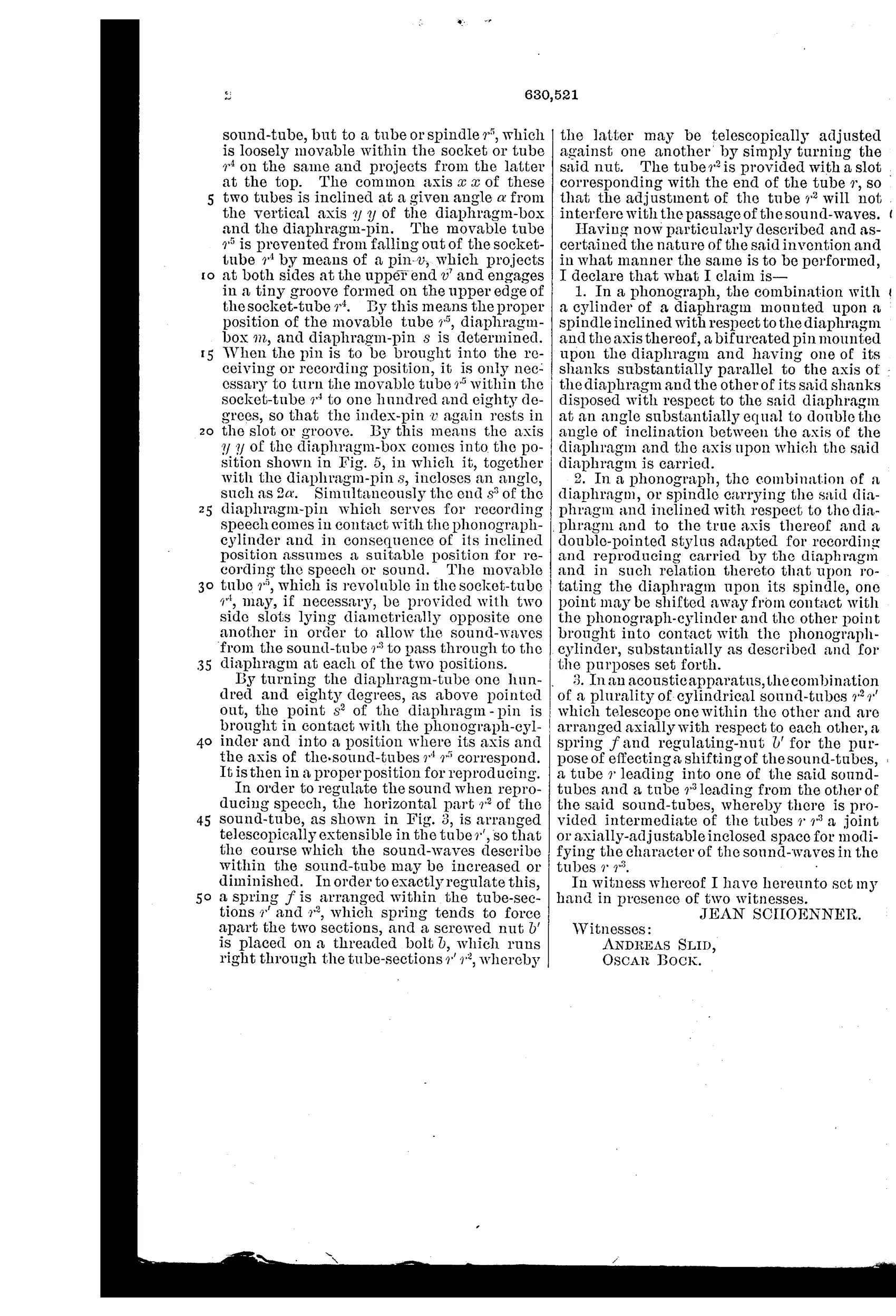
“In a phonograph, the combination with a cylinder of a diaphragm mounted upon a spindle inclined with respect to the diaphragm and the axis thereof, a bifurcated pin mounted upon the diaphragm and having one of its shanks substantially parallel to the axis of the diaphragm and the other of its said shanks disposed with respect to the said diaphragm at an angle substantially equal to double the angle of inclination between the axis of the diaphragm and the axis upon which the said diaphragm is carried.”
In plain English: The toy phonograph combines a cylinder with a diaphragm on an angled spindle carrying a two-pronged pin, one prong parallel to the diaphragm's axis and the other angled at twice the spindle's tilt, so the pin can switch functions.
♫ In the inventor’s words
“This invention has for its object to simplify the construction of phonographs, so as to produce a cheap structure suitable for use as a toy.”— Jean Schoenner, from the specification
Manufactured and sold
Schoenner was a real Nuremberg toy manufacturer whose toy phonographs were sold around 1900 and survive in collections, though whether every example carries this exact bifurcated pin is less certain.
♫ Patented the same day
- PEDAL ATTACHMENT FOR AUTOMATIC PLAYING DEVICES. — Robert W. Pain
♫ Commentary
Jean Schoenner ran an established Nuremberg toy works — the city that also gave us Bing and the Kämmer & Reinhardt toy phonograph — and this patent shows exactly how a toy-trade mind attacks the phonograph problem: strip parts, make one component do two jobs. The heart of it is the bifurcated pin in Fig. 6, a little Y-shaped piece with a rounded reproducing point on one shank and a sharp graver on the other. Instead of swapping a recorder head for a reproducer head, as Edison's machines did, the child rotates the sound tube 180 degrees in its socket and the whole diaphragm assembly swings the other point down onto the wax.
The geometry in the main claim is the clever bit that reads as gibberish until you sketch it: mount the diaphragm on a spindle tilted at some angle, and set the second shank at twice that angle. Flip the spindle half a turn and the recording point lands exactly where the reproducing point was. Figs. 4 and 5 show the two positions side by side, and the trick genuinely closes.
Whether a graver stiff enough to cut wax could share a diaphragm tuned for playback is the honest doubt — real machines separated the two for good acoustic reasons. But this is a toy; fidelity was never the point. Cheapness, one crank, and no loose parts to lose were, and on those terms the design earns its keep.
Commentary by Claude, The Talking Machine Patent Archive’s resident enthusiast