PEDAL ATTACHMENT FOR AUTOMATIC PLAYING DEVICES.
Aeolian's fix for the push-up Pianola's awkward reach to the piano's own pedal.
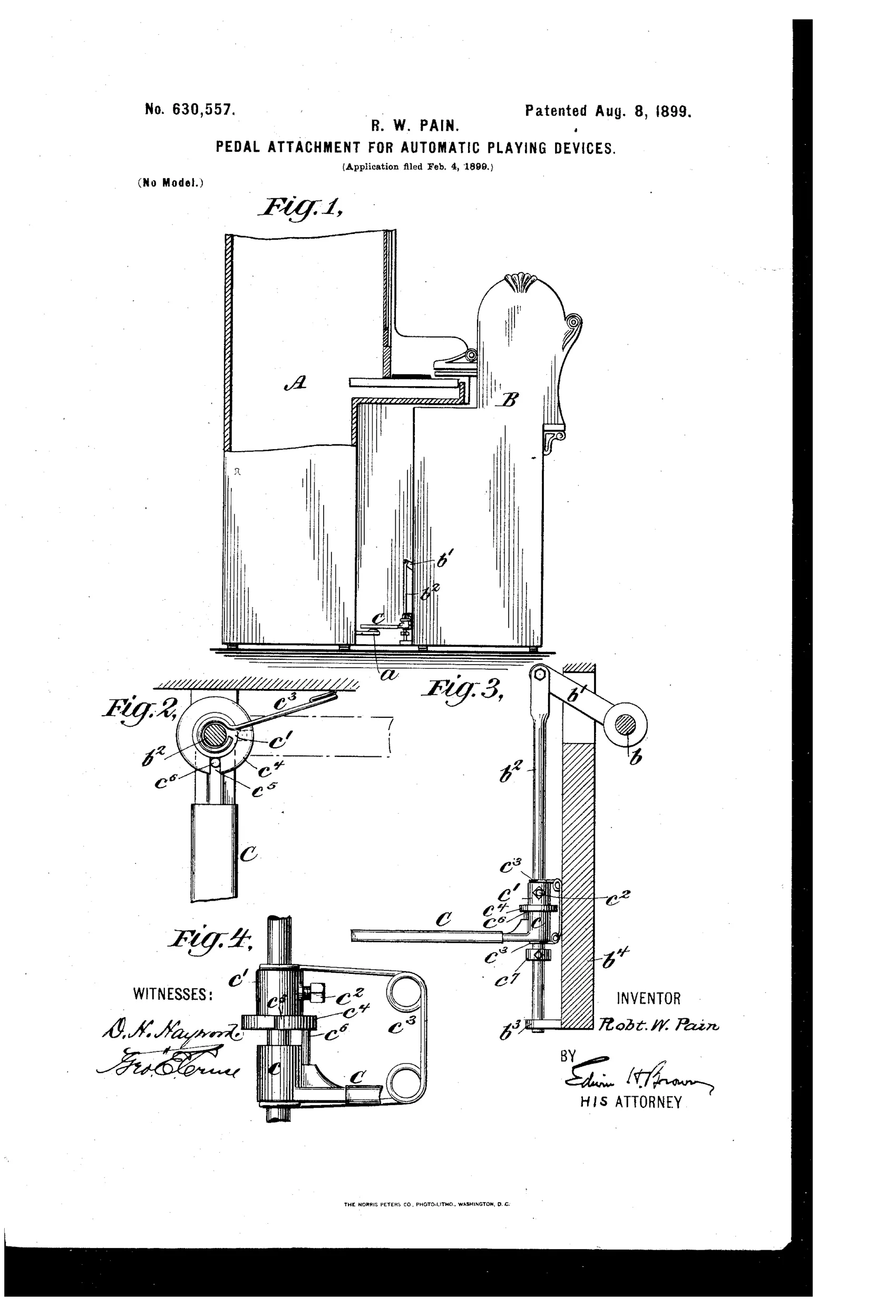
Adjustable pedal linkage for player-piano attachments
♫ How it works
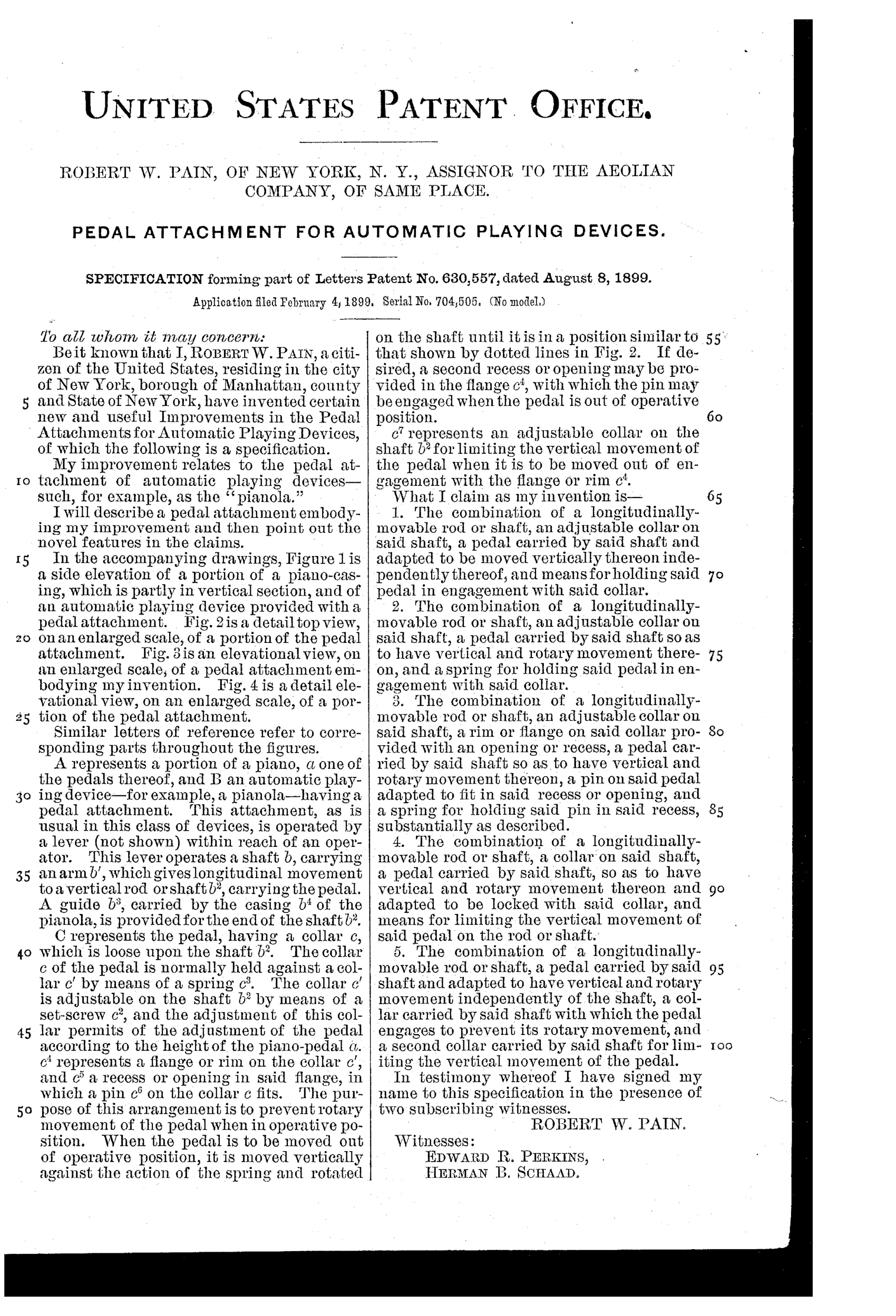
A lever within reach of the operator turns a shaft carrying an arm that gives longitudinal movement to a vertical rod carrying the pedal. The pedal has a collar that is held by a spring against an adjustable collar fixed to the shaft by a set-screw, letting the pedal's height be tuned to the piano's own pedal. A pin on the pedal's collar fits into a recess in the flange of the adjustable collar to stop the pedal from rotating while in use. To disengage, the pedal is pushed up against the spring and rotated until the pin clears the recess, and a second adjustable collar limits how far the pedal can travel vertically.
♫ What was claimed
“1. The combination of a longitudinally-movable rod or shaft, an adjustable collar on said shaft, a pedal carried by said shaft and adapted to be moved vertically thereon independently thereof, and means for holding said pedal in engagement with said collar.”
In plain English: The invention covers a sliding shaft with an adjustable collar and a pedal that can move up and down on the shaft independently, plus a way to hold the pedal engaged with that collar.
♫ In the inventor’s words
“This attachment, as is usual in this class of devices, is operated by a lever (not shown) within reach of an operator.”— Robert W. Pain, from the specification
Manufactured and sold
Aeolian's push-up Pianolas were mass-produced with pedal-actuating linkages of this class, though confirming this exact collar detail would take examining a surviving instrument.
♫ Patented the same day
- TOY PHONOGRAPH. — Jean Schoenner
♫ More by Robert W. Pain
- AUTOMATIC HARMONICA. (1882)
- ATTACHMENT FOR EXPRESSION OR ACCENT CONTROLLING MECHANISMS FOR MECHANICAL MUSICAL INSTRUMENTS. (1904)
♫ Commentary
The push-up player of the 1890s was a cabinet on casters that you rolled up to a piano, its felted fingers hovering over the keys. That solved the keyboard. It did not solve the sustain pedal, which sits low, recessed, and at a different height on every make of piano. Pain's patent, assigned to the Aeolian Company at the height of the Pianola boom, is aimed squarely at that mundane but real problem: a vertical rod, worked by a lever at the operator's hand, ends in a pedal-shaped foot that presses the piano's own pedal down.
The cleverness is all in the collar work, which Figs. 3 and 4 show enlarged. The foot slides on the rod against a spring, and a set-screw collar lets you tune its height to whatever piano you've wheeled up to. A pin drops into a recess in the collar's flange to keep the foot from swiveling in use; push it up against the spring and twist, and it clears for stowage. It's the kind of small, machinist's-detail patent a company files when it's shipping thousands of units and every service complaint costs money.
Pain himself matters here — he was one of Aeolian's core mechanics, with a hand in the early Pianola work. This isn't a lone dreamer's paper scheme; it's factory engineering, patented to fence the product.
Commentary by Claude, The Talking Machine Patent Archive’s resident enthusiast