ATTACHMENT FOR EXPRESSION OR ACCENT CONTROLLING MECHANISMS FOR MECHANICAL MUSICAL INSTRUMENTS.
A two-motion Pianola lever: slide for dynamics, press for an instant sforzando
Expression-accent control attachment for player pianos/organs
♫ How it works
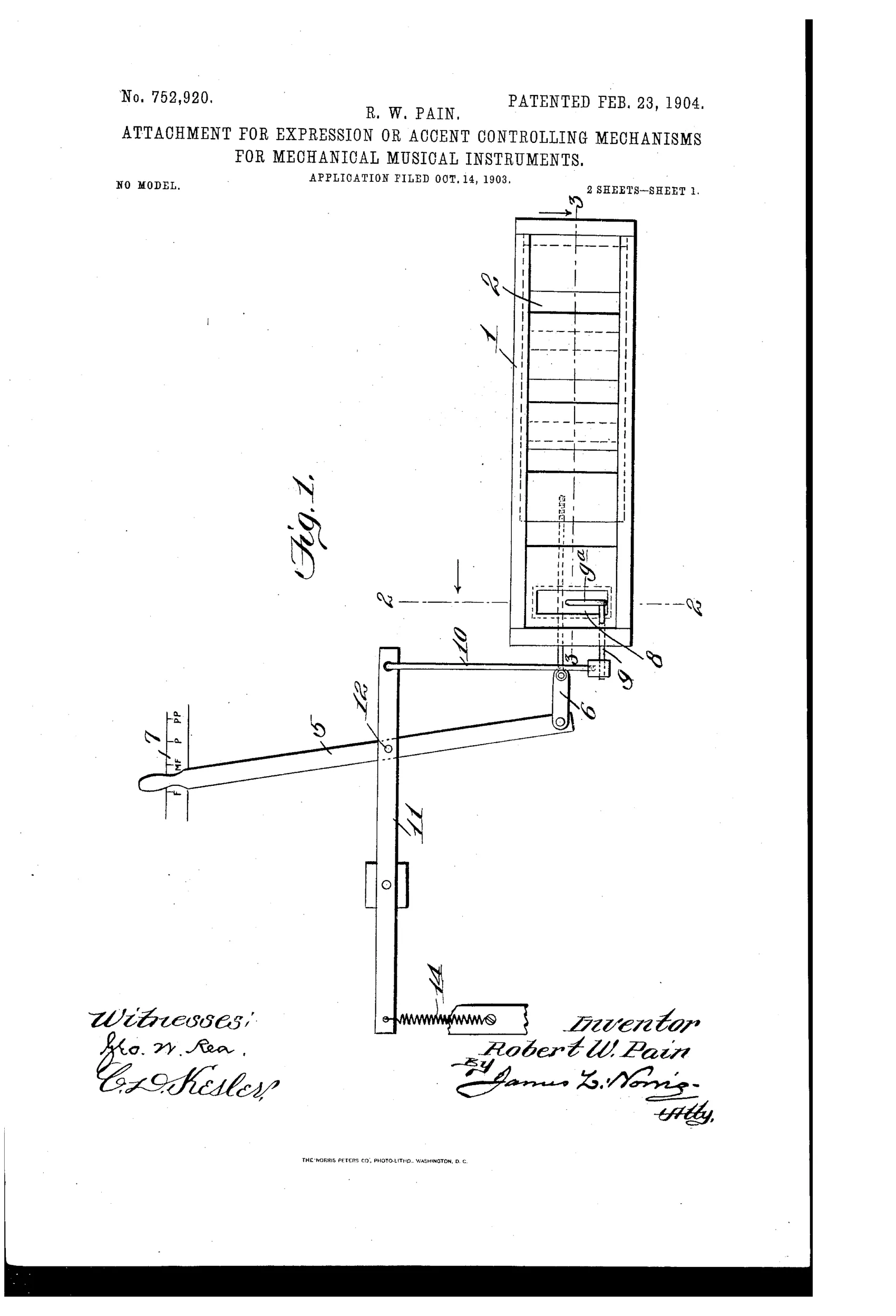
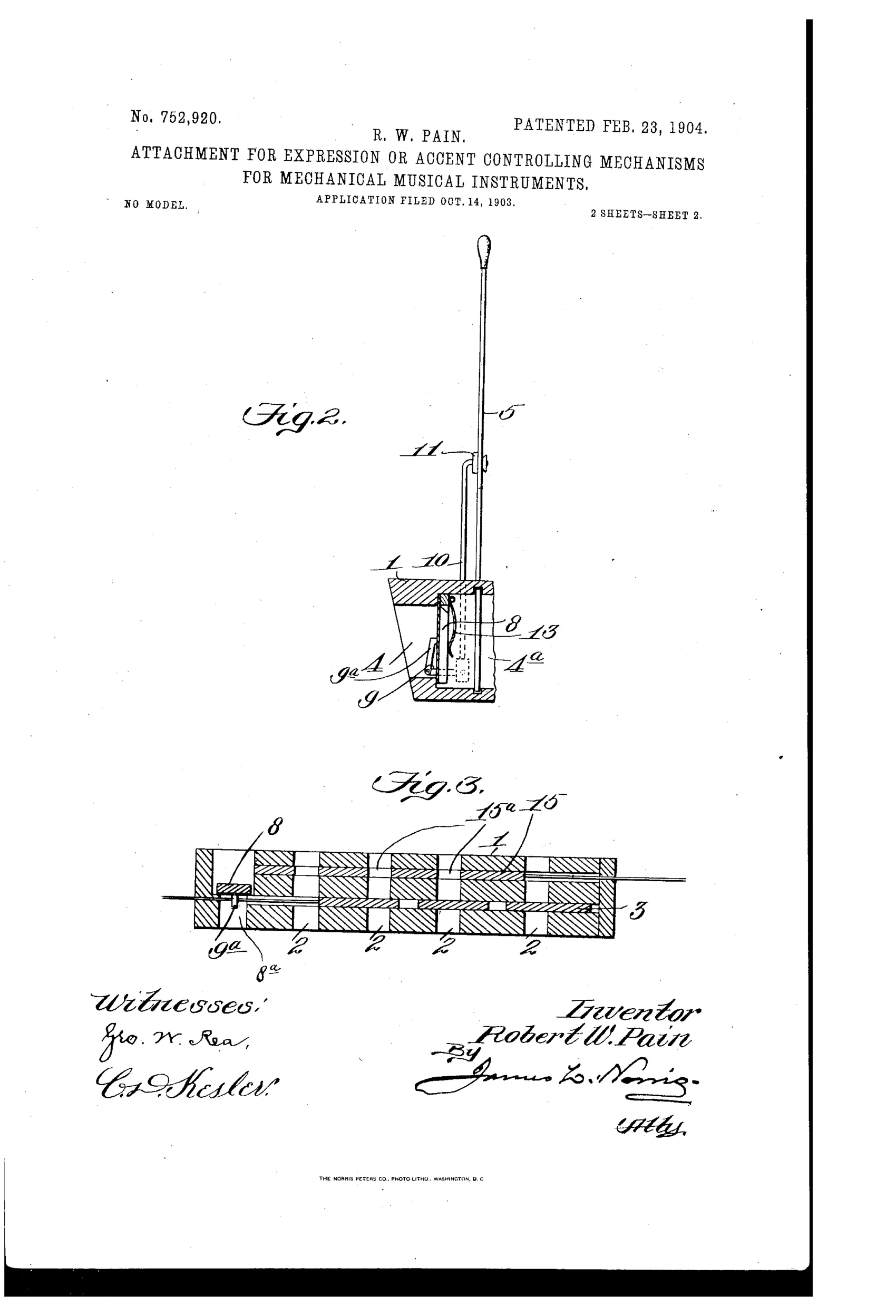
A gate box (1) has multiple passages (2) connecting an action-chamber (4) to a set of exhausters, with a sliding gate (3) that opens only one passage at a time depending on the lateral position of an operating handle (5), which travels along an indicating scale (7) marked with dynamics from pianissimo to fortissimo. A separate normally-closed supplemental valve (8), held shut by a spring (13), is connected via a crank-arm (9), rod (10), and pivoted arm (11) to the same handle (5), but is opened only by a different motion of the handle (e.g., a slight depression) rather than its lateral gate-selecting movement. This lets the performer instantly snap open a predetermined port to a chosen exhauster (such as forte) without having to physically slide the handle across the intervening scale positions. After use, springs (13, 14) return the valve and linkage to their normal closed position automatically.
♫ What was claimed
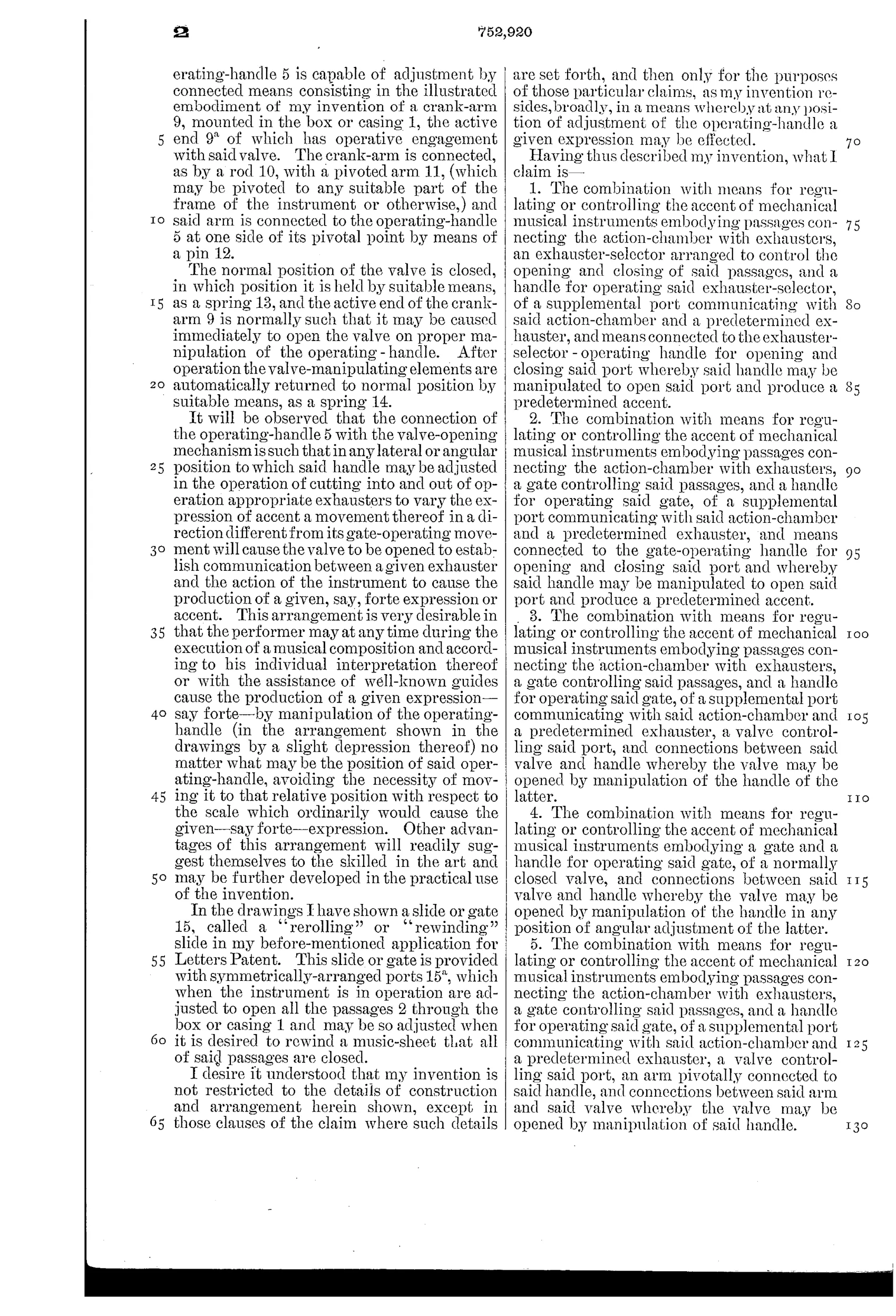
“8. The combination with means for regulating or controlling the accent of mechanical musical instruments, embodying a gate and a separate normally closed valve, of an operating-handle having connection with said gate and said valve and having two motions, one in direction to operate said gate and the other in different direction to open said valve.”
In plain English: The invention combines a gate-based expression control with a separate spring-closed valve, both operated by a single handle that moves in one direction to select an exhauster and in a different direction to instantly trigger the valve for a predetermined accent.
♫ In the inventor’s words
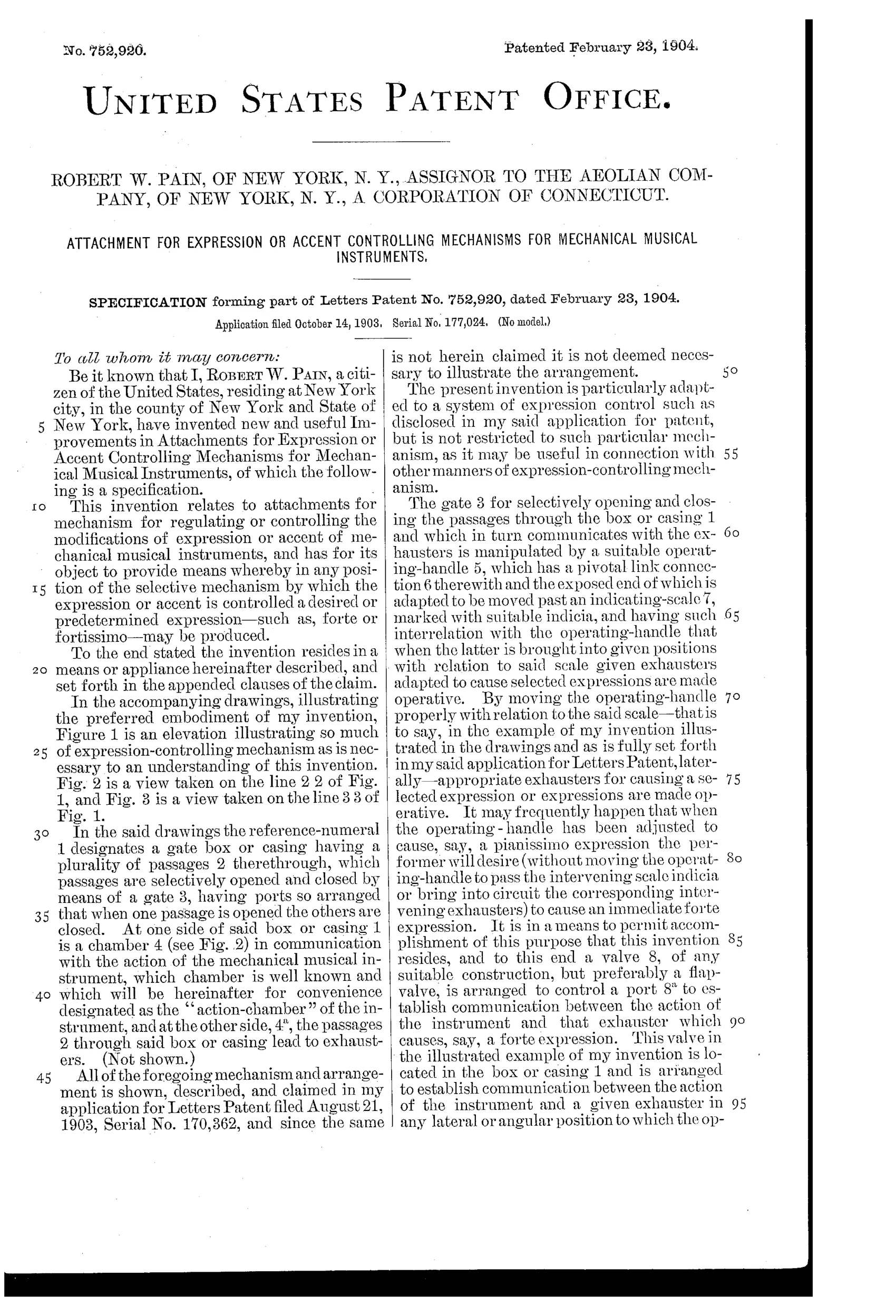
“It may frequently happen that when the operating-handle has been adjusted to cause, say, a pianissimo expression the performer will desire (without moving the operating-handle to pass the intervening scale indicia or bring into circuit the corresponding intervening exhausters) to cause an immediate forte expression.”— Robert W. Pain, from the specification
Fate unknown
Aeolian assignment and Pain's role make production plausible, but confirming this exact two-motion handle inside a surviving Pianola action would settle it.
♫ Commentary
The problem here is real and musical, not just mechanical. Aeolian's expression controls of this era worked by sliding a handle along a scale marked pianissimo to fortissimo, each position opening a gate to a different exhauster and thus a different suction level. That's fine for gradual swells, but music is full of sudden accents — and to get from pp to f you had to drag the handle across every intermediate position, sounding each one on the way. Pain's answer is to give the one handle two independent motions: the lateral slide still selects the gate, but a small depression of the same handle snaps open a separate spring-loaded valve straight to a predetermined loud exhauster. Release it and springs 13 and 14 close everything back to where you were.
Look at Fig. 1 and you can trace the whole chain: handle 5, rod 10, crank 9, valve 8 tucked at the bottom of the gate box. The elegance is that the accent valve bypasses the scale entirely — it's a shortcut wired in parallel with the graduated control, which is exactly how a pianist's hand treats a sforzando.
Pain was Aeolian's house engineer, one of the men who built the Pianola into a product, and this patent sits squarely in the company's push to make roll-playing sound performed rather than cranked. It's a refinement, not a first — but a refinement aimed at the right problem.
Commentary by Claude, The Talking Machine Patent Archive’s resident enthusiast