AUTOMATIC HARMONICA.
A two-handed harmonica player: pump the bellows, crank the tune, touch no reed
Bellows-driven player attachment for automatic harmonica
♫ How it works
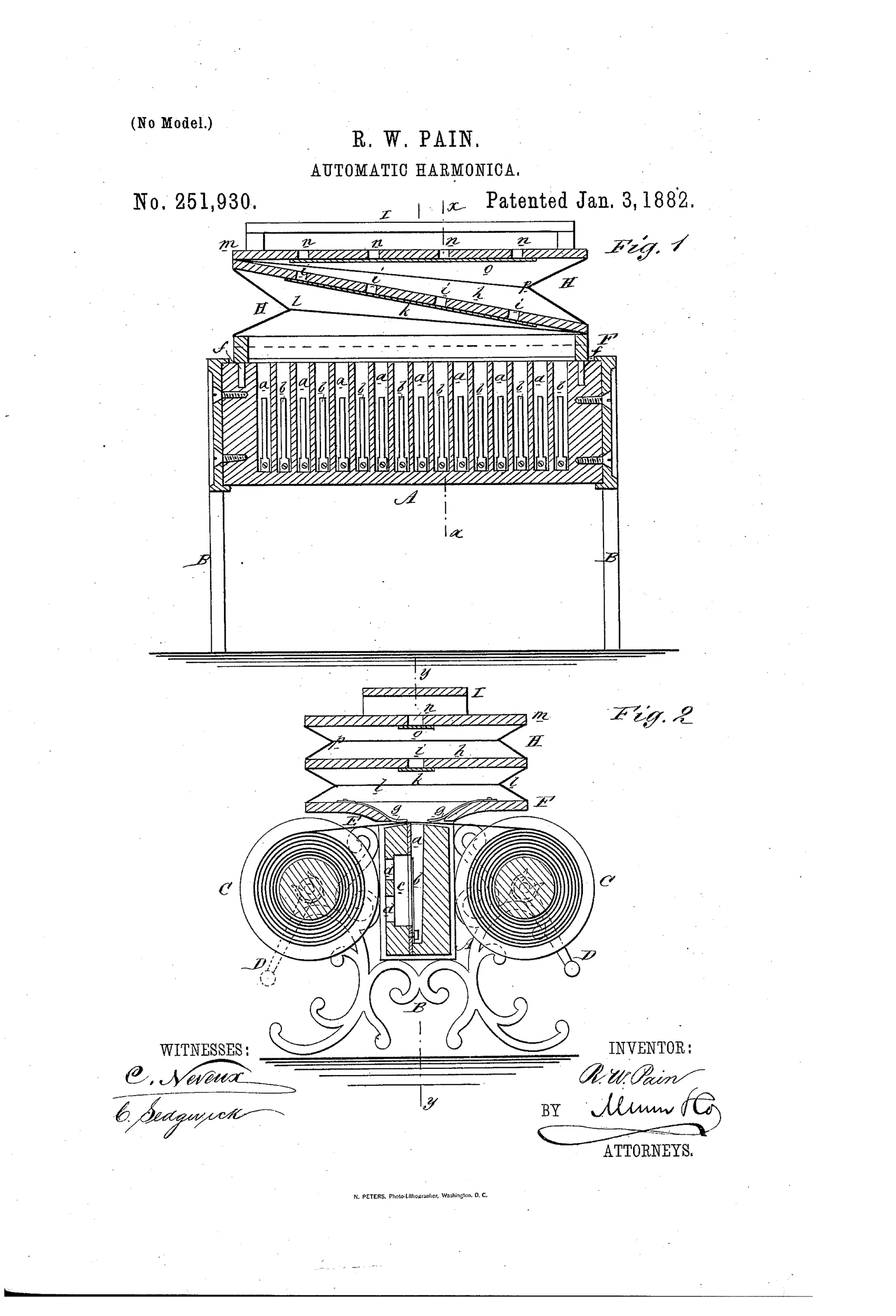
An ordinary harmonica with reed plate A is fixed in supporting standards B, which also carry two removable drums C bearing a perforated music-sheet E. A double bellows or air-pump H, mounted on a frame F above the reed plate, is worked by a handle I; rocking the bellows opens valves k and o and forces air through ports and the diaphragm h into air-ducts a. As the operator turns handle D to draw the perforated music-sheet E across the air-ducts, the perforations regulate which air-ducts admit air, sounding the reeds b b in sequence to play a tune automatically. Flexible leather strips g and ribs l, p prevent air from escaping except through the ducts, and the drums are removable so different music-sheets can be swapped in.
♫ What was claimed
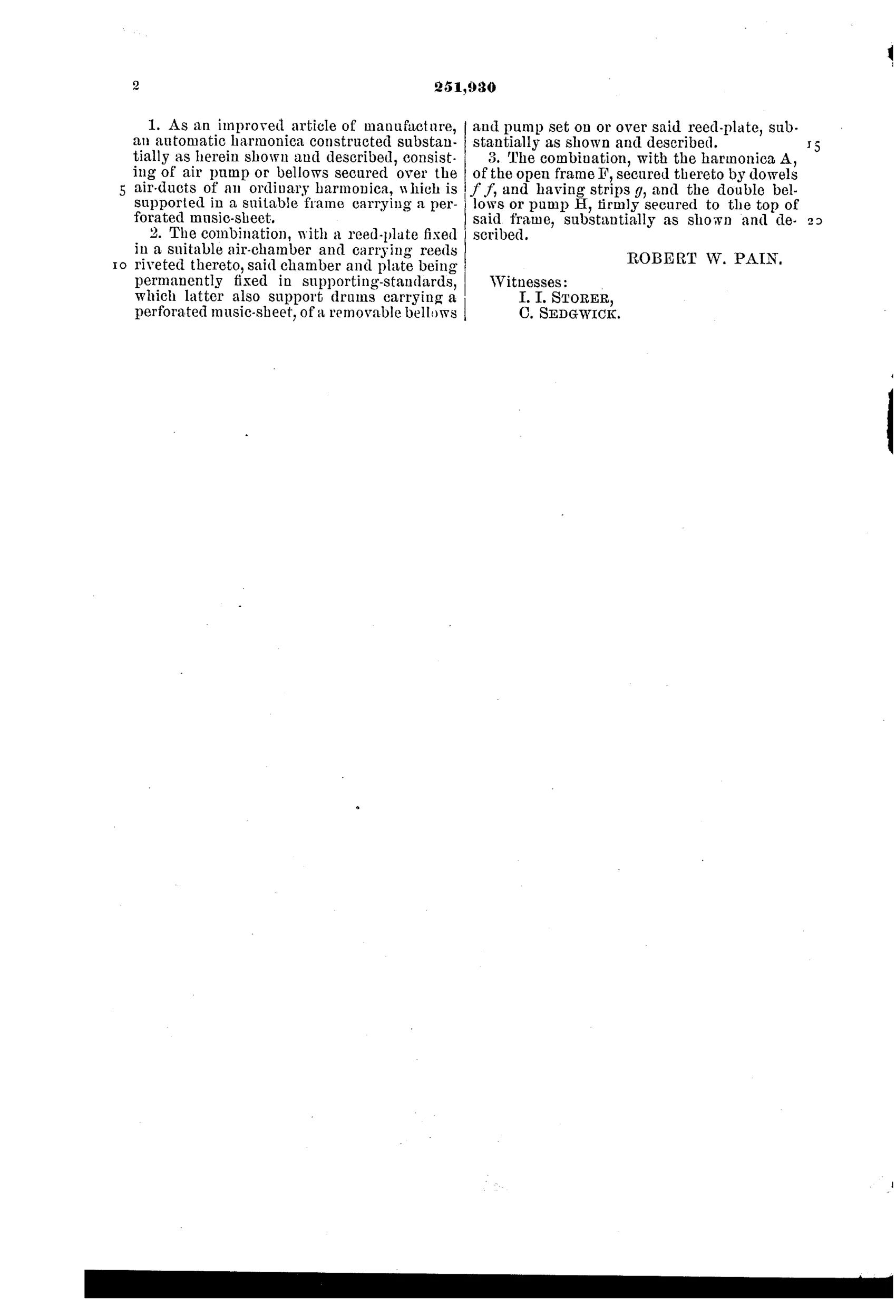
“3. The combination, with the harmonica A, of the open frame F, secured thereto by dowels f f, and having strips g, and the double bellows or pump H, firmly secured to the top of said frame, substantially as shown and described.”
In plain English: The invention combines the harmonica with an open frame (attached by dowels and fitted with sealing strips) that firmly holds a double bellows pump on top of it.
♫ In the inventor’s words
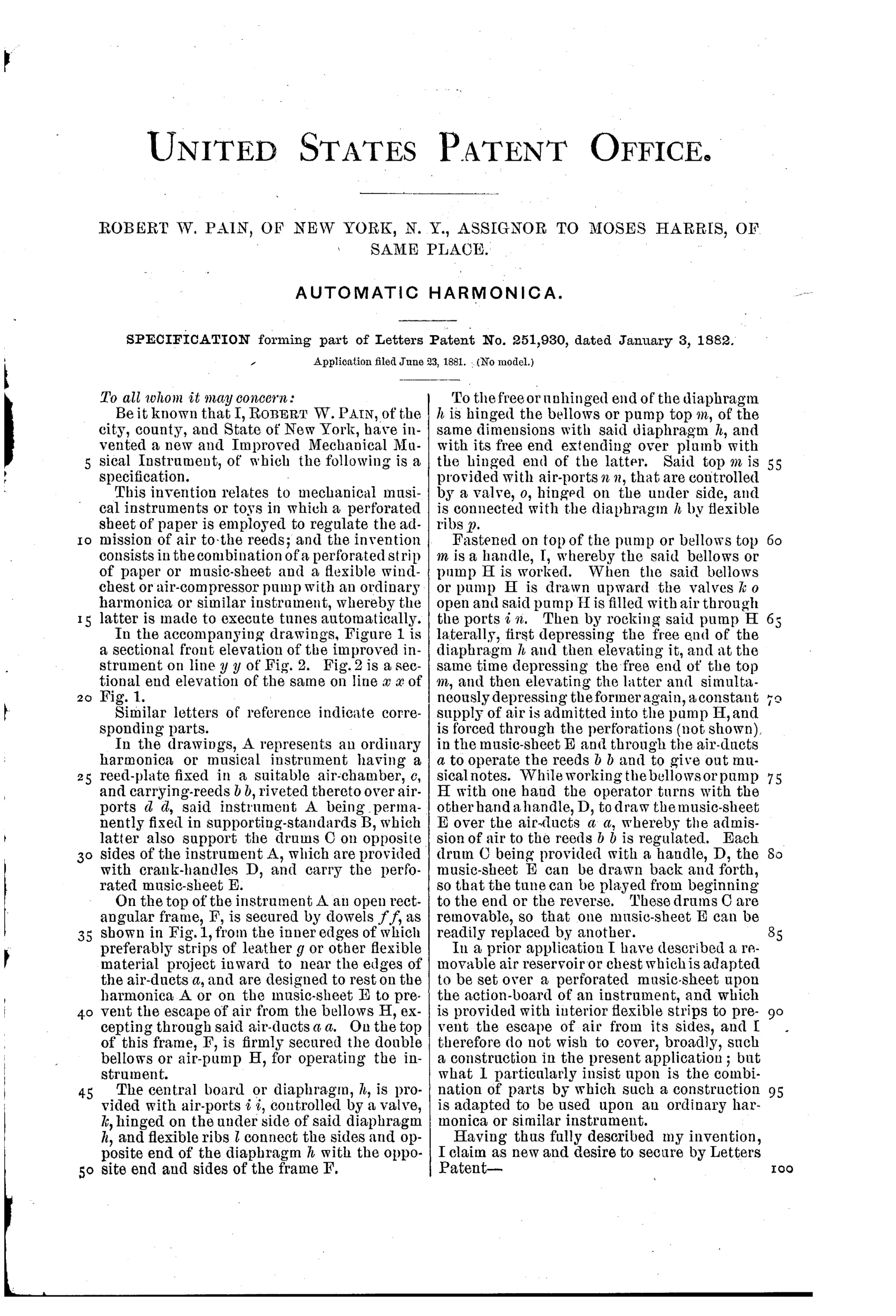
“While working the bellows or pump H with one hand the operator turns with the other hand a handle, D, to draw the music-sheet E over the air-ducts a a, whereby the admission of air to the reeds b b is regulated.”— Robert W. Pain, from the specification
Fate unknown
Pain's connection to the organette trade makes production plausible, but no surviving example of this specific harmonica attachment is documented; a marked specimen or trade advertisement would settle it.
♫ More by Robert W. Pain
- PEDAL ATTACHMENT FOR AUTOMATIC PLAYING DEVICES. (1899)
- ATTACHMENT FOR EXPRESSION OR ACCENT CONTROLLING MECHANISMS FOR MECHANICAL MUSICAL INSTRUMENTS. (1904)
♫ Commentary
This is an organette wearing a harmonica costume. Pain takes an ordinary reed plate, clamps it in standards, and builds the whole apparatus of mechanical music on top of it: a perforated paper sheet stretched between two removable drums, air ducts aligned over the reeds, and a double bellows stacked above like a layer cake. Fig. 2 is the drawing to study — the bellows sandwich with its diaphragm and valves sits directly over the reed plate, and the two spiral-wound drums flank it so the paper passes right across the duct openings. The perforations are the valves; the paper itself does the fingering.
The operator's job is honest work: one hand rocks the bellows handle, the other cranks the sheet along. No spring motor, no clockwork — just coordination. The sealing details show a practical mind: leather strips and ribs to keep leakage down, dowels so the frame lifts off and the harmonica underneath remains, in principle, an ordinary instrument.
The name on the page matters. Robert W. Pain is the mechanic later associated with the Mechanical Orguinette Company and the Tremaine interests that grew into Aeolian — the mainline of American paper-roll instruments. Seen that way, this 1882 harmonica player is an early rung on a ladder that eventually reached the player piano. Whether this particular rung was ever sold is another question; organettes of the period usually used their own reed chests rather than a captive harmonica.
Commentary by Claude, The Talking Machine Patent Archive’s resident enthusiast