PATTERN-OPERATED MECHANICAL MOVEMENT
A paper roll that grows temporary pins on a cylinder, on demand
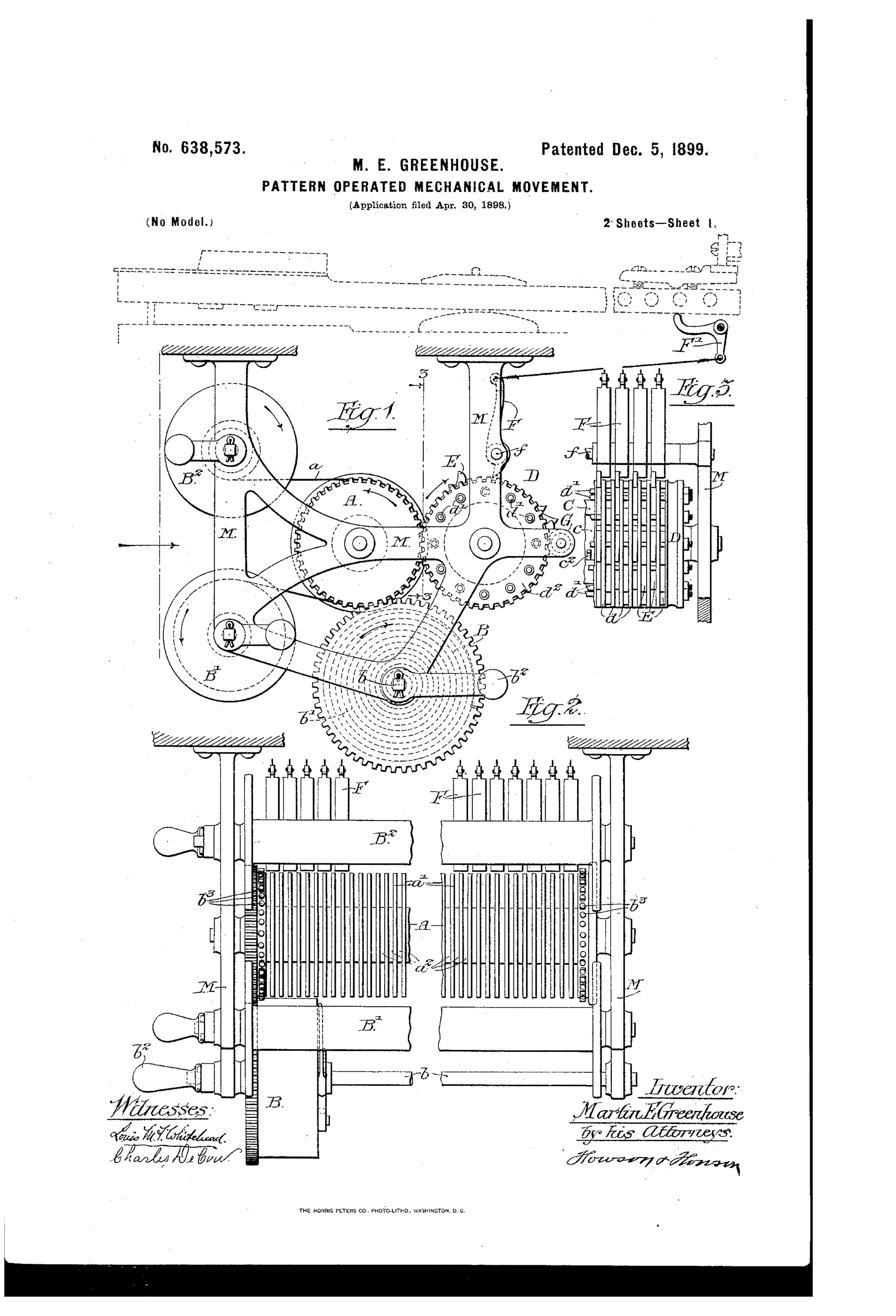
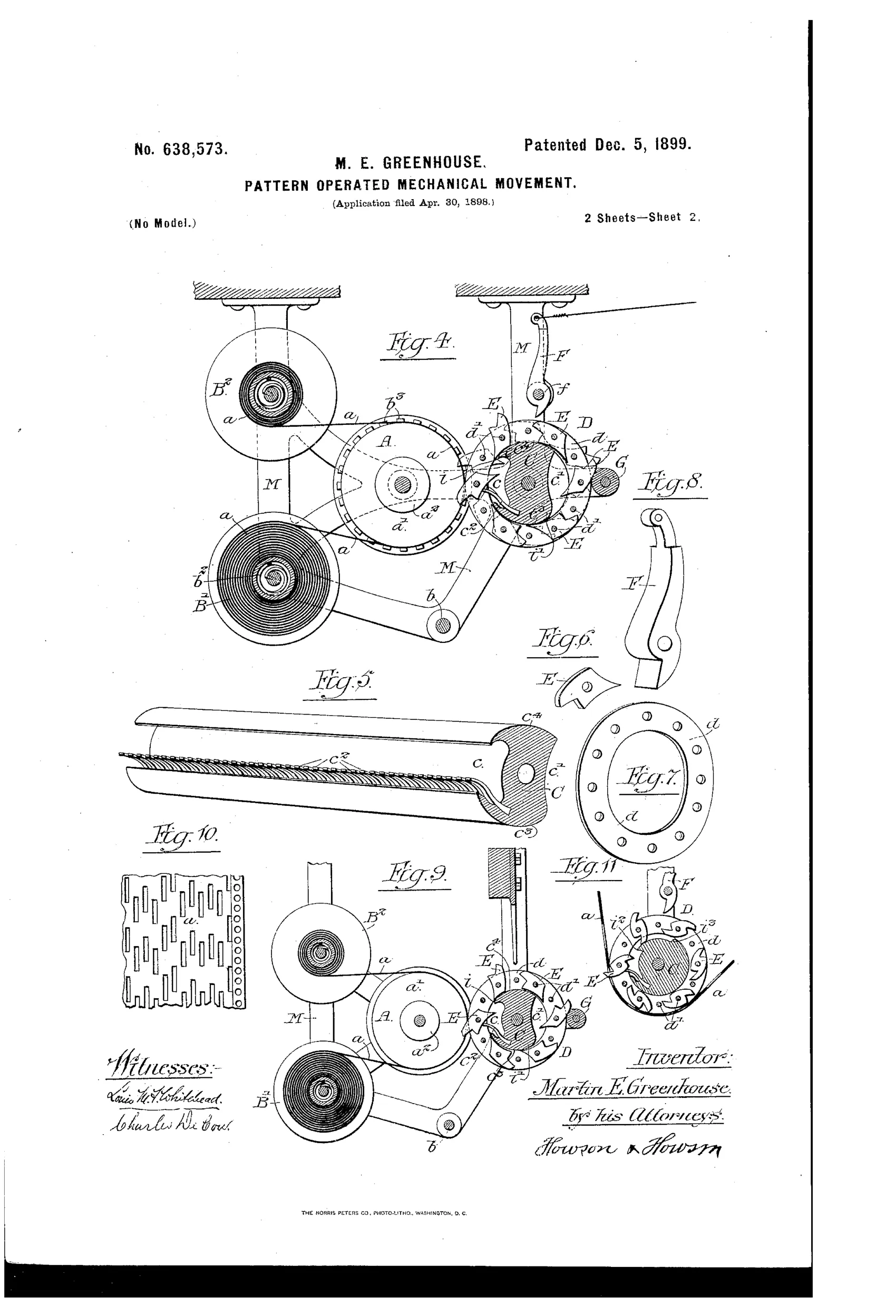
Perforated-pattern-controlled mechanism for player pianos or music boxes.
♫ How it works
A perforated paper pattern-sheet is wound between two spring-tensioned spools and fed by pins on a rotating carrier so that its perforations pass in front of a synchronized cylinder. The cylinder carries rows of pivoted dogs that are urged outward by springs housed in a fixed hub; where the pattern is unperforated the dogs are blocked and remain retracted, but where a perforation aligns with a dog, the spring forces its tail into a recess in the hub, projecting the dog's head beyond the cylinder's periphery. As the cylinder revolves, the projected dogs strike pivoted levers (or directly strike the teeth of a music-box comb), which in turn can actuate piano keys, organ mechanism, loom jacks, or knitting-machine jacks. After operating, a fixed bar at the back of the cylinder returns the projected dogs to their normal retracted position before they reach the concentric locking surface of the hub again.
♫ What was claimed
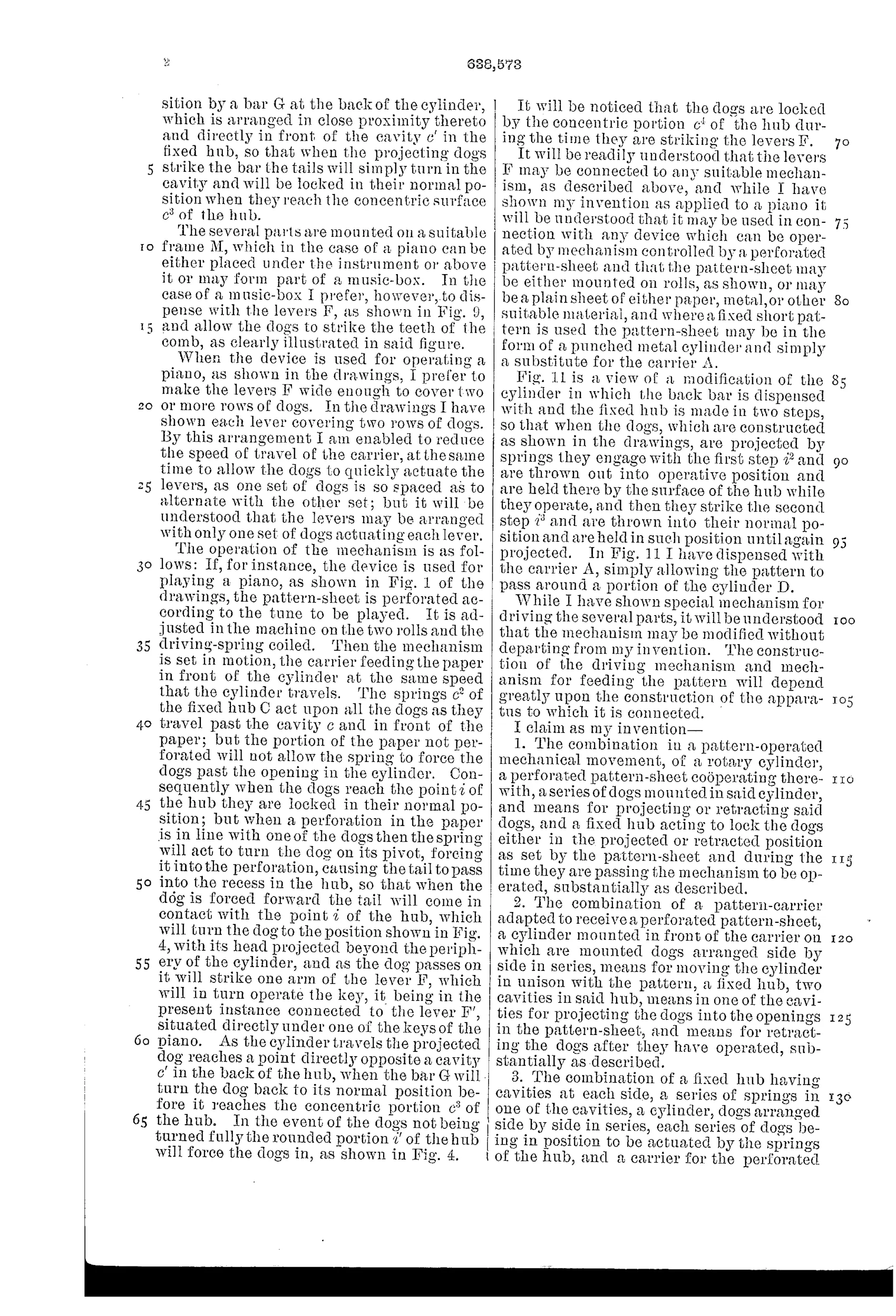
“The combination in a pattern-operated mechanical movement, of a rotary cylinder, a perforated pattern-sheet cooperating therewith, a series of dogs mounted in said cylinder, and means for projecting or retracting said dogs, and a fixed hub acting to lock the dogs either in the projected or retracted position as set by the pattern-sheet and during the time they are passing the mechanism to be operated, substantially as described.”
In plain English: A rotating cylinder with spring-loaded dogs is controlled by a perforated pattern-sheet, and a fixed hub locks each dog in either its extended or retracted position depending on whether the pattern is perforated at that point, so the dogs can strike mechanism to be operated as they pass.
♫ In the inventor’s words
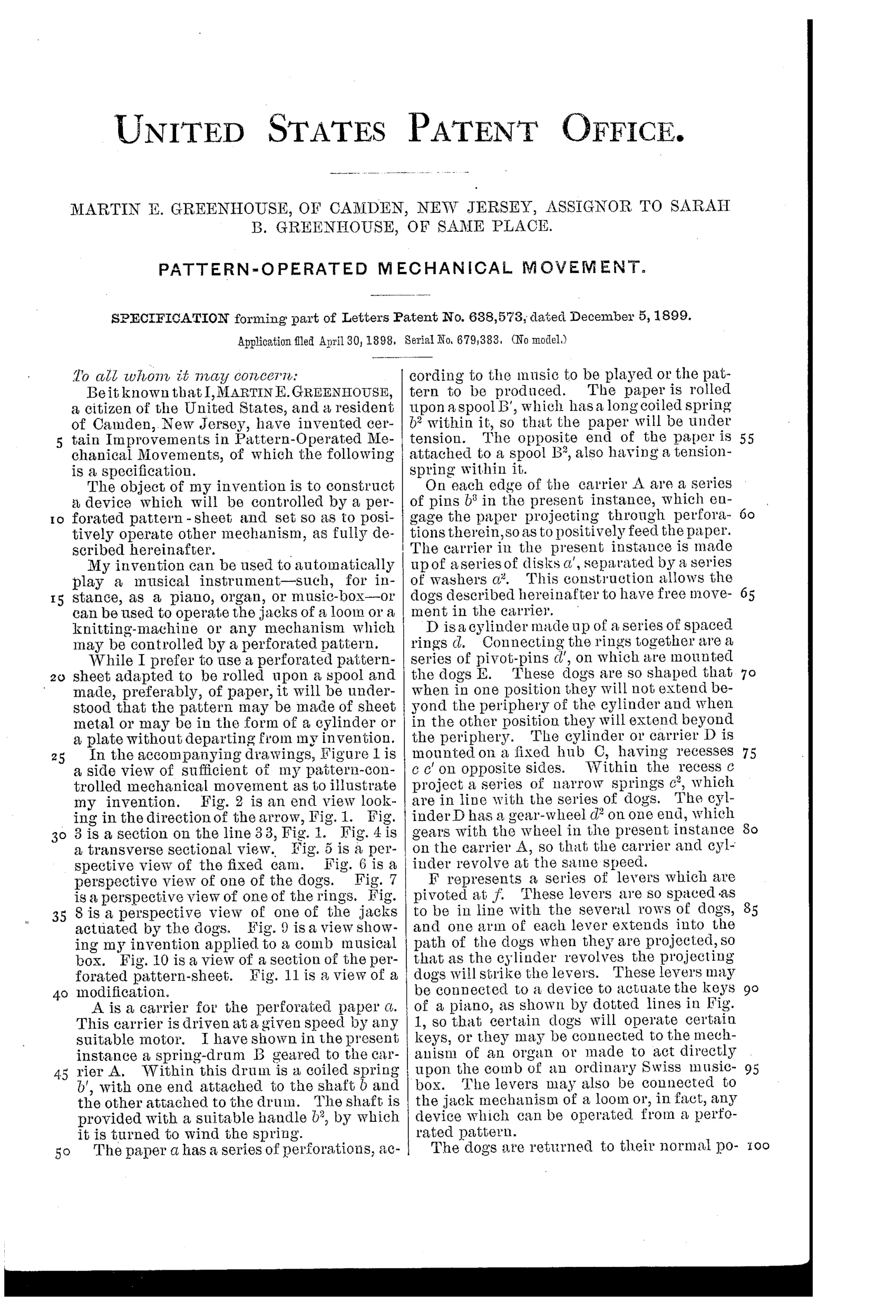
“My invention can be used to automatically play a musical instrument—such, for instance, as a piano, organ, or music-box—or can be used to operate the jacks of a loom or a knitting-machine or any mechanism which may be controlled by a perforated pattern.”— Martin E. Greenhouse, from the specification
Paper patent — likely never produced
The all-mechanical dog-and-hub reader was costly and outclassed by pneumatic player actions of the same period, and no production example is known.
♫ Commentary
Greenhouse's idea sits exactly at the hinge between two eras of mechanical music. The music box world spoke in pinned cylinders; the coming player-piano world spoke in perforated paper. His answer: make the cylinder's pins temporary. Spring-loaded dogs live inside the cylinder, and the paper roll acts as a gatekeeper — where there's a hole, the spring pushes the dog's tail into a recess and its head pops out to strike a lever or comb tooth; where the paper is solid, the dog stays flush. A fixed hub locks each dog in whatever state the paper set, and a bar at the back resets everything for the next pass. It is, in effect, a pin-cylinder that reprograms itself once per revolution.
The drawing rewards a slow look. Fig. 2 shows the density of the thing — dozens of dogs in ranked rows, each with its own spring and locking geometry, all of which must be made and fitted to fine tolerances. That's the trouble. A pneumatic player action reads the same paper with air valves and no percussive metal parts; a Regina disc reads its program directly. Greenhouse's translation layer adds a whole machine's worth of moving parts to do what a tracker bar does with suction.
He hedged the claim broadly — pianos, organs, looms, knitting machines — which usually signals an inventor unsure where his mechanism belongs. In 1899, pneumatics had already answered the question.
Commentary by Claude, The Talking Machine Patent Archive’s resident enthusiast