AUTOMATIC PIANO-PLAYER
Organ builder E. M. Skinner uses blank paper, not holes, to accent notes
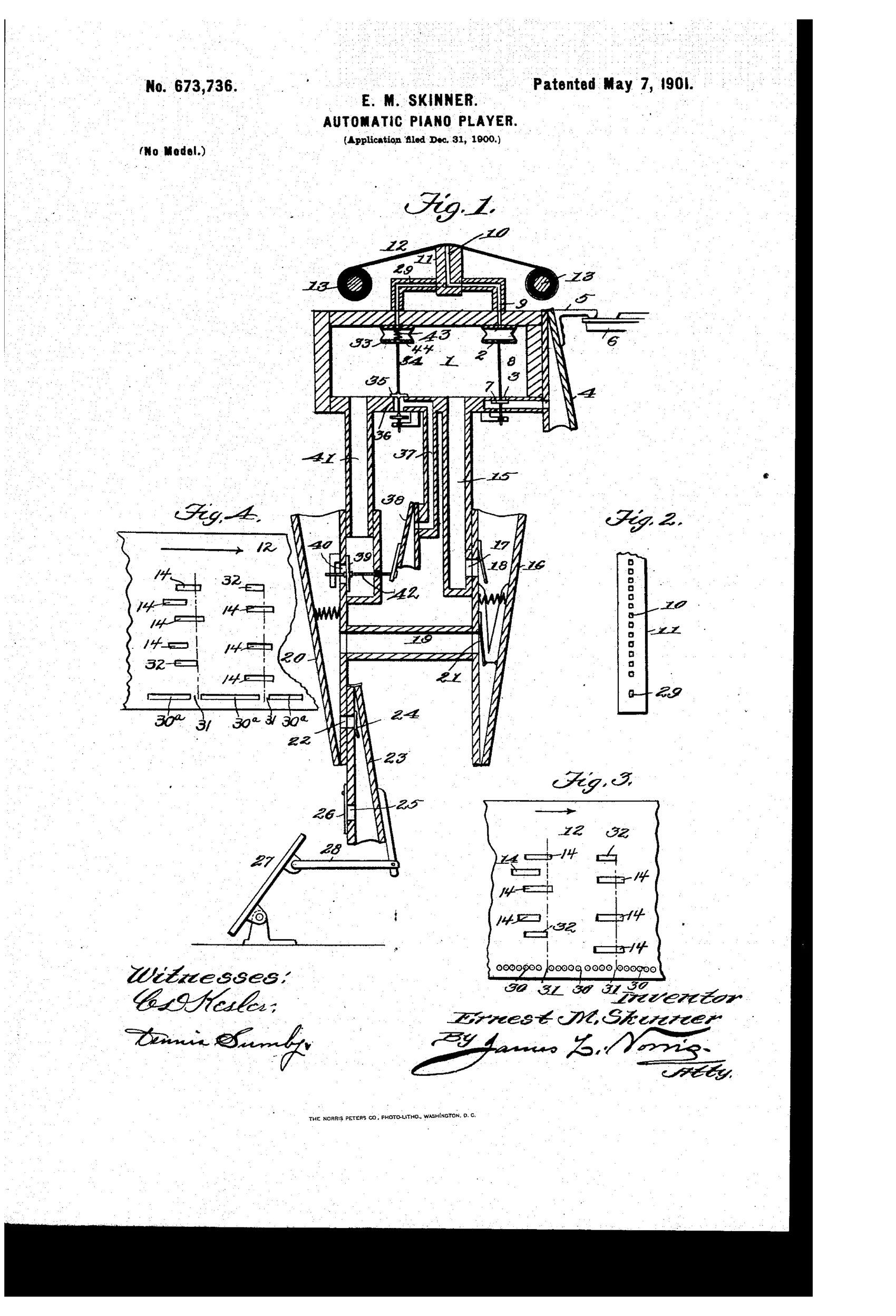
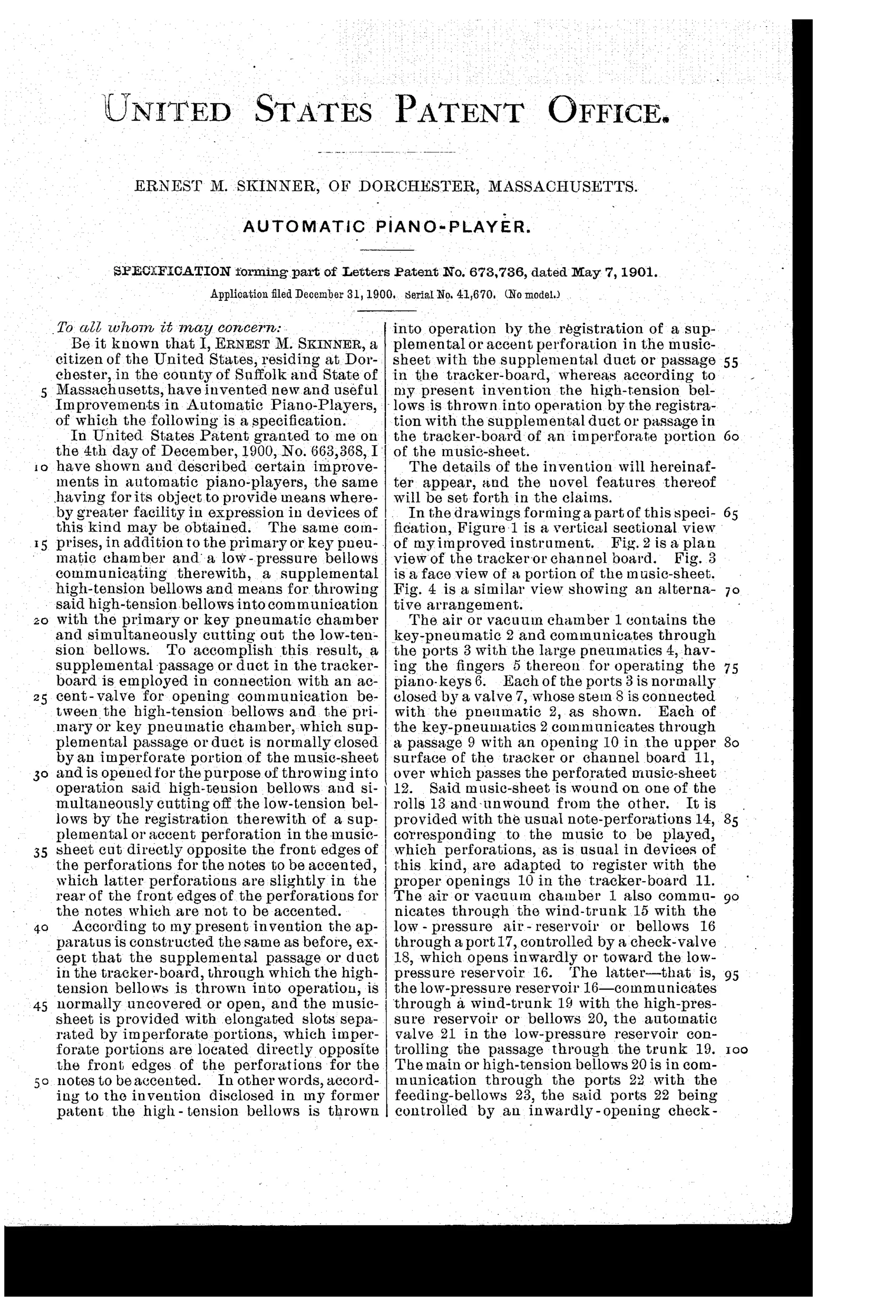
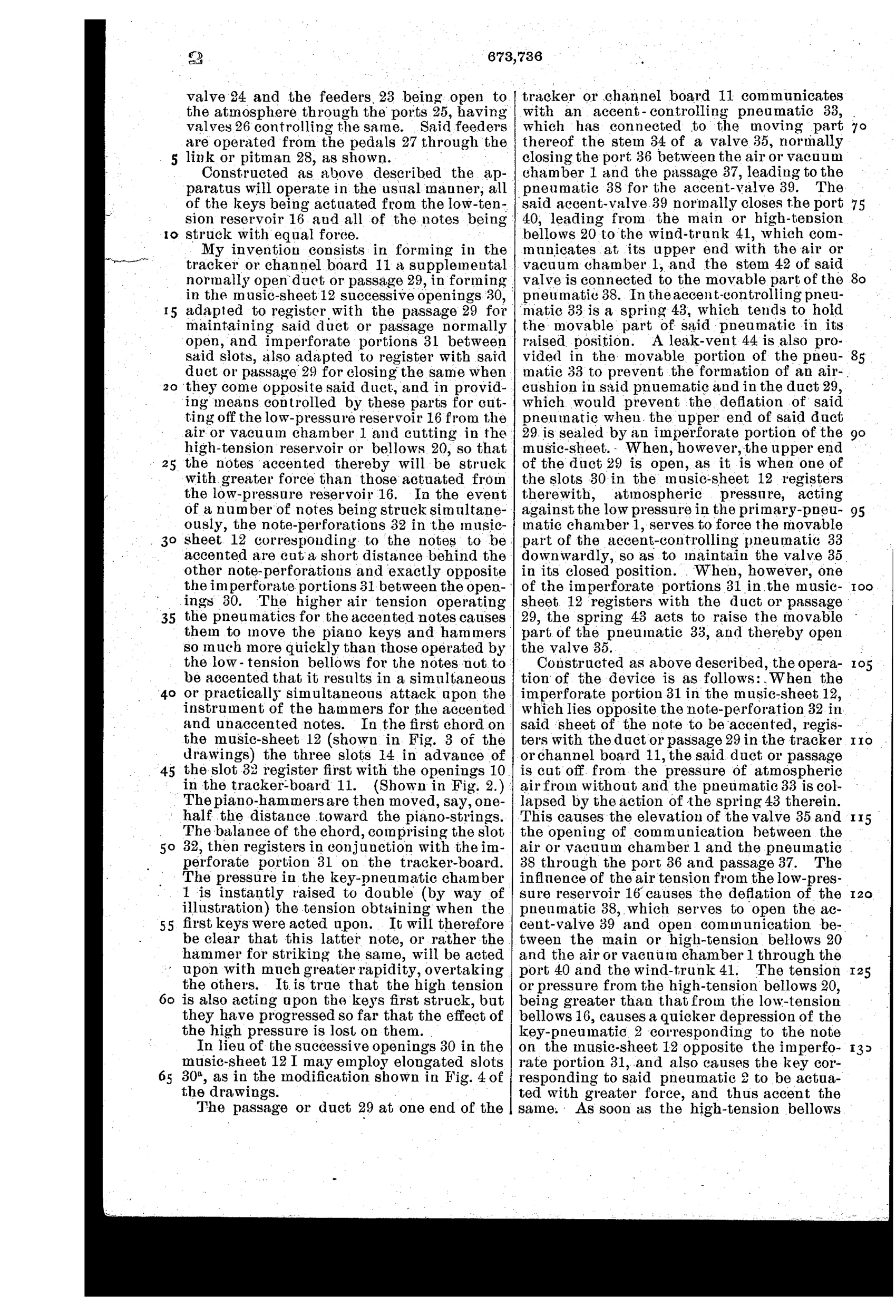
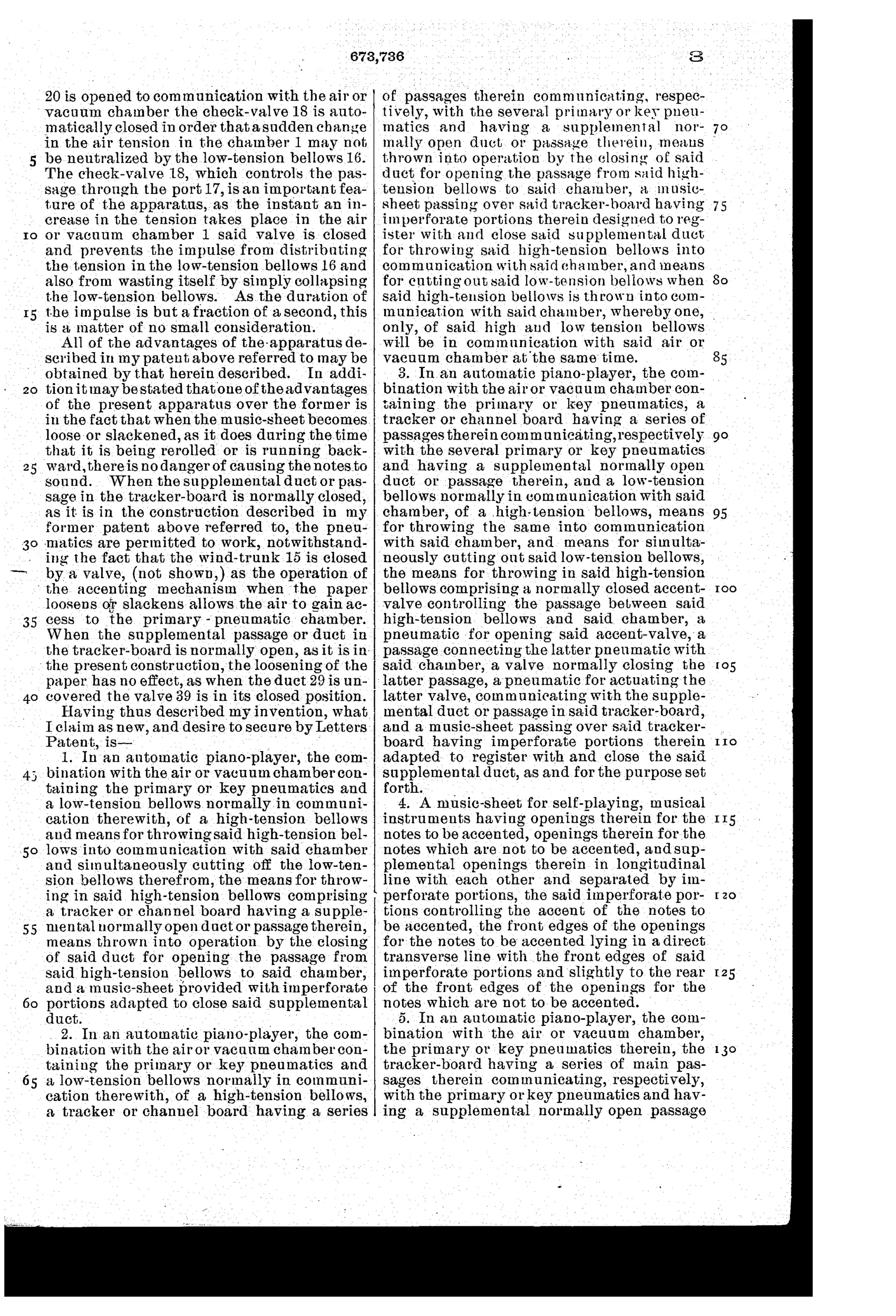
Pneumatic player-piano accenting mechanism
♫ How it works
An air or vacuum chamber contains key-pneumatics that operate the piano keys via fingers on large pneumatics. A tracker board with openings registers with perforations in a moving music-sheet to admit or block air, actuating each key-pneumatic through low-tension bellows normally. A supplemental duct in the tracker-board, when uncovered by imperforate portions of the music-sheet cut opposite accented notes, opens an accent-valve pneumatic that shifts control to a high-tension bellows. Because the high-tension bellows moves the key-pneumatic with greater force and speed than the low-tension bellows, the accented notes are struck harder and essentially simultaneously with unaccented ones despite being registered slightly later on the sheet.
♫ What was claimed
“1. In an automatic piano-player, the combination with the air or vacuum chamber containing the primary or key pneumatics and a low-tension bellows normally in communication therewith, of a high-tension bellows and means for throwing said high-tension bellows into communication with said chamber and simultaneously cutting off the low-tension bellows therefrom, the means for throwing in said high-tension bellows comprising a tracker or channel board having a supplemental normally open duct or passage therein, means thrown into operation by the closing of said duct for opening the passage from said high-tension bellows to said chamber, and a music-sheet provided with imperforate portions adapted to close said supplemental duct.”
In plain English: The piano-player combines a low-pressure bellows for normal notes with a high-pressure bellows that is switched in—cutting out the low-pressure bellows—whenever a solid (unperforated) section of the music roll covers a special extra channel in the tracker board, giving accented notes a harder, faster strike.
♫ In the inventor’s words
“The higher air tension operating the pneumatics for the accented notes causes them to move the piano keys and hammers so much more quickly than those operated by the low-tension bellows for the notes not to be accented that it results in a simultaneous or practically simultaneous attack upon the instrument of the hammers for the accented and unaccented notes.”— Ernest M. Skinner, from the specification
Paper patent — likely never produced
No player piano using this specific accent scheme is documented, and Skinner's career went to pipe organs almost immediately; it reads as a talented mechanic's side patent.
♫ Commentary
The name should ring a bell: this is the Ernest M. Skinner, then a young voicer and mechanic in the Boston organ trade, a few years before founding the company that would build America's grandest orchestral pipe organs. Here he's attacking the player-piano's central artistic problem — everything plays at the same dead volume — and doing it with a genuinely clever inversion.
Every accenting scheme needs a way to signal 'hit this one harder' from the roll. Most inventors reached for extra perforations. Skinner runs a supplemental duct in the tracker bar that is normally open, and lets an imperforate patch of paper — solid roll, not a hole — cover it. That closure trips a valve pneumatic which cuts out the low-tension bellows and slams the high-tension bellows onto the chamber. Fig. 3 shows the tell: the accented note's perforation sits slightly downstream on the sheet, because the harder, faster strike catches up, landing the accented and unaccented hammers together. That timing compensation, spelled out in the specification, is the mark of someone who actually understood pneumatic lag.
The weakness is that switching the whole chamber to high tension accents everything sounding at that instant — no per-note dynamics, the problem Aeolian's later Themodist and the reproducing pianos would chase with divided chests. So this is an early, honorable half-step: right diagnosis, coarse cure, from a man about to spend his real career on wind-blown instruments.
Commentary by Claude, The Talking Machine Patent Archive’s resident enthusiast