MECHANICAL PIANO-PLAYER
Double-acting air power drives keys down and pulls them back up
Pneumatic key-actuating mechanism for player pianos
♫ How it works
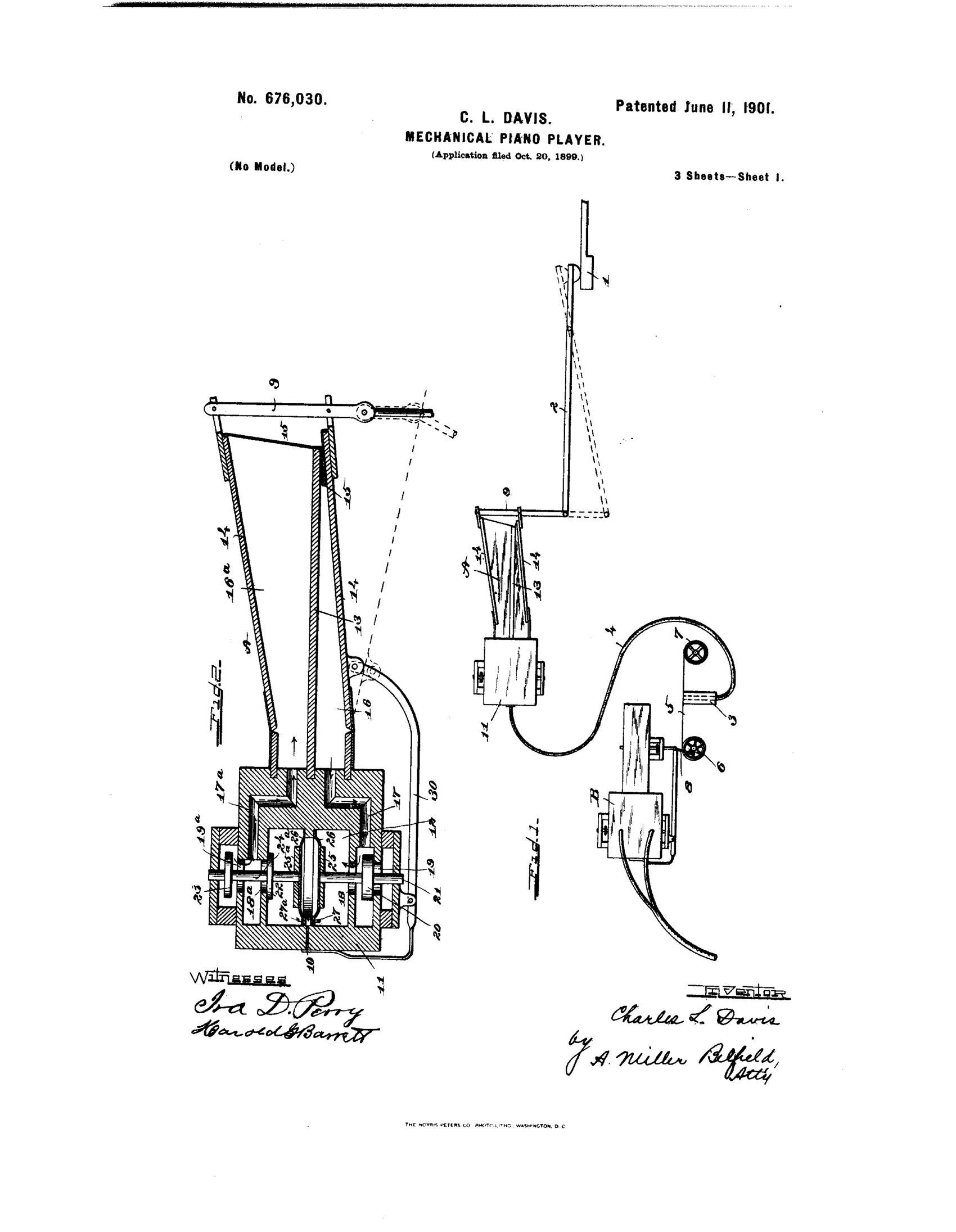
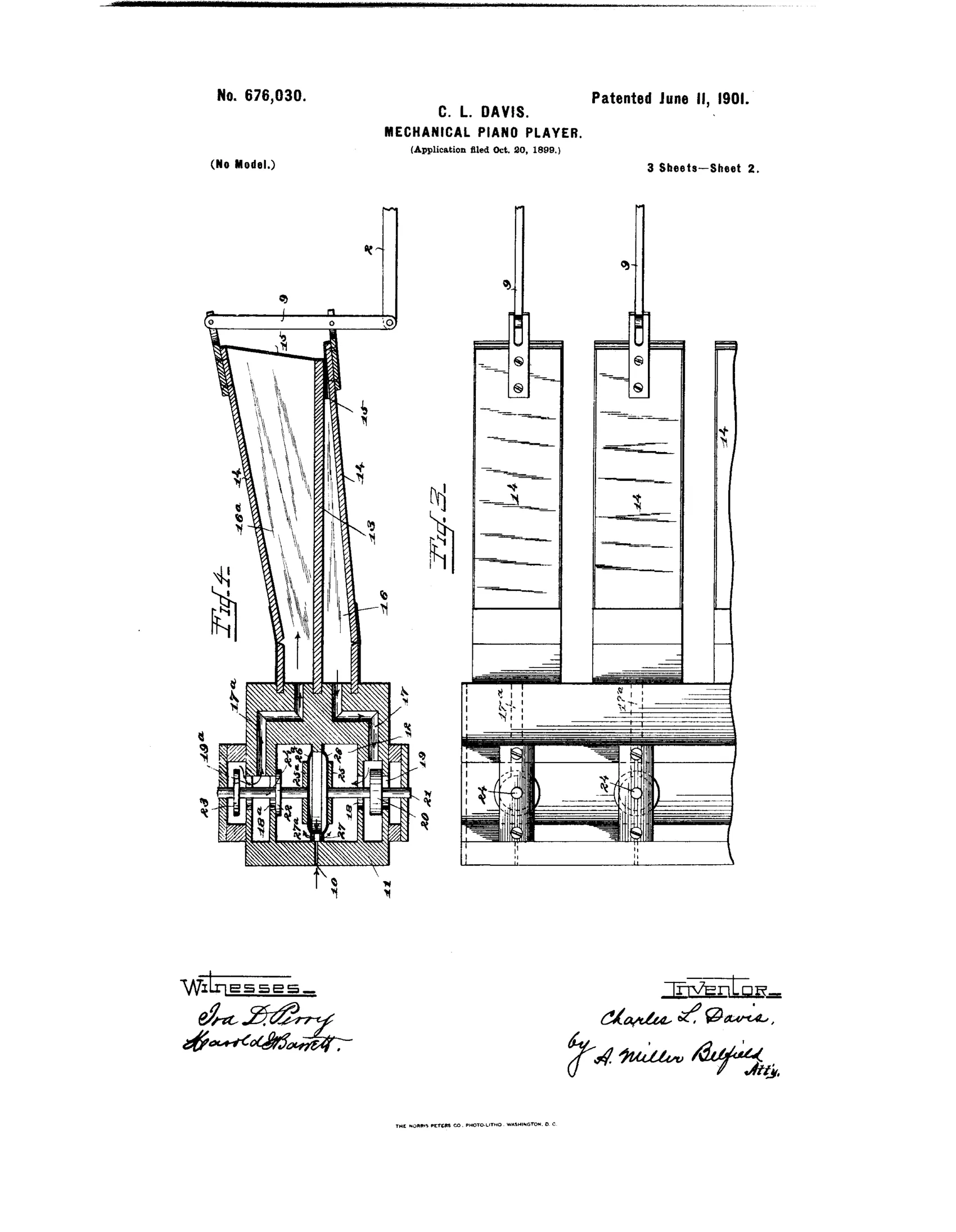
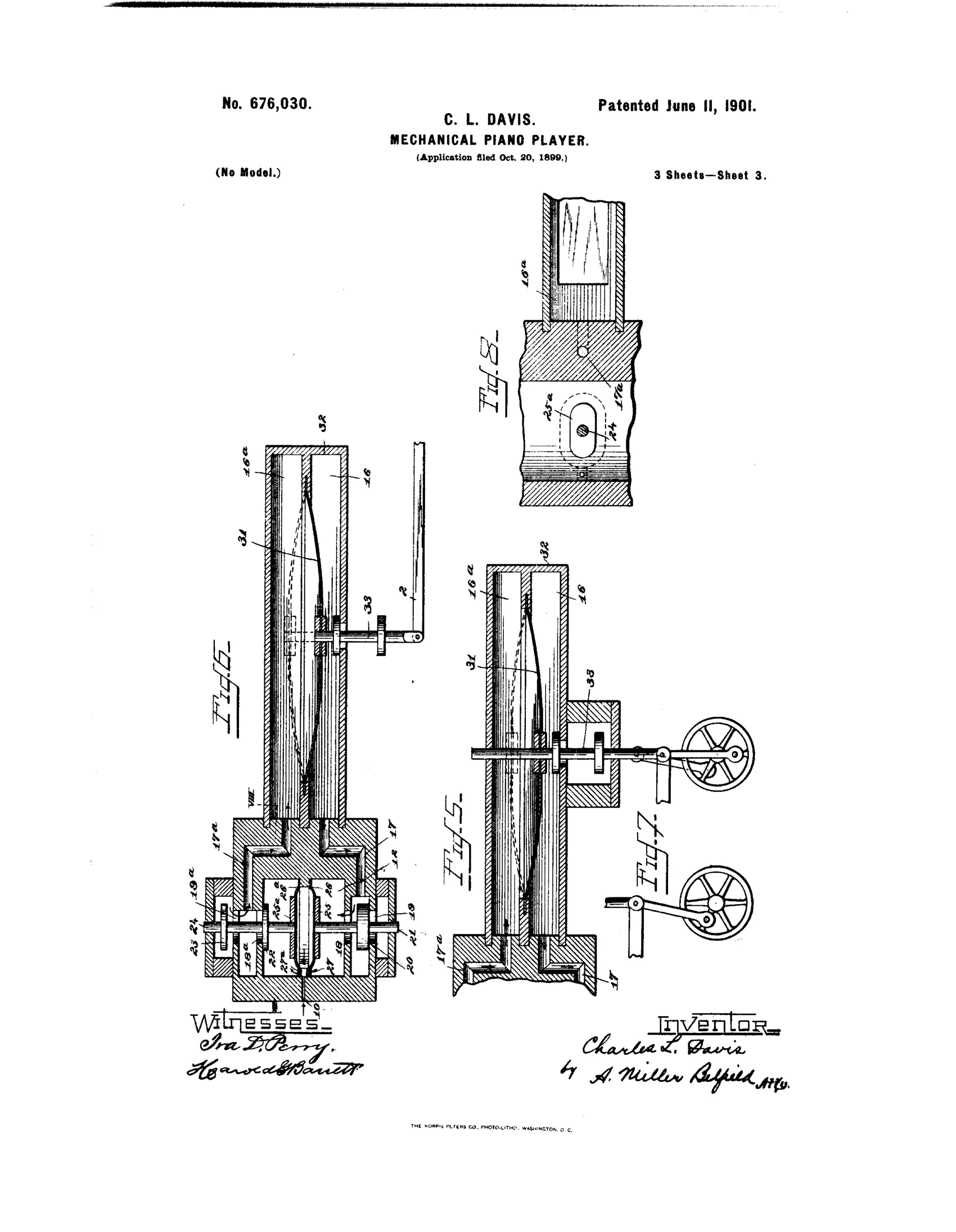
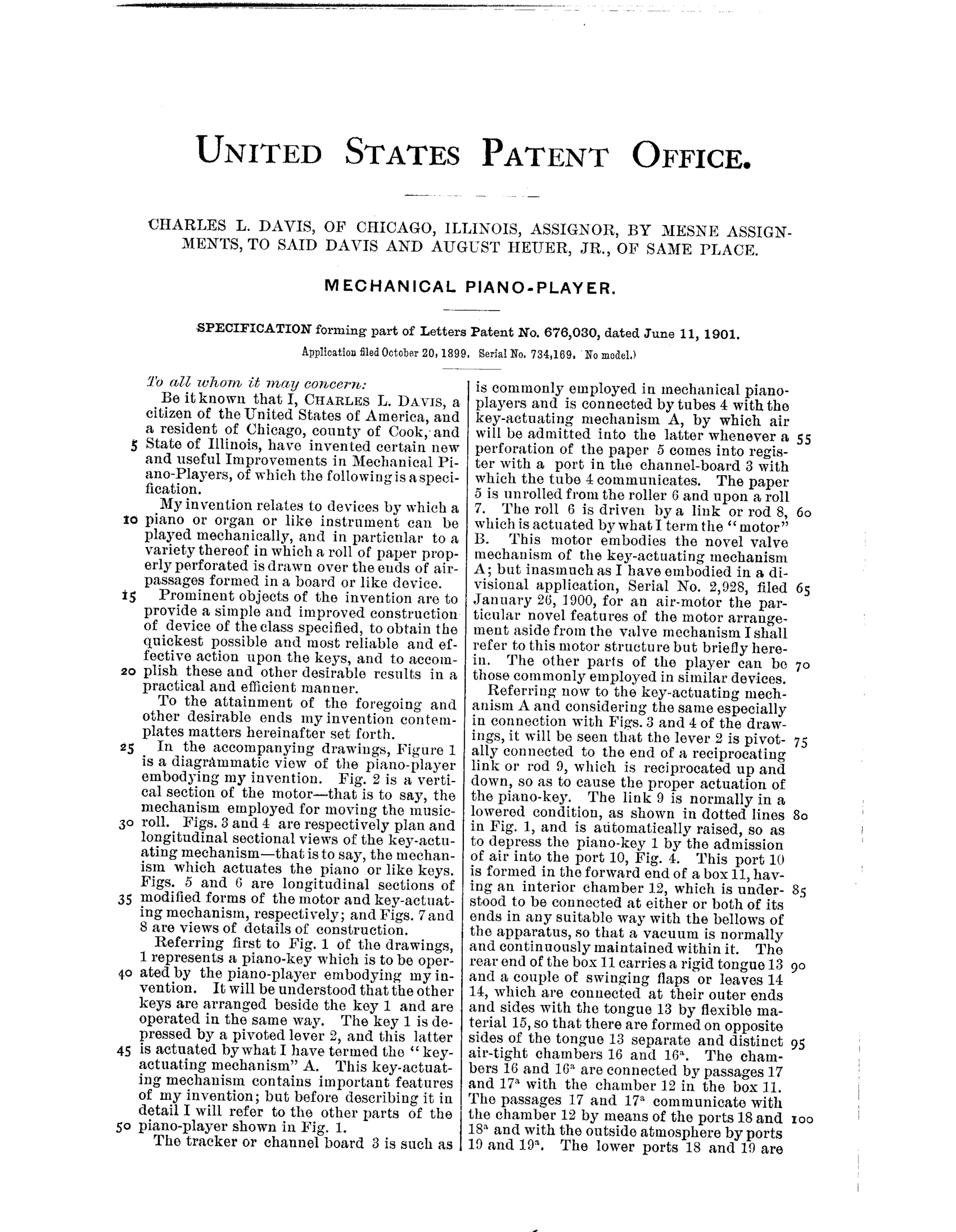
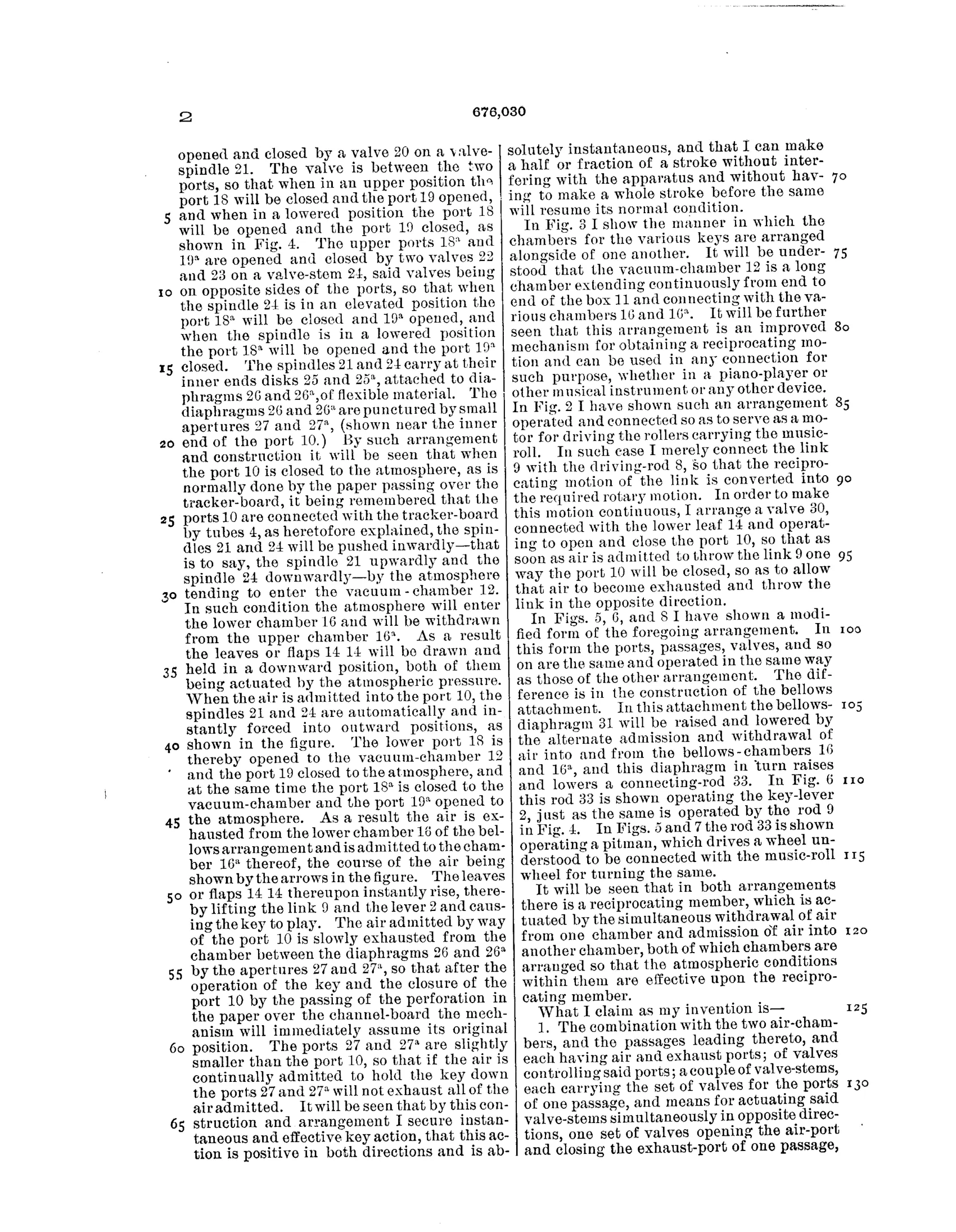
A perforated paper roll passes over a tracker or channel-board, and when a perforation registers with a port, air is admitted through a tube into a key-actuating mechanism. This mechanism contains a box with an interior vacuum-chamber connected to bellows, and a rigid tongue with swinging flaps or leaves that form separate air-tight chambers on either side. Flexible diaphragms punctured with small apertures control valve-spindles that open and close ports, so admission of air to one chamber and simultaneous exhaust from the other instantly reciprocates a link or rod. This link is pivotally connected to a lever that depresses the piano key, and the same reciprocating principle, when connected to a driving-rod, can also serve as a motor to turn the rollers that advance the music-roll.
♫ What was claimed
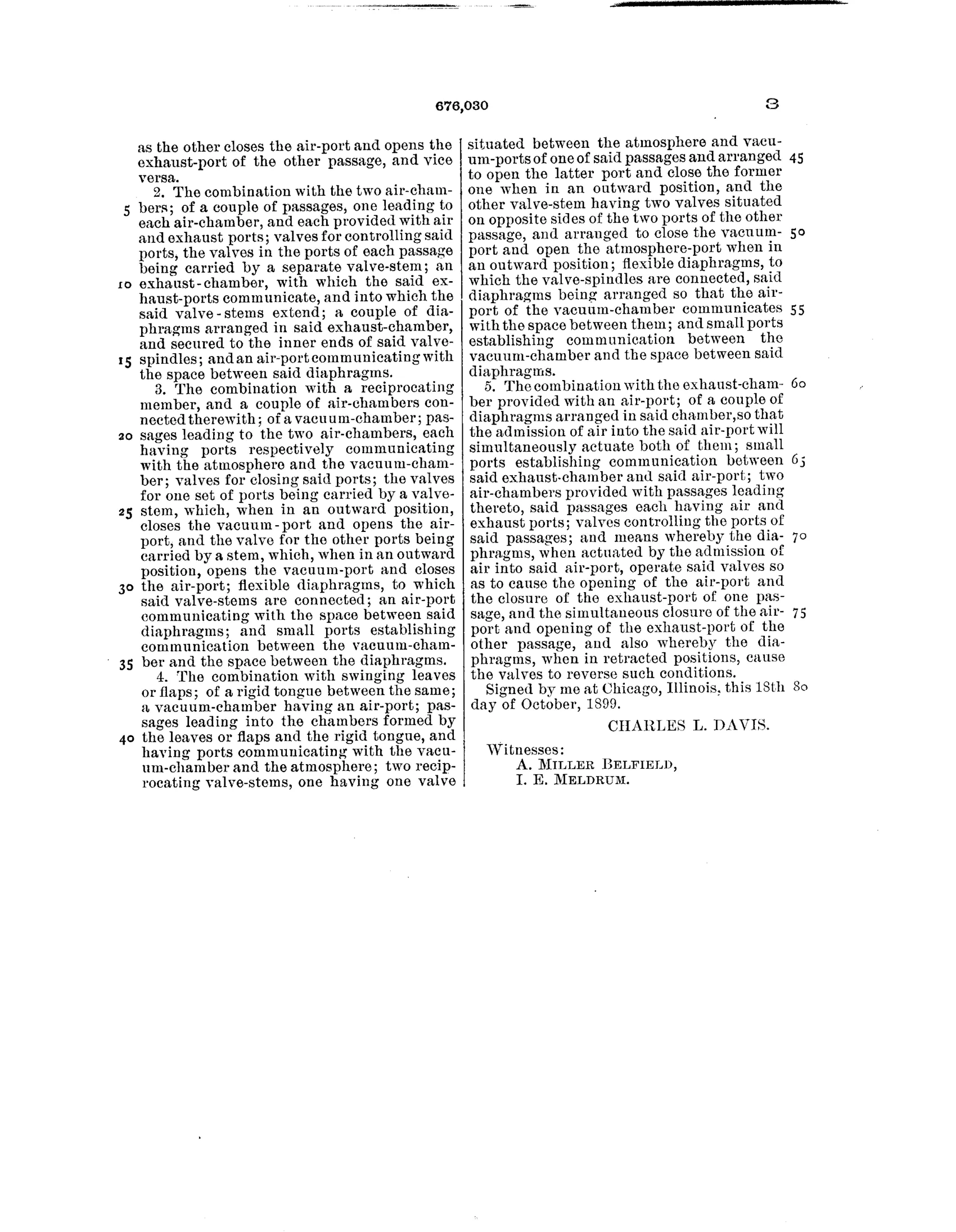
“The combination with the two air-chambers, and the passages leading thereto, and each having air and exhaust ports; of valves controlling said ports; a couple of valve-stems, each carrying the set of valves for the ports of one passage, and means for actuating said valve-stems simultaneously in opposite directions, one set of valves opening the air-port and closing the exhaust-port of one passage, as the other closes the air-port and opens the exhaust-port of the other passage, and vice versa.”
In plain English: Two air chambers each have their own valves on separate stems, and the stems move in opposite directions together so that opening the air port on one side automatically closes the exhaust port, while the other side does the reverse, and this action can also reverse itself.
♫ In the inventor’s words
“It will be seen that by this construction and arrangement I secure instantaneous and effective key action, that this action is positive in both directions and is absolutely instantaneous, and that I can make a half or fraction of a stroke without interfering with the apparatus and without having to make a whole stroke before the same will resume its normal condition.”— Charles L. Davis, from the specification
Fate unknown
No commercial player bearing Davis's double-acting action is documented; a surviving instrument or trade-catalog listing under Davis or Heuer would settle it.
♫ Commentary
Most pneumatic player actions of this era were single-acting: vacuum collapses a pneumatic, the key goes down, and a spring or the piano's own action returns it. Davis wanted something more forceful. His mechanism pairs two air chambers on either side of a rigid tongue, with valves on twin spindles that always move in opposition — pressurize one side while exhausting the other, and the link snaps across. Reverse the valves and it snaps back. It is essentially a tiny double-acting steam engine run on air, applied to a piano key.
The quote gives away what he was chasing: 'a half or fraction of a stroke' — the ability to reverse mid-motion for fast repeated notes, the classic weakness of sluggish pneumatics. His diaphragms with deliberate small bleed apertures controlling the valve spindles are the same trick the mature player industry settled on, so he was thinking along the right lines even if his packaging was baroque.
The clever economy is in Figs. 5 and 7: the same reciprocating unit, hitched to a pitman and wheel, becomes the motor that winds the roll. One mechanism, two jobs. The catch is cost — building a double-acting valve box for every one of sixty-odd notes, when a simple collapsing pneumatic did the job at a fraction of the parts count, is why the industry went the simpler way. This filing lands in 1899, right as the Aeolian push-up boom was cresting, and it reads like a small Chicago shop's bid to enter that gold rush.
Commentary by Claude, The Talking Machine Patent Archive’s resident enthusiast