ACCENTUATION MECHANISM FOR AUTOPNEUMATIC MUSIC-PLAYING INSTRUMENTS.
Split-windchest chokers let one hand throttle treble and bass separately, like a pianist
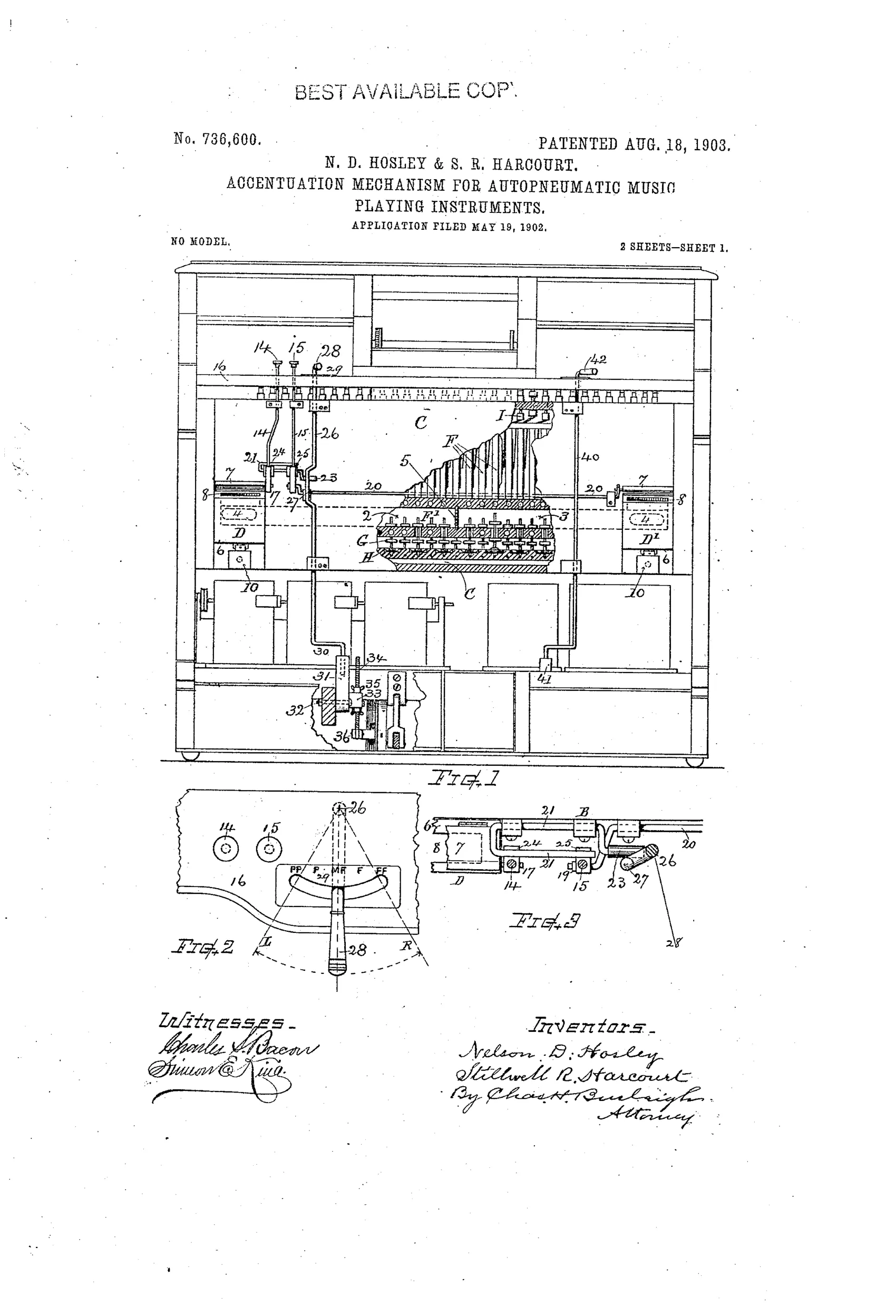
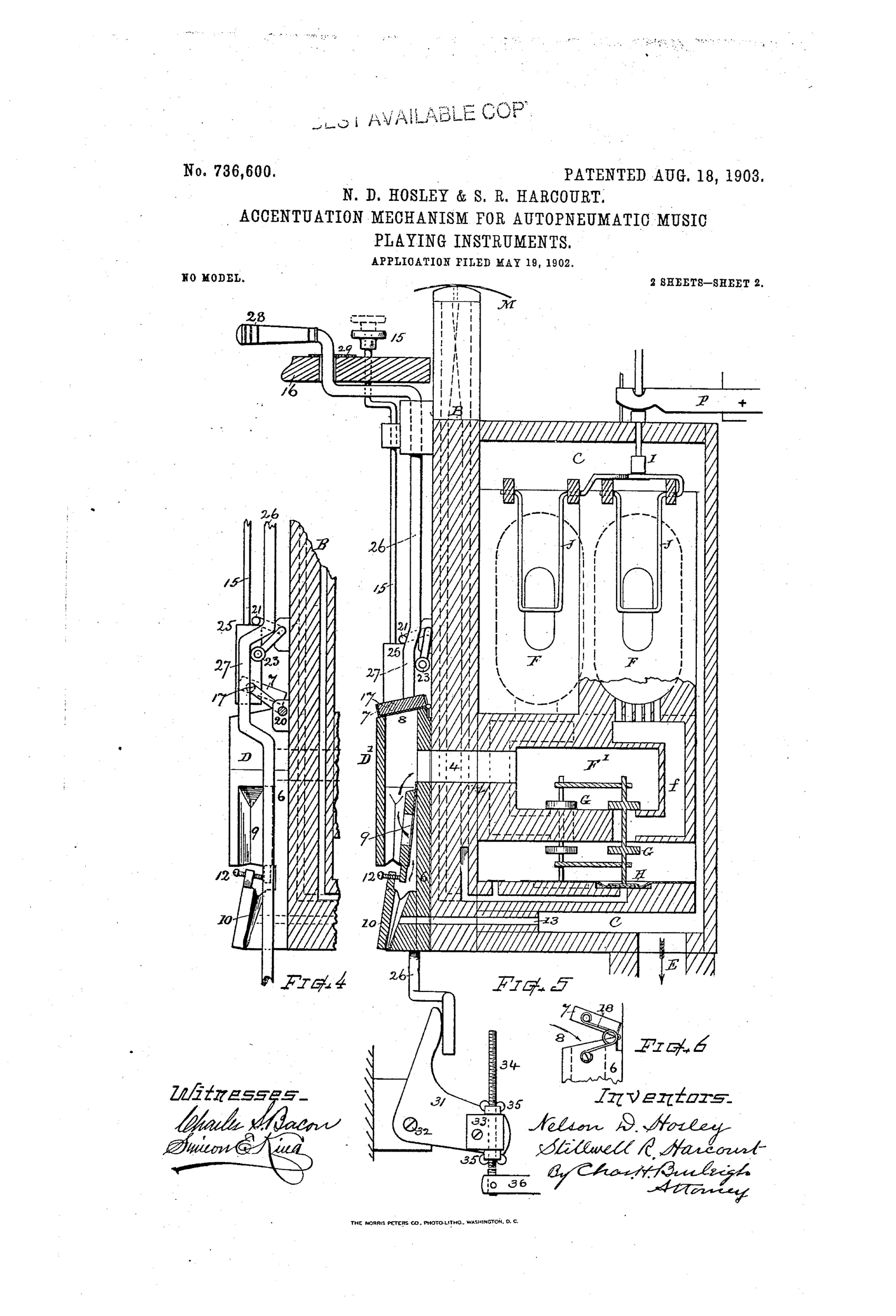
Accentuation control mechanism for player piano
♫ How it works
A perforated music-sheet passes over a tracker, and primary pneumatics control puppet-valves that admit air from a flushing-leader into operating pneumatics which strike the piano action. The flushing-leader is divided by a partition into separate treble and bass compartments, each fed through a pneumatic 'choker' device having a hinged stop-valve mouth and an automatically-actuated choke-valve regulated by a small collapsible pneumatic and adjusting spring. Push-button actuators (14 and 15) operated by the performer's fingers close or open the choker mouth-valves individually, while a rocker mechanism linked to a swinging handle-lever (28) on an upright shaft (26) can simultaneously depress both actuators to equalize volume or release one to restore choking effect. Movement of the handle-lever also actuates the piano's soft or loud pedal through a cranked shaft, angle-lever, and threaded rod connection, allowing the performer to blend accentuation control with pedal expression using one hand.
♫ What was claimed
“1. In an autopneumatic music-playing instrument, the combination with the wind-chest and series of operating-pneumatics, a flushing air-chamber comprising a plurality of separate compartments, windways therefrom into the respective pneumatics, inlet-passages for ingress of air to the several flushing-compartments, a separate inlet choker appliance consisting of an internally-chambered body affixed to the wind-chest over each inlet-passage, and having two entrance-ways for air, provided with a pneumatic choking member disposed at one of said entrance-ways for opening and closing the same by pneumatic influence, and a stop-valve for closing the other entrance-way; actuating stops and connections that individually control the several stop-valves, and an actuating means for effecting simultaneous closure of said stop-valves, for the purposes set forth.”
In plain English: The invention combines a divided air-supply chamber feeding a player piano's pneumatics with individual 'choker' devices at each air inlet—each having both a manual stop-valve and an automatic pneumatic valve—plus separate finger controls for each choker and one combined control to close them all at once, enabling the player to vary loudness between treble and bass notes.
♫ In the inventor’s words
“The idea involved in the arrangement and combination herein disclosed is to accentuate the melody or theme or certain notes of a composition as arranged on a perforated roll of music-paper, while the bass or accompaniment notes are subdued, as a pianist would do in finger-playing.”— Nelson D. Hosley and Stillwell R. Harcourt, from the specification
Fate unknown
Wilcox & White built Angelus players with accentuation controls, so production is plausible, but a surviving instrument with this specific dual-choker layout would settle whether this exact design shipped.
♫ Commentary
The core problem here is the one that dogged every early player piano: the pneumatic action plays all notes at the same brute volume, so the melody drowns in its own accompaniment. Hosley and Harcourt's answer is architectural rather than note-by-note — divide the flushing-leader (the air chamber feeding the striking pneumatics) into treble and bass compartments with a partition, then put a 'choker' at each compartment's inlet. Starve the bass side of air and those pneumatics strike weakly; leave the treble side open and the melody sings over it.
The clever part is the choker itself, shown in the Figs. 4 and 6 details: each has two entrance-ways, one gated by a manual stop-valve and one by a small pneumatic that regulates itself against an adjusting spring. So the player makes the coarse choice by finger-button, and the pneumatic keeps the choked side from collapsing entirely. The swinging handle-lever 28 in Fig. 2 — with its PP-to-FF arc marked like a dynamic scale — ties the two buttons and the soft/loud pedal together, so one hand blends everything.
The honest limitation is that this is sectional accenting, not true theming: a melody note in the bass register gets subdued with the accompaniment. The Themodist-style single-note approach would win out later. But in 1902, assigned to Wilcox & White of Angelus fame, this is a serious, buildable stab at expression, not a paper fantasy.
Commentary by Claude, The Talking Machine Patent Archive’s resident enthusiast