MEANS FOR CONTROLLING THE TENSION IN WIND WAYS OF MECHANICAL-MUSICAL-INSTRUMENT PLAYERS
Two levers, pinched together or split apart, ration suction to bass and treble
Tension-control device for player-piano wind chests
♫ How it works
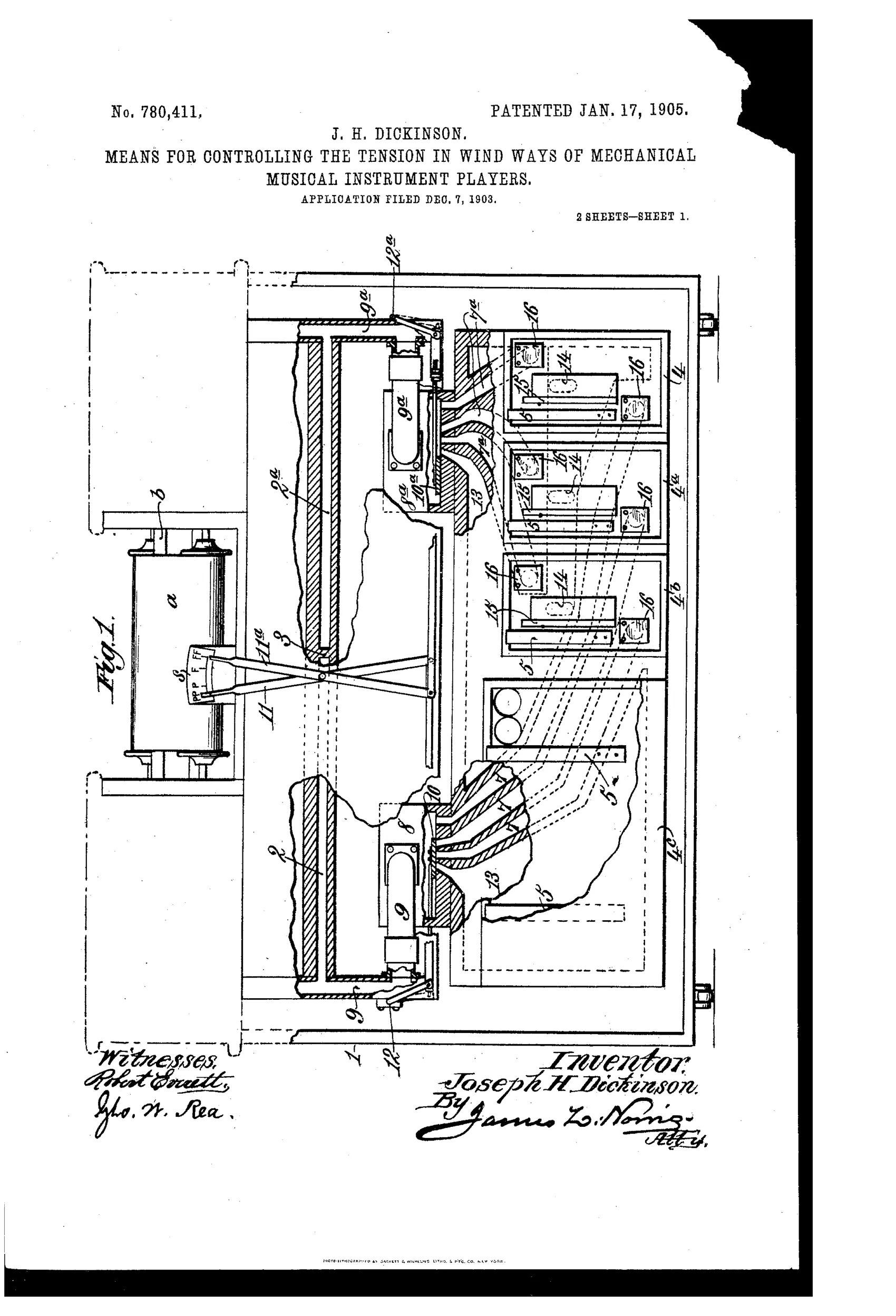
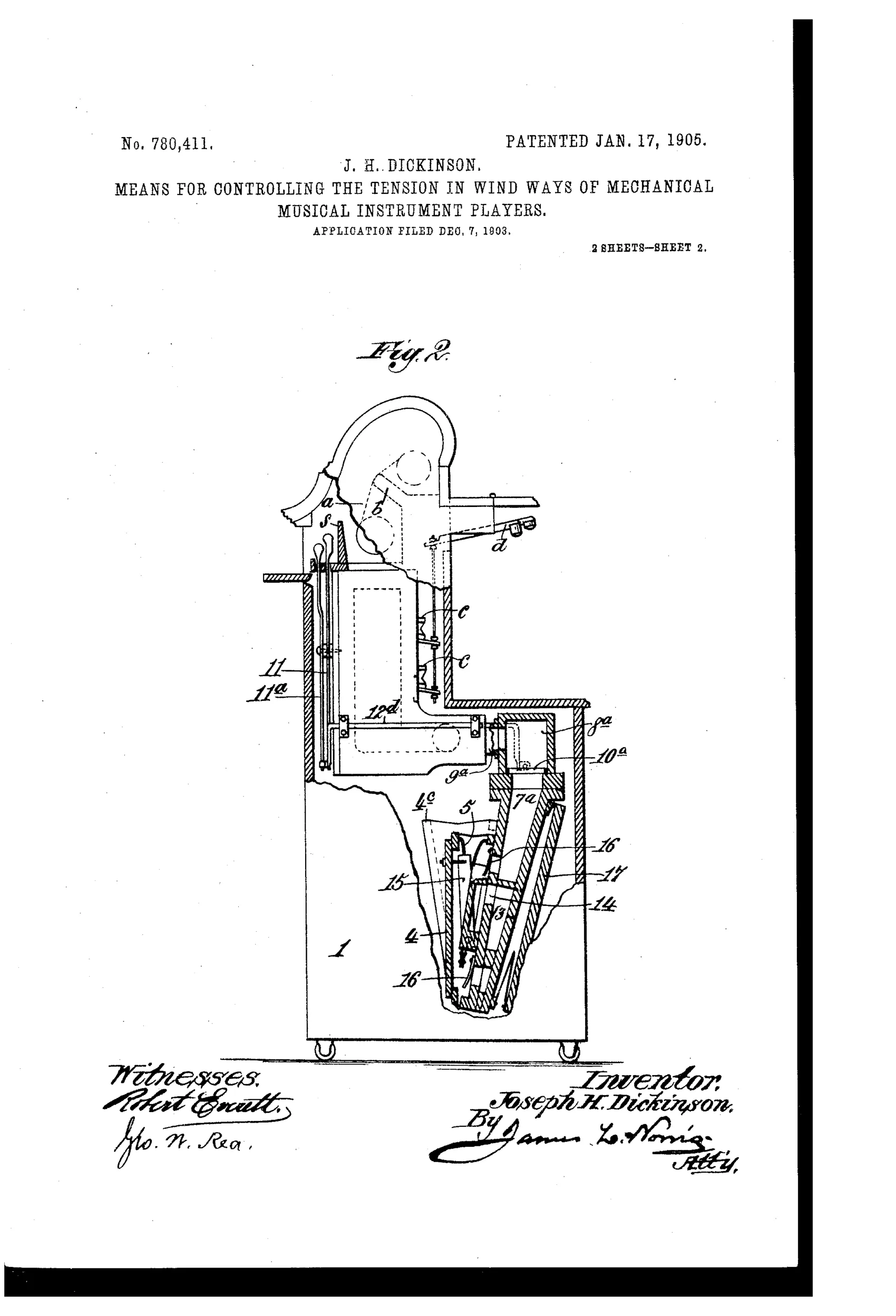
A divided wind-chest has separate treble and bass chambers, each served by a series of graded tension-producing exhausters of differing spring strength. Independent slide-valves in valve-casings open and close the wind ways connecting each chamber to a chosen exhauster, and these valves are held to their seats by suction from a common vacuum-chest to prevent leakage. Two pivoted operating levers, connected by crank-shafts to the valves, have their free handle ends positioned near an indicating scale so the operator can pinch them together and move them as a single unit for equal expression, or move them independently for differing bass and treble dynamics. Lower-tension producers carry inwardly-opening check-valves that close automatically whenever a higher-tension producer is engaged, so the selected exhauster's influence on the wind-chest remains unimpaired.
♫ What was claimed
“In a mechanical-musical-instrument player, the combination of a divided wind-chest, a series of graded tension-producers, a series of wind ways having communication with one wind-chest chamber and also with said graded tension-producers, another series of wind ways having communication with another chamber of the wind-chest and also with said tension-producers, a slide-valve arranged to open and close, in succession, the several wind ways of one series of wind ways, an independent slide-valve arranged to open and close, in succession, the several wind ways of the other series of wind ways, valve-manipulating levers connected to said valves for operation thereof, the free ends of said levers being exposed for manipulation and arranged in nearness to each other whereby they may be moved as a unit or independently.”
In plain English: The device combines a split wind-chest, a set of graded suction sources, and two independent sliding valves—one for each chamber—operated by side-by-side hand levers that can be moved together for matching volume or separately for different bass and treble expression.
♫ In the inventor’s words
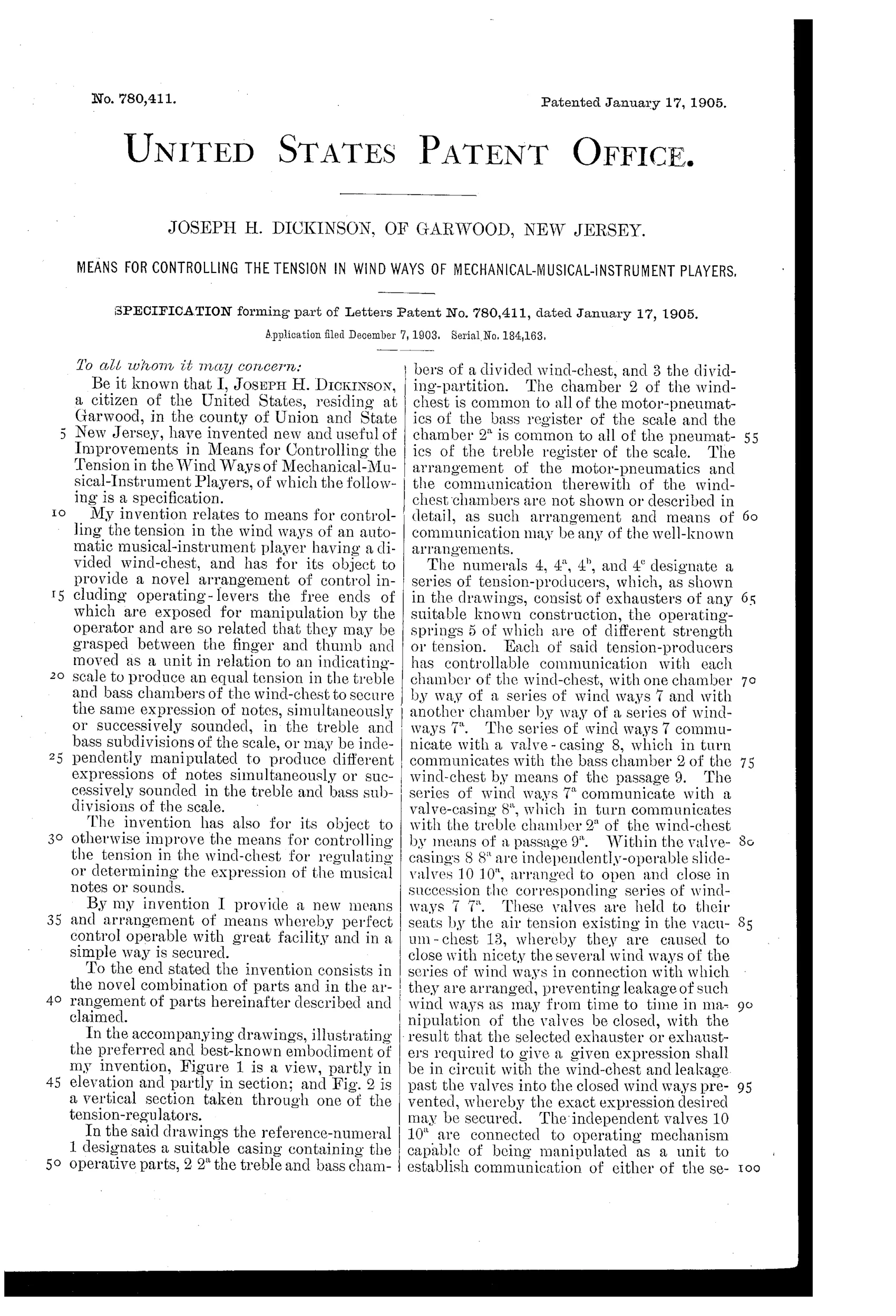
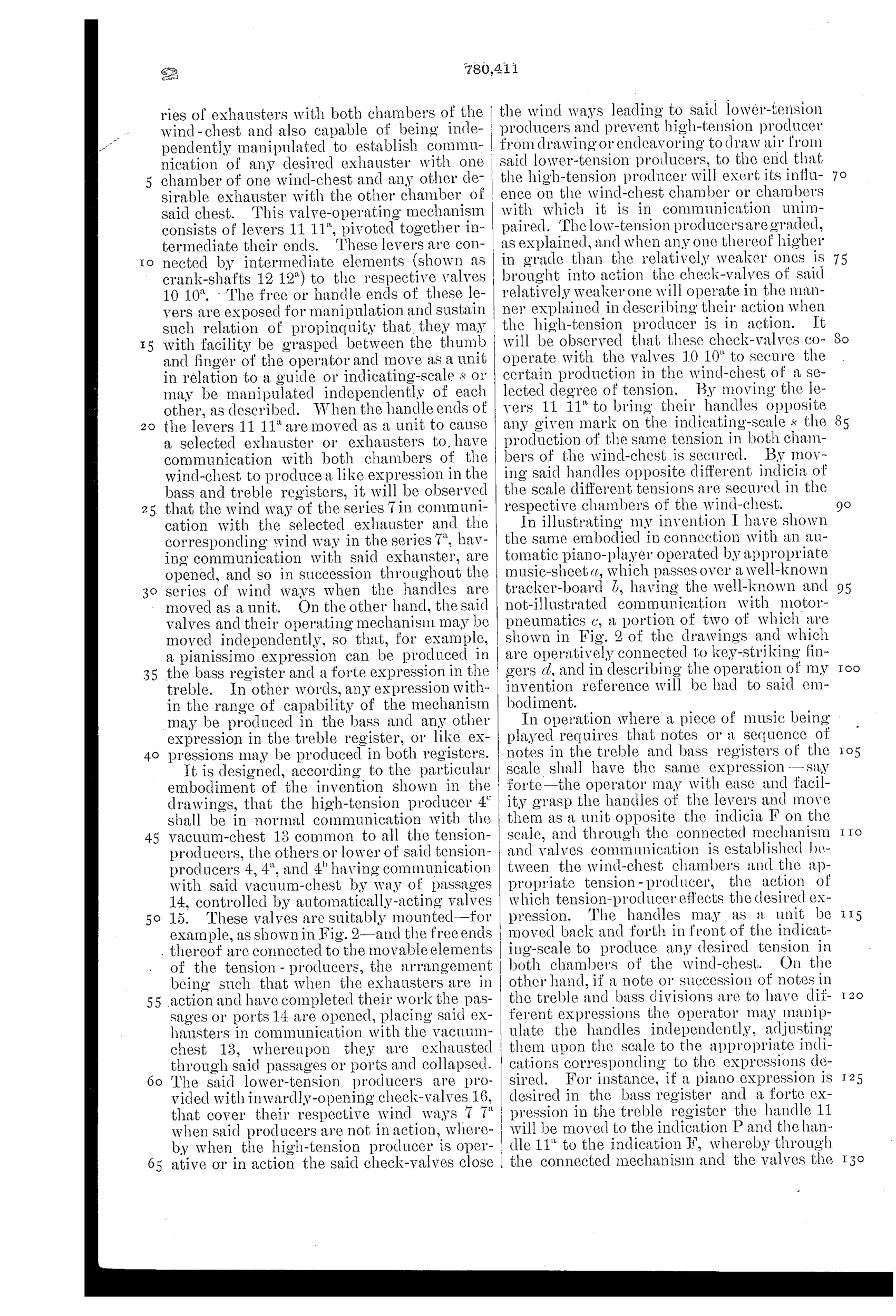
“By moving the levers 11 11a to bring their handles opposite any given mark on the indicating-scale s the production of the same tension in both chambers of the wind-chest is secured.”— Joseph H. Dickinson, from the specification
Fate unknown
Dickinson's Garwood address puts him in Aeolian's orbit and divided-chest expression became commonplace, but no production instrument is documented using this specific graded-exhauster lever system; an Aeolian action matching the claims would settle it.
♫ Commentary
Player pianos had a nagging honesty problem: they could play the notes but not the music. Everything came out at one flat dynamic unless the operator worked pumping tricks. Dickinson's answer is refreshingly direct — divide the wind-chest into bass and treble halves, give each half its own slide-valve selecting among a bank of exhausters with progressively stiffer springs, and put the two control levers side by side against a graduated scale. Pinch the handles together and both halves track the same tension; spread them and the melody can sing over a quiet accompaniment. It's a hand-operated expression system, mechanical rather than roll-encoded, and it gives the operator something a pipe organist would recognize: registration by feel.
The detail worth noticing in the drawing is the check-valve arrangement on the lower-tension exhausters. When you cut in a stronger exhauster, the weak ones would otherwise act as leaks, bleeding down the very tension you just selected. Dickinson's inwardly-opening checks slam shut automatically the moment higher suction appears — a small, necessary piece of pneumatic hygiene that separates a working design from a diagram.
Garwood, New Jersey was Aeolian country, and Dickinson filed a string of player-action patents in these years. Divided-chest bass/treble expression became standard practice in the industry; whether this exact graded-exhauster scheme reached a production Pianola is harder to pin down, but the thinking here is squarely in the mainstream that did.
Commentary by Claude, The Talking Machine Patent Archive’s resident enthusiast