EXPRESSION MECHANISM FOR SELF-PLAYING MUSICAL INSTRUMENTS.
Separate vacuum lines for dampers and keys — expression without robbing the wind-chest
Pneumatic expression mechanism for player pianos
♫ How it works
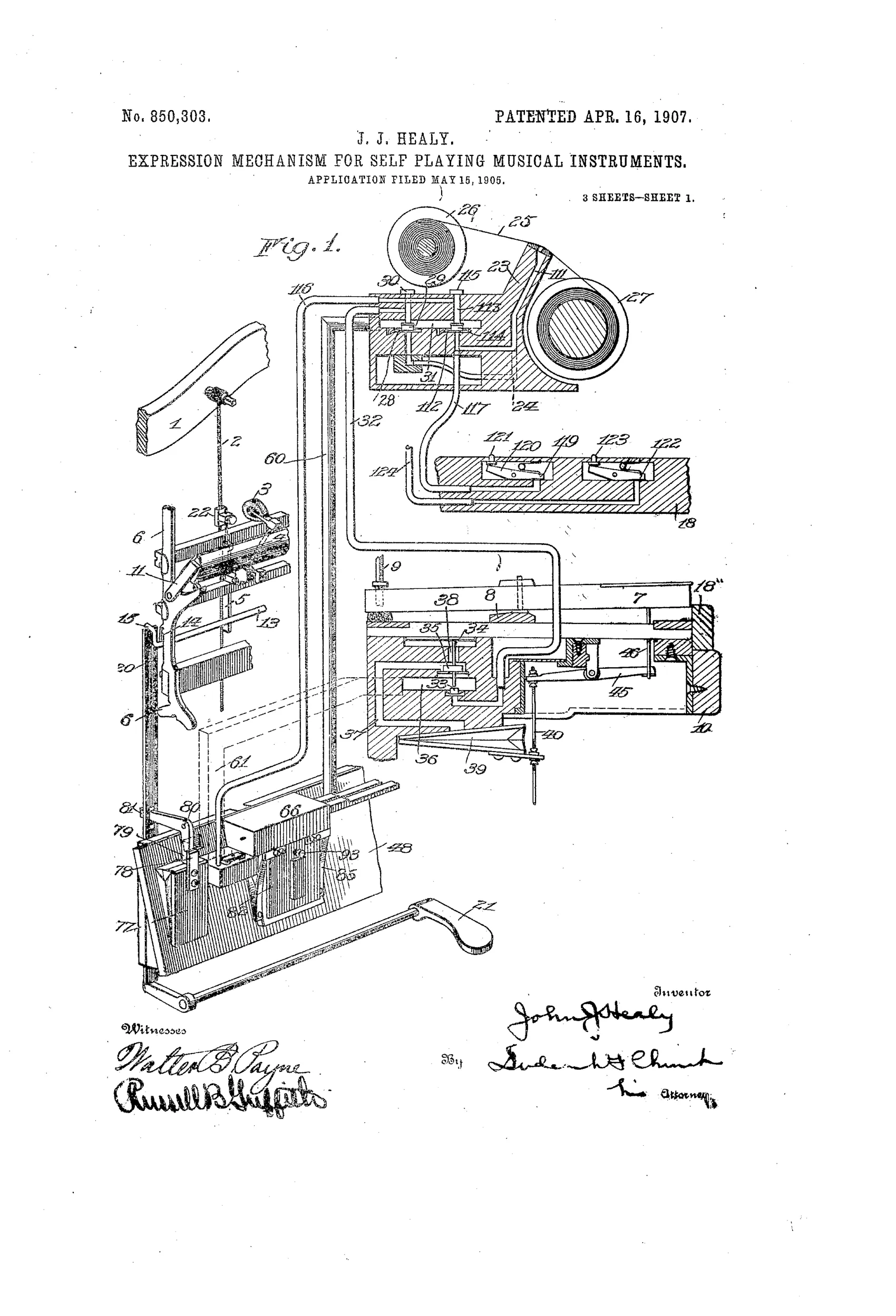
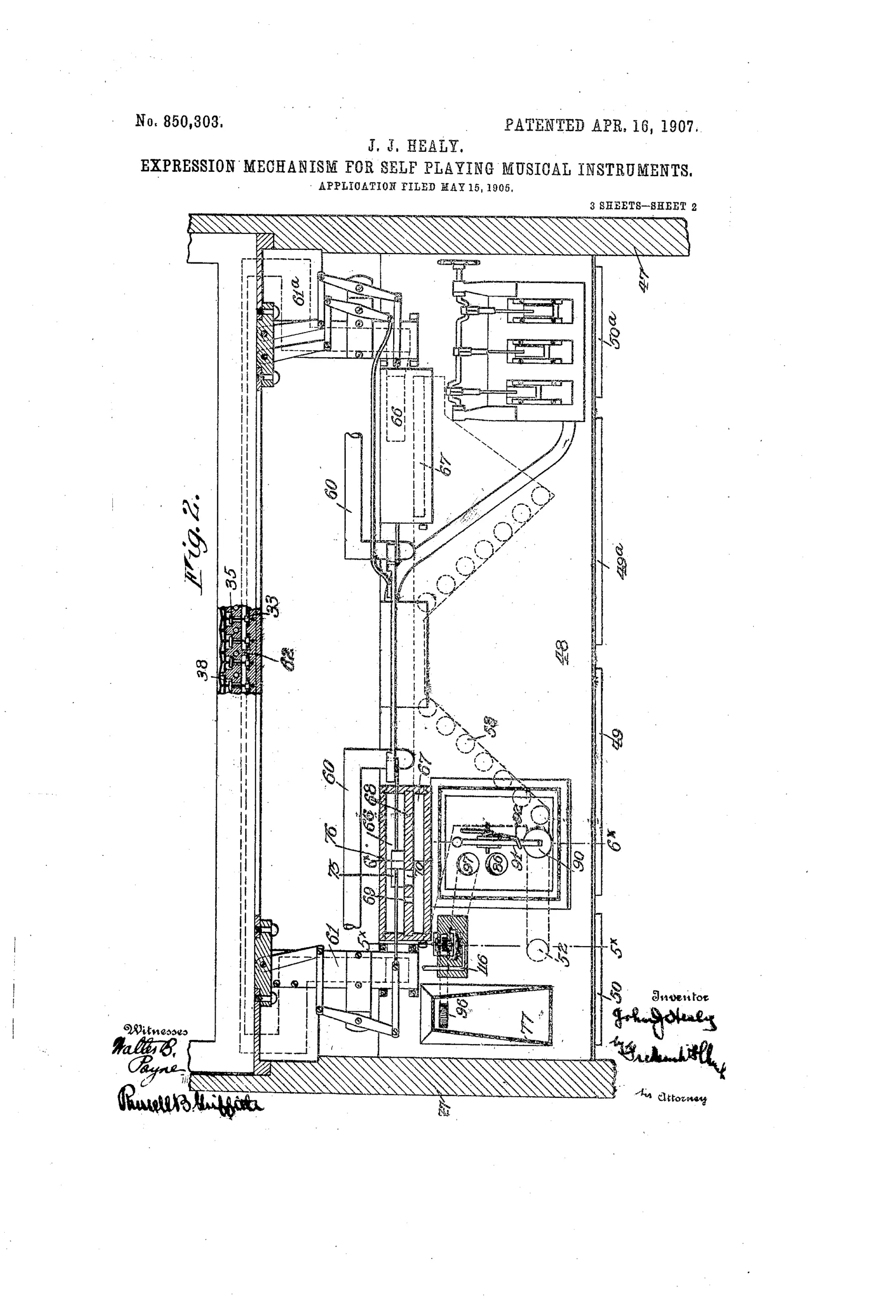
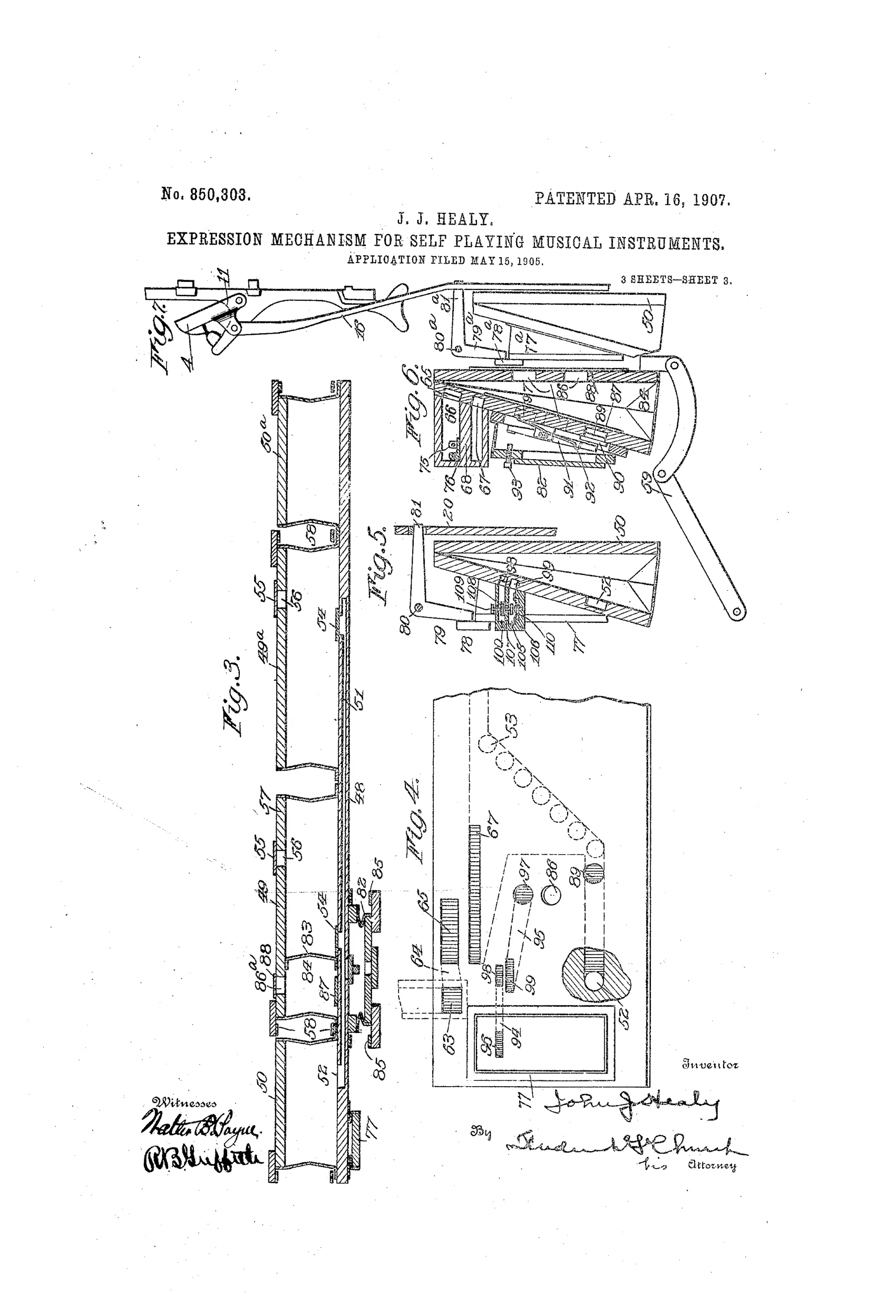
A perforated music-sheet passes over a tracker-board whose passages, controlled by perforations, admit or vent air to primary and secondary valves. These valves operate puffs and diaphragms that in turn control feeder and main bellows, which pump and store vacuum to actuate the key-pneumatics via rods and levers connected to the piano action. Separate auxiliary and supplemental bellows, valved passages, and manually-operated buttons allow the operator to independently control the string-dampers and hammer-rail (loud/soft pedal functions) either automatically from the music-sheet or manually, producing forte or pianissimo effects without disturbing the main wind-chest pressure.
♫ What was claimed
“1. In a pneumatically-operated musical instrument, the combination with an action embodying string-dampers and keys, key-pneumatics and devices for operating said dampers, a power-pneumatic connected to the latter, separate exhaust-bellows for operating the pneumatics and valves for controlling them, of separate feeder-bellows for the exhaust-bellows, a valved passage connecting the latter, means for operating the feeder and means for controlling the operation of the valves.”
In plain English: The invention combines a piano action with string-dampers, key-pneumatics, and a separate power-pneumatic for the dampers, each with its own exhaust bellows, feeder bellows, and connecting valved passage, all controllable to independently operate the dampers and keys.
♫ In the inventor’s words
“My present invention relates to pneumatically-operated musical instruments and to those devices employed in connection therewith for producing pianissimo and forte effects; and it has for its object to provide suitable mechanism to be employed in connection with a pianoforte for operating the string-dampers and, if desired, the hammer-rail or other attachments, whereby these parts may be controlled by perforations in the music-sheet or independently thereof, at the will of the operator, whenever it is desired to subdue or accent certain notes in a musical composition.”— John J. Healy, from the specification
Fate unknown
No known production instrument carries this design; a player action or trade literature citing Healy or Hess would settle it.
♫ Commentary
The player piano's great weakness in 1905 was that everything ran off one vacuum supply. Punch a big chord and the wind-chest pressure sags; try to lift the dampers for a sustained passage and you steal air from the notes themselves. Healy's answer is brute-force plumbing: give the damper and hammer-rail pneumatics their own feeder and exhaust bellows, joined to the main system only through a valved passage. The loud and soft functions can then fire from perforations in the roll or from finger buttons without disturbing the pressure that actually plays the notes.
Fig. 1 is worth a slow look. It's a diagrammatic exploded view — the roll and tracker-board float at the top, tubing snakes down through primary and secondary valve stages to the bellows stack, and a single piano key with its damper and hammer sits at left like a specimen. You can trace the whole pneumatic logic on one sheet, which is more than can be said for most player-action patents of the decade.
This is a refinement, not a first — automatic expression was the industry's obsession between roughly 1900 and the Ampico and Duo-Art reproducing systems a decade later. Healy, working from the small town of Cohocton with a Rochester backer holding half the rights, was one of many chasing it. The engineering is sound; the question is whether any builder adopted it.
Commentary by Claude, The Talking Machine Patent Archive’s resident enthusiast