STOP MECHANISM FOR SELF-PLAYING MUSICAL INSTRUMENTS.
Two holes punched side by side tell a coin piano to shut itself off
Automatic pneumatic stop mechanism for player pianos
♫ How it works
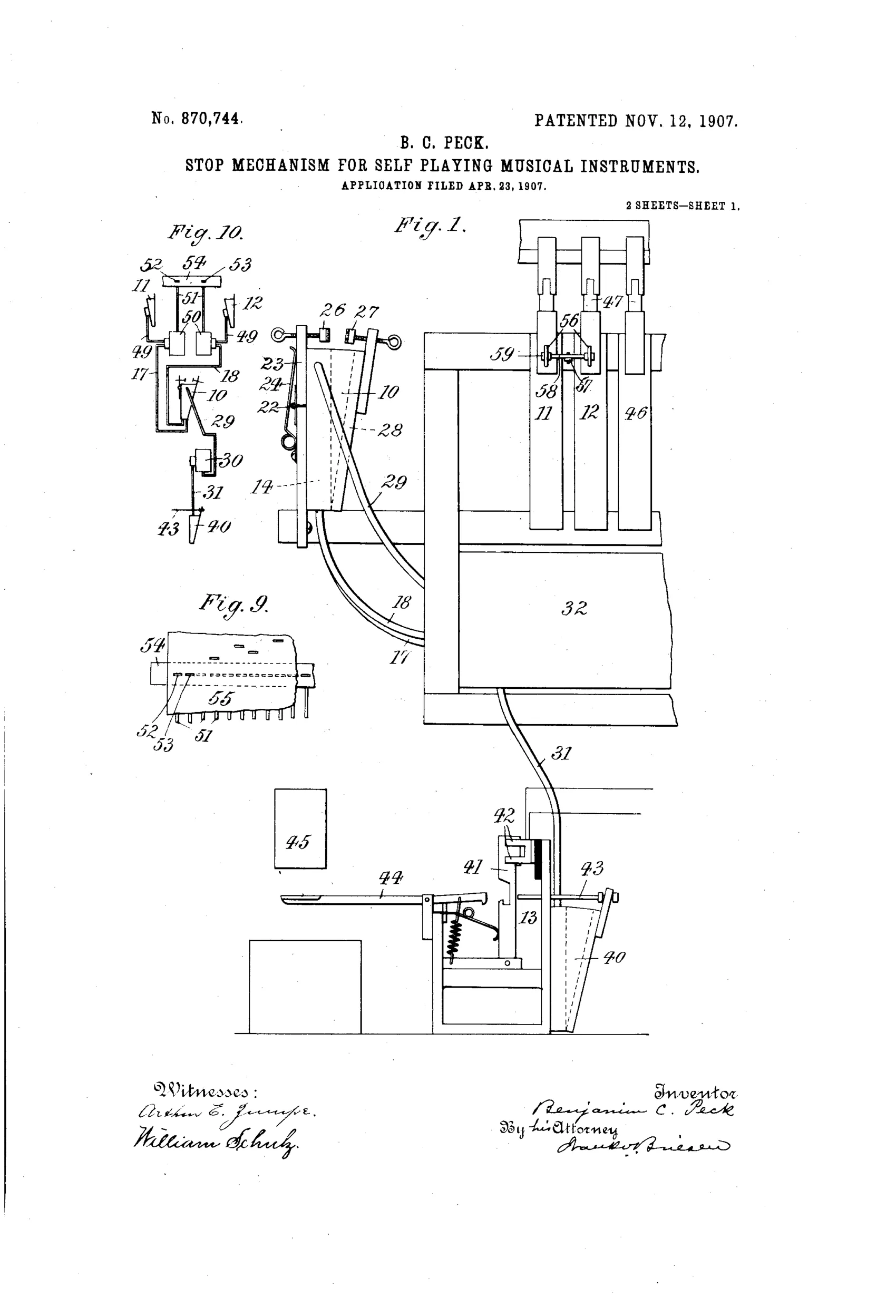
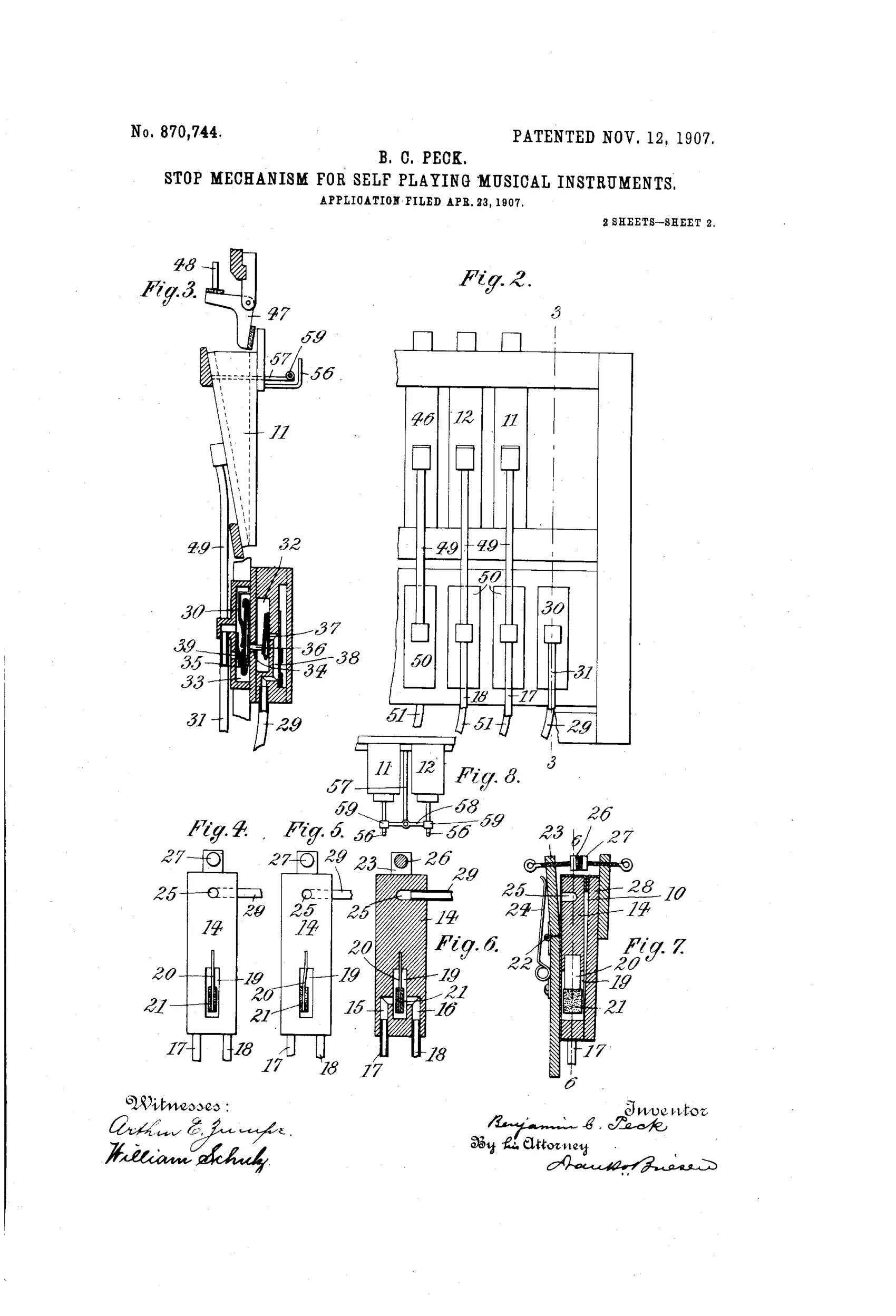
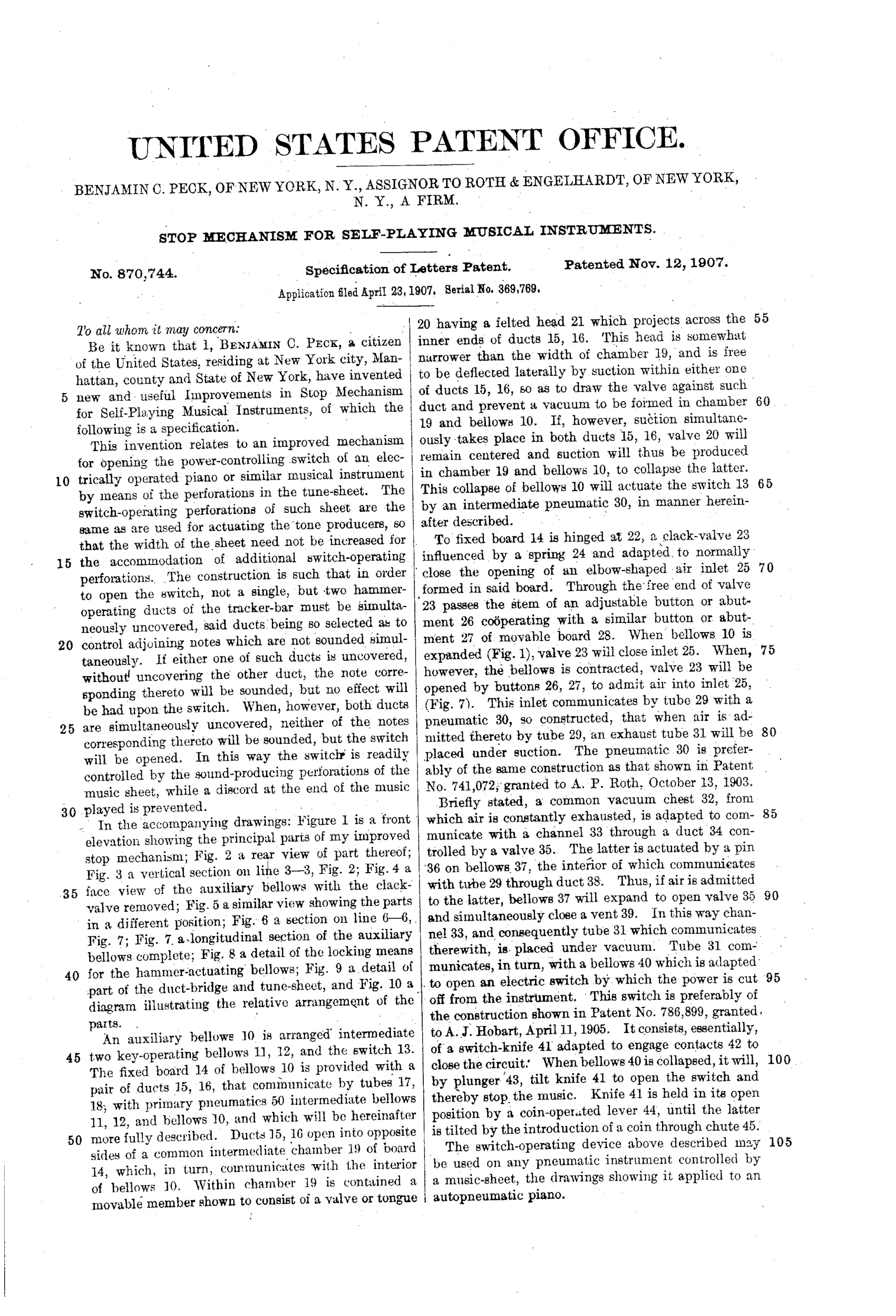
An auxiliary bellows is arranged between two adjoining key-operating bellows and the power switch, with a fixed board containing a pair of ducts opening into a common chamber where a felted valve tongue is centered. When only one duct is uncovered by the tune-sheet perforation, suction deflects the valve against that duct, preventing collapse of the auxiliary bellows so the note sounds normally. When both adjoining ducts are simultaneously uncovered at the end of a piece, the valve stays centered, suction collapses the auxiliary bellows, and this actuates an intermediate pneumatic and a clack-valve that admits air to a secondary bellows, which in turn places a vacuum chest tube under suction to collapse a switch-bellows. The collapsing switch-bellows drives a plunger that tilts a switch-knife to break electrical contact and cut off power to the instrument, stopping the music; a coin-operated lever holds the switch open until a coin resets it.
♫ What was claimed
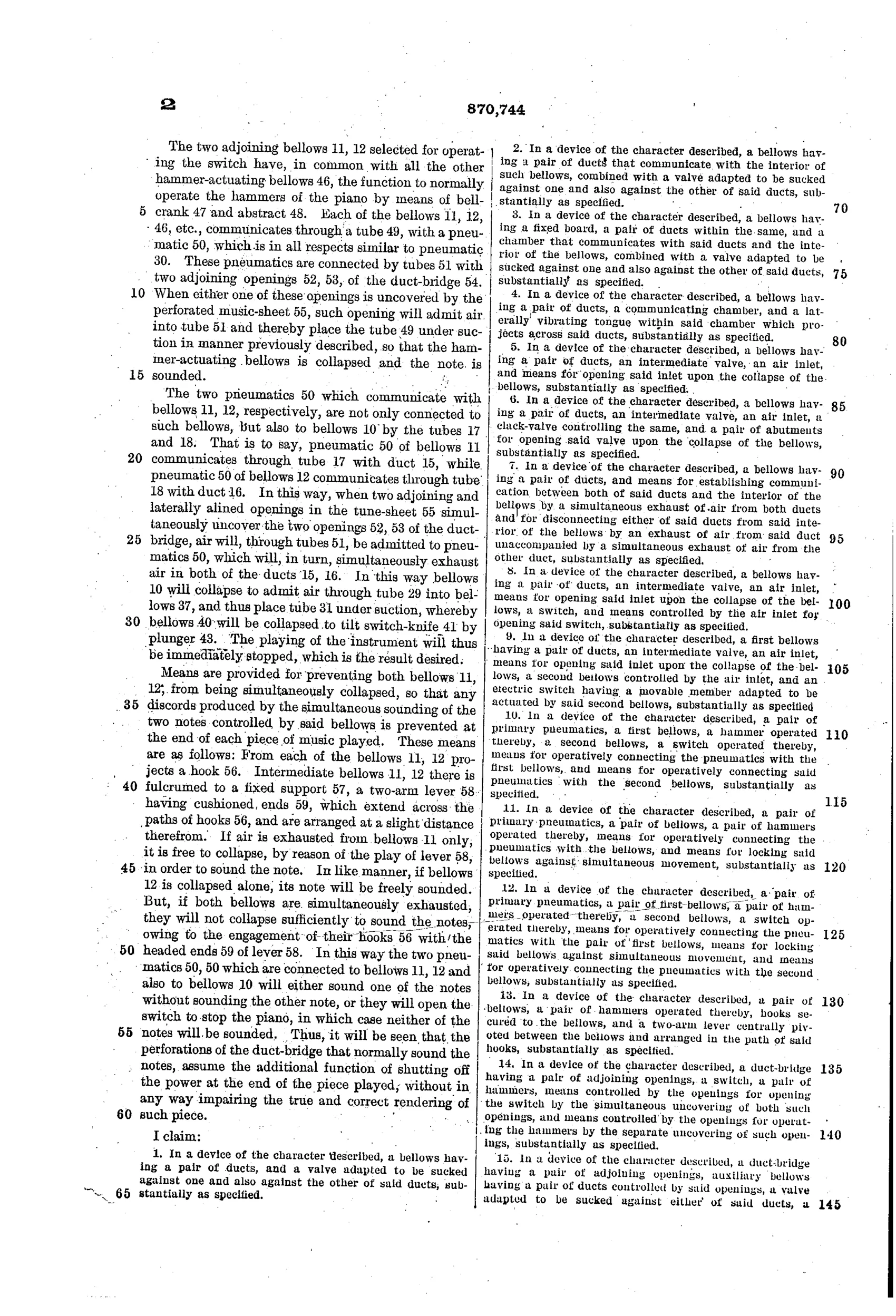
“9. In a device of the character described, a first bellows having a pair of ducts, an intermediate valve, an air inlet, means for opening said inlet upon the collapse of the bellows, a second bellows controlled by the air inlet, and an electric switch having a movable member adapted to be actuated by said second bellows, substantially as specified.”
In plain English: The invention covers a bellows-and-valve system where an intermediate valve and air inlet open upon bellows collapse to trigger a second bellows, which in turn actuates an electric switch to stop the instrument.
♫ In the inventor’s words
“In this way the switch is readily controlled by the sound-producing perforations of the music sheet, while a discord at the end of the music played is prevented.”— Benjamin C. Peck, from the specification
Fate unknown
Assignment to Roth & Engelhardt, maker of Peerless coin pianos, makes production likely, but only an examined Peerless stop assembly matching these figures would confirm this specific design shipped.
♫ Commentary
The problem here is specific to the coin-operated trade: a nickel-in-the-slot piano has to know when the tune is over, kill its own power, and wait for the next nickel. Peck's answer is elegant because it uses no special hardware on the roll — just two adjacent note perforations opened at the same instant. His trick is the felted valve tongue centered between two ducts in a common chamber. Open one duct and suction slams the tongue against it, sealing things off so the note plays normally. Open both at once and the pressures balance, the tongue floats, and the auxiliary bellows collapses — starting a pneumatic relay chain that ends with a switch-knife breaking the electrical circuit.
That balanced-valve logic is essentially a pneumatic AND gate, decades before anyone would have called it that. The best line in the specification is the practical one: a discord at the end of the piece is prevented, since the two stop-holes are chosen so the momentary double note doesn't clash.
The assignee matters. Roth & Engelhardt built the Peerless line of coin-operated pianos — the machines that filled saloons and ice cream parlors before jukeboxes existed — and Peck was solving their exact production problem. Fig. 10's schematic shows how compactly the whole relay chain tucks against the vacuum chest. This is a working engineer's patent, not a dreamer's.
Commentary by Claude, The Talking Machine Patent Archive’s resident enthusiast