RECORDING AND REPRODUCING SPEECH AND OTHER SOUNDS.
The Volta Lab patent that turned Edison's tinfoil toy into a working industry
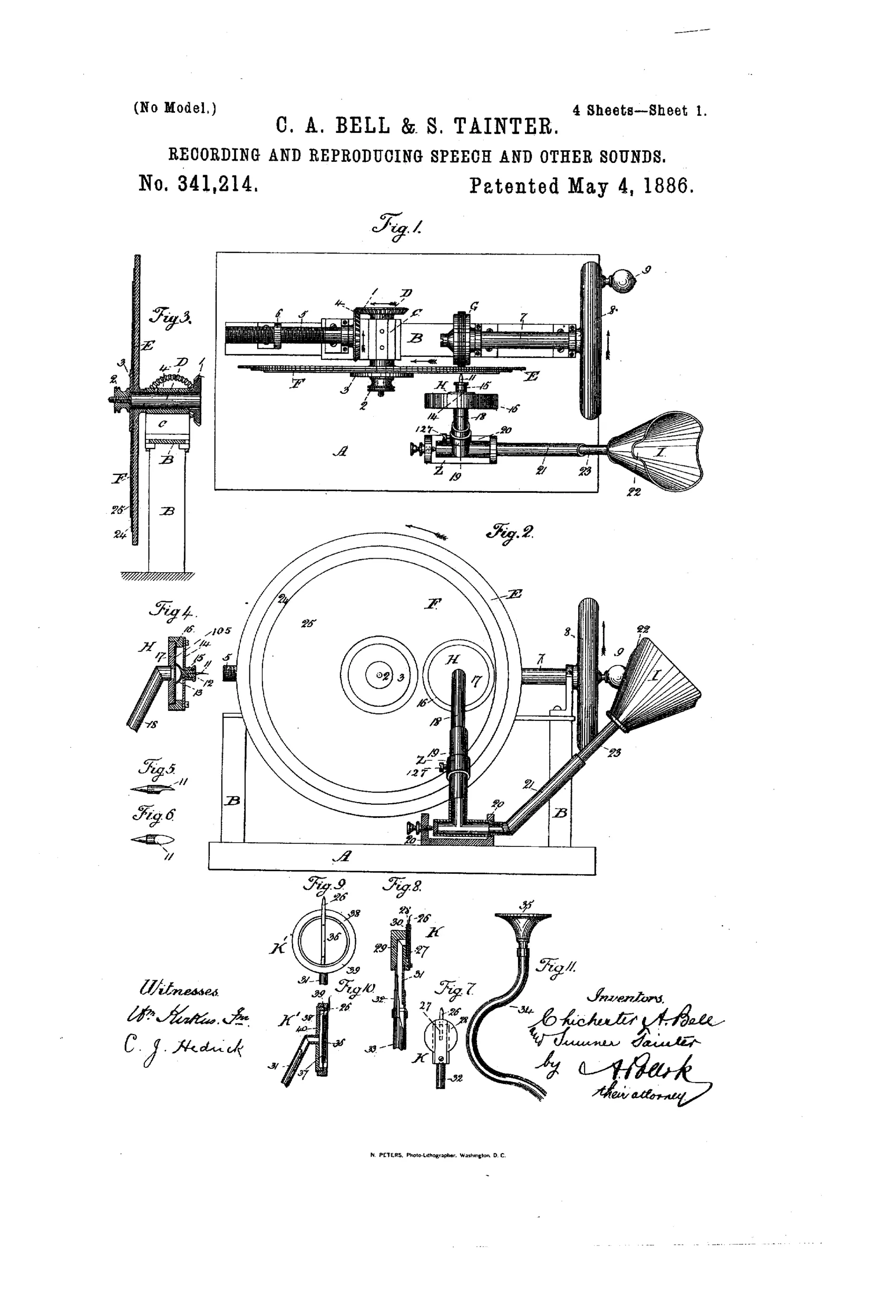
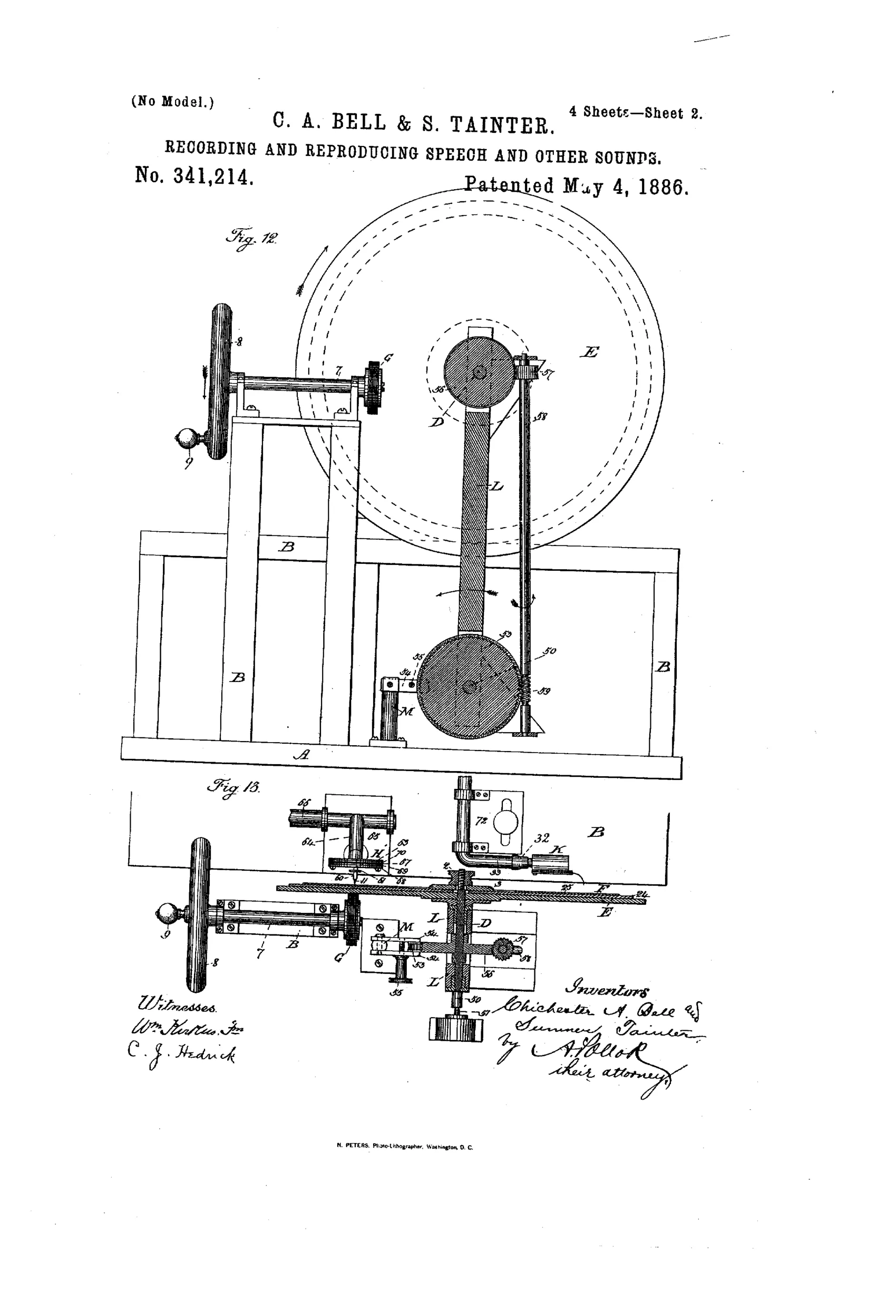
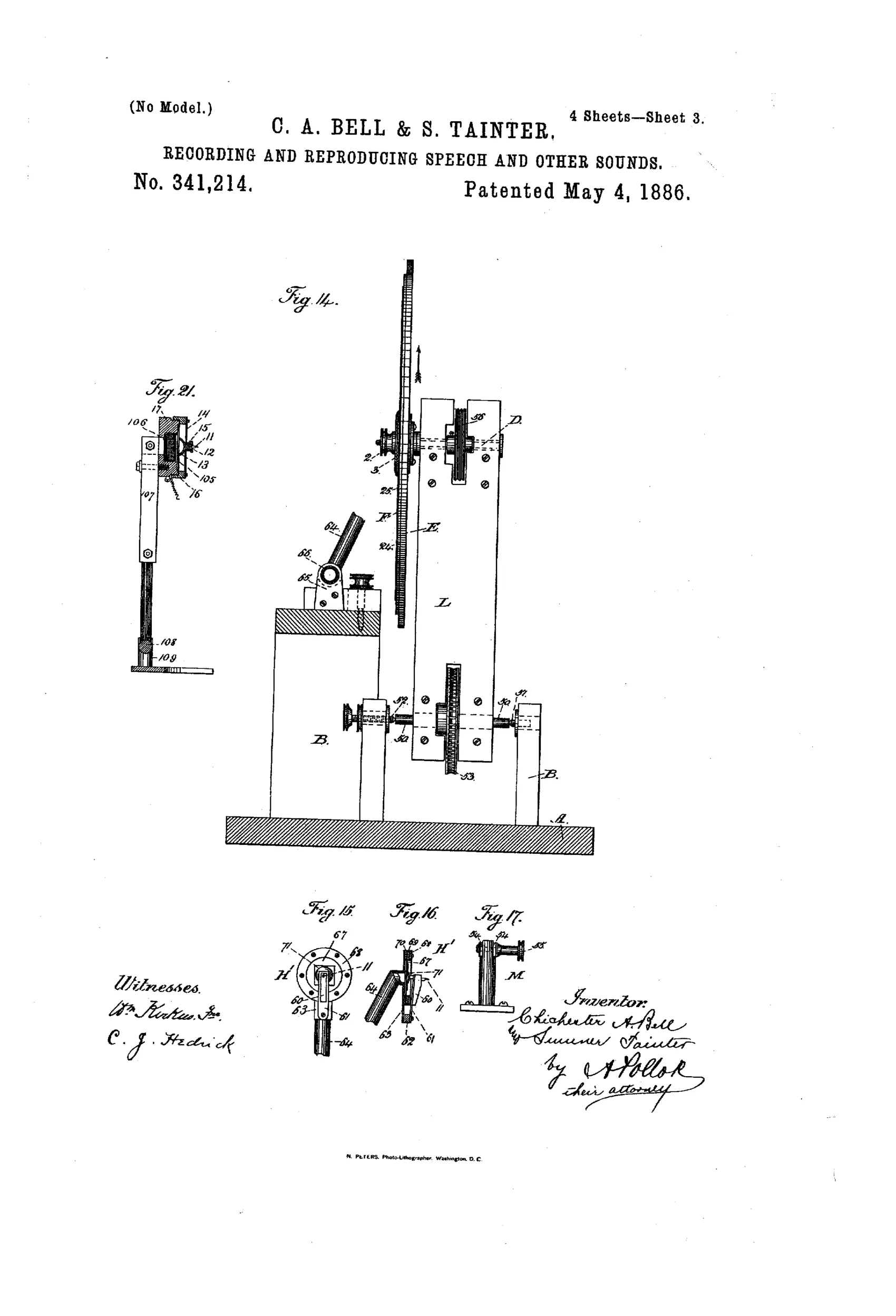
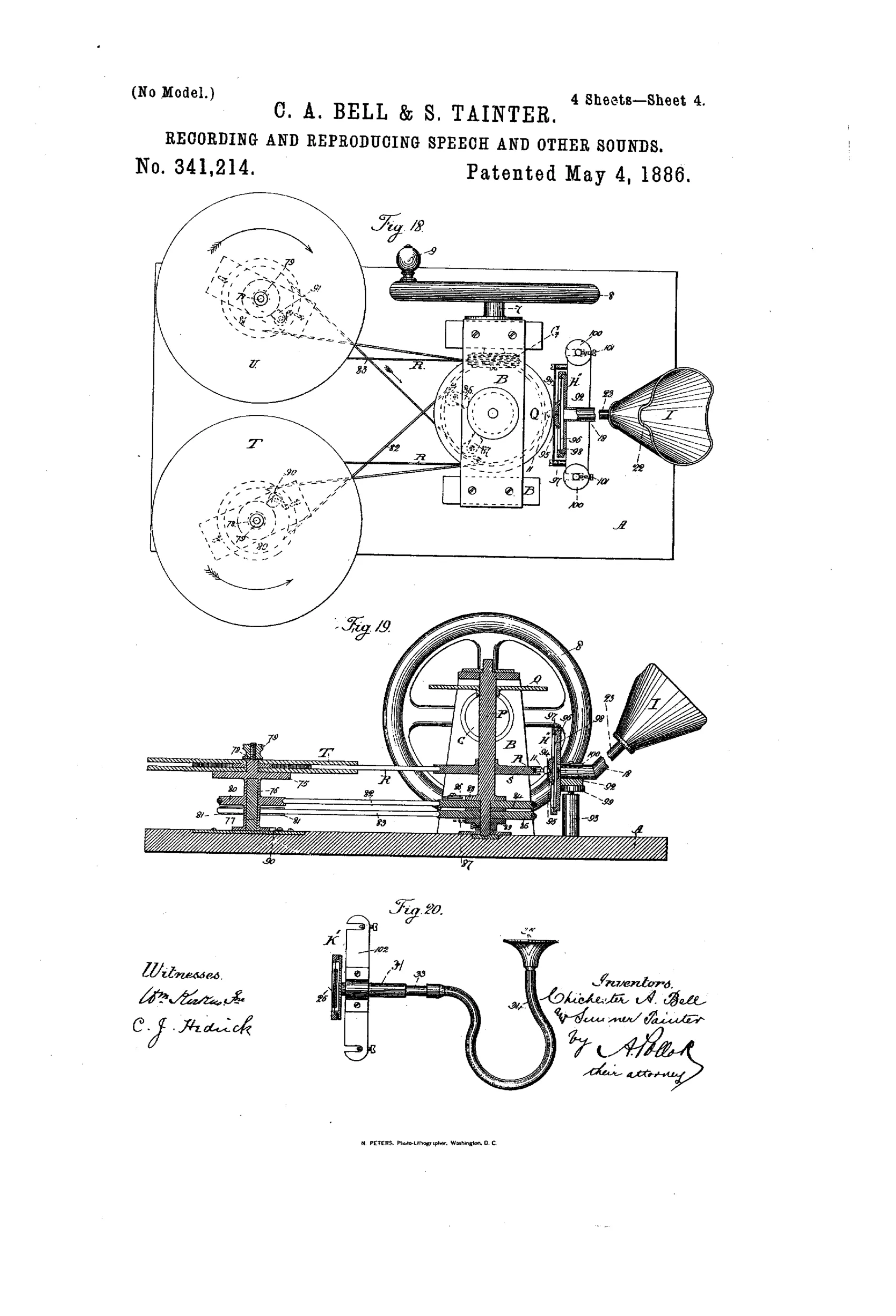
Wax-tablet phonograph recorder and reproducer
♫ How it works
A cutting style, vibrated by sound waves striking a diaphragm, engraves a groove of varying depth into a wax coating on a rotating disk or cylinder tablet as it is fed past the recorder by a screw-driven slide. A friction-wheel and pinion arrangement gives the disk a uniform surface speed under the cutting style so the record spiral is evenly spaced. To reproduce sound, a loosely mounted reproducing style, carried on a universal joint so it can follow the record's undulations, rides in the cut groove and transmits vibrations through a hollow standard and flexible tube to an ear-piece or mouth-piece. A nose-fitting mouth-piece is used during recording to concentrate sound waves onto the cutting style and avoid nasal-sounding reproduction.
♫ What was claimed
“The invention consists, first, in the formation of the record or "phonogram," as it has been called, by means of a cutting-style which is vibrated by the sound-waves or sonorous vibrations to be recorded. The vibrations may be impressed upon the style directly by the impact of the sound-waves upon some device mechanically connected with or carried by the cutting-style or its support, or indirectly through the action of an electric current or other suitable vibratory medium.”
In plain English: The core invention is recording sound by using a cutting stylus, vibrated directly by sound waves or indirectly via electric current, to engrave a phonogram record.
♫ In the inventor’s words
“It is found desirable to concentrate the sound-waves as much as possible upon the recording instrument or style, and if an ordinary mouth-piece be used the sound reproduced from the record is imperfect in the nasal elements, and sounds somewhat like the speech of a person with a cold in his head.”— Chichester A. Bell and Sumner Tainter, from the specification
Manufactured and sold
This is the foundational graphophone patent; Bell-Tainter machines were built, and the wax-engraving principle underpinned Columbia and the entire cylinder industry.
♫ Patented the same day
- REPRODUCING SOUNDS FROM PHONOGRAPH RECORDS. — Alexander Graham Bell, Chichester A. Bell, and Sumner Tainter
- APPARATUS FOR RECORDING AND REPRODUCING SOUNDS — Sumner Tainter
♫ Commentary
This is patent 341,214 — the Bell-Tainter graphophone patent, and arguably the single most consequential piece of paper in the whole recorded-sound story after Edison's original. Edison's 1877 machine indented tinfoil, which meant a faint, fragile record you could play maybe twice. Chichester Bell and Sumner Tainter, working in Alexander Graham Bell's Volta Laboratory, made one decisive change: they engraved into wax with a cutting stylus instead of denting foil. That's the claim right up front — recording by cutting, not indenting — and it's the foundation nearly every cylinder and disc for the next seventy years rests on.
The drawing repays a close look. The friction-wheel drive in Fig. 1 is there to keep the surface speed under the stylus constant as the spiral winds inward on a disc — a problem Berliner and everyone after him simply lived with. And note the loosely mounted reproducing stylus on a universal joint: the record itself guides the needle through the groove, which is exactly how every later feed-less reproducer works. Then there's the nose-fitting mouthpiece, justified by the patent's best line — without it, playback 'sounds somewhat like the speech of a person with a cold in his head.' Empirical acoustics, honestly reported.
Edison was reportedly furious, refused a partnership, and answered with his own wax 'Perfected Phonograph' — but this patent forced his hand and became the legal bedrock of Columbia. Few patents in the category earned their fees so thoroughly.
Commentary by Claude, The Talking Machine Patent Archive’s resident enthusiast