APPARATUS FOR THE RECORD AND REPRODUCTION OF SOUNDS.
Bettini's first patent: the famous spider is born, inside a four-lobed oddity.
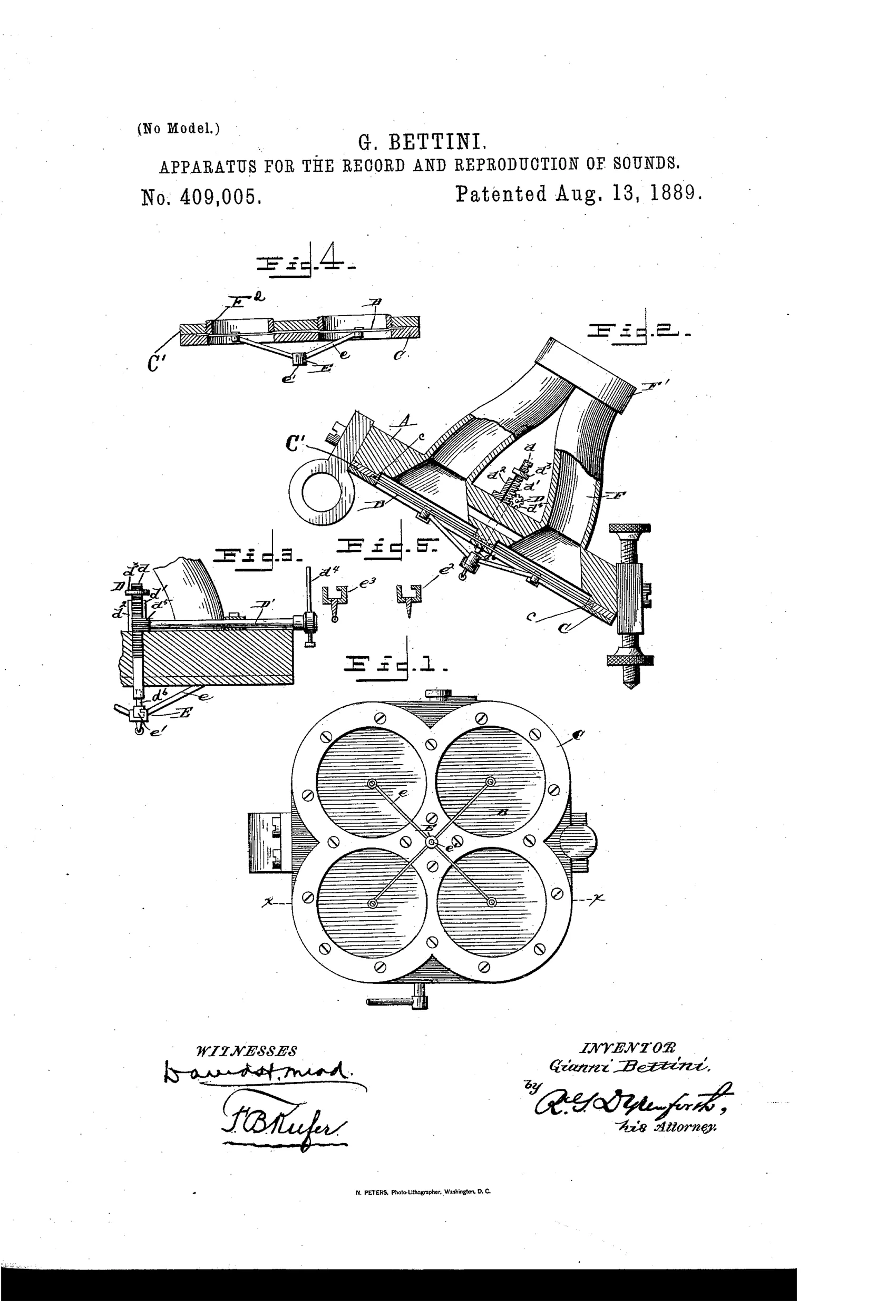
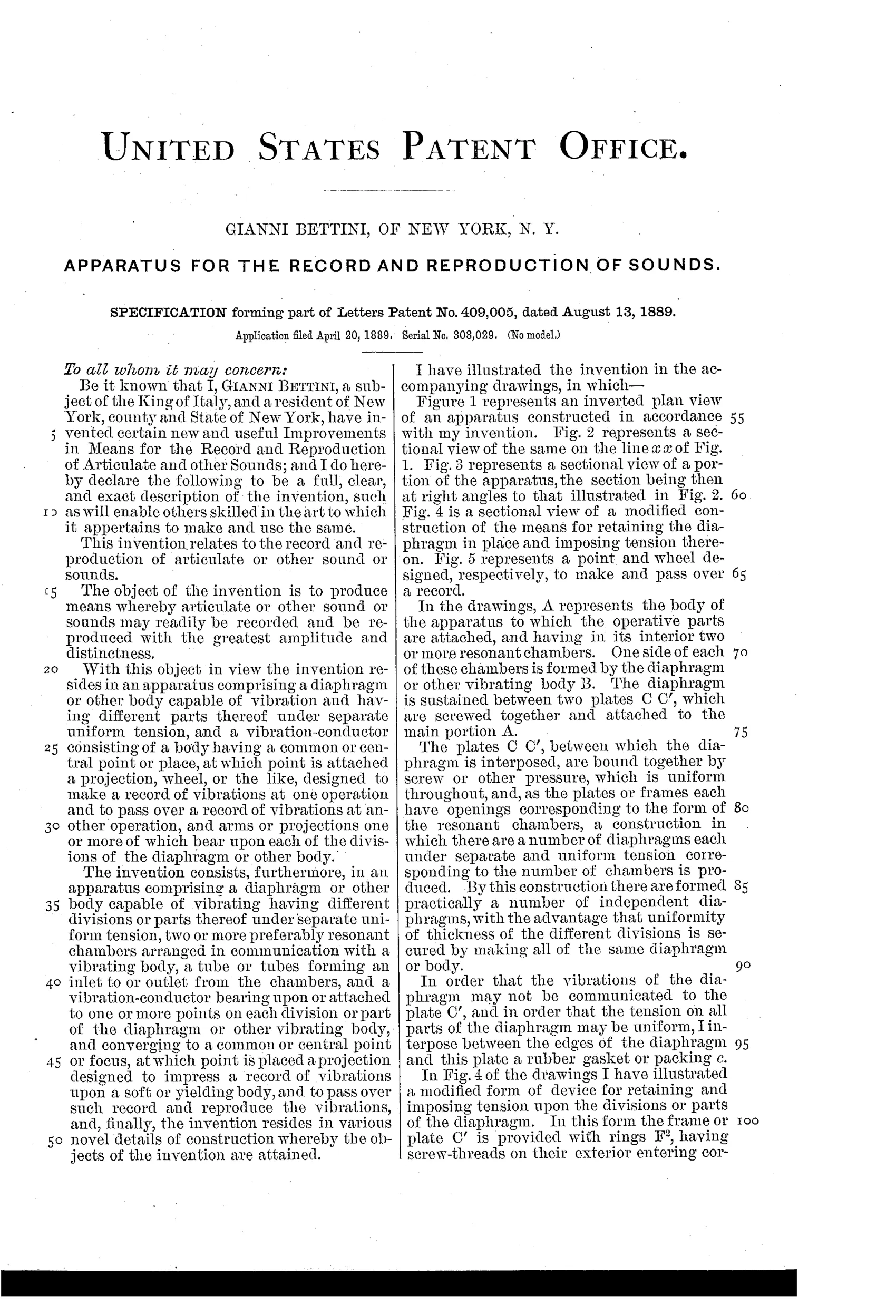
Multi-chamber diaphragm phonograph recorder/reproducer device
♫ How it works
A single diaphragm is divided into multiple independently-tensioned sections, each communicating with its own resonant chamber formed within body A and sealed by plates C and C' with a rubber gasket. A spider (E) with converging arms (e) bears on each division of the diaphragm, transmitting vibrations to a common focal point where a stylus or wheel projection can be attached. During recording, an adjustable rigidifying pin (d) presses down on the spider to stiffen the diaphragm so the stylus can cut a record without damaging it; during reproduction the pin is withdrawn, freeing the diaphragm to vibrate naturally as a wheel passes over the record. Tubes (F) lead from each resonant chamber and converge at a common point (F') where a speaking tube or funnel-shaped horn attachment is fitted, collecting sound from all chambers to increase amplitude.
♫ What was claimed
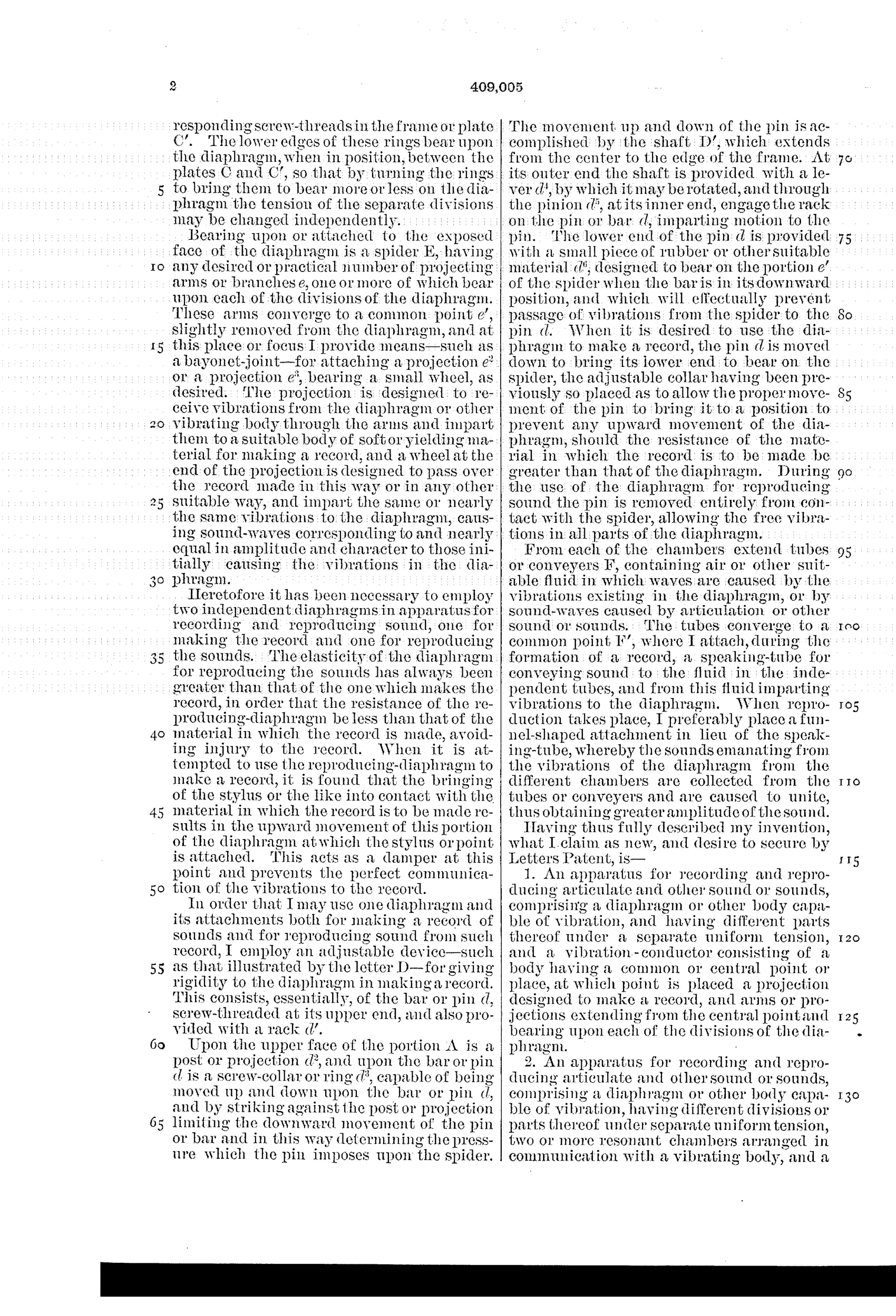
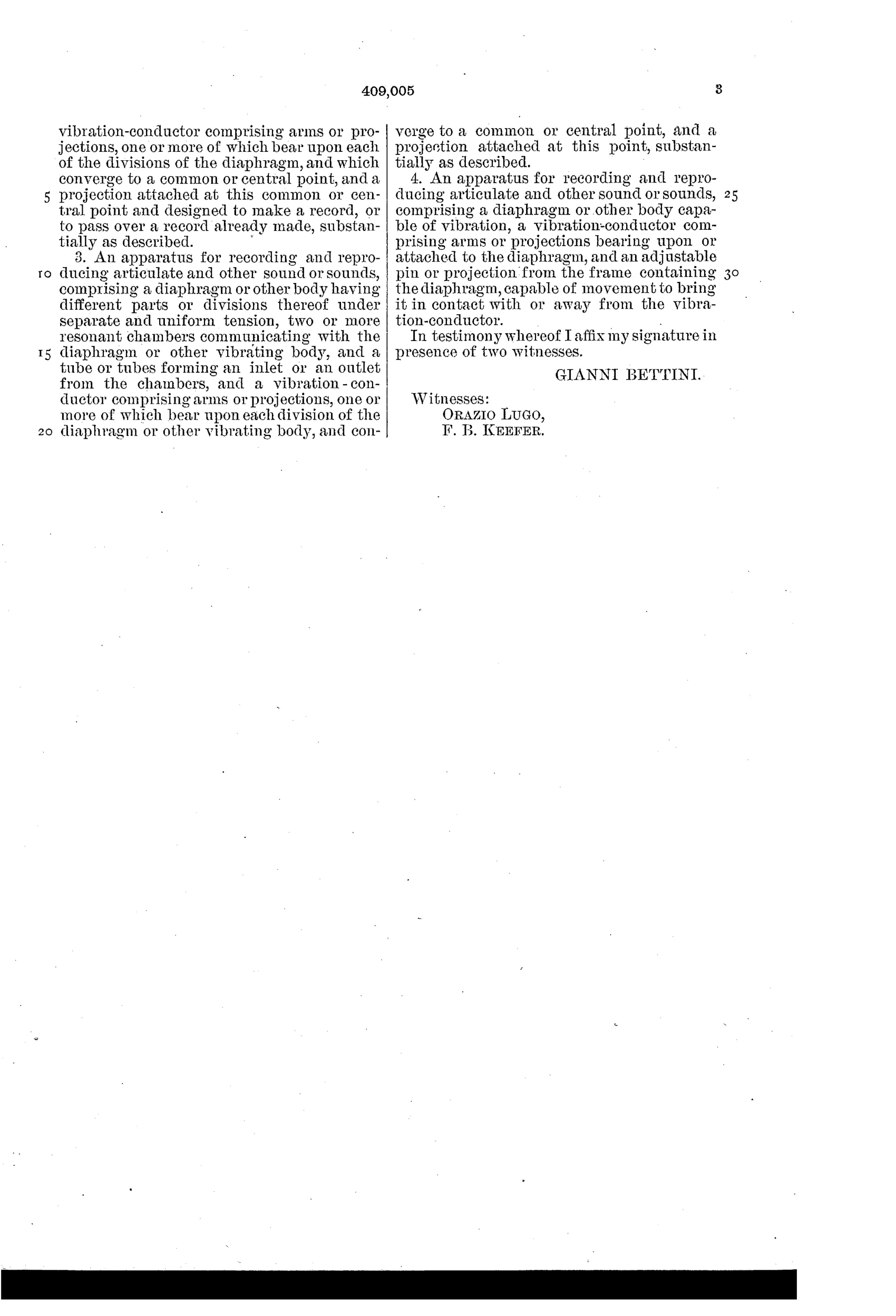
“An apparatus for recording and reproducing articulate and other sound or sounds, comprising a diaphragm or other body capable of vibration, and having different parts thereof under a separate uniform tension, and a vibration-conductor consisting of a body having a common or central point or place, at which point is placed a projection designed to make a record, and arms or projections extending from the central point and bearing upon each of the divisions of the diaphragm.”
In plain English: A sound apparatus where a segmented, separately-tensioned diaphragm connects through a spider-like arm assembly to a central point holding a recording stylus.
♫ In the inventor’s words
“Heretofore it has been necessary to employ two independent diaphragms in apparatus for recording and reproducing sound, one for making the record and one for reproducing the sounds.”— Gianni Bettini, from the specification
Manufactured and sold
The four-chamber form as drawn likely never shipped, but the spider vibration-conductor claimed here went directly into Bettini's commercial micro-reproducer attachments of the 1890s.
♫ More by Gianni Bettini
- PHONOGRAPH. (1892)
- PHONOGRAPH. (1892)
♫ Commentary
This is Gianni Bettini's opening move, and buried inside a strange four-chambered contraption is the one idea that made his name: the spider. Look at Fig. 2 — those converging arms marked E gather vibration from separate sections of the diaphragm and deliver it to a single central point carrying the stylus. Bettini's insight was that a diaphragm clamped at one center point vibrates unevenly; by bearing on it at several points and summing the motion, the spider captures more of the diaphragm's actual movement. Collectors know this device from the later Bettini micro-reproducers, prized for their unusually lifelike cylinders, and this is where the geometry first appears on paper.
The rest of the patent is more speculative. The clover-shaped body in Fig. 1 divides one diaphragm into four independently tensioned quadrants, each with its own resonant chamber and tube, all merging at a common horn fitting — an attempt to multiply amplitude by parallel pickup. The adjustable pin d is a clever touch: it stiffens the diaphragm for cutting a record, then withdraws for playback, letting one assembly do both jobs, which Bettini plainly states was the point.
The four-chamber layout was a dead end; the spider was not. Bettini refined it into a single-diaphragm attachment for Edison machines, and those attachments — and the cylinders recorded through them — are among the most sought-after artifacts in early recorded sound.
Commentary by Claude, The Talking Machine Patent Archive’s resident enthusiast