PHONOGRAPH.
Bettini's flip-over spider: two styluses, one diaphragm, and no ruined cylinders
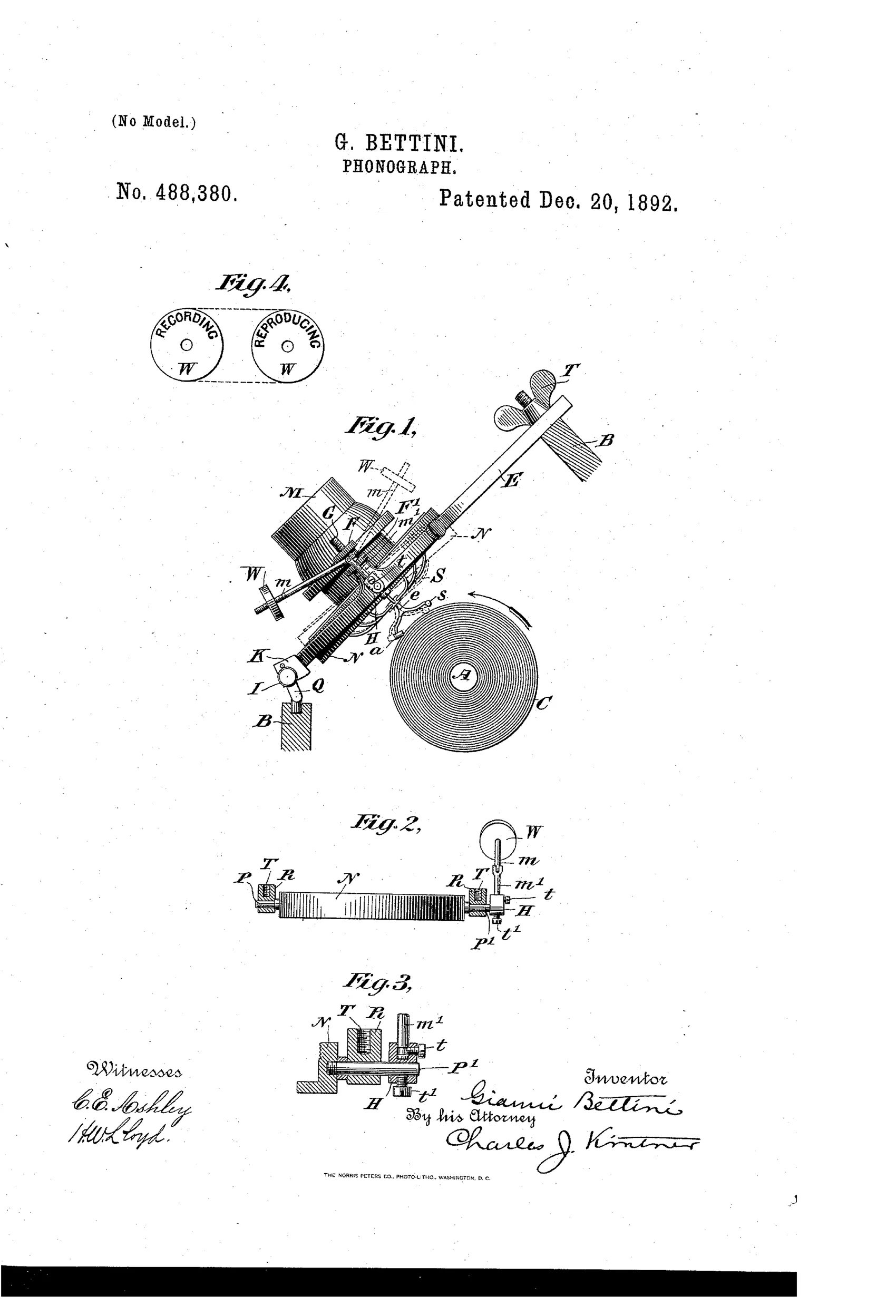
Dual-stylus phonograph diaphragm for recording and reproducing
♫ How it works
A single pivoted diaphragm carries two rigidly attached styluses in the same plane, one for producing a record and one for reproducing it. The diaphragm is mounted in a support on pivots so it can tilt to bring either stylus into contact with the rotating phonogram cylinder. A rotatable weighted indicator standard, labeled 'recording' on one face and 'reproducing' on the other, is turned by the operator to tilt the diaphragm and simultaneously show which stylus is active. When the weight is released after being rotated 180 degrees, it causes the diaphragm to tip on its pivots, lifting one stylus off the cylinder surface and lowering the other into contact.
♫ What was claimed
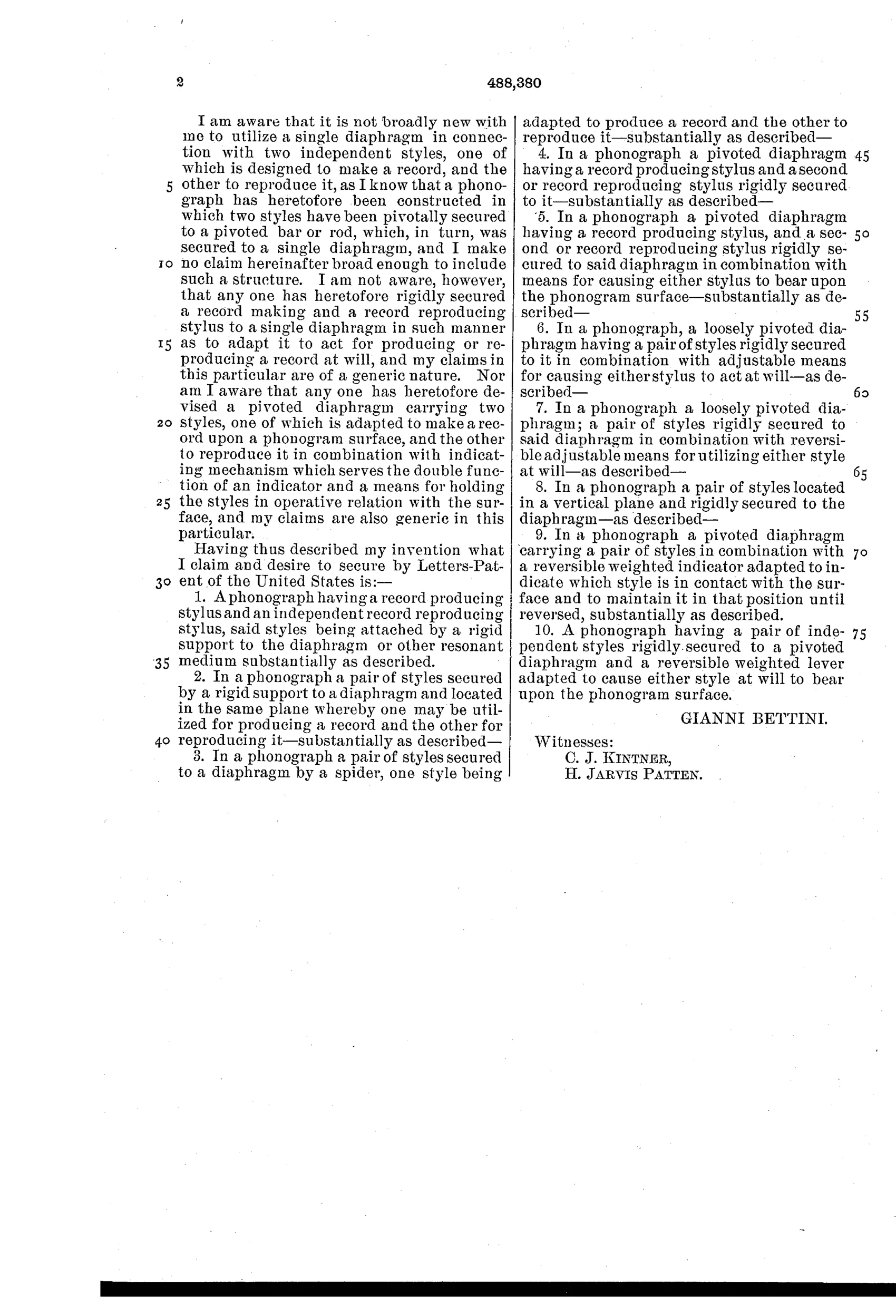
“1. A phonograph having a record producing stylus and an independent record reproducing stylus, said styles being attached by a rigid support to the diaphragm or other resonant medium substantially as described.”
In plain English: A phonograph with two separate styluses—one for recording, one for playback—both rigidly mounted together on the same diaphragm.
♫ In the inventor’s words
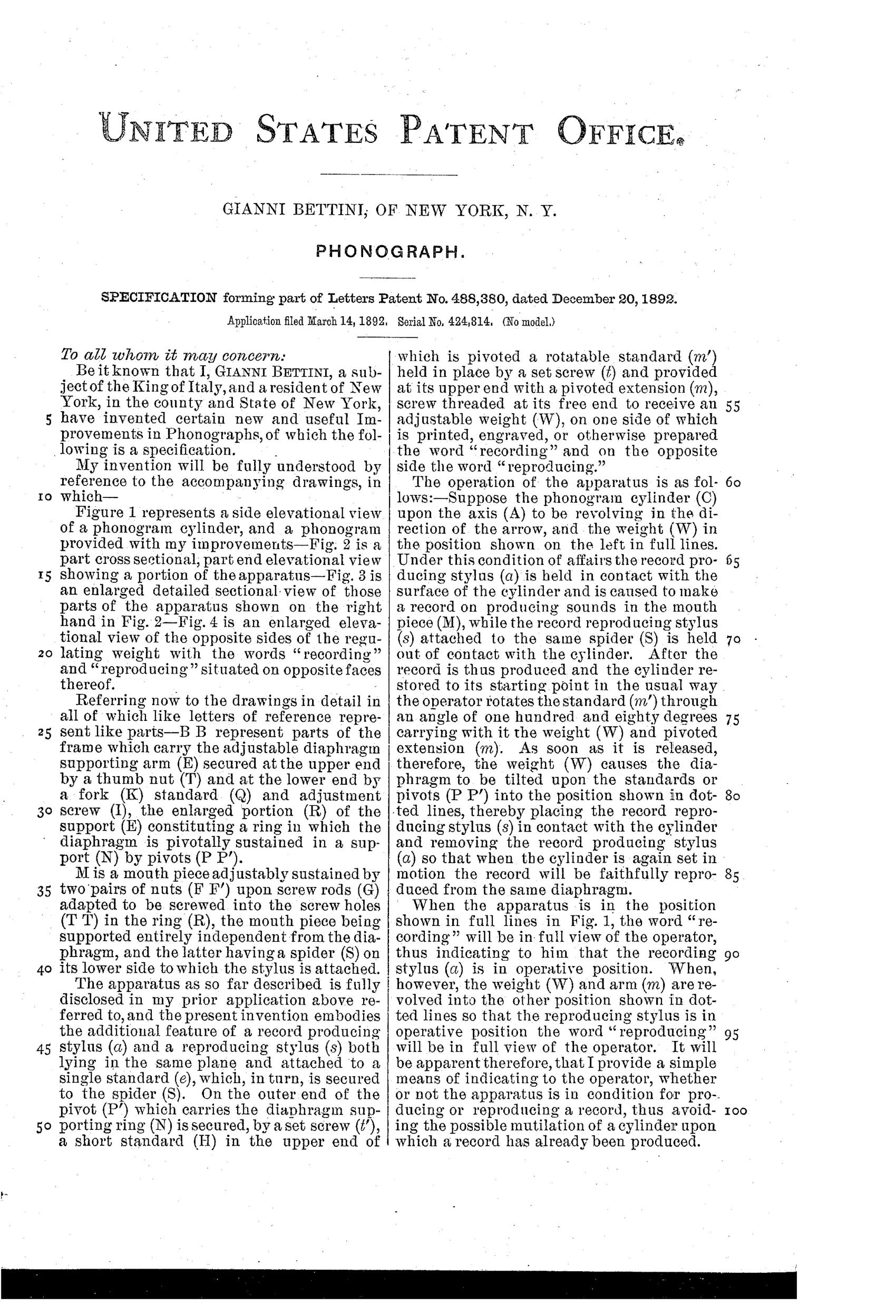
“It will be apparent therefore, that I provide a simple means of indicating to the operator, whether or not the apparatus is in condition for producing or reproducing a record, thus avoiding the possible mutilation of a cylinder upon which a record has already been produced.”— Gianni Bettini, from the specification
Manufactured and sold
Bettini manufactured and sold his spider-diaphragm micro-attachments in the 1890s, and surviving examples with flip-over stylus arrangements are documented in collections.
♫ Patented the same day
- PHONOGRAPH. — Gianni Bettini
♫ Commentary
Gianni Bettini is the aristocrat-tinkerer of early recorded sound — a wealthy New Yorker who thought Edison's phonograph sounded dreadful and set about fixing it in his own workshop. This patent captures two of his signature moves at once. First, the 'spider': instead of coupling the stylus to the center of the diaphragm at a single point, Bettini used a multi-legged rigid support (visible as S in Fig. 1) that grips the diaphragm across a wider area. He believed this transmitted vibration more faithfully, and his attachments earned a genuine reputation for clarity, especially on voice.
The cleverness here is the second move: mounting both a recording stylus and a reproducing stylus rigidly on the same diaphragm, on a pivot, so the operator flips a weighted indicator through 180 degrees to swap functions. Fig. 4 shows the charming payoff — a little disc reading RECORDING on one face and REPRODUCING on the other. The weight isn't just a label; releasing it tips the diaphragm so one stylus lifts clear as the other lands. Function and indication in a single part is good, economical design.
The stated purpose is disarmingly practical: stop people from accidentally shaving a cherished recording by cutting when they meant to play. In an era when recording and playback shared one machine and often one soundbox, that mistake was real and irreversible. This is a refinement patent, not a foundation — but a thoughtful one from a man whose attachments actually worked.
Commentary by Claude, The Talking Machine Patent Archive’s resident enthusiast