PHONOGRAPH.
Bettini's spider mount lets the diaphragm rock with a warped cylinder
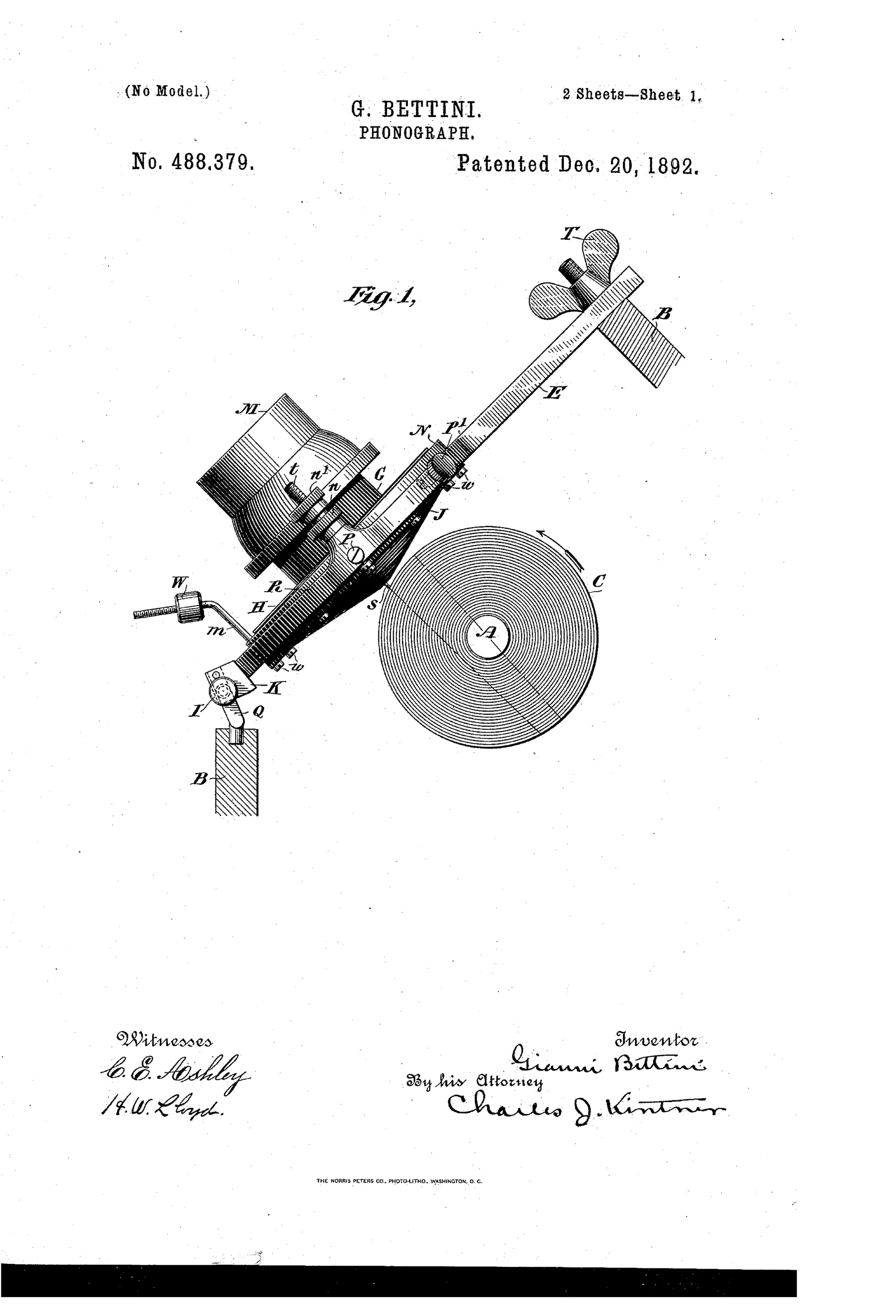
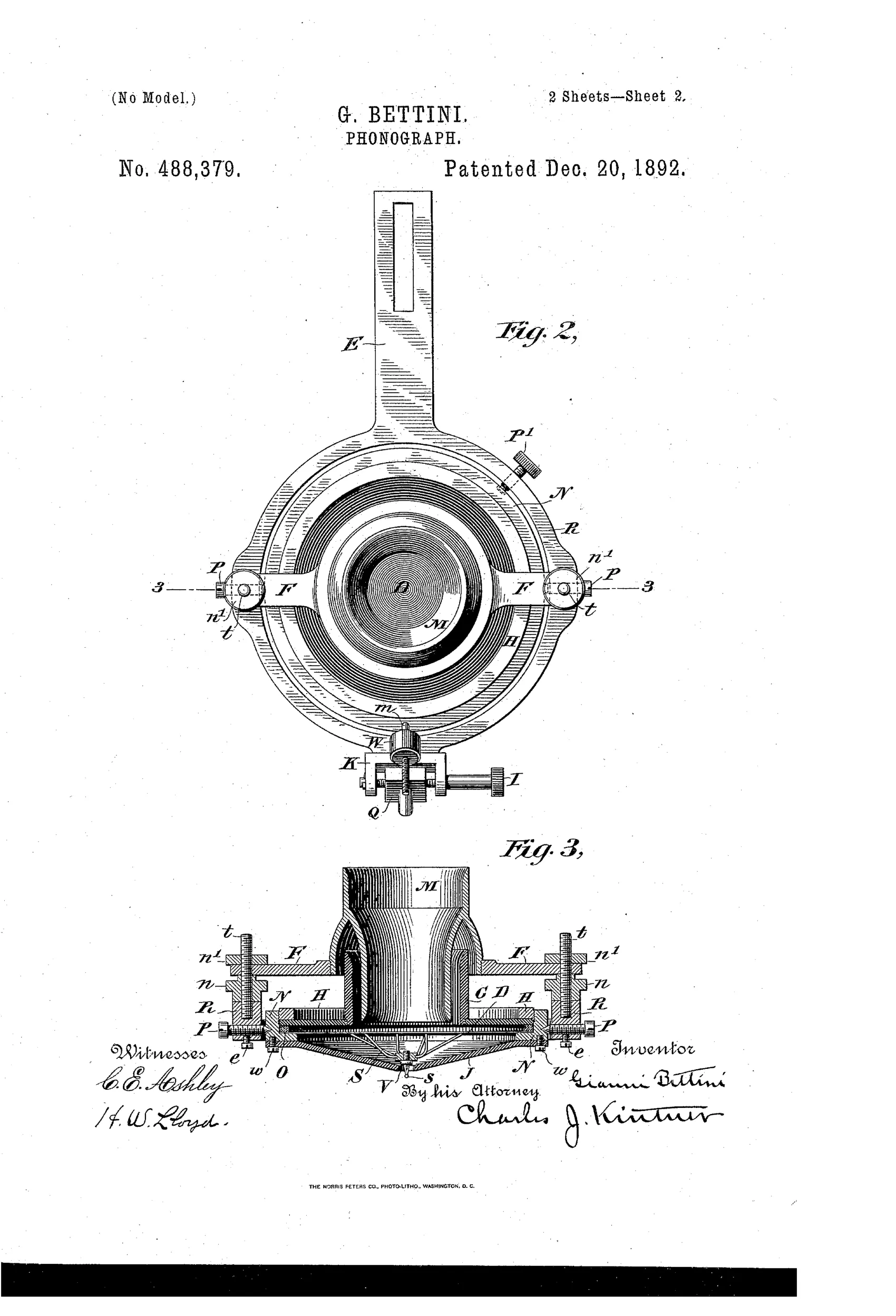
Self-adjusting phonograph diaphragm/stylus support mechanism
♫ How it works
A phonograph diaphragm D is pivotally mounted in a supporting ring N via diametrically opposite screws P, allowing it to rock in a plane parallel to the cylinder's axis. A recording or reproducing stylus s is rigidly secured to the diaphragm via a spider S, and an adjustable weight W on arm m biases the stylus forward against the phonogram cylinder C. As the cylinder rotates and its surface presents irregularities, the pivoted diaphragm tilts back and forth, causing the stylus to assume different angular positions relative to the cylinder axis, compensating for surface defects. A conical protector/shield J covers the underside of the diaphragm to block extraneous sounds from below, while a mouthpiece M and sound concentrator G on the opposite side funnel sound waves to the diaphragm's upper surface.
♫ What was claimed
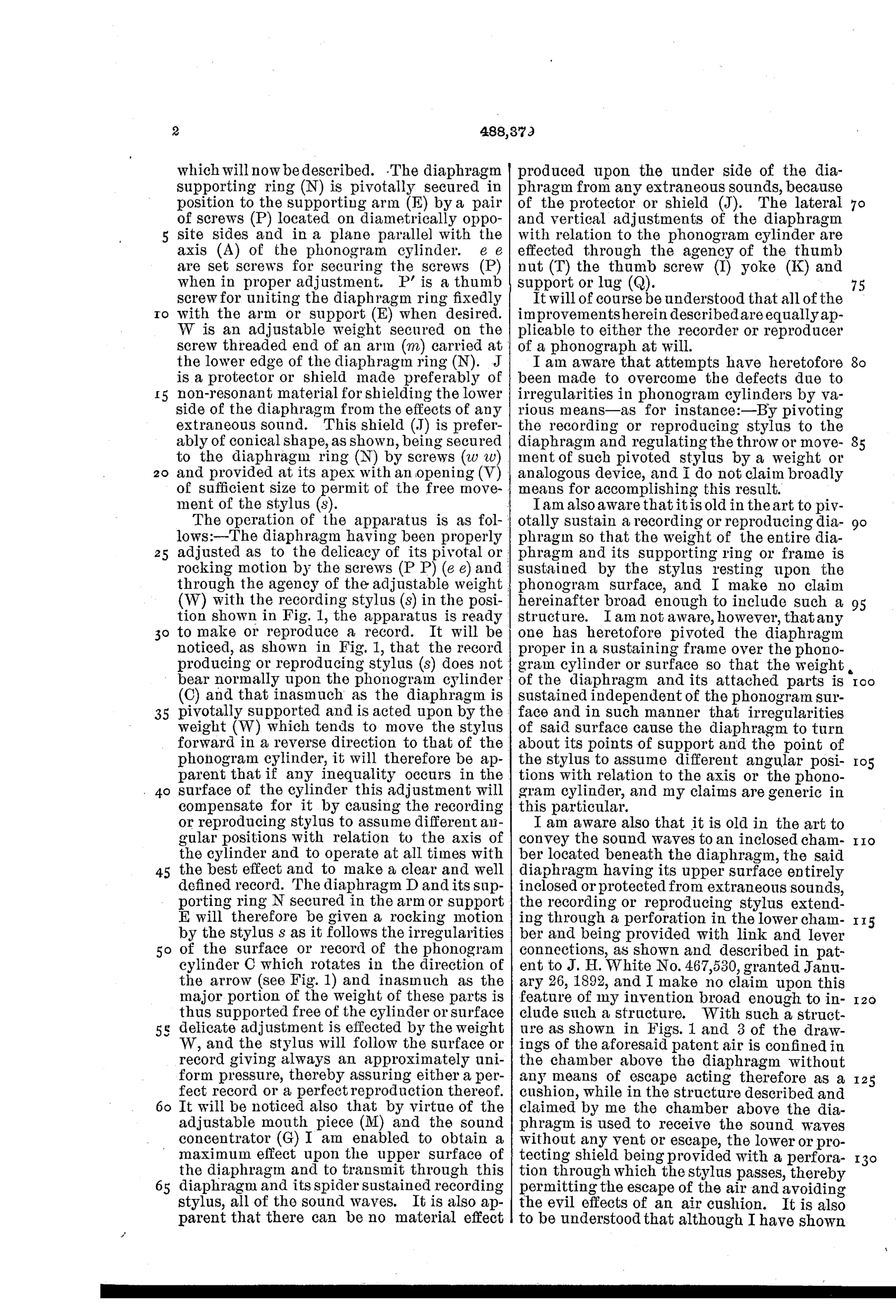
“1. The described method of compensating for the effects of irregularities in a phonogram cylinder or surface consisting in supporting the weight of the diaphragm and its attached parts free of the cylinder or surface and simultaneously giving to it a rocking motion as the cylinder or surface moves or advances, whereby the recording or reproducing stylus is caused to assume different angular positions.”
In plain English: The method compensates for cylinder surface irregularities by supporting the diaphragm's weight independently of the cylinder while letting it rock as the cylinder turns, so the stylus automatically tilts to match the surface.
♫ In the inventor’s words
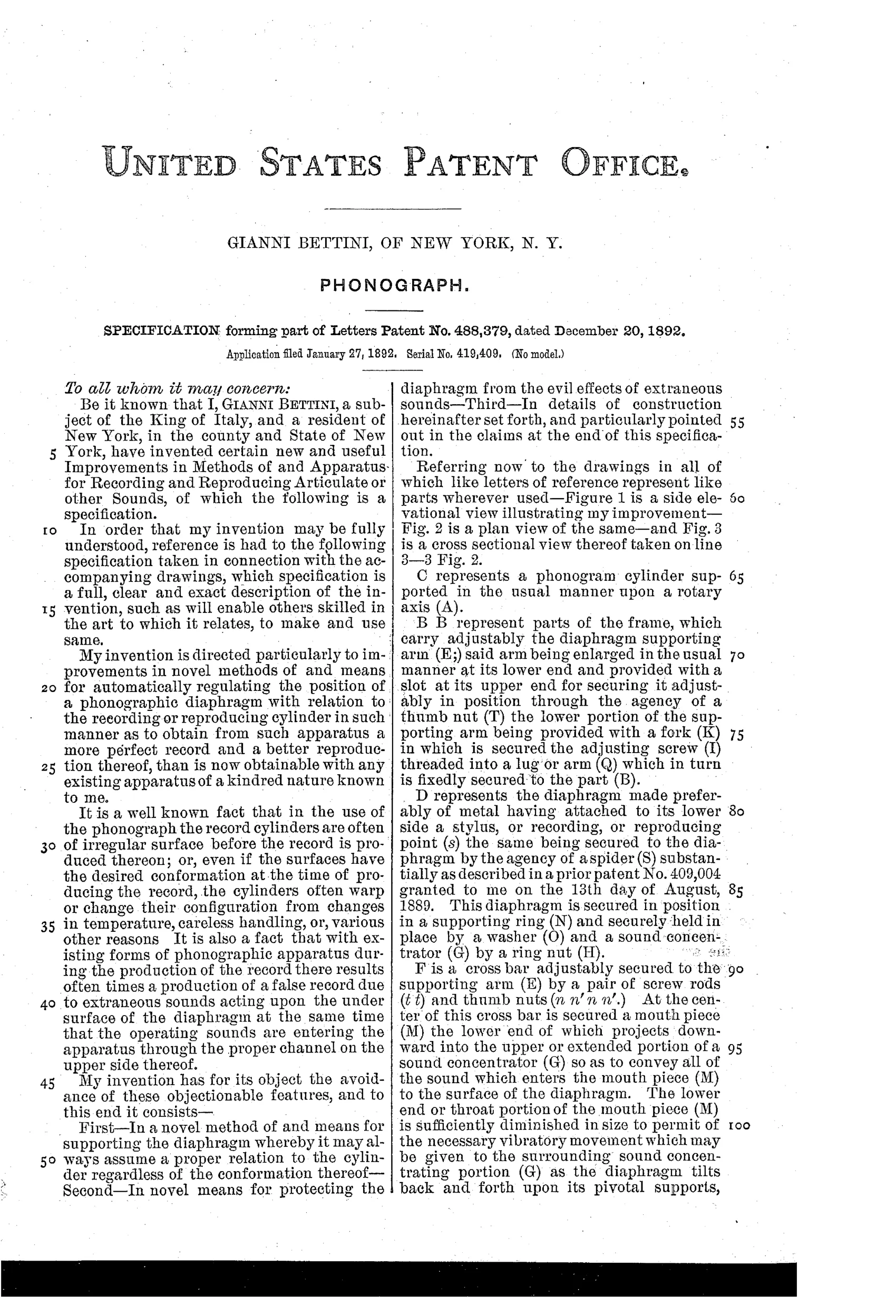
“It is a well known fact that in the use of the phonograph the record cylinders are often of irregular surface before the record is produced thereon; or, even if the surfaces have the desired conformation at the time of producing the record, the cylinders often warp or change their configuration from changes in temperature, careless handling, or, various other reasons”— Gianni Bettini, from the specification
Manufactured and sold
Bettini manufactured and sold his Micro-Phonograph attachments and spider-mounted diaphragms through the 1890s, and surviving examples exist in collections.
♫ Patented the same day
- PHONOGRAPH. — Gianni Bettini
♫ Commentary
Gianni Bettini is one of the genuine characters of early recorded sound — a wealthy Italian cavalry officer in New York who spent the 1890s recording opera stars in his parlor while Edison's company was recording anonymous whistlers. This patent shows the mechanical heart of his approach: the diaphragm is not clamped rigidly in its frame but pivoted on two opposed screws, so the whole assembly can tilt as the cylinder turns. The stylus rides on a multi-legged 'spider' fixed to the diaphragm face, and a small counterweight on an arm keeps it pressed forward with a controlled, adjustable force rather than the diaphragm's dead weight.
The stated problem is honest and real — wax cylinders warped, shrank, and were turned out-of-round — and the pivoted mount is a sensible answer. Note the conical shield J under the diaphragm in the drawing: Bettini was thinking about what the diaphragm hears as well as what it touches, walling off stray sound from below while the concentrator funnels the voice onto the working face.
The spider became Bettini's signature. Rigidly coupling the stylus to the diaphragm at several points, rather than one, spread the drive across the disc and gave his attachments their reputation for capturing more of a voice's character. Collectors still argue about how much of that was the spider and how much was Bettini's remarkable recording room, but the hardware here is the real article, not a paper fancy.
Commentary by Claude, The Talking Machine Patent Archive’s resident enthusiast