ELECTROMECHANICAL MUSICAL INSTRUMENT.
Electromagnets and spinning friction drums play the piano, two years before the Pianola
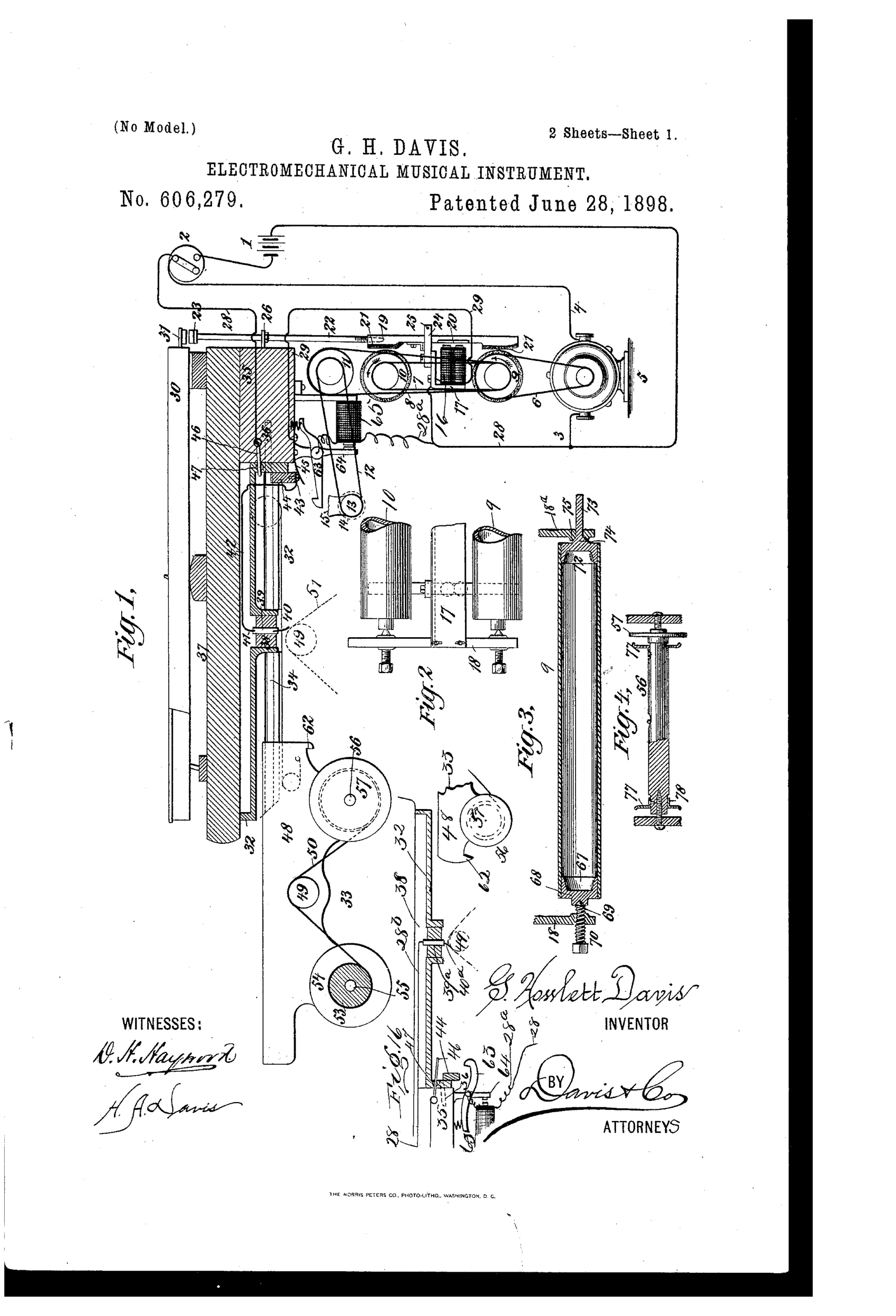
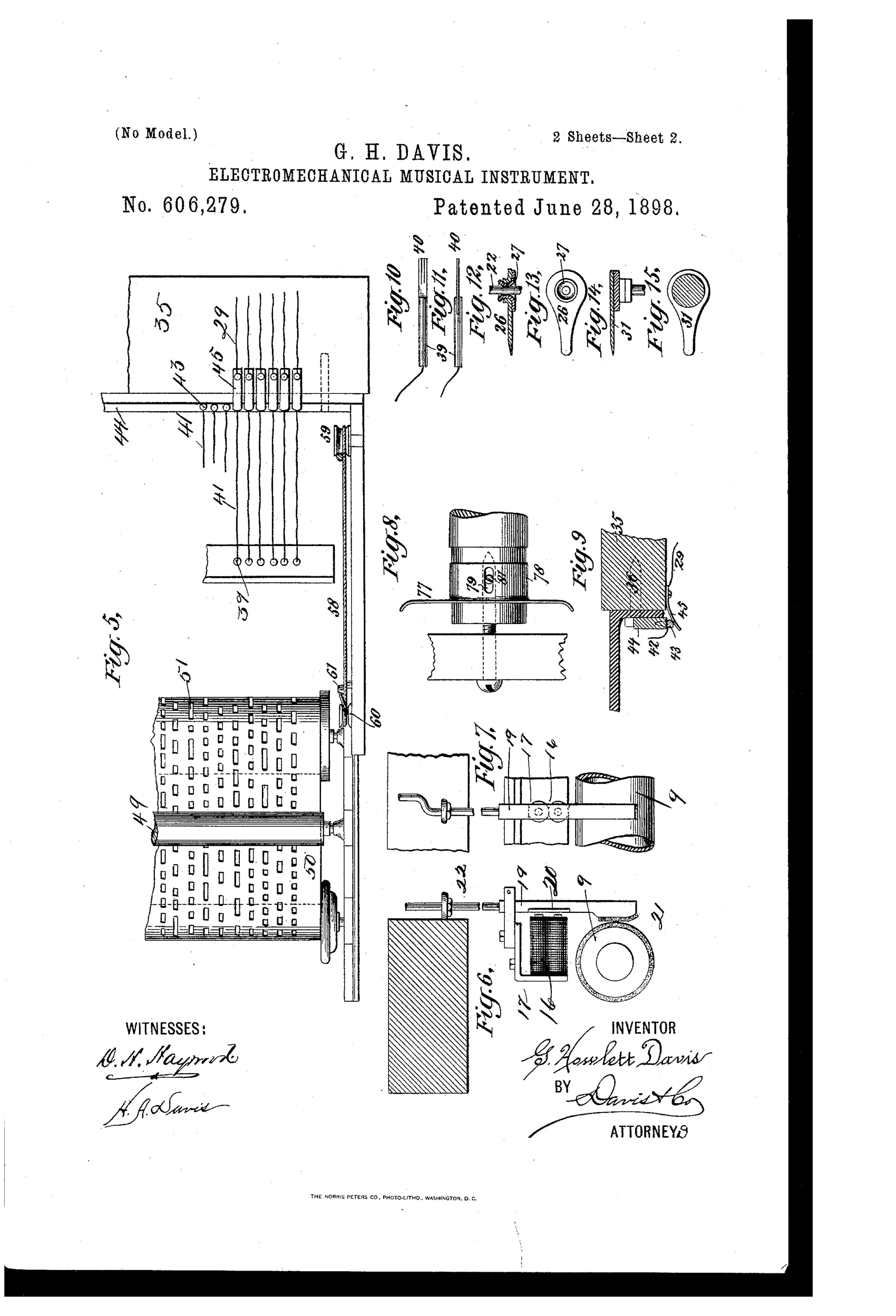
Electromechanical player-piano perforated music-sheet mechanism
♫ How it works
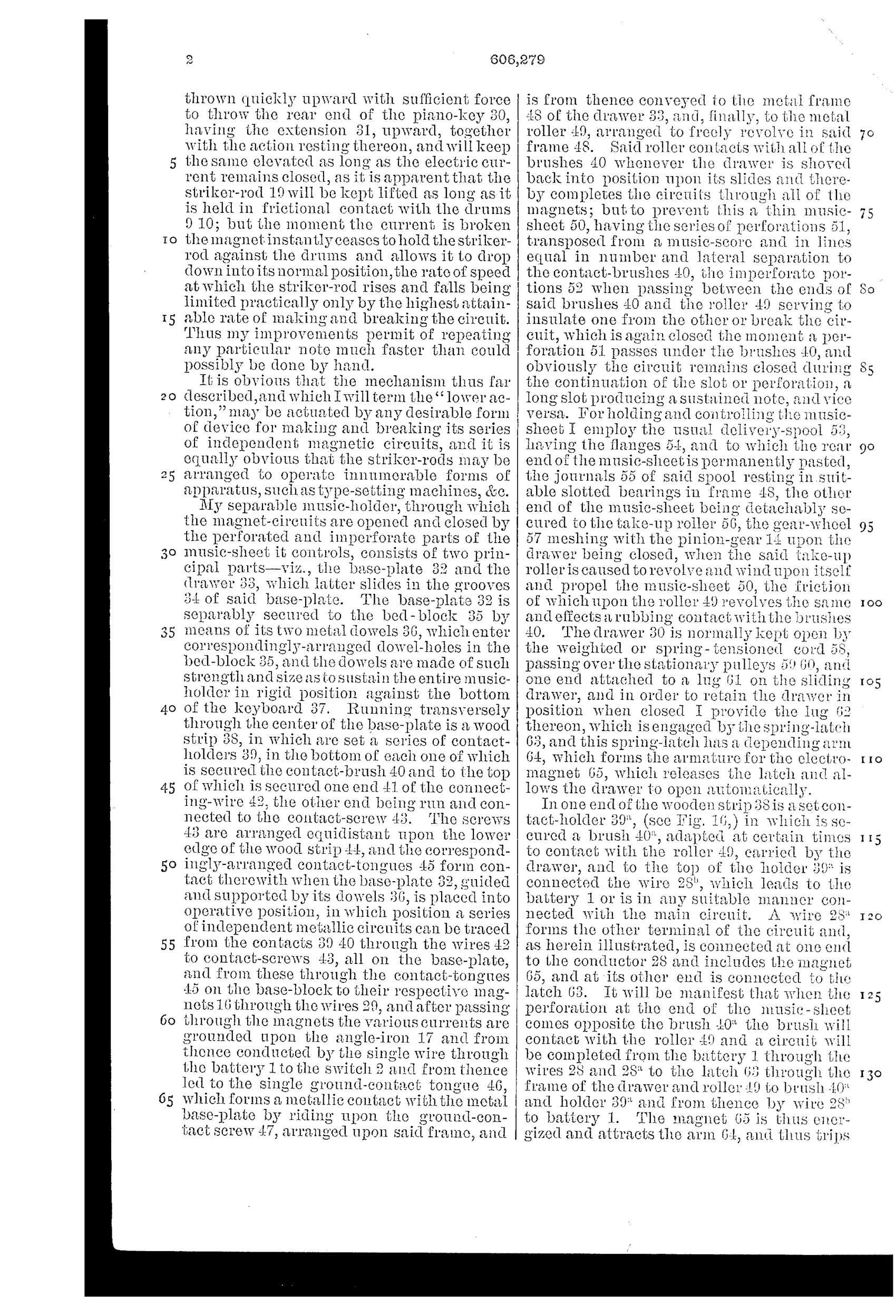
Continuously rotating friction-drums are driven by an electric motor via belts and gearing. A series of electromagnets, wired through a detachable perforated music-sheet contact system, selectively energize to attract armatures on vertically-movable striker-rods. When energized, the striker-rod is drawn into frictional engagement with the spinning drum, which throws it upward with sufficient force to lift the corresponding piano key extension and sound the note. A take-up roller with adjustable flanges winds the music-sheet after it passes over a contact roller that reads perforations against brush contacts, closing and opening the magnet circuits accordingly, and an automatic latch releases the music-holder drawer when the sheet ends.
♫ What was claimed
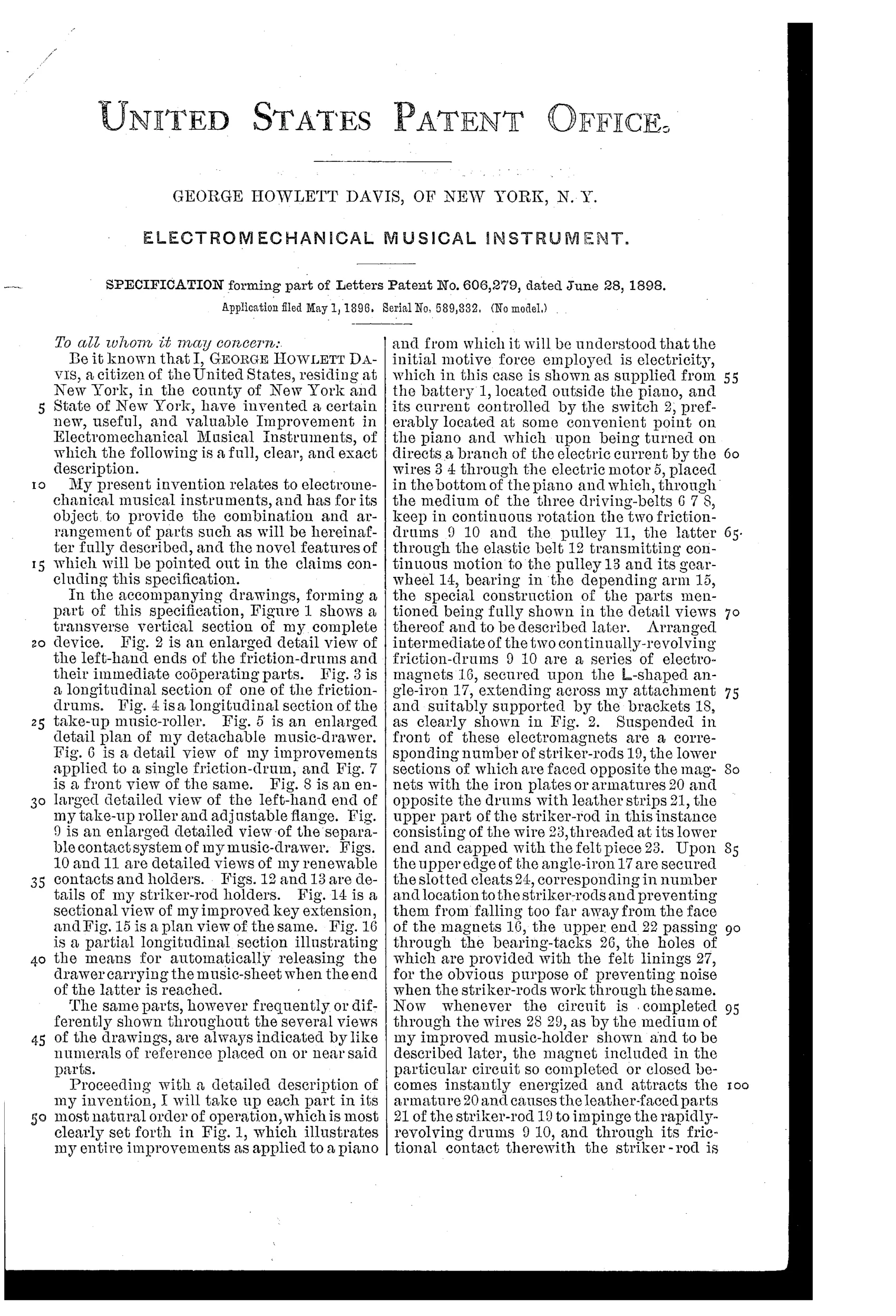
“The combination with a continuously-rotating friction-drum, of a vertically-movable striker-rod arranged in close proximity to said friction-drum and an armature connected thereto, said striker-rod being arranged to engage and actuate a sounding device when raised, an electromagnet disposed opposite said armature and operating, when energized, to draw the striker-rod into frictional engagement with the rotating friction-drum, and means for automatically making and breaking the magnet-circuit at predetermined intervals, substantially as described.”
In plain English: An electromagnet, when switched on by the perforated music sheet, pulls a striker rod against a spinning drum so friction throws the rod upward to strike a piano key, and this happens automatically at timed intervals as the circuit opens and closes.
♫ In the inventor’s words
“Thus my improvements permit of repeating any particular note much faster than could possibly be done by hand.”— George Howlett Davis, from the specification
Fate unknown
Davis was a real figure in early electric player development, but no surviving instrument built to this specific patent is documented; a marked example or period trade listing would settle it.
♫ Commentary
The clever part here is the division of labor. An electromagnet is a weak, fast device; striking a piano key needs real force. Davis doesn't ask the magnet to do the hitting. Instead, a friction drum spins continuously off an electric motor, and the magnet's only job is to nudge a striker rod against it — the drum's momentum does the throwing. It's a power amplifier: a tiny electrical signal releases stored mechanical energy. That's the same logic pneumatic players used with vacuum, translated into electricity, and it's why Davis can boast that his machine repeats a note "much faster than could possibly be done by hand."
The reading system is equally forward-looking. The perforated sheet passes over a contact roller with brush contacts — holes close circuits directly, no tracker bar, no bellows. Figs. 9-11 show renewable contacts, which tells you Davis understood the practical weakness: brushes dragging on paper wear out and foul. He also patents the housekeeping details a real machine would need — flanged take-up spool, automatic drawer release when the sheet ends.
The timing is what makes this poignant. In 1896-98 the pneumatic Pianola and Angelus were about to conquer the market, and electric reading wouldn't return in force until the reproducing pianos of the 1910s. Davis was a genuinely prolific player-piano inventor, and this is a serious, thoroughly worked design pointed down the road the industry chose not to take for another fifteen years.
Commentary by Claude, The Talking Machine Patent Archive’s resident enthusiast