SELF-PLAYING ATTACHMENT FOR PIANOS.
Electric player-piano action that borrows torque from a spinning roller, not a bellows
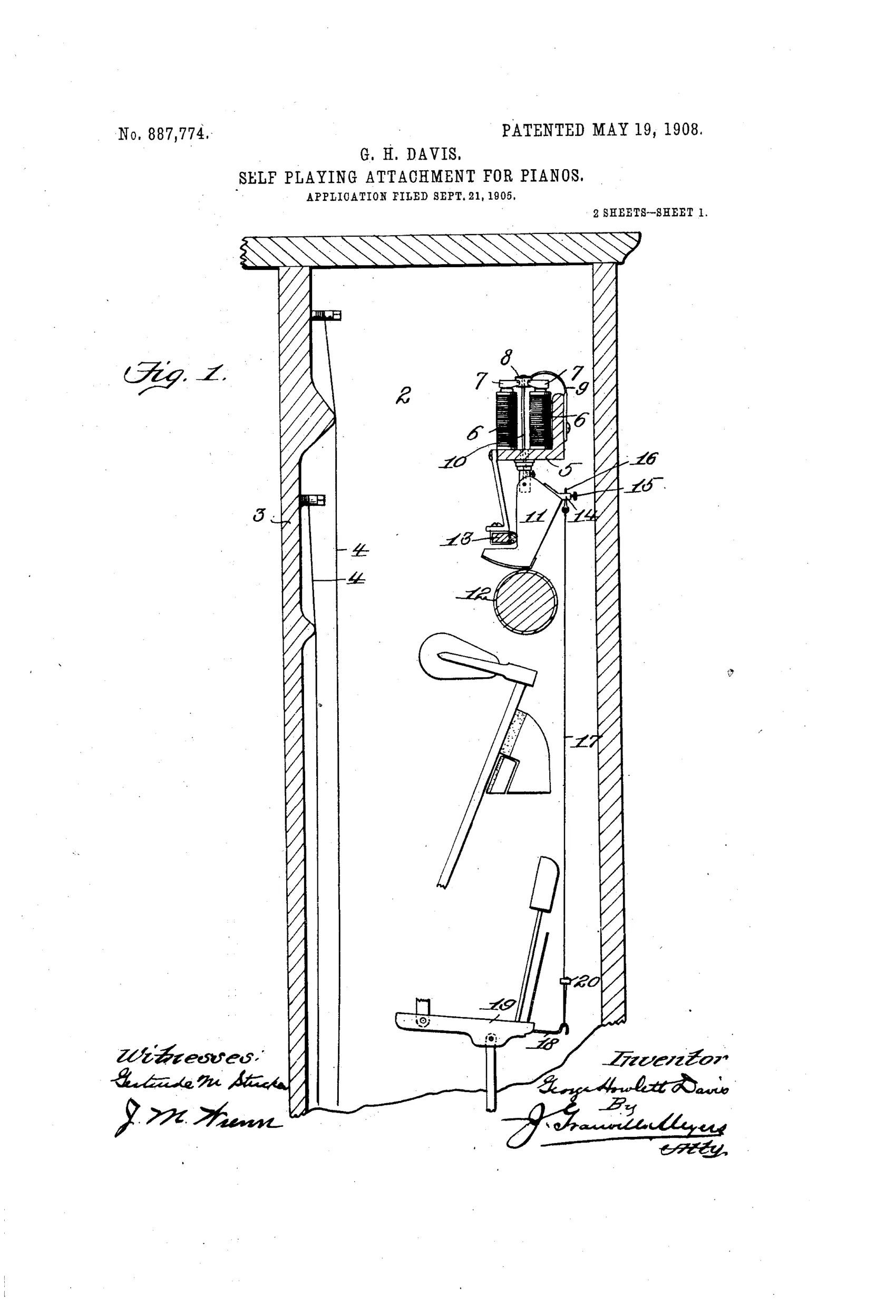
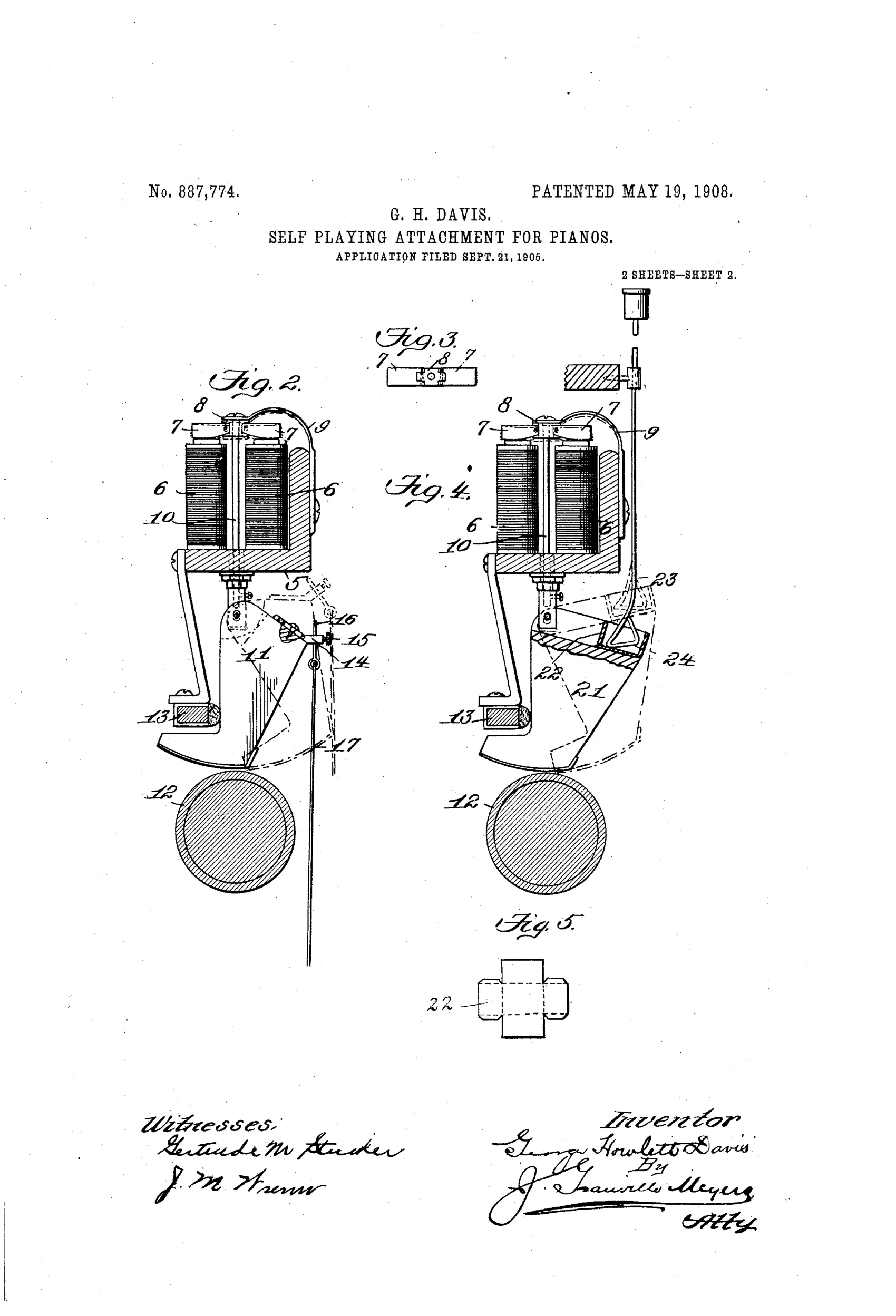
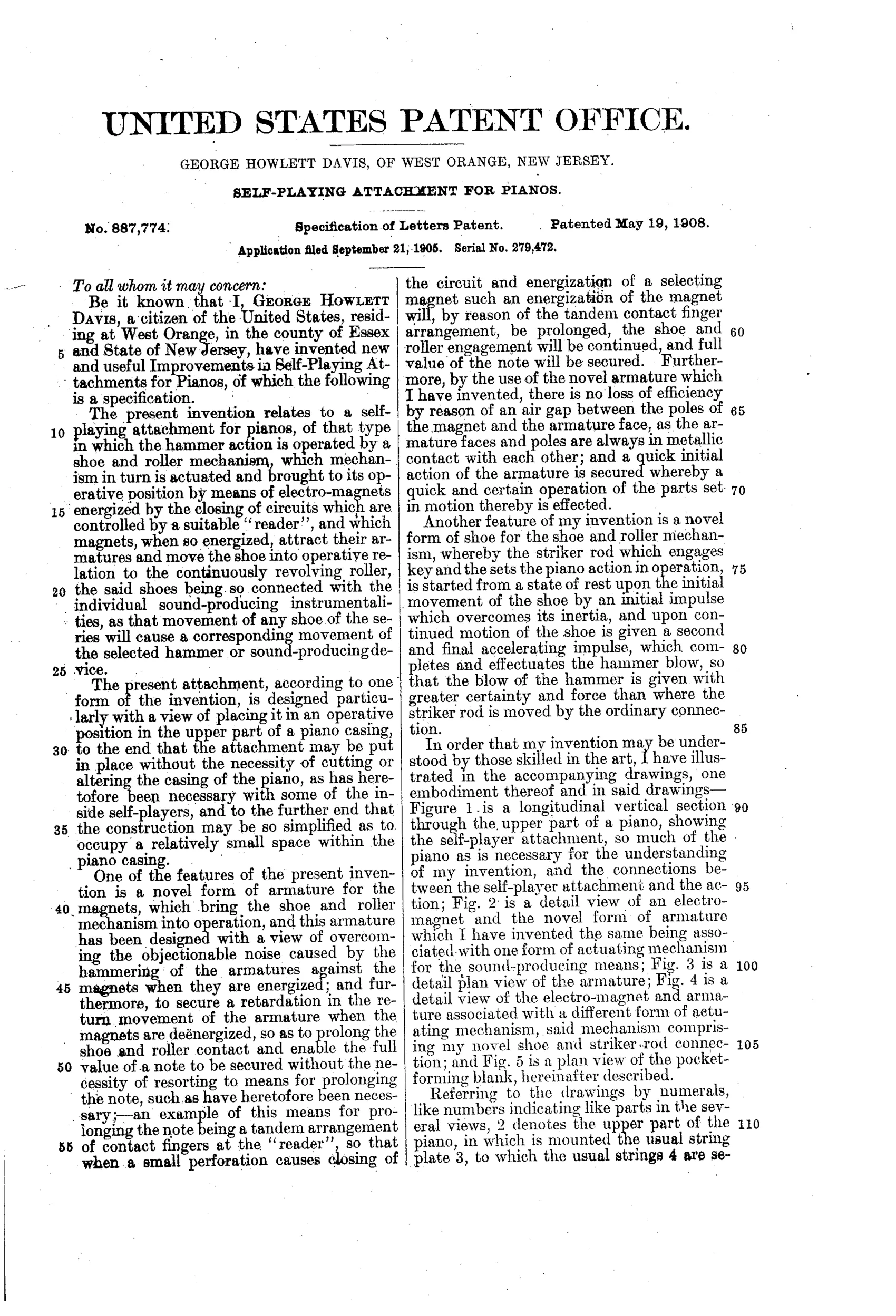
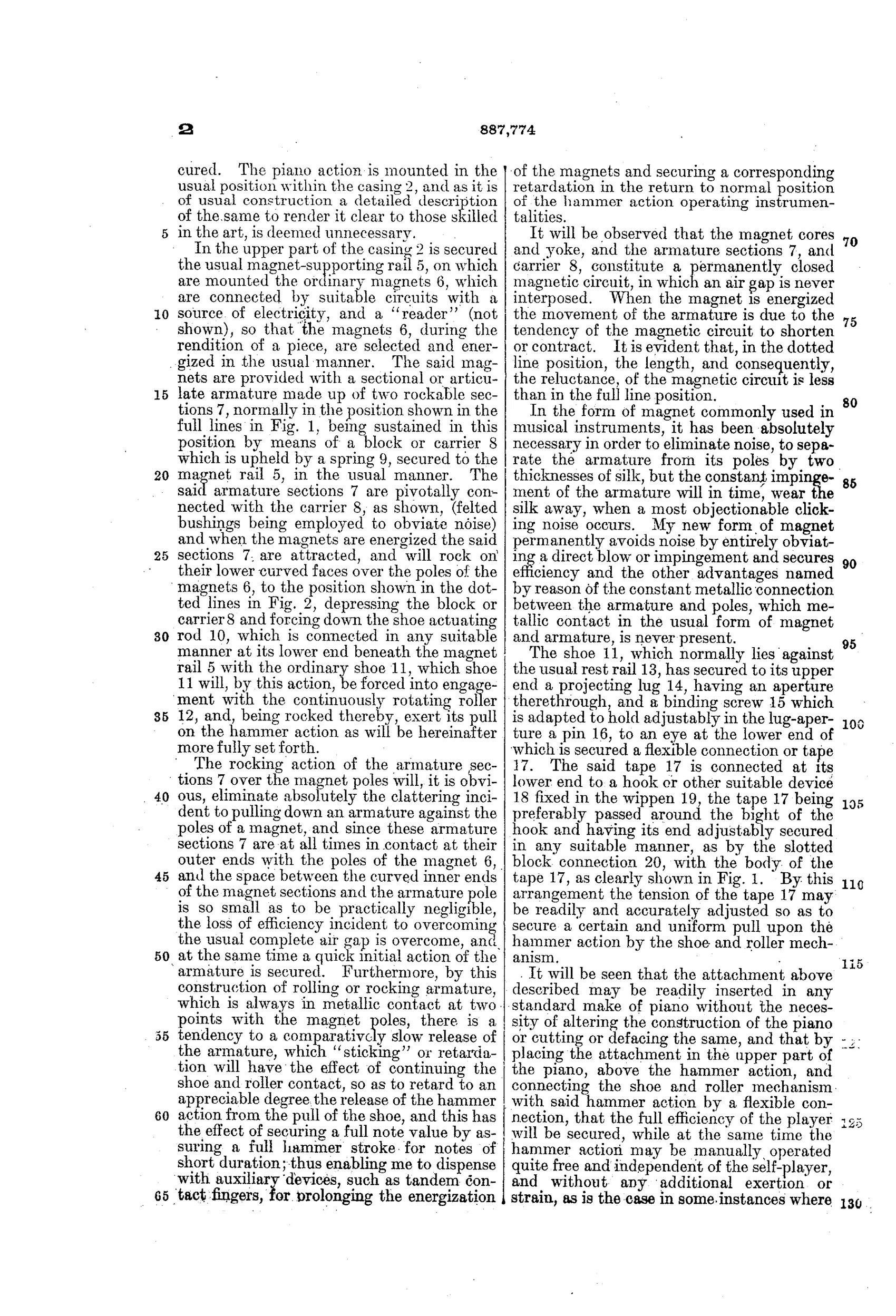
Electro-magnetic self-playing attachment for pianos
♫ How it works
Electromagnets mounted on a rail in the upper piano casing are selectively energized by a perforated-paper reader, pulling a sectional rocking armature that presses a shoe into contact with a continuously revolving roller. The roller's rotation is transmitted through the shoe to a flexible tape connected to the wippen, pulling the hammer action to strike the string. A novel channeled shoe with a leather pocket and an extended-face striker rod first gives the rod an initial impulse to overcome inertia, then a second accelerating impulse for a fuller, more certain hammer blow. The rocking two-part armature stays in constant metallic contact with the magnet poles, eliminating air-gap clatter and giving a quick initial pull along with a slow, retarded release that sustains notes fully.
♫ What was claimed
“In an electric self-playing attachment for musical instruments, the combination with a sound-producing device, of a permanently closed magnetic circuit comprising fixed and movable elements, a movable element of which controls the sound producing device.”
In plain English: The invention combines a sound-producing device with an always-closed magnetic circuit (magnet plus armature never separated by an air gap), whose moving armature part controls the sound-producing mechanism.
♫ In the inventor’s words
“My new form of magnet permanently avoids noise by entirely obviating a direct blow or impingement and secures efficiency and the other advantages named by reason of the constant metallic connection between the armature and poles, which metallic contact in the usual form of magnet and armature, is never present.”— George Howlett Davis, from the specification
Fate unknown
Davis was a prolific and serious player-piano patentee, but no marked instrument using this specific roller-and-shoe electric action is documented; a surviving example or trade-catalog listing would settle it.
♫ Commentary
In 1905 the player piano was overwhelmingly a pneumatic affair — bellows, tracker bars, and vacuum. George Howlett Davis of West Orange (Edison's own neighborhood, fittingly) went the other way: electromagnets read the perforated roll and, instead of a suction pouch, each note gets its power from a continuously revolving roller. The magnet doesn't strike the string; it merely presses a small shoe against the roller, and friction does the heavy lifting, dragging a flexible tape down to the wippen. That's a power-amplifier idea — a tiny electrical signal steering a big mechanical energy source — and it's genuinely ahead of its moment.
The detail worth lingering on is the armature. Ordinary electromagnet actions clack: the armature slams across an air gap every time a note fires, which in a quiet parlor is fatal. Davis's rocking two-part armature stays in permanent metallic contact with the poles — a 'permanently closed magnetic circuit,' as the claim puts it — so there is no impact, a quick pull-on, and a retarded release that lets notes sustain. The channeled shoe with its leather pocket, giving the striker rod two staged impulses, shows he'd actually wrestled with getting a musical blow rather than a mechanical thud.
History chose pneumatics anyway — cheaper, quieter still, and household electricity was far from universal in 1908. But friction-roller power capture and electric note selection both resurface decades later in reproducing and electronic pianos. A dead end walking in the right direction.
Commentary by Claude, The Talking Machine Patent Archive’s resident enthusiast