SELF-PLAYING ATTACHMENT FOR MUSICAL INSTRUMENTS
Worcester's Theodore Brown files the pneumatic groundwork for his Simplex piano player
Pneumatic player-piano mechanism with adjustable key-levers
♫ How it works
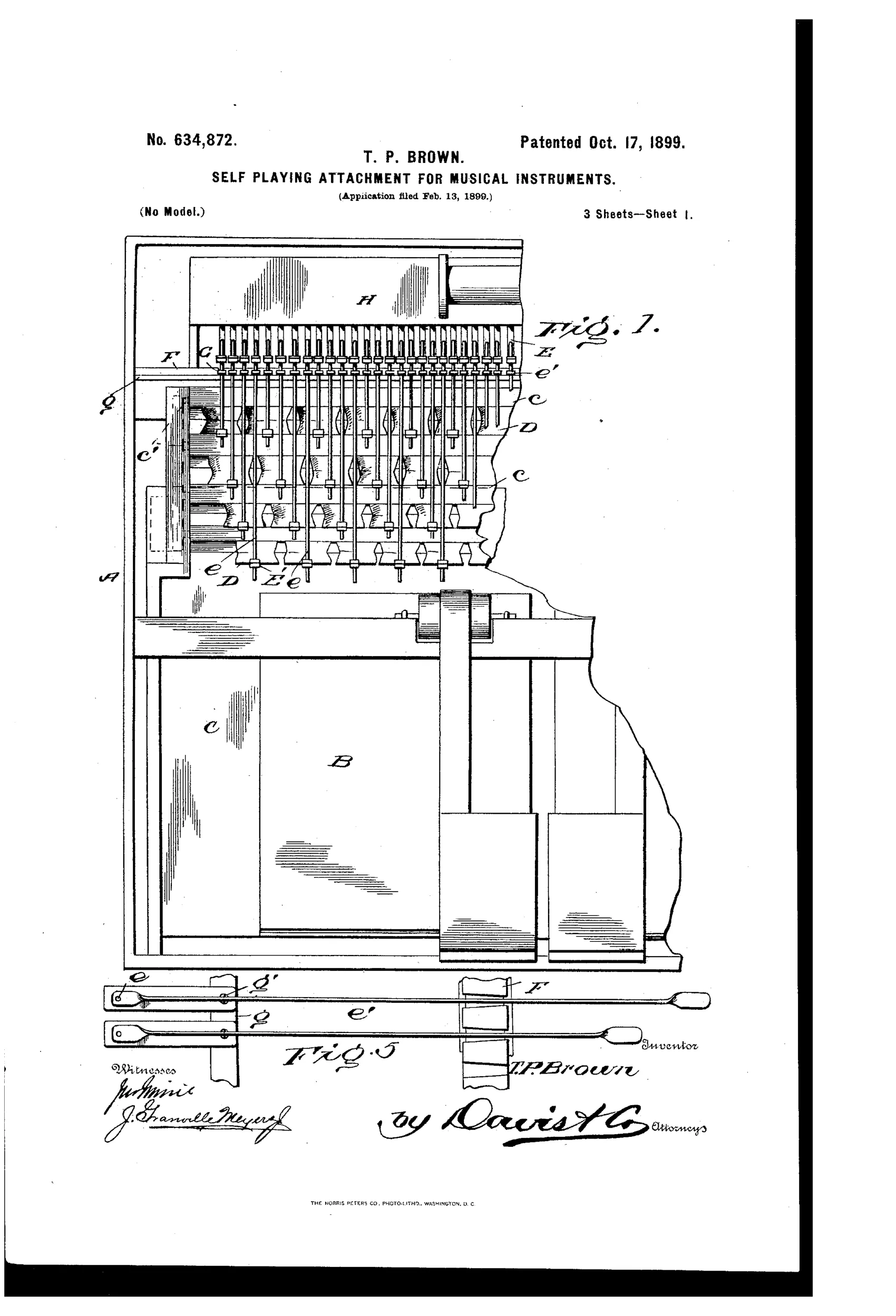
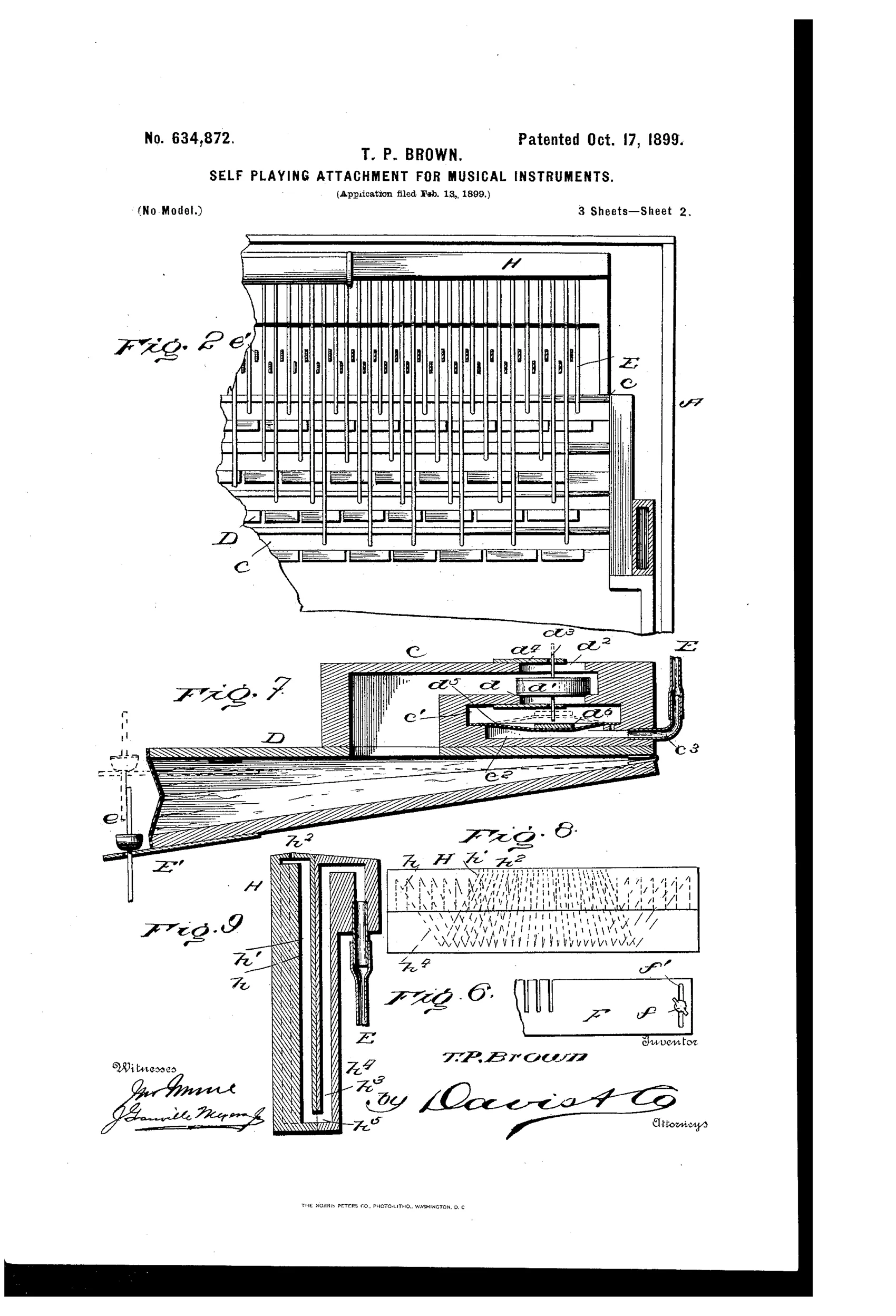
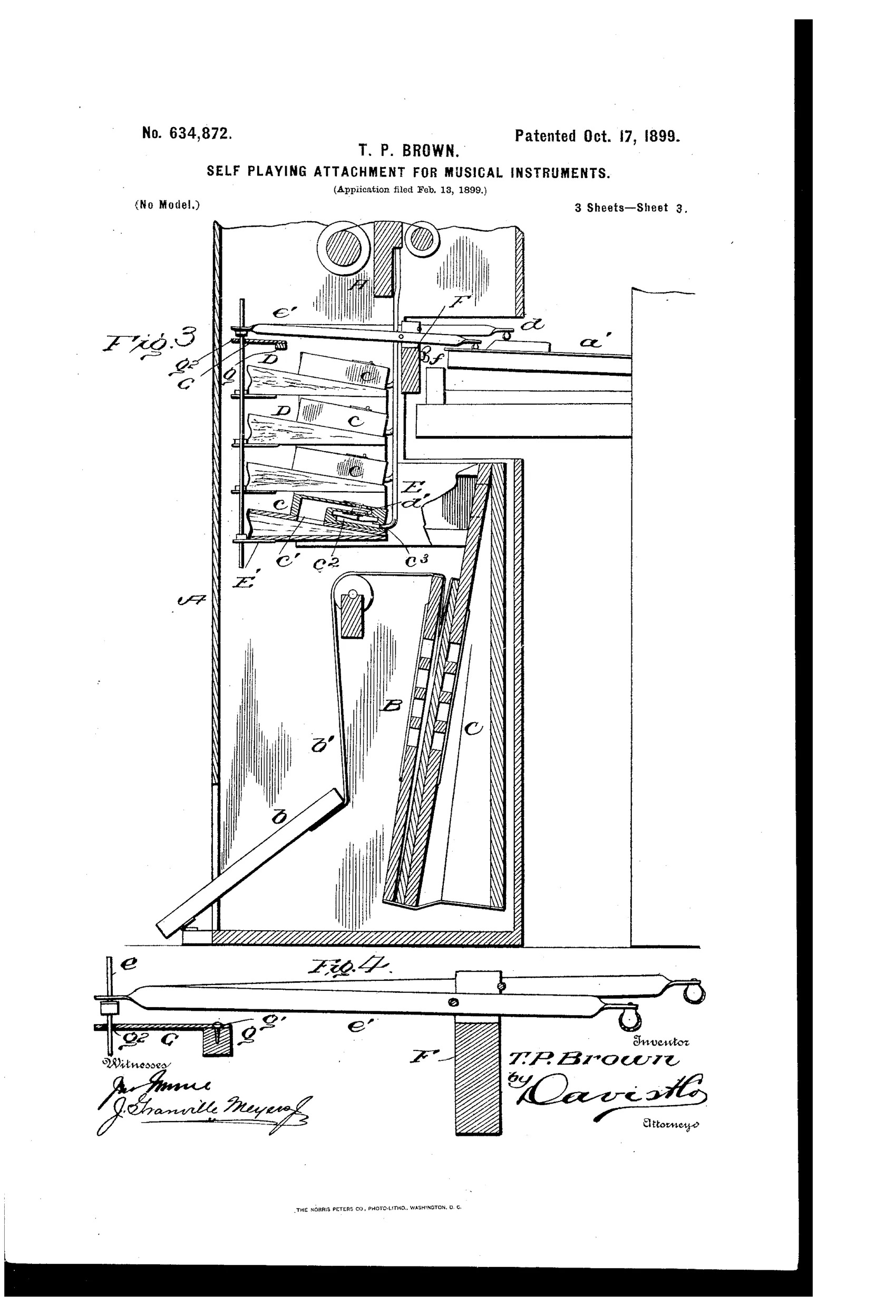
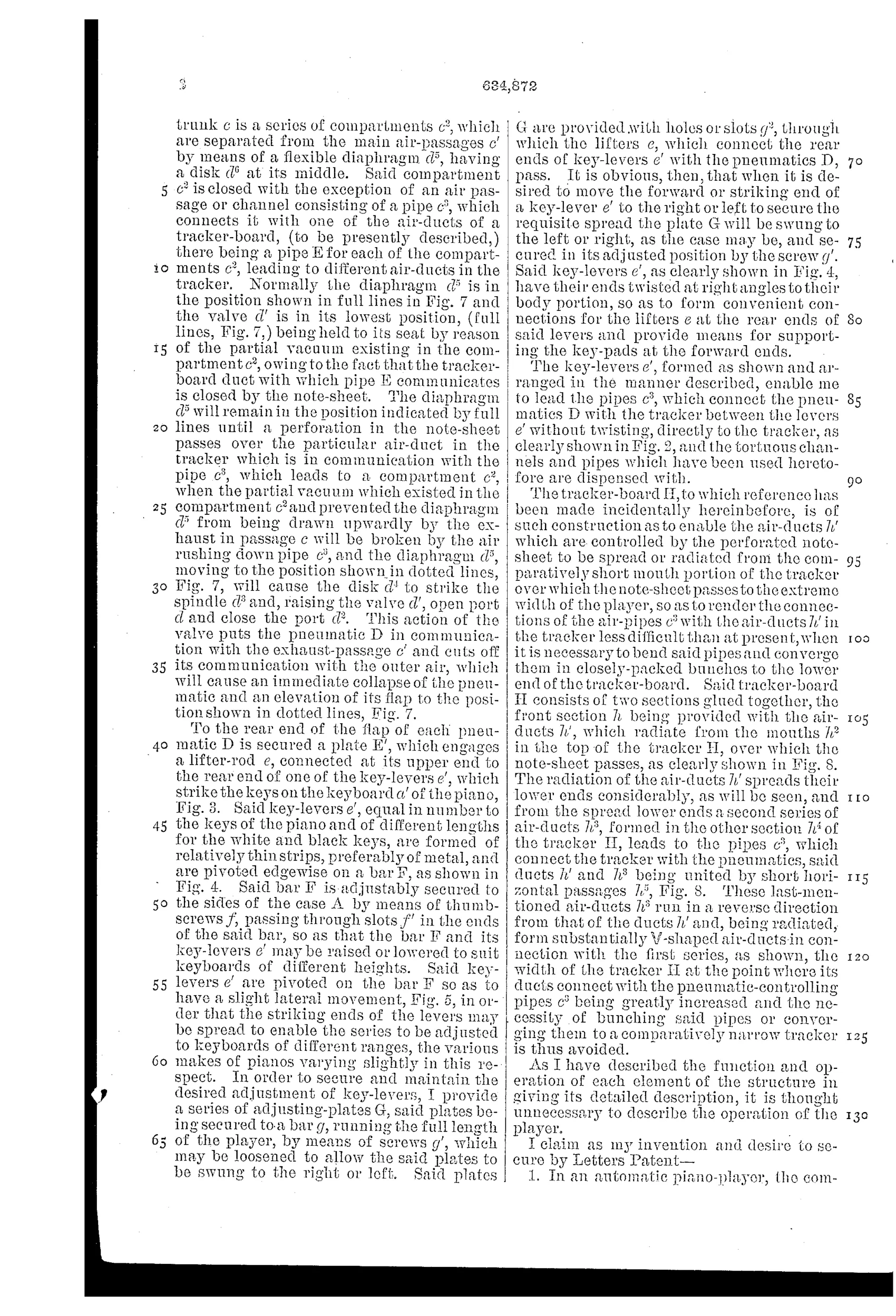
A perforated note-sheet passes over a tracker-board, and when a perforation aligns with an air-duct it breaks a partial vacuum in a compartment, causing a diaphragm to strike a valve spindle. This raises a puppet-valve that opens the pneumatic to the exhaust-trunk while cutting off outside air, collapsing the pneumatic bellows. The collapsing pneumatic pulls a lifter-rod connected to a thin, edgewise-pivoted key-lever, causing its forward end to strike the corresponding piano key. The tracker-board is built in two glued sections with radiating and reverse-radiating air-ducts so that the pneumatic-connecting pipes can run straight to the tracker without twisting or bunching, and the key-lever bar and adjusting plates allow vertical and independent horizontal adjustment to fit pianos of different heights and keyboard ranges.
♫ What was claimed
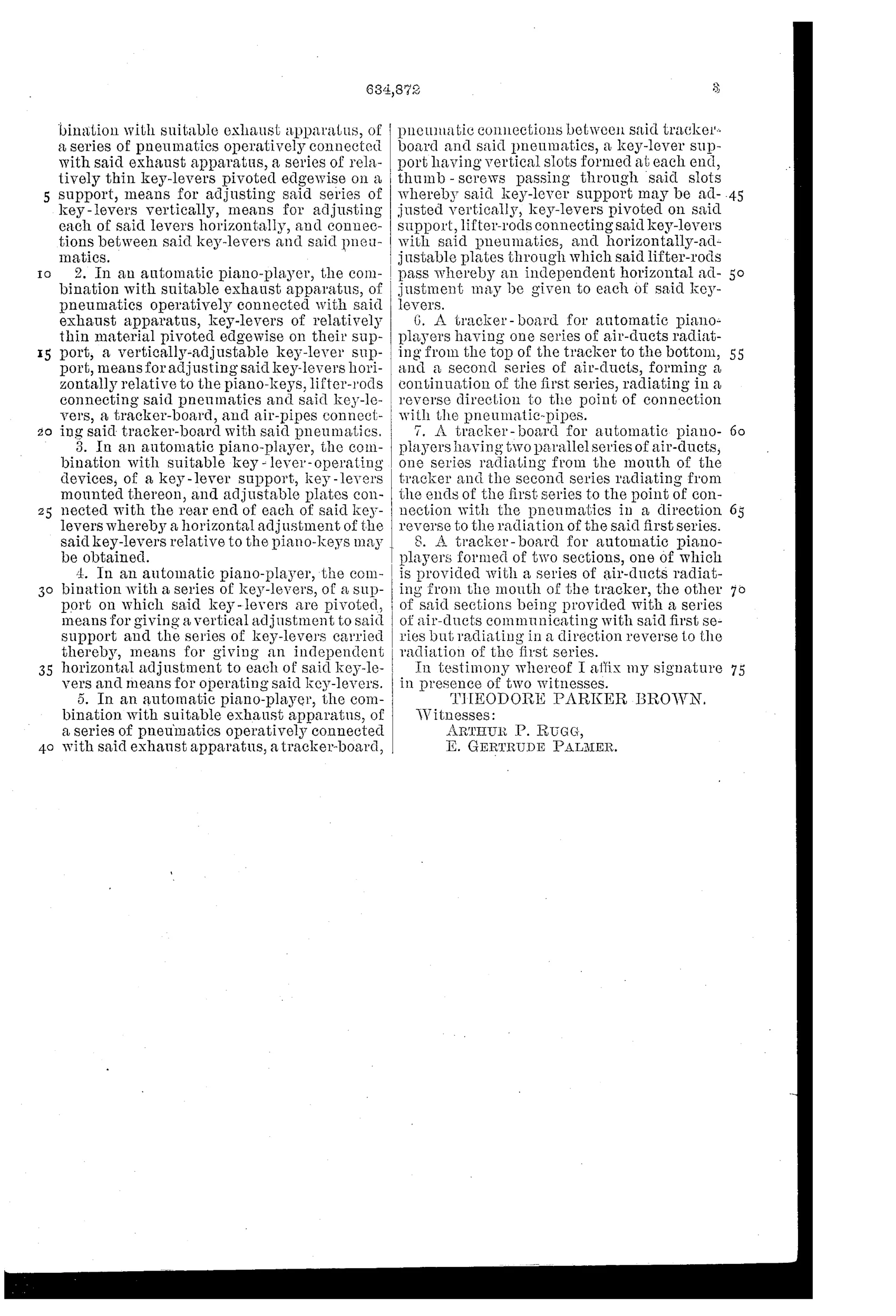
“In an automatic piano-player, the combination with suitable exhaust apparatus, of a series of pneumatics operatively connected with said exhaust apparatus, a series of relatively thin key-levers pivoted edgewise on a support, means for adjusting said series of key-levers vertically, means for adjusting each of said levers horizontally, and connections between said key-levers and said pneumatics.”
In plain English: An automatic piano-player combining an exhaust system, a set of pneumatics, and a row of thin, edge-pivoted key-levers that can each be adjusted both vertically as a group and individually side-to-side, connected to the pneumatics.
♫ In the inventor’s words
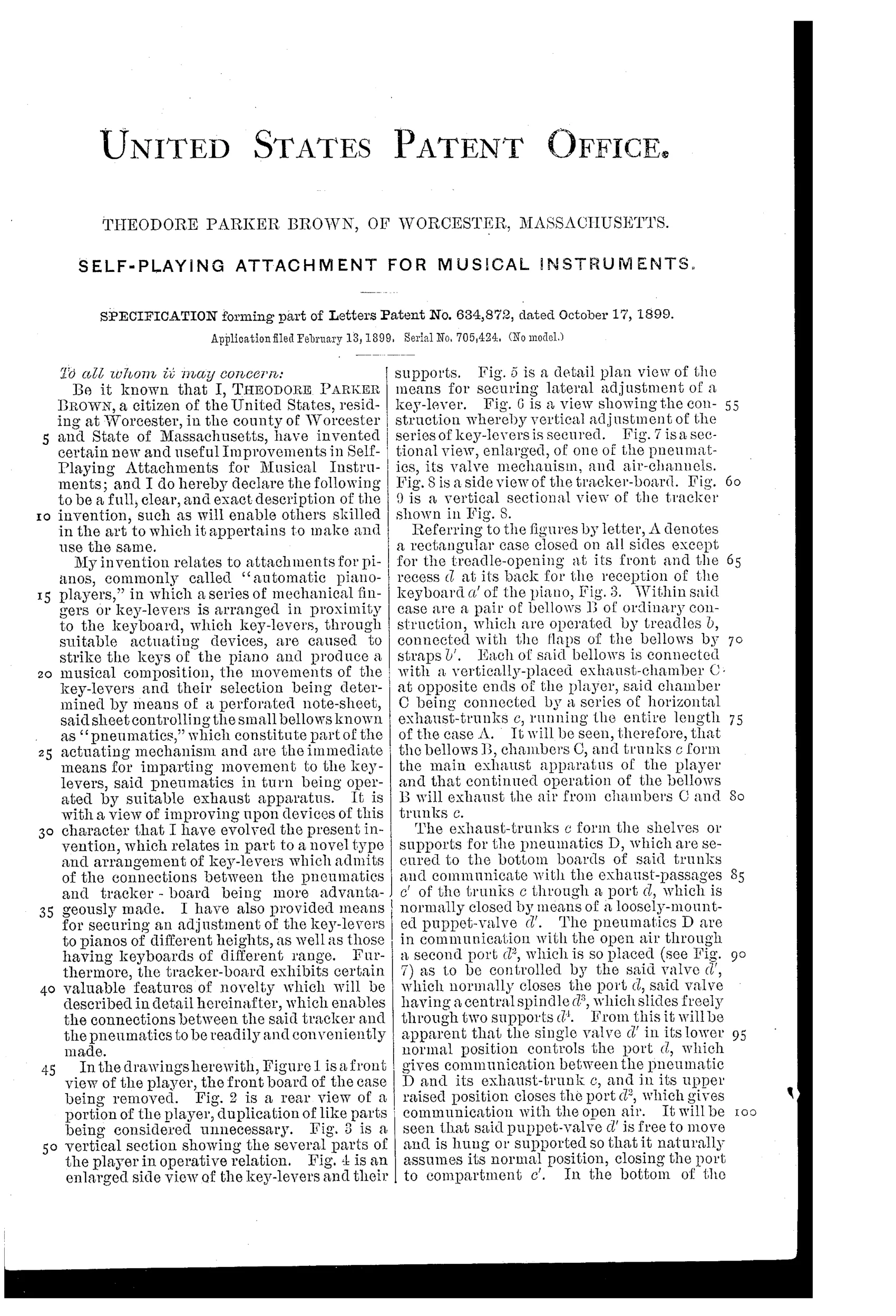
“It is with a view of improving upon devices of this character that I have evolved the present invention, which relates in part to a novel type and arrangement of key-levers which admits of the connections between the pneumatics and tracker-board being more advantageously made.”— Theodore Parker Brown, from the specification
Manufactured and sold
Brown was a documented Worcester player-piano manufacturer, and this patent's adjustable key-lever design belongs to the lineage of his commercially sold Simplex players.
♫ Commentary
This is a push-up piano player of the kind that swept parlors just before and after 1900: a cabinet full of bellows and valves that you rolled up to an ordinary piano, its row of felted fingers hanging over the keyboard. Brown's contribution here is not the pneumatic chain itself — tracker-bar, diaphragm, puppet-valve, collapsing pneumatic — which by 1899 was becoming standard grammar. It is the fingers. His key-levers are thin blades pivoted edgewise, and the whole row can be raised or lowered as a unit while each lever slides independently sideways. That sounds fussy until you remember the real-world problem: no two pianos of the era had quite the same key height or spacing, and an attachment that only fit one maker's keyboard was a dead product.
The other quiet cleverness is in the tracker-board, built in two glued sections with radiating and reverse-radiating ducts so the tubing runs straight instead of crossing into a rat's nest. Anyone who has restored a player action knows that tubing layout is where these machines live or die, and Brown was plainly thinking like a production man, not a tinkerer.
Brown was exactly that. He went on to manufacture the Simplex piano player in Worcester, one of the recognizable names of the push-up era before interior player actions made the whole cabinet-on-wheels genre obsolete around 1910. This patent reads like a factory drawing that happened to pass through the Patent Office.
Commentary by Claude, The Talking Machine Patent Archive’s resident enthusiast