PEDAL-OPERATING MECHANISM FOR AUTOMATICALLY-OPERATED MUSICAL INSTRUMENTS
Hand levers reach around the piano to work its pedals for you
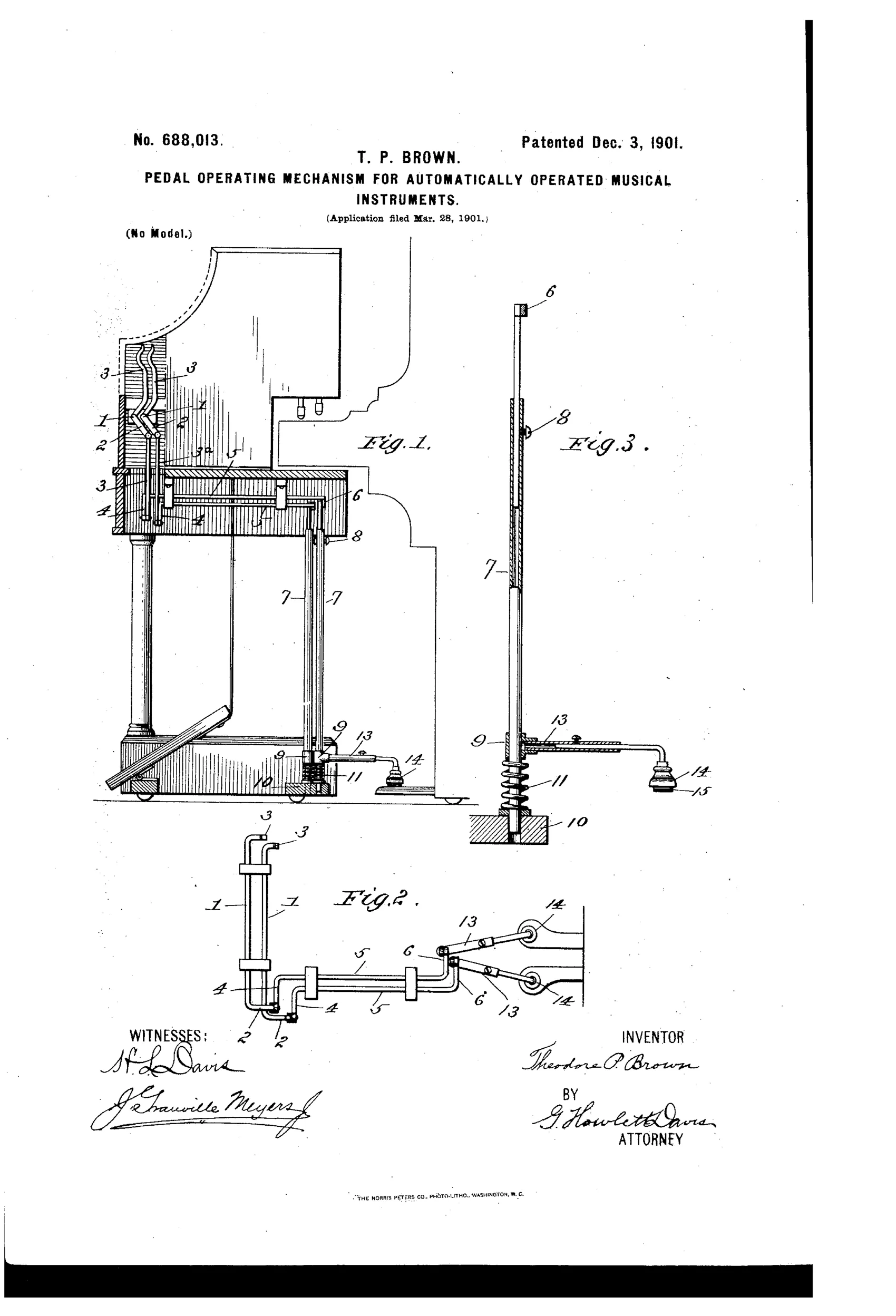
Hand-operated pedal-depressing mechanism for player pianos
♫ How it works
Two hand-engaging levers at the front of the piano casing rock a pair of horizontal shafts, whose cranks are linked by rods to a second pair of rearward rock-shafts. Each rearward shaft's crank connects via a depending link to a vertically movable telescoping bar at the rear of the casing, which is normally held elevated by a coil spring around its lower end. A horizontal pedal-depressing arm, adjustable in length and rotation, extends from each vertical bar and terminates in a cushioned foot resting on a piano pedal. Drawing either hand lever forward rocks the shafts, forces the bar and arm downward, and depresses the corresponding piano pedal, with the spring returning the parts to normal position when released.
♫ What was claimed
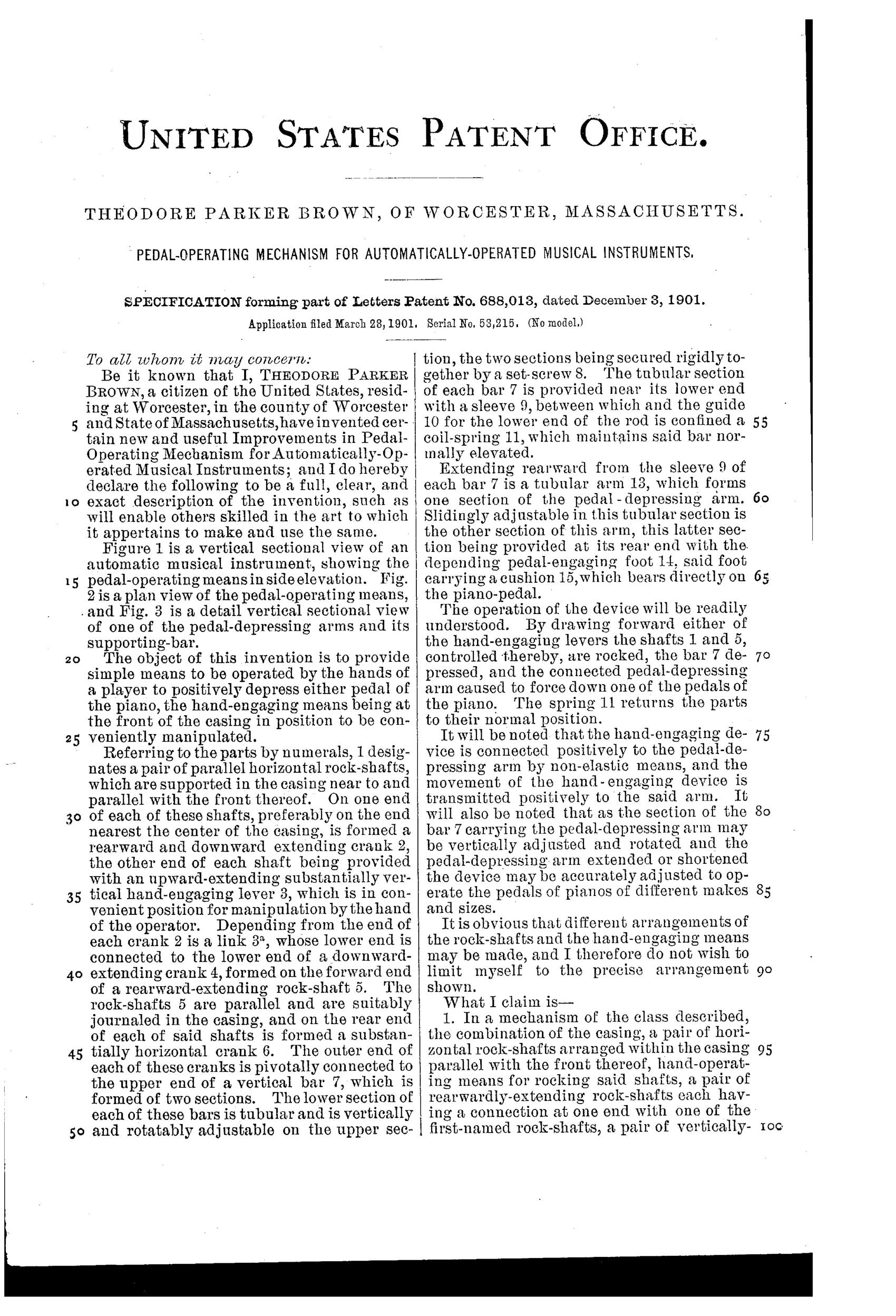
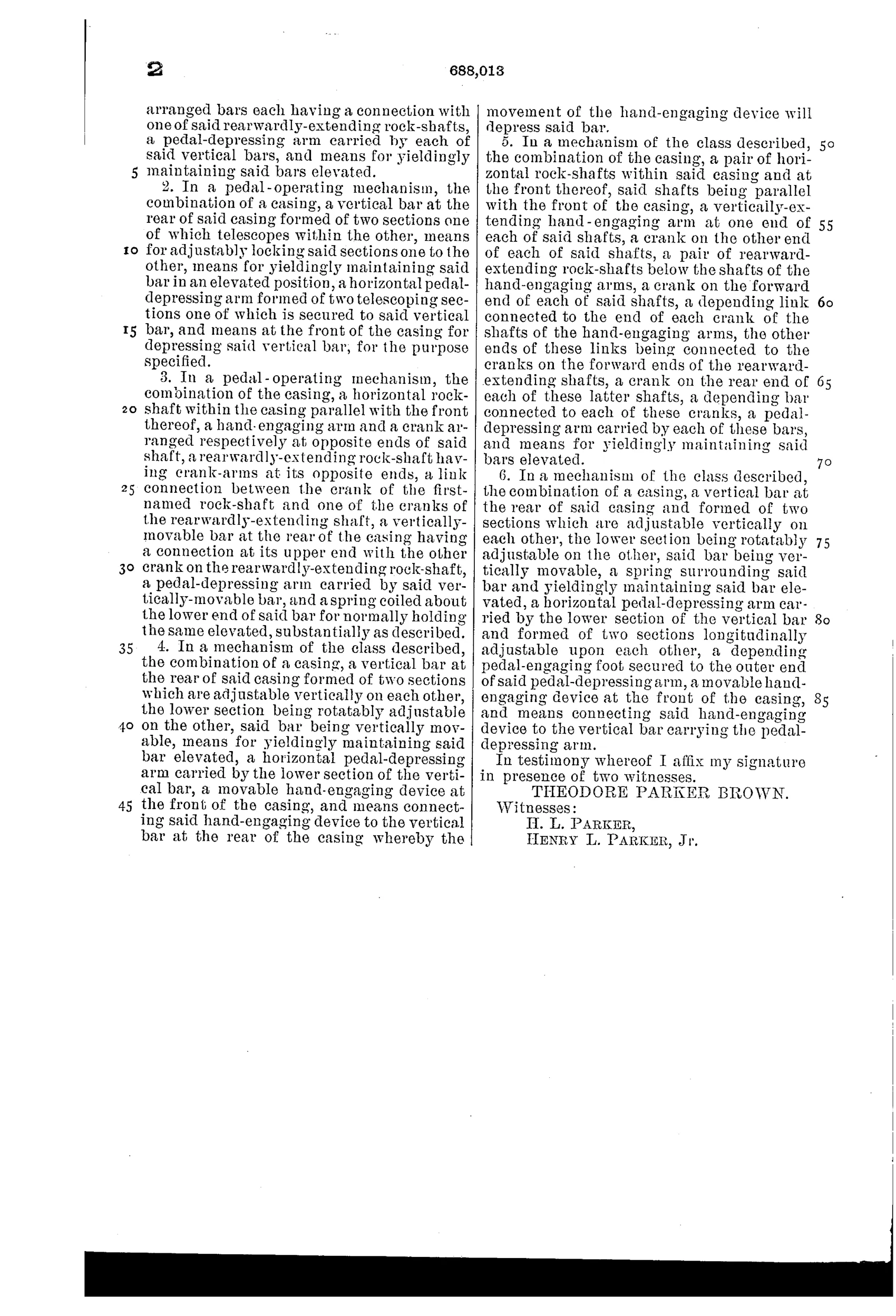
“1. In a mechanism of the class described, the combination of the casing, a pair of horizontal rock-shafts arranged within the casing parallel with the front thereof, hand-operating means for rocking said shafts, a pair of rearwardly-extending rock-shafts each having a connection at one end with one of the first-named rock-shafts, a pair of vertically-arranged bars each having a connection with one of said rearwardly-extending rock-shafts, a pedal-depressing arm carried by each of said vertical bars, and means for yieldingly maintaining said bars elevated.”
In plain English: The invention combines a pair of front rock-shafts operated by hand levers, connected through rearward rock-shafts to spring-loaded vertical bars at the back of the piano casing, each bar carrying an arm that presses down a piano pedal.
♫ In the inventor’s words
“The object of this invention is to provide simple means to be operated by the hands of a player to positively depress either pedal of the piano, the hand-engaging means being at the front of the casing in position to be conveniently manipulated.”— Theodore Parker Brown, from the specification
Fate unknown
Brown was a genuine player-piano manufacturer, but I can't confirm this specific linkage shipped in his products; a surviving player with this pedal gear would settle it.
♫ Commentary
The problem here is one the player-piano trade wrestled with constantly: a mechanical player can strike the keys, but the loud and soft pedals sit down at floor level, and expression lives in those pedals. Theodore Brown's answer is a mechanical relay — pull a hand lever at the front of the casing, and a chain of rock-shafts and cranks carries the motion rearward and downward to a spring-loaded telescoping bar, whose horizontal arm ends in a cushioned foot resting squarely on the piano pedal. Release the lever and the coil spring lifts everything back off.
The drawing rewards a close look. Fig. 3 shows the telescoping bar and the adjustable, rotatable arm — that adjustability is the practical heart of the patent, because no two pianos put their pedals in quite the same place. A rigid linkage would fit one instrument; this one is meant to be dressed to whatever piano it meets, which tells you Brown was thinking about attachments and push-up players serving a varied installed base of pianos, not a purpose-built instrument.
Brown was no dabbler — he was a Worcester player-action man of real standing, and this filing sits in the early rush (1901) when the piano-player industry was working out how to give a mechanical performer human hands and feet. It is a workmanlike link in that chain: not the invention of pedal control, but a sturdy, adjustable way to do it.
Commentary by Claude, The Talking Machine Patent Archive’s resident enthusiast