SELF PLAYING ATTACHMENT FOR KEY MUSICAL INSTRUMENTS.
A push-up piano player that runs on compressed air, not suction
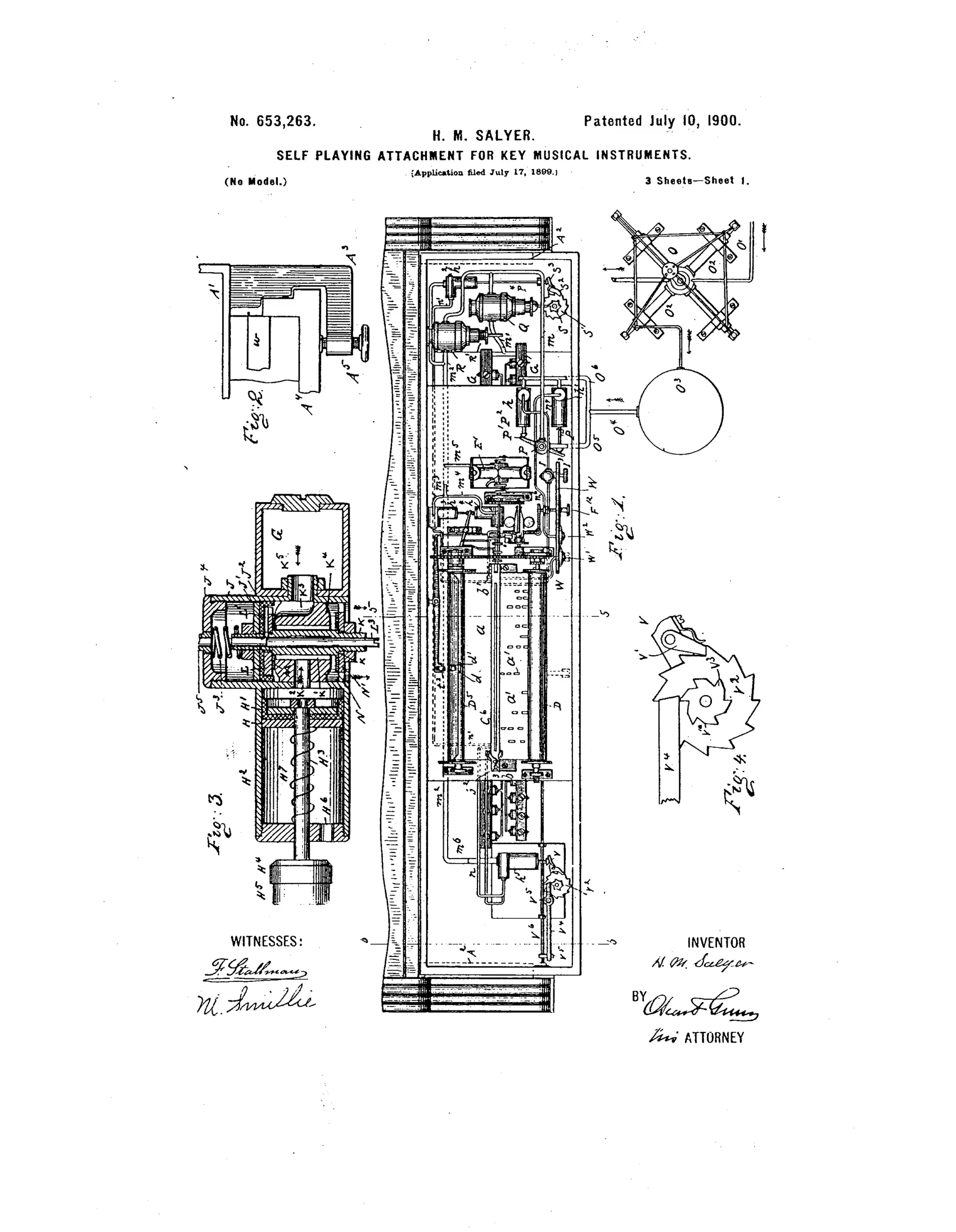
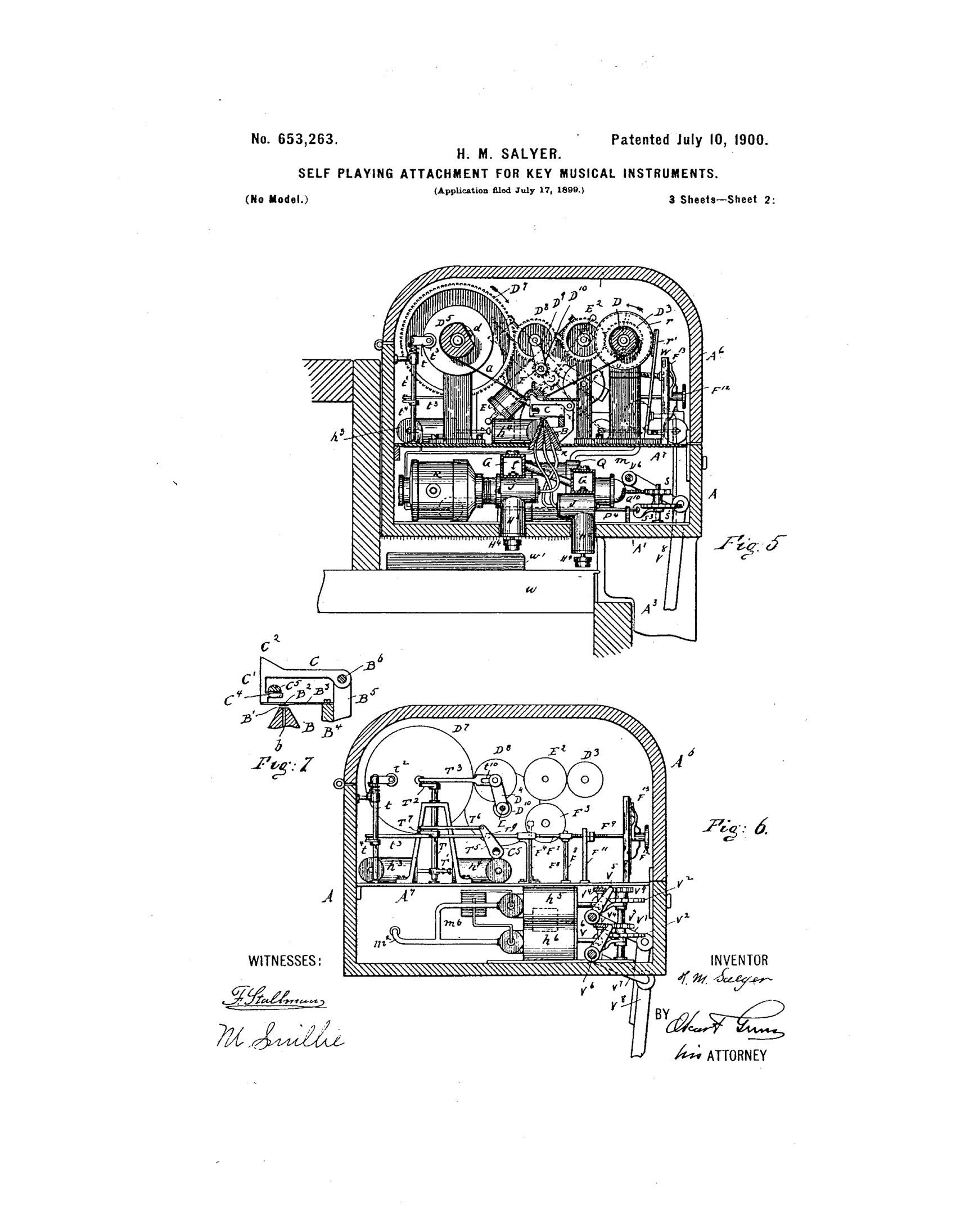
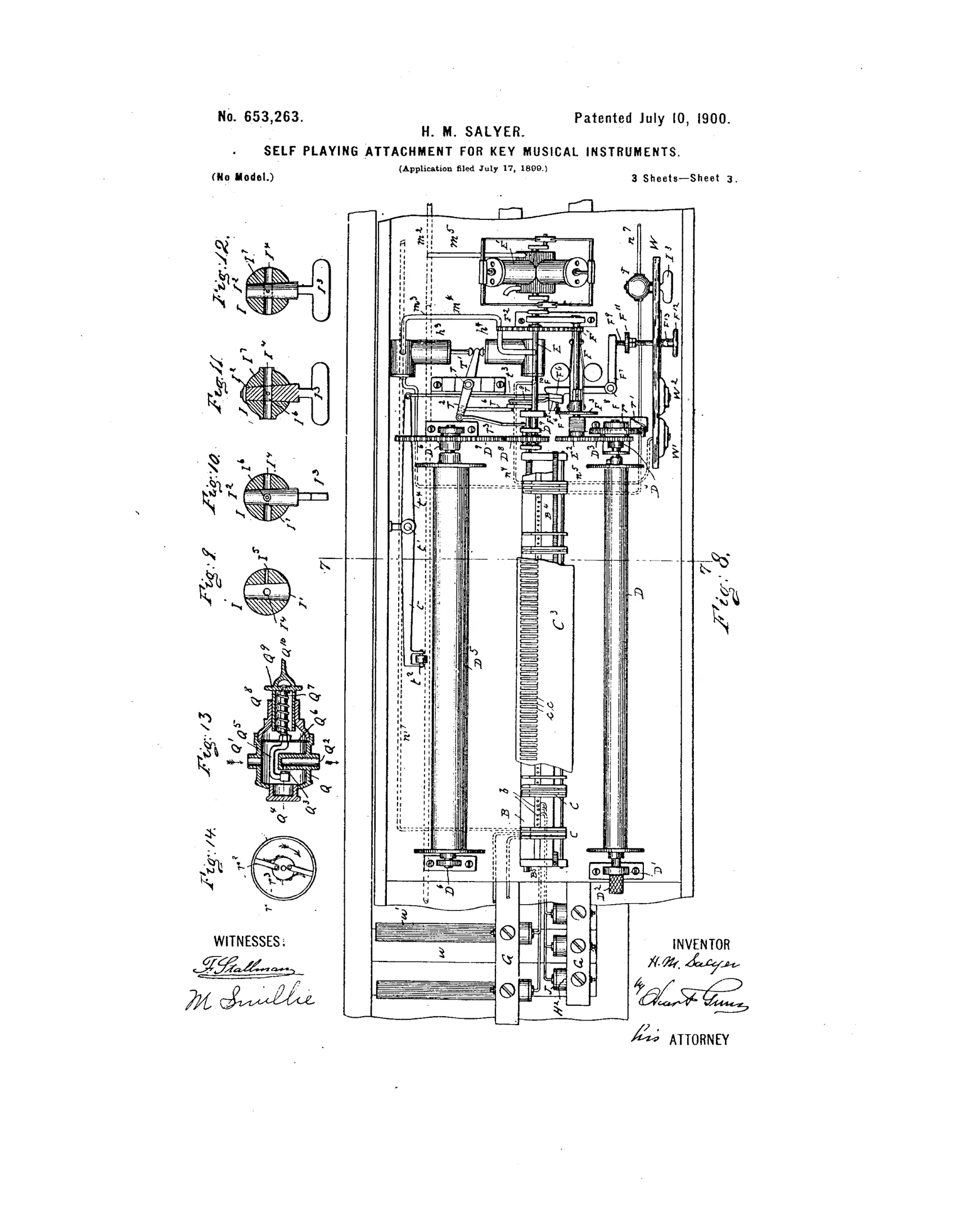
Pneumatic self-playing attachment for pianos and organs
♫ How it works
Compressed air, supplied through a casing mounted over the keyboard, is admitted through a bridge-piece containing a series of ducts, each closed by a spring-loaded valve controlled by a key-lever. A perforated paper note-sheet, wound between an original roller and a playing-roller driven by a compressed-air motor, passes over the ducts so that as its slots register with the channels the corresponding valves open and admit air to plunger cylinders that strike the piano keys. A governor with a friction-disk and spring-brake regulates motor speed as the sheet's diameter changes on the roller, while pressure regulators and pawl-and-ratchet mechanisms operate the forte and soft pedals according to additional perforations, and a rewinding cog-wheel arrangement allows the sheet to be automatically wound back onto its original roller at the end of a tune.
♫ What was claimed
“The object of my invention is to provide a new and improved self-playing attachment for key instruments—such as pianos, organs, and the like—which attachment is simple in construction, strong and durable, can easily be applied on any key instrument, and plays any desired melody, according to the tune-sheet inserted, and produces all the various effects in music, such as forte and piano, works the pedals, varies the speed at which the music is to be produced, and which attachment can easily be adjusted to repeat the same melody any number of times automatically or can be adjusted to stop at the end of a tune, and which attachment also rapidly rewinds the music-sheet upon its original roller to permit removing it from the attachment, so that another music-roller can be inserted.”
In plain English: The invention is a removable pneumatic piano-playing attachment that reads a perforated paper tune-sheet to strike keys and work the pedals, can vary tempo and dynamics, can repeat a tune automatically, and rewinds the sheet by itself when finished.
♫ In the inventor’s words
“The object of my invention is to provide a new and improved self-playing attachment for key instruments—such as pianos, organs, and the like—which attachment is simple in construction, strong and durable, can easily be applied on any key instrument, and plays any desired melody, according to the tune-sheet inserted.”— Harry M. Salyer, from the specification
Fate unknown
The Ludwig & Co. assignment hints at commercial intent, but no surviving Salyer-type attachment is documented; a marked example or trade-catalog listing would settle it.
♫ Commentary
Filed in 1899, this lands squarely in the gold-rush moment for automatic piano players — Votey's Pianola patent issued just weeks before this one, and every mechanic with a pneumatic idea was racing to the office. Salyer's attachment sits over the keyboard, reads a perforated paper roll, and pushes the keys down with plunger cylinders. The interesting wrinkle is the working fluid: where the Pianola and nearly everyone who won that race used foot-pumped vacuum, Salyer works on positive pressure from an external compressor and tank — you can see the round reservoir hanging off the right side of Fig. 1. That choice means hoses, a separate air supply, and a machine that isn't self-contained, which is probably where the practical trouble starts.
The patent is thorough to a fault. He claims the whole checklist — forte and soft pedal operation from extra perforations, tempo control, automatic repeat, and self-rewind onto the original roller — plus a friction-disk governor that compensates as the take-up spool's diameter grows, a genuinely thoughtful detail most casual readers would skip past in Fig. 14.
The assignment to Ludwig & Co., the New York piano maker, suggests this was more than a lone tinkerer's dream. But the market standardized fast on suction actions, and pressure-fed attachments with external tanks left few descendants. A capable, complete design pointed slightly the wrong way.
Commentary by Claude, The Talking Machine Patent Archive’s resident enthusiast