Mechanical Musical-Instrument.
Gally's 1878 pneumatic action anticipates the player piano by two decades
Pneumatic player-mechanism for automatic musical instruments
♫ How it works
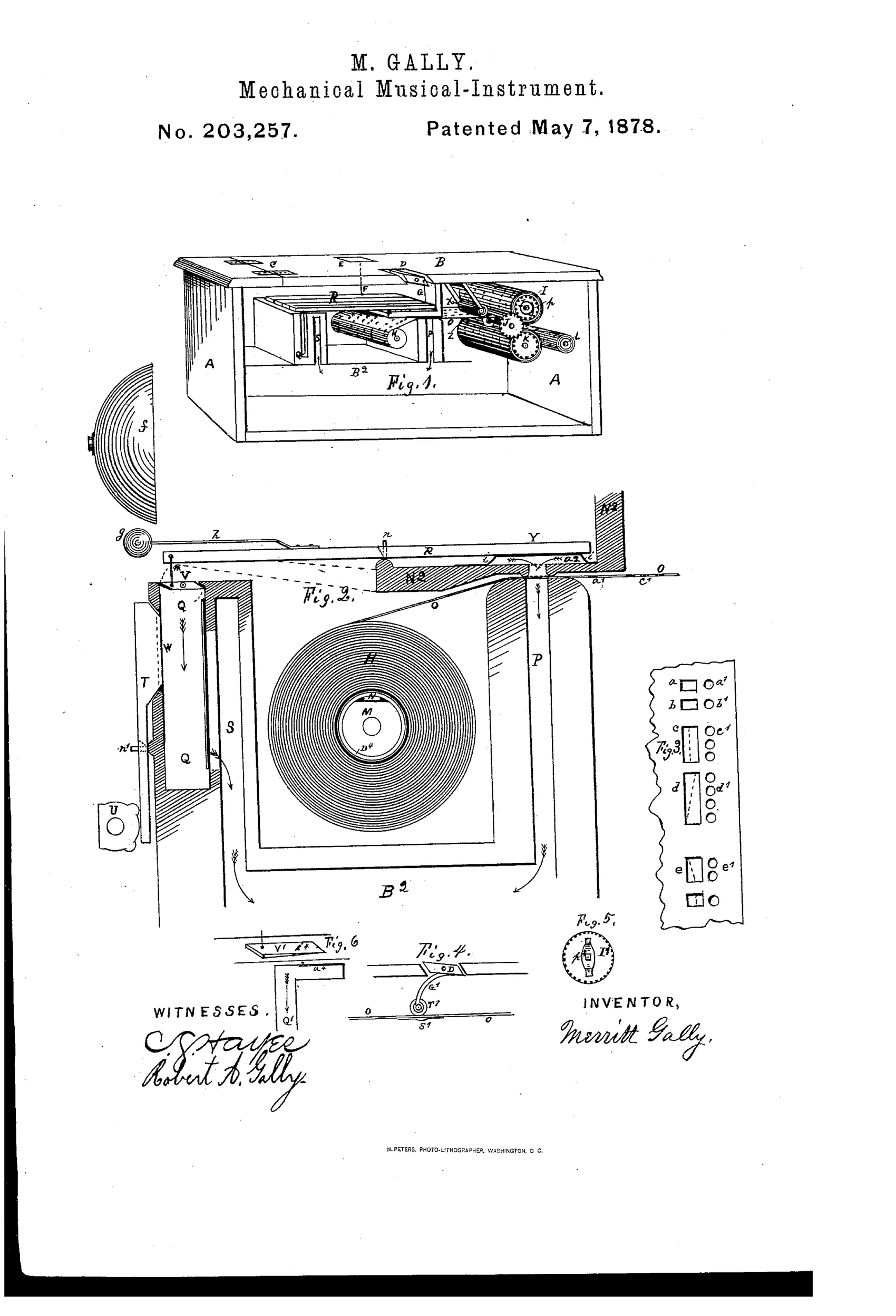
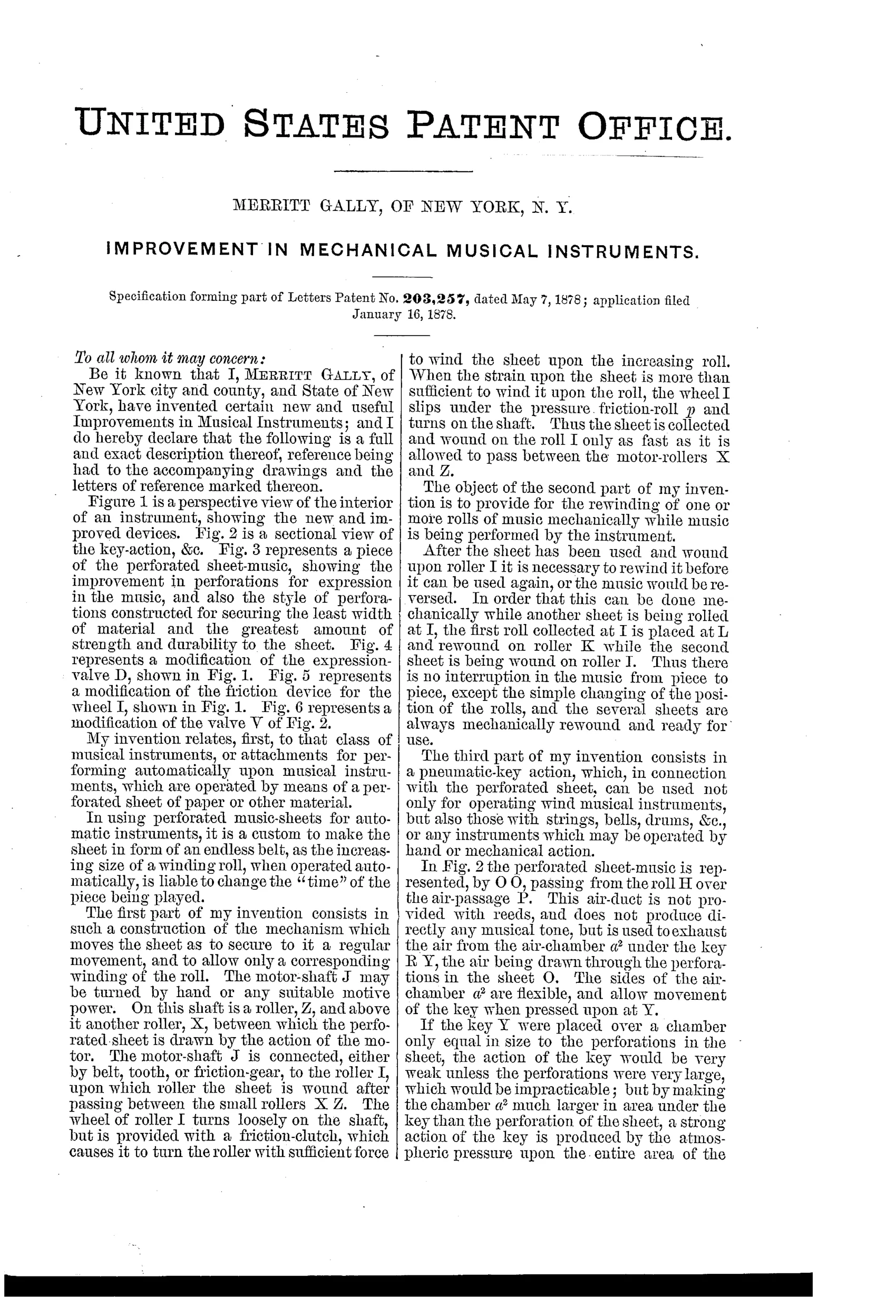
A perforated music-sheet is drawn between motor-rollers X and Z by a hand- or motor-driven shaft J, then wound onto a take-up roller I through a slipping friction-clutch that limits winding force to match the sheet's actual feed rate. A second roller K allows one spent sheet to be mechanically rewound while a fresh sheet is simultaneously being collected on roller I, so playing continues without interruption. The sheet passes over an air-duct P leading to a pneumatic key action: perforations in the sheet allow air to be exhausted from an enlarged air-chamber a2 beneath a key follower Y, and the pressure differential across the much-larger chamber area (versus the small perforation) produces a strong key stroke via atmospheric pressure. A tremolo device uses a flexible-walled air-duct Q vibrated by an external vibrator T to expand and condense the air rhythmically, imitating the human voice's tremolo without obstructing the passage. Valve-doors D and E, operated by additional perforations in the sheet, open and close over the reeds/strings/bells to produce graduated expression (soft, loud, etc.), and a tube D4 formed from the sheet's own rolled end serves as a removable storage/handling roller with a stop N to secure positive winding.
♫ What was claimed
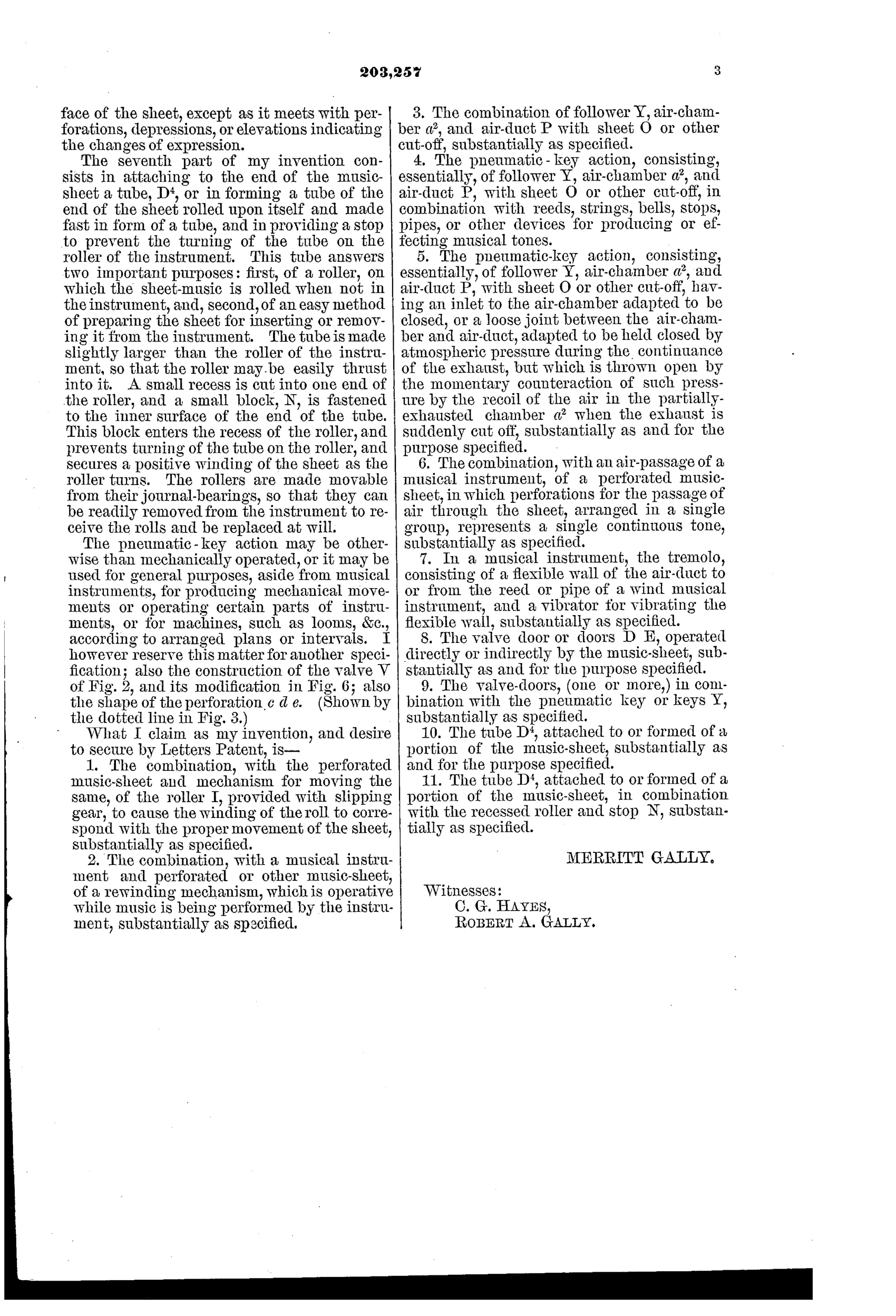
“The pneumatic-key action, consisting, essentially, of follower Y, air-chamber a2, and air-duct P, with sheet O or other cut-off, having an inlet to the air-chamber adapted to be closed, or a loose joint between the air-chamber and air-duct, adapted to be held closed by atmospheric pressure during the continuance of the exhaust, but which is thrown open by the momentary counteraction of such pressure by the recoil of the air in the partially-exhausted chamber a2 when the exhaust is suddenly cut off, substantially as and for the purpose specified.”
In plain English: A pneumatic key mechanism where a valve stays closed under vacuum but pops open automatically the instant the air exhaust is cut off, due to the rebound of trapped air in the partially-emptied chamber.
♫ In the inventor’s words
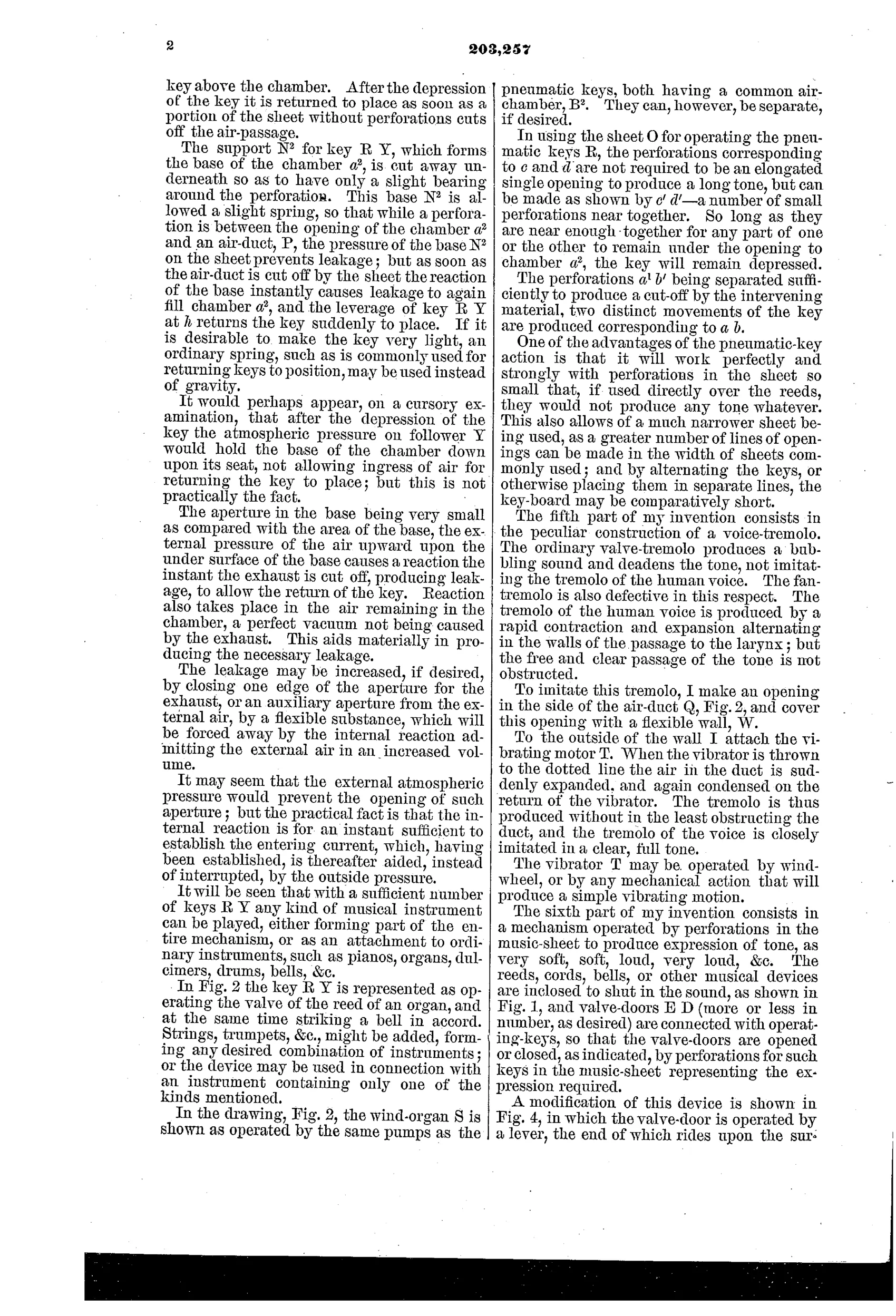
“The tremolo of the human voice is produced by a rapid contraction and expansion alternating in the walls of the passage to the larynx; but the free and clear passage of the tone is not obstructed.”— Merritt Gally, from the specification
Manufactured and sold
Gally manufactured pneumatic self-playing reed organs (his Orchestrone line), which embody this roll-fed pneumatic action, though matching every claimed detail to a surviving instrument takes a specimen in hand.
♫ More by Merritt Gally
- IMPROVEMENT IN MECHANICAL MUSICAL INSTRUMENTS (1878)
- MECHANICAL MUSICAL INSTRUMENT (1883)
- MECHANICAL MUSICAL INSTRUMENT. (1885)
♫ Commentary
Merritt Gally was a printer by trade — his Universal platen press was a print-shop staple — and this patent reads like a pressman's answer to mechanical music: paper feed under controlled tension, a slipping friction clutch on the take-up roller so the winding force never outruns the sheet, and even a second roller so a spent roll can be rewound while a fresh one plays. Anyone who has fought a paper web understands why those details matter.
The heart of the patent is the pneumatic key action: a perforation in the traveling sheet is tiny, but it vents an enlarged chamber under a follower, so atmospheric pressure across the big chamber area delivers a strong, decisive stroke from a small hole. His key claim is subtler still — a valve held shut by vacuum that pops open by itself from the recoil of trapped air the instant the exhaust cuts off. That self-timing repetition is exactly the problem player-piano builders would still be wrestling with in the 1890s.
Add the flexible-walled tremolo duct and the expression valves worked by extra perforations in the sheet, and you have, in 1878 — the same year Edison was showing off tinfoil — most of the vocabulary of the player instrument, laid out before the industry existed to use it.
Commentary by Claude, The Talking Machine Patent Archive’s resident enthusiast