MECHANICAL MUSICAL INSTRUMENT.
Merritt Gally balances a valve on a bag of air, four years before Aeolian
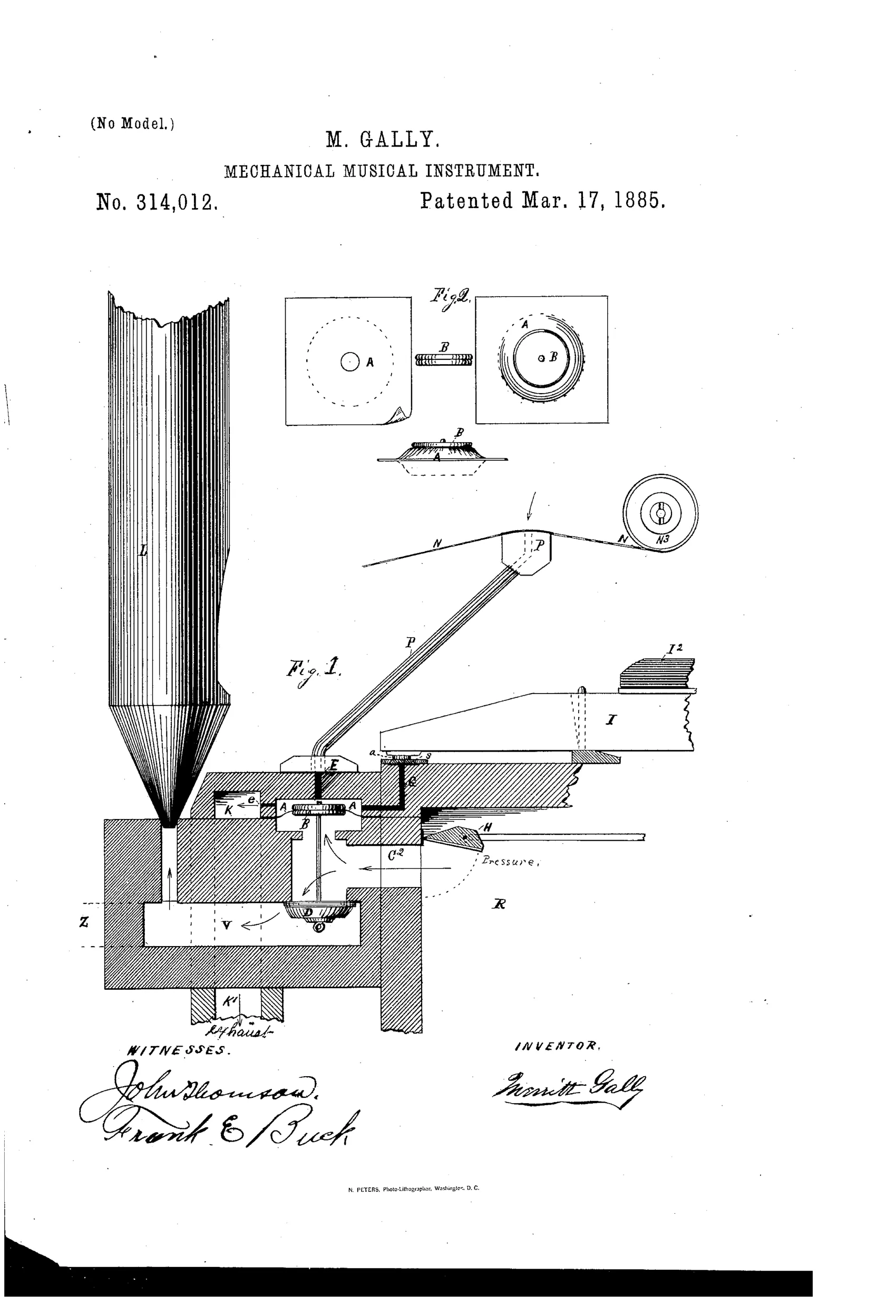
Pneumatic organ valve action with flexible diaphragm control.
♫ How it works
Air pressure from a wind-chest passes through an air-passage to organ pipes, controlled by a sounding-valve suspended from a flexible diaphragm. The diaphragm is stretched over a central button to give it a baggy, sensitive shape, allowing a slight touch to move the valve up or down. A small chamber above the diaphragm connects to an exhaust-bellows; venting or drawing exhaust in this chamber causes the valve to seat or drop, sounding or silencing the pipe. The vent is operated either by a mechanical music-sheet (perforated paper roll) or by a manual key, allowing automatic or hand playing of the organ pipes.
♫ What was claimed
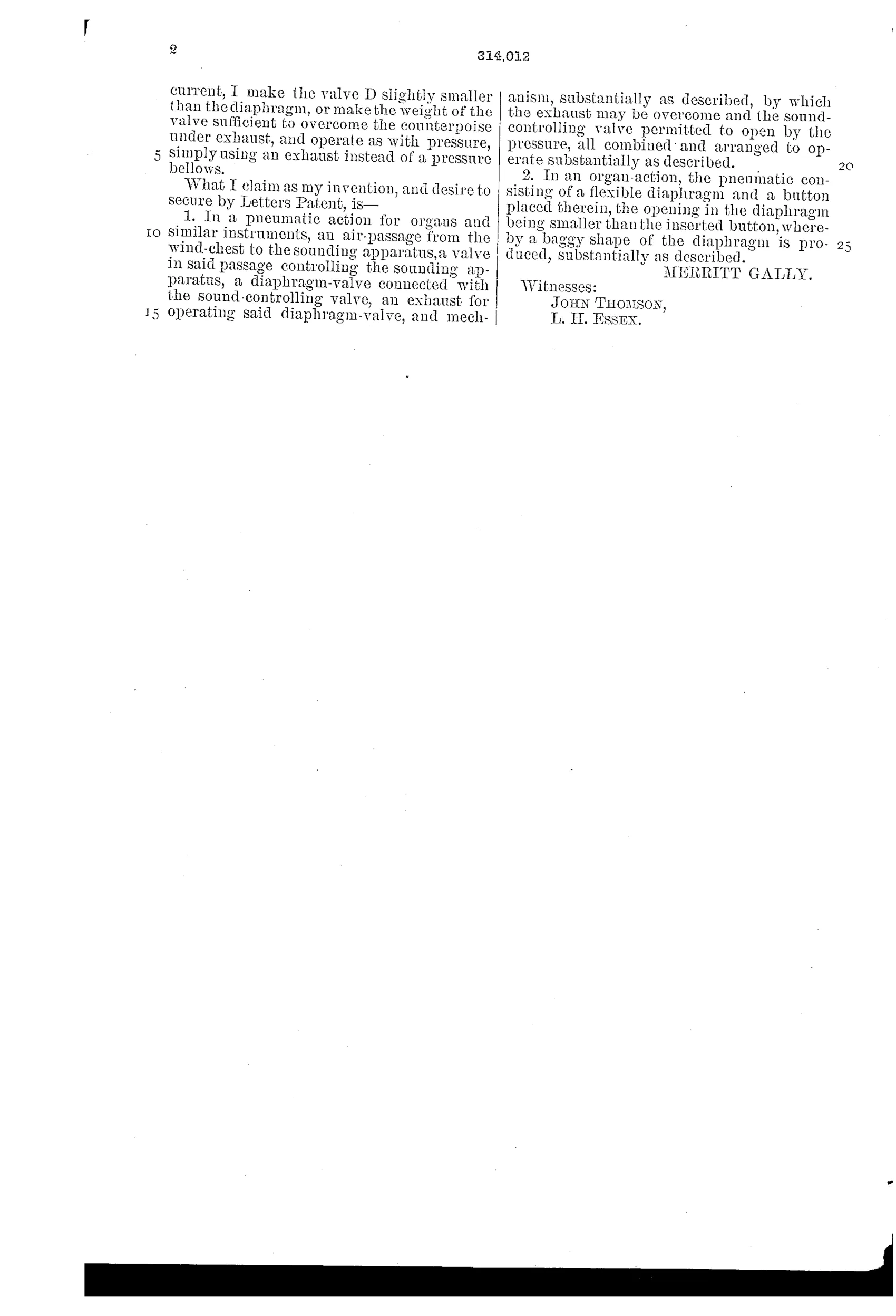
“In a pneumatic action for organs and similar instruments, an air-passage from the wind-chest to the sounding apparatus, a valve in said passage controlling the sounding apparatus, a diaphragm-valve connected with the sound-controlling valve, an exhaust for operating said diaphragm-valve, and mechanism, substantially as described, by which the exhaust may be overcome and the sound-controlling valve permitted to open by the pressure, all combined and arranged to operate substantially as described.”
In plain English: A pneumatic organ system where air pressure normally seats a sound-controlling valve, but an exhaust acting on a connected diaphragm can overcome that pressure and let the valve open, sounding the pipe.
♫ In the inventor’s words
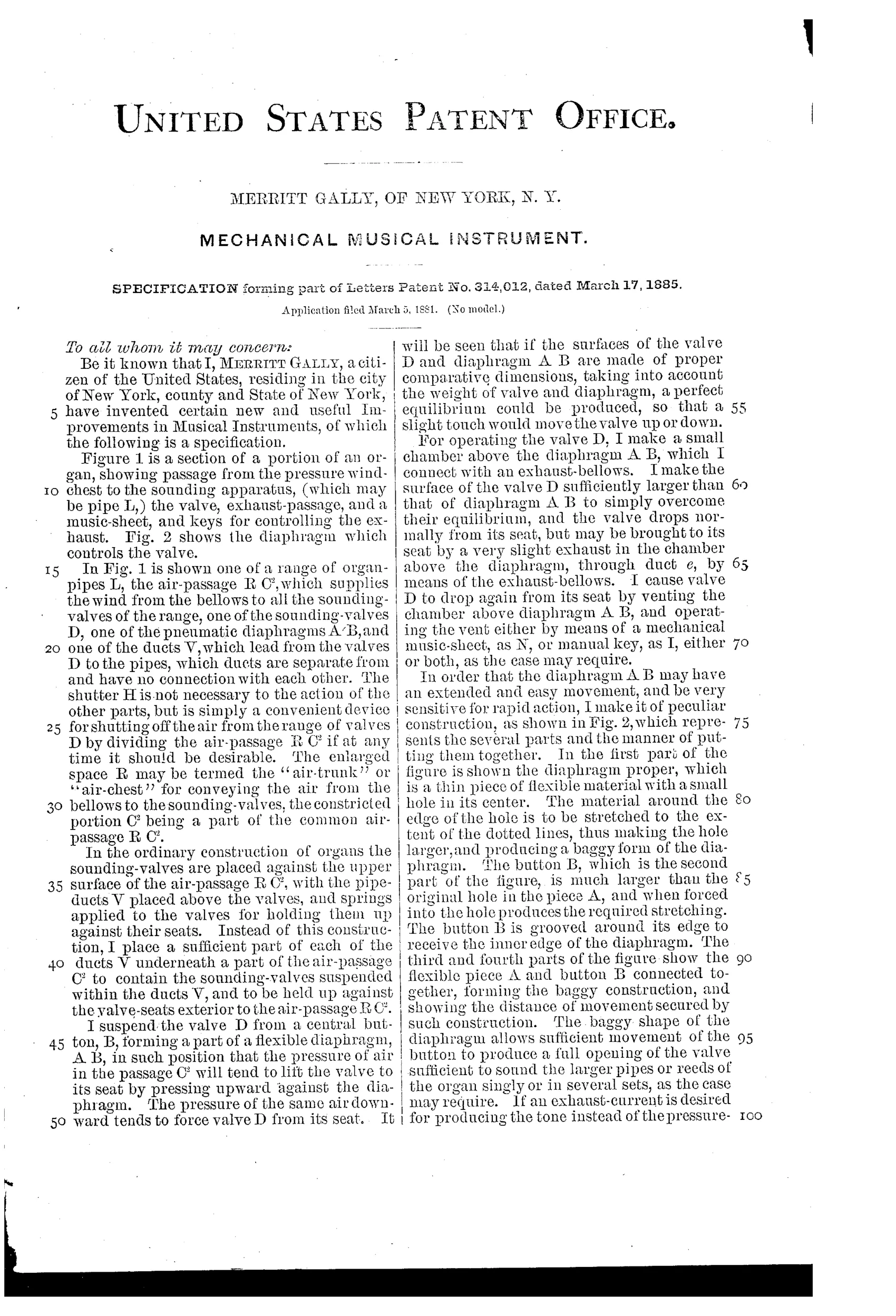
“It will be seen that if the surfaces of the valve D and diaphragm A B are made of proper comparative dimensions, taking into account the weight of valve and diaphragm, a perfect equilibrium could be produced, so that a slight touch would move the valve up or down.”— Merritt Gally, from the specification
Manufactured and sold
Gally manufactured and sold his Orchestrone player organs in the 1880s, which used his pneumatic valve actions; surviving instruments document the line, though tying this exact claim to a specific model takes a close look at an example.
♫ More by Merritt Gally
- Mechanical Musical-Instrument. (1878)
- IMPROVEMENT IN MECHANICAL MUSICAL INSTRUMENTS (1878)
- MECHANICAL MUSICAL INSTRUMENT (1883)
♫ Commentary
Merritt Gally is better remembered for printing presses — his Universal platen press was a jobbing-shop standard — but he spent a productive second career on pneumatic instruments, and this patent shows why his player organs worked. The problem he attacks is the fundamental one of all paper-roll instruments: a perforation in a moving sheet admits only a whisper of air, and that whisper must open a valve against full wind-chest pressure without lag or leak.
His answer is equilibrium. The sounding valve hangs from a diaphragm deliberately stretched over a central button so it goes baggy and slack — his own phrase — and the areas of valve and diaphragm are proportioned so that chest pressure below and exhaust above very nearly cancel. The valve floats. A tiny vent through the tracker bar tips the balance one way; closing it tips it back. His quoted line about 'a perfect equilibrium... so that a slight touch would move the valve up or down' is the whole player-instrument industry in one sentence. Note also the dual provision for music-sheet or manual key: he wanted one action serving both automatic and hand playing.
Filed in 1881, this sits early in the pneumatic-action story, well before the Aeolian and player-piano boom made such valve stacks ubiquitous. The drawing's Fig. 1, with the pipe, floating valve, and the pneumatic linkage running up to the sheet roller, is essentially a player action a decade ahead of the crowd.
Commentary by Claude, The Talking Machine Patent Archive’s resident enthusiast