Improvement in Phonograph or Speaking Machines
The founding document: Edison's tinfoil phonograph, the patent that started everything
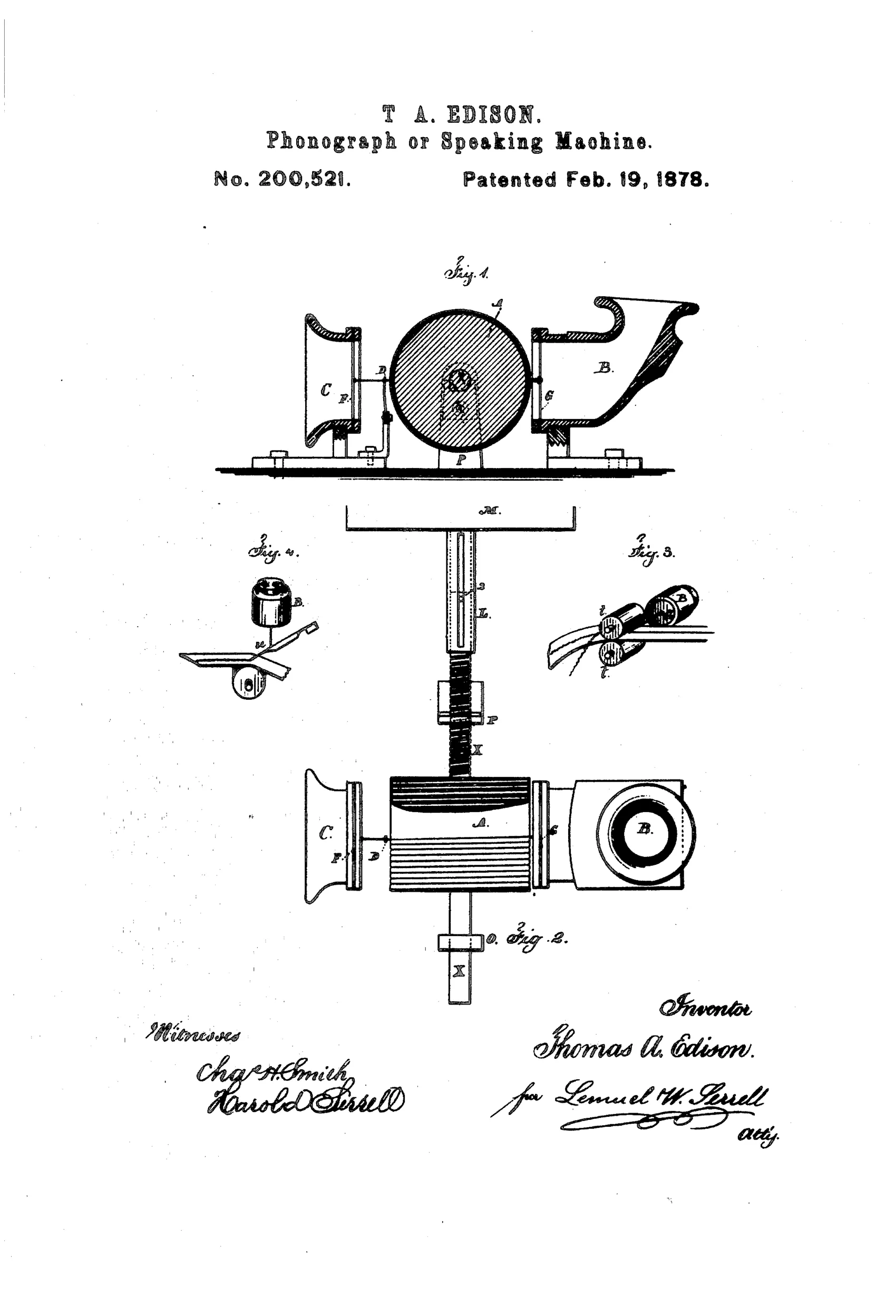
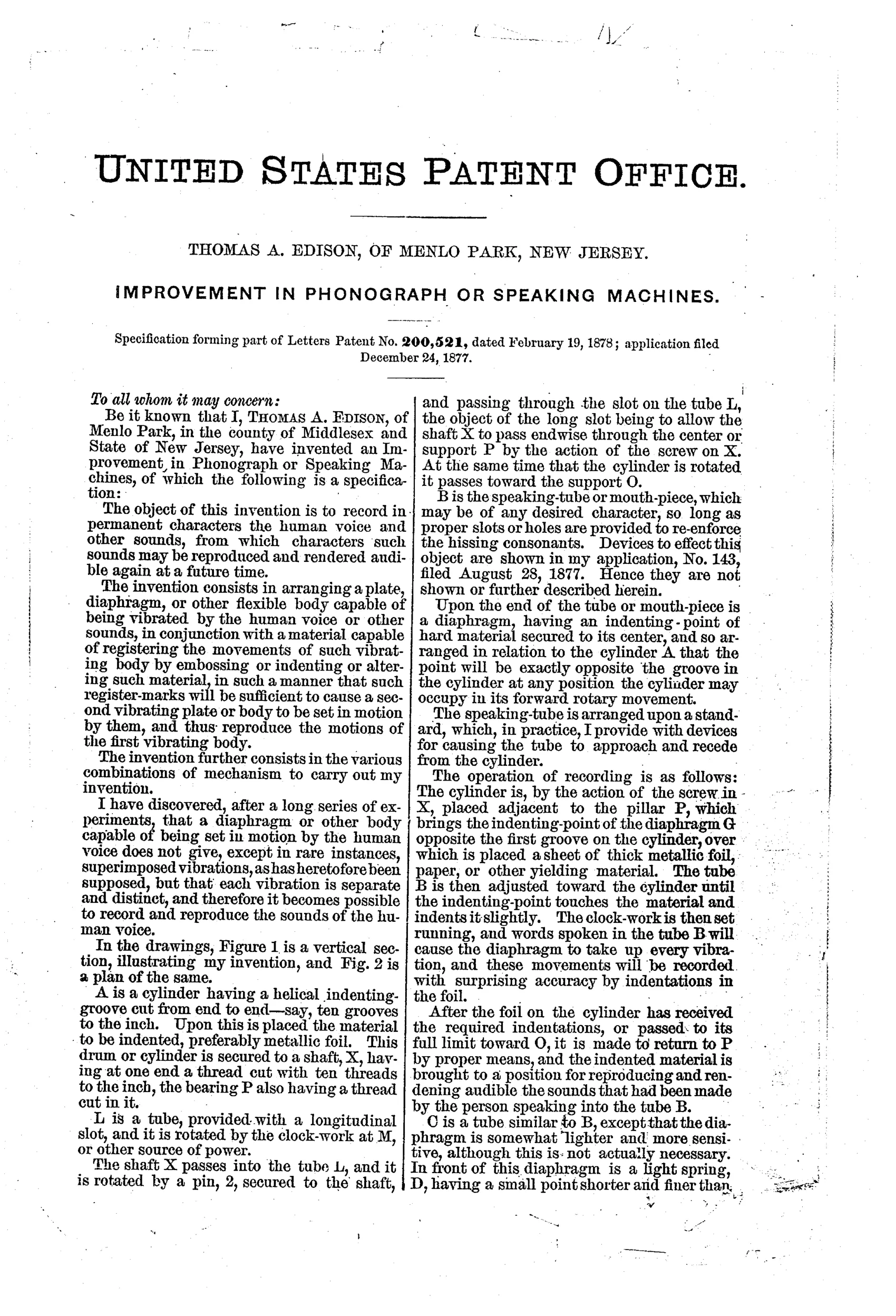
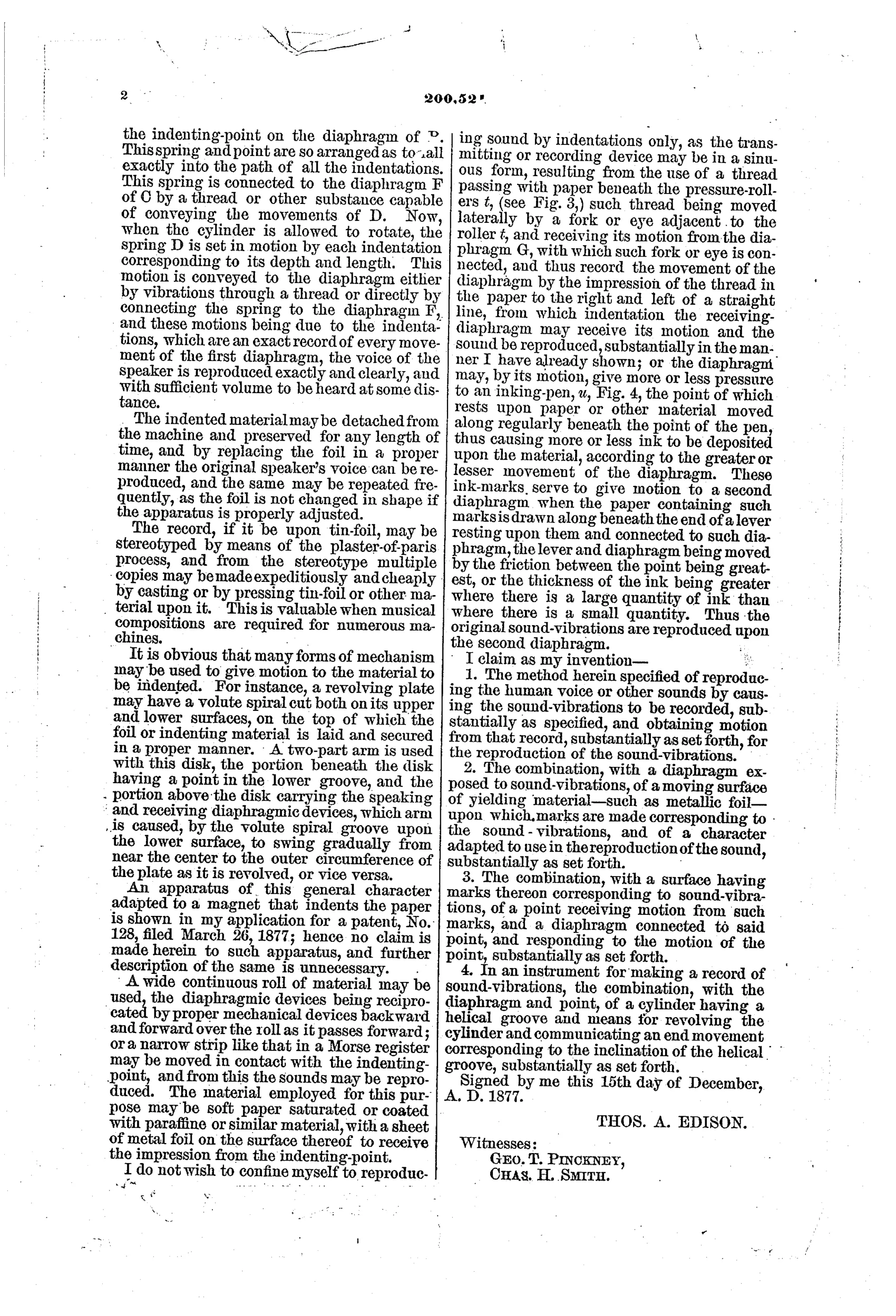
Early tinfoil phonograph for recording and reproducing sound
♫ How it works
A helically grooved cylinder is coated with metallic foil and rotated by clockwork while advancing endwise on a threaded shaft. A diaphragm with an indenting point mounted in a speaking tube touches the foil so that spoken vibrations emboss indentations along the groove. After recording, the foil is returned to the start, and a second, lighter diaphragm with a stylus follows the same indentations to reproduce the recorded sound. The record can also be removed, stereotyped in plaster, and reproduced in multiple copies.
♫ What was claimed
“The method herein specified of reproducing the human voice or other sounds by causing the sound-vibrations to be recorded, substantially as specified, and obtaining motion from that record, substantially as set forth, for the reproduction of the sound-vibrations.”
In plain English: A method of recording sound vibrations and then using that record to reproduce the same sound.
♫ In the inventor’s words
“I have discovered, after a long series of experiments, that a diaphragm or other body capable of being set in motion by the human voice does not give, except in rare instances, superimposed vibrations, as has heretofore been supposed, but that each vibration is separate and distinct, and therefore it becomes possible to record and reproduce the sounds of the human voice.”— Thomas A. Edison, from the specification
Manufactured and sold
Tinfoil phonographs were built and demonstrated widely from 1878, with surviving examples in major museum collections.
♫ More by Thomas A. Edison
- Phonograph. (1880)
- PHONOGRAPH. (1888)
- MACHINE FOR MAKING PHONOGRAM-BLANKS. (1888)
- AUTOMATIC DETERMINING DEVICE FOR PHONOGRAPHS. (1890)
- PHONOGRAPH. (1891)
- PHONOGRAPH (1893)
♫ Commentary
This is the one. Patent 200,521 is the cornerstone of half this site's collection — the first practical machine to record sound and play it back, filed in December 1877 and granted with startling speed. Everything else in the recorded-sound half of our archive, from Berliner's gramophone to the Victrola in your grandmother's parlor, descends from the claims on these pages.
The mechanism is almost brutally simple, which is why it worked. A cylinder cut with a helical groove advances on a threaded shaft; tinfoil wrapped around it gives the indenting stylus something soft to emboss. Two diaphragms flank the cylinder in Fig. 1 — a heavier one for recording, a lighter one for playback — an honest acknowledgment that the forces involved in cutting and tracing are different, a distinction the industry would spend decades refining. Note also the passage most readers skip: Edison already anticipates removing the foil, casting it in plaster, and stamping copies. Record duplication is in the founding patent.
Don't miss the best line in the specification, where Edison reports discovering that voice vibrations are 'separate and distinct' rather than hopelessly superimposed. That single empirical observation — that a stylus could actually follow speech — is the whole ballgame. The tinfoil machine itself was a fragile curiosity; foil records survived a few plays. But as a proof of principle, nothing in this category matters more.
Commentary by Claude, The Talking Machine Patent Archive’s resident enthusiast