MACHINE FOR MAKING PHONOGRAM-BLANKS.
Edison heats the cutter so the wax cylinder bore won't crack
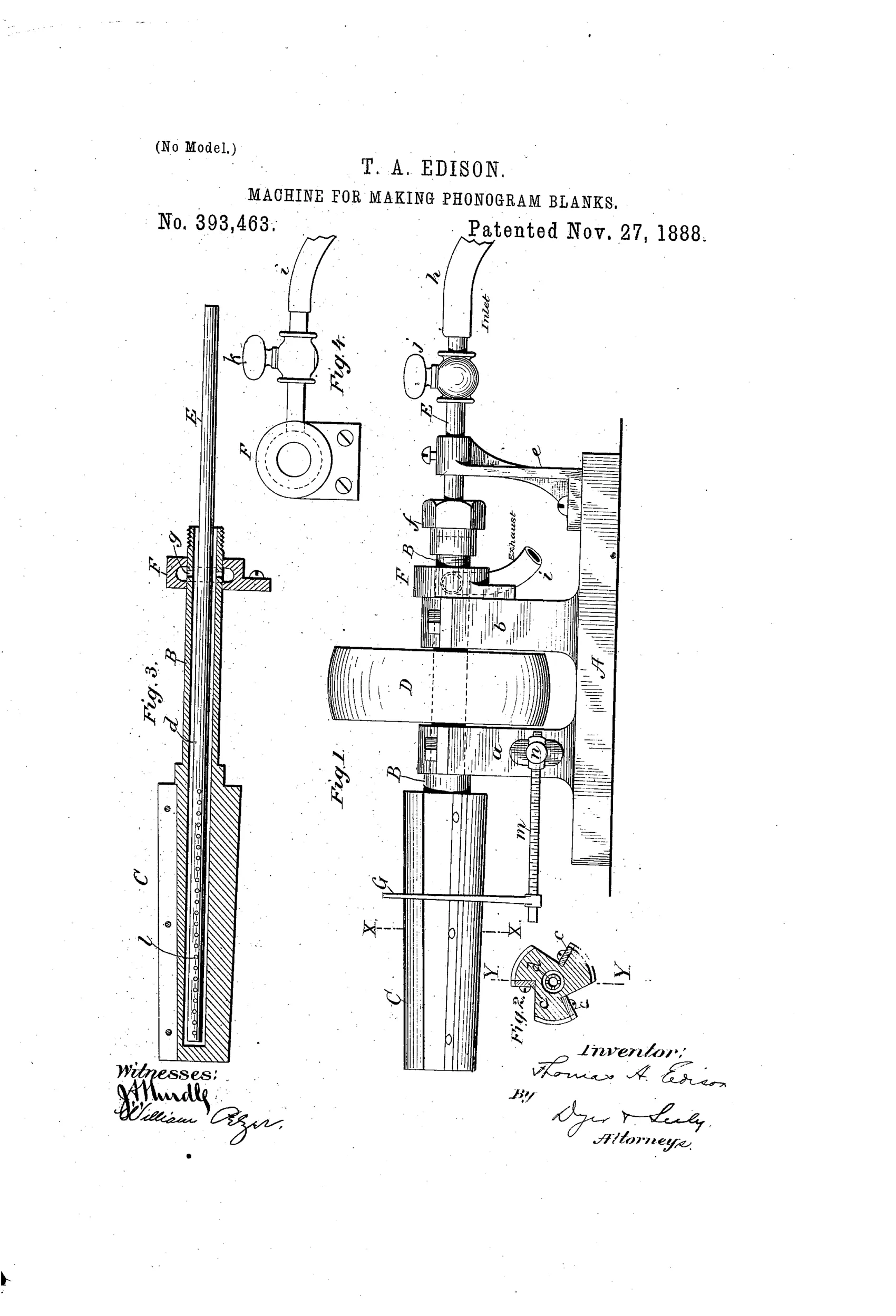
Heated revolving reamer for finishing wax phonogram-blank bores
♫ How it works
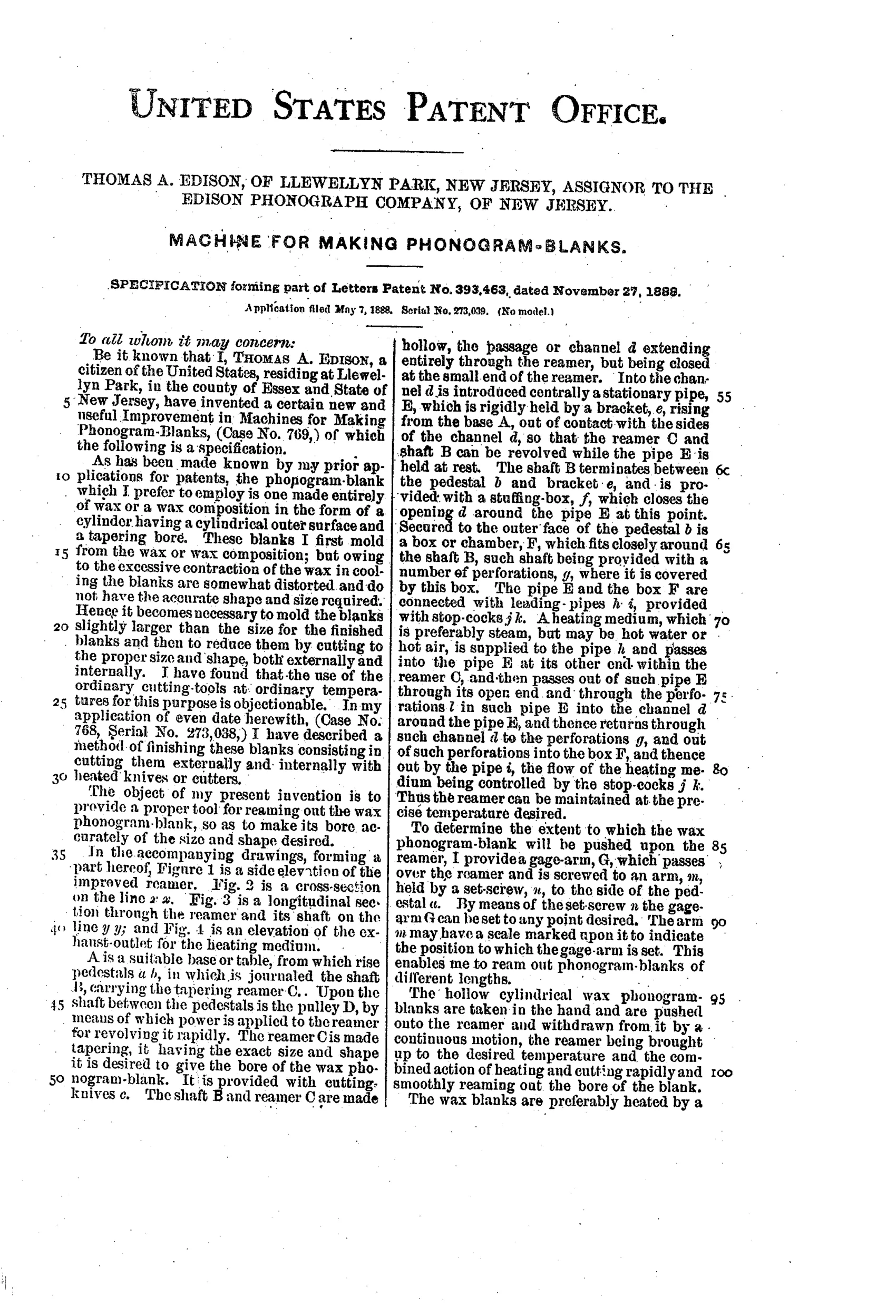
A revolving shaft carries a hollow tapering reamer fitted with cutting knives that shape the inner bore of a wax phonogram-blank to precise size. A stationary central pipe delivers a heating medium such as steam into the hollow reamer through perforations, warming the cutting surface so it slices the wax smoothly without cracking it from uneven expansion. The heated medium circulates through a channel around the pipe and exits through a box with perforations, its flow regulated by stop-cocks. A gage-arm set with a screw on a marked scale lets the operator position the blank on the reamer to control how far it is pushed, allowing blanks of different lengths to be reamed to the same accurate bore.
♫ What was claimed
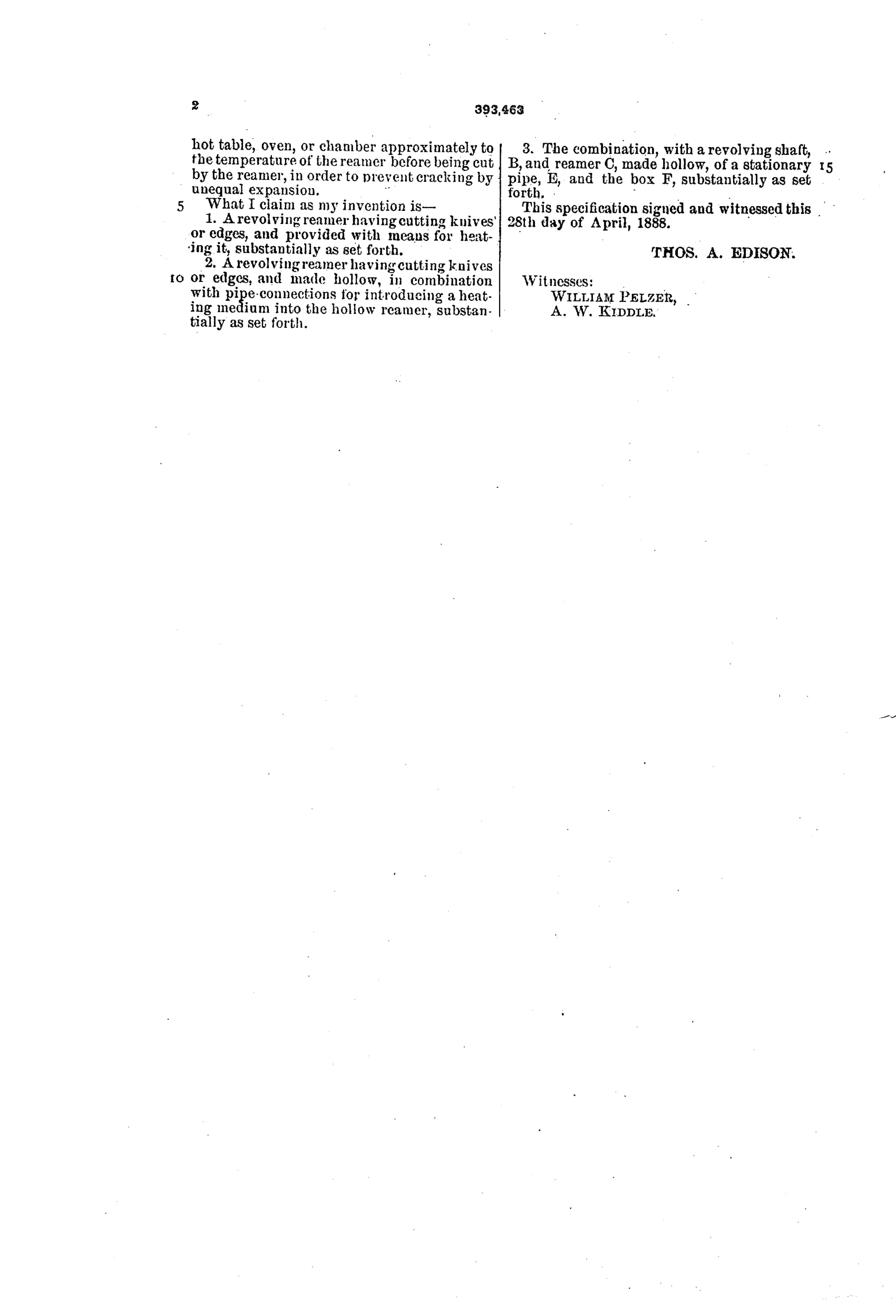
“1. A revolving reamer having cutting knives or edges, and provided with means for heating it, substantially as set forth.”
In plain English: The invention is a spinning reamer with cutting edges that is also heated as it works.
♫ In the inventor’s words
“I have found that the use of the ordinary cutting-tools at ordinary temperatures for this purpose is objectionable.”— Thomas A. Edison, from the specification
Manufactured and sold
Assigned to the Edison Phonograph Company as part of the 1888 wax-blank manufacturing push, this class of finishing tooling served Edison's actual cylinder production, though as internal factory equipment no consumer example exists.
♫ More by Thomas A. Edison
- Improvement in Phonograph or Speaking Machines (1878)
- Phonograph. (1880)
- PHONOGRAPH. (1888)
- AUTOMATIC DETERMINING DEVICE FOR PHONOGRAPHS. (1890)
- PHONOGRAPH. (1891)
- PHONOGRAPH (1893)
♫ Commentary
This is not a phonograph patent — it's a factory patent, and that distinction matters. By mid-1888 Edison had committed to the wax cylinder, which meant he suddenly needed to manufacture thousands of blanks with bores accurate enough to seat firmly on any machine's tapered mandrel. A cylinder that fits loosely wobbles; one that fits too tight cracks when pushed home. This tool is his answer to the second problem.
The clever part is thermal, not mechanical. Wax is brittle at room temperature, and Edison says plainly that ordinary cutting tools were 'objectionable' — a cold reamer chips and splits the bore. So he made the reamer hollow, ran a stationary steam pipe up its center, and let the heating medium bleed through perforations to warm the knives. A warm blade slices wax like cheese instead of shattering it, and the uniform heat avoids the uneven expansion that would crack a blank from the inside out. Fig. 3 shows the concentric pipe-within-shaft arrangement; the stop-cocks in Figs. 1 and 4 let the operator throttle the temperature.
Note also the gage-arm with its graduated screw — blanks of varying lengths all end up with the same finished bore. That's production-line thinking, standardization applied to a product that barely existed yet. Unglamorous, essential, and exactly the kind of patent that separated Edison's operation from the tinkerers.
Commentary by Claude, The Talking Machine Patent Archive’s resident enthusiast