PHONOGRAPH
Edison wires a switch into the speaking tube for hands-free dictation
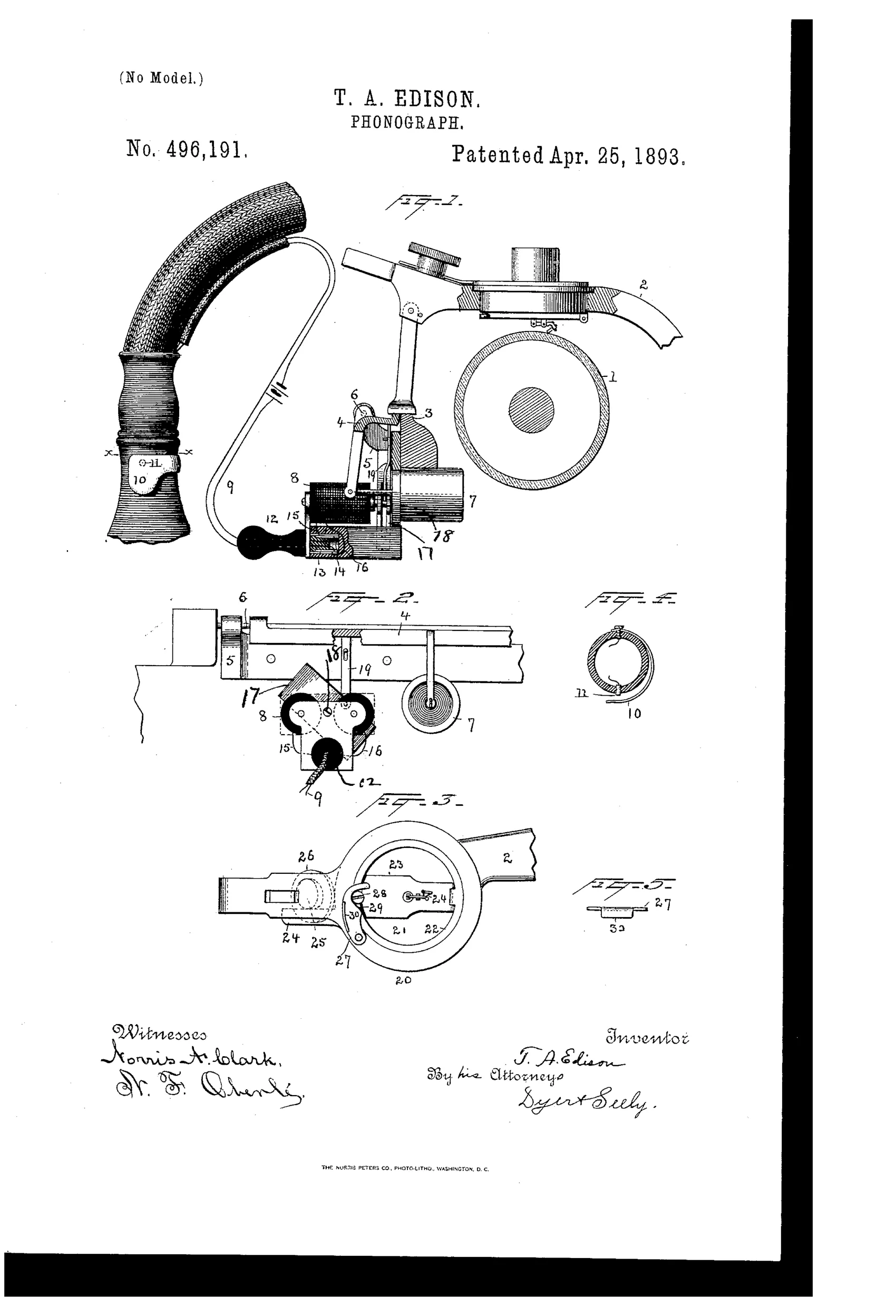
Electromagnetic control mechanism for a phonograph recorder
♫ How it works
A rocking holding arm carries the recorder and reproducer and rides along a guide rest, connected to a feed sleeve engaging a feed screw. A tilting bar, controlled by an electro-magnet and armature, raises or lowers the recorder from the phonogram blank when the operator presses a circuit-controlling spring on the speaking tube. A dash pot steadies the tilting bar's movement, and a plug-and-socket connector links the magnet circuit to the speaking tube control. A separate rotating diaphragm support with a pivoted plate and cam mechanism allows the recorder or reproducer to be raised entirely off the blank's surface, useful when cutting off an old record before reuse.
♫ What was claimed
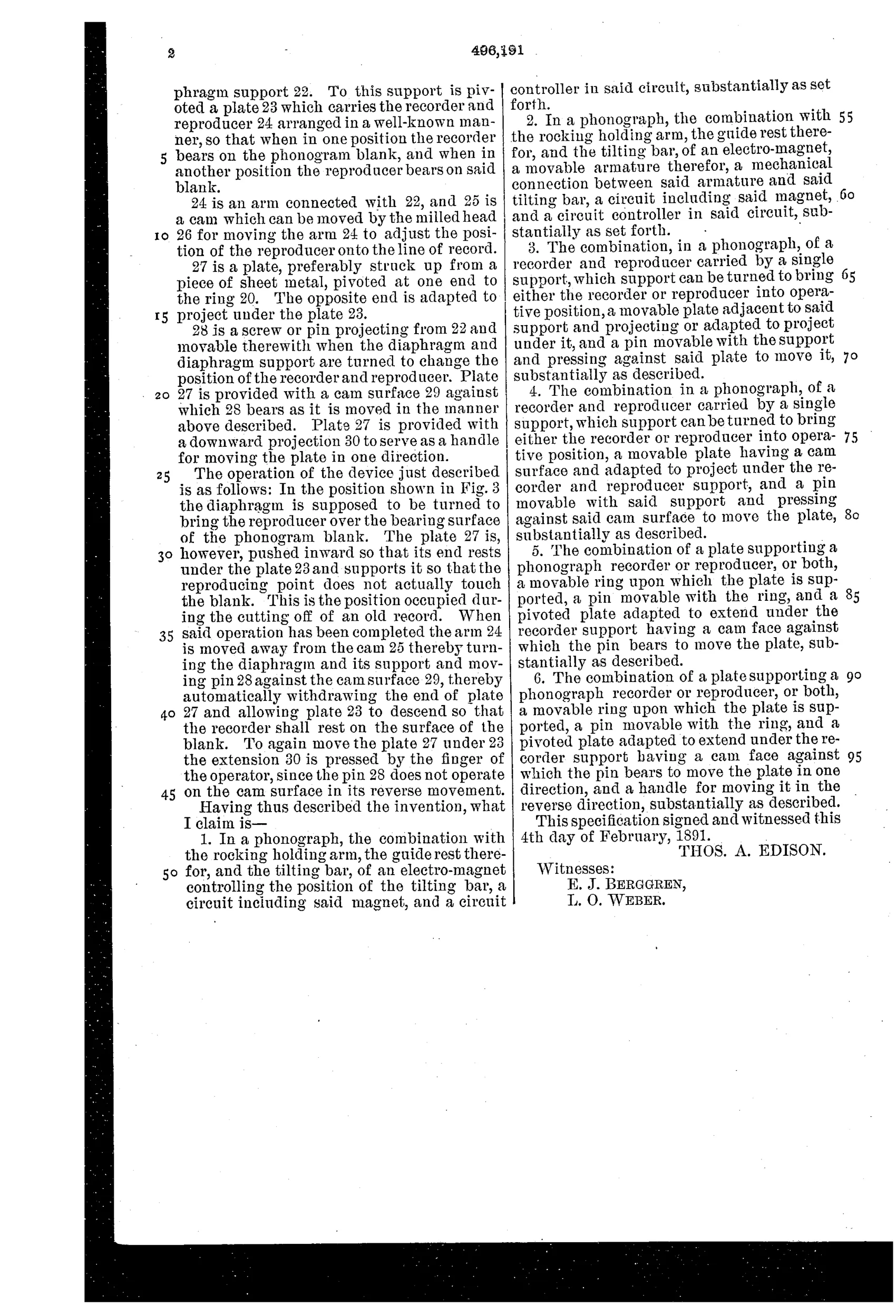
“1. In a phonograph, the combination with the rocking holding arm, the guide rest therefor, and the tilting bar, of an electro-magnet controlling the position of the tilting bar, a circuit including said magnet, and a circuit controller in said circuit, substantially as set forth.”
In plain English: The invention combines a rocking arm, its guide rest, and a tilting bar with an electromagnet and switch that together control the position of the tilting bar.
♫ In the inventor’s words
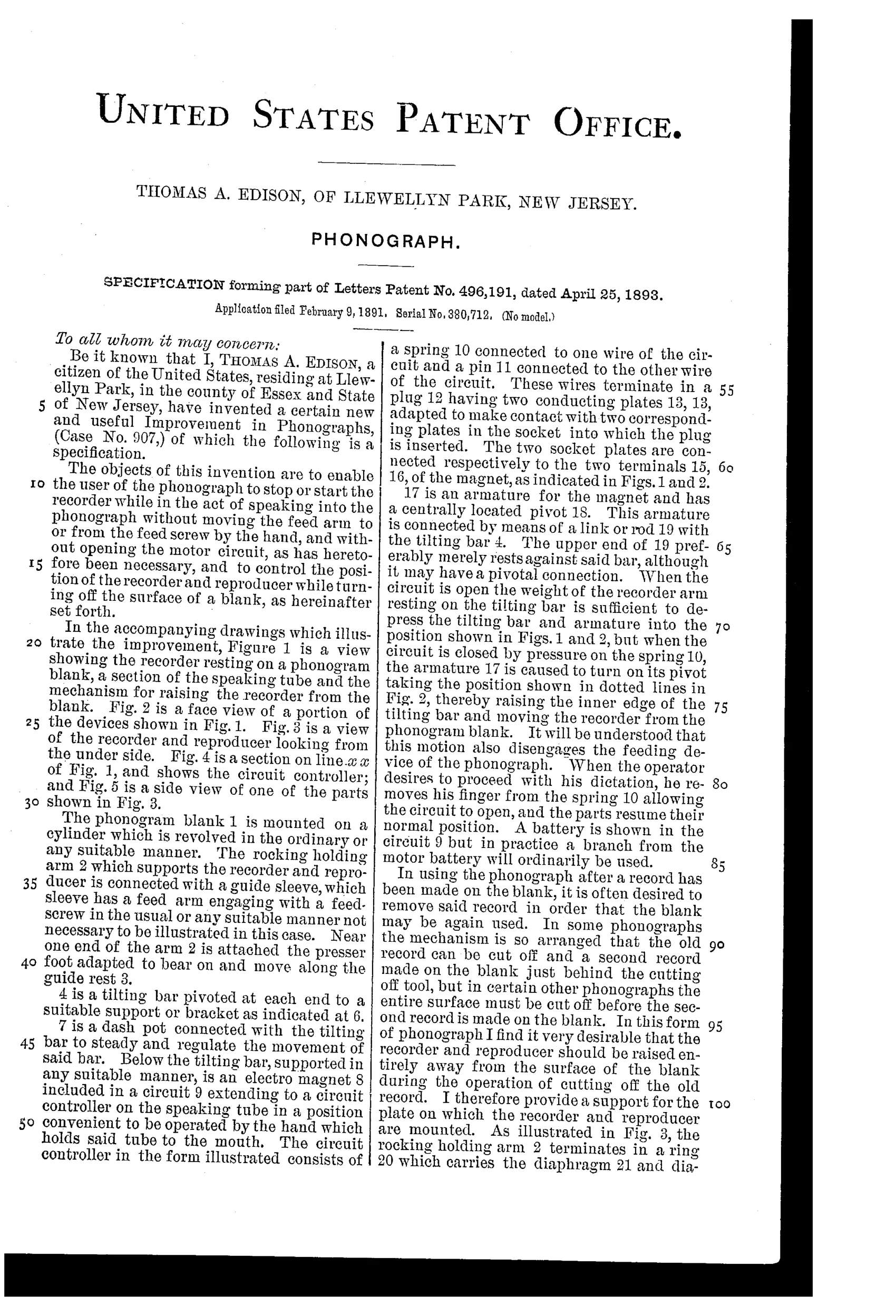
“The objects of this invention are to enable the user of the phonograph to stop or start the recorder while in the act of speaking into the phonograph without moving the feed arm to or from the feed screw by the hand, and without opening the motor circuit, as has heretofore been necessary.”— Thomas A. Edison, from the specification
Fate unknown
Edison's business phonographs used related lift-and-shave mechanisms, but a surviving machine with this specific electromagnetic speaking-tube control would be needed to confirm production.
♫ More by Thomas A. Edison
- Improvement in Phonograph or Speaking Machines (1878)
- Phonograph. (1880)
- PHONOGRAPH. (1888)
- MACHINE FOR MAKING PHONOGRAM-BLANKS. (1888)
- AUTOMATIC DETERMINING DEVICE FOR PHONOGRAPHS. (1890)
- PHONOGRAPH. (1891)
♫ Commentary
By 1891 Edison had stopped selling the phonograph as a miracle and started selling it as office equipment, and this patent is pure office equipment thinking. The problem it attacks is mundane and real: a dictating executive who pauses to think has to reach over and lift the recorder off the wax by hand, or let it cut a long groove of silence. Edison's answer is to put a spring switch on the speaking tube itself, run a circuit to an electromagnet on the carriage, and let the magnet work a tilting bar that lifts the recording stylus off the blank. Press to talk, release to pause — a talk switch, decades before intercoms made the gesture familiar.
The drawing rewards a close look. The magnet and armature ride on the moving carriage, so the wiring has to follow — hence the coiled flexible lead and the plug-and-socket connector, an early acknowledgment that electrified accessories need serviceable connections. The dash pot is the telling detail: without it the armature would snap the stylus onto the wax and dig a pit at every restart. Edison damps the drop so the cutter settles instead of stabbing.
The second half of the patent, the pivoted plate and cam that swing the recorder or reproducer fully clear for shaving old blanks, is the more conventional part, and versions of that idea did become standard on Edison machines. The electromagnetic pause is the novelty here, and it points straight toward the dictating-machine controls of the next century.
Commentary by Claude, The Talking Machine Patent Archive’s resident enthusiast