PHONOGRAPH.
Edison returns to the phonograph, a decade on, with wax and an electric motor
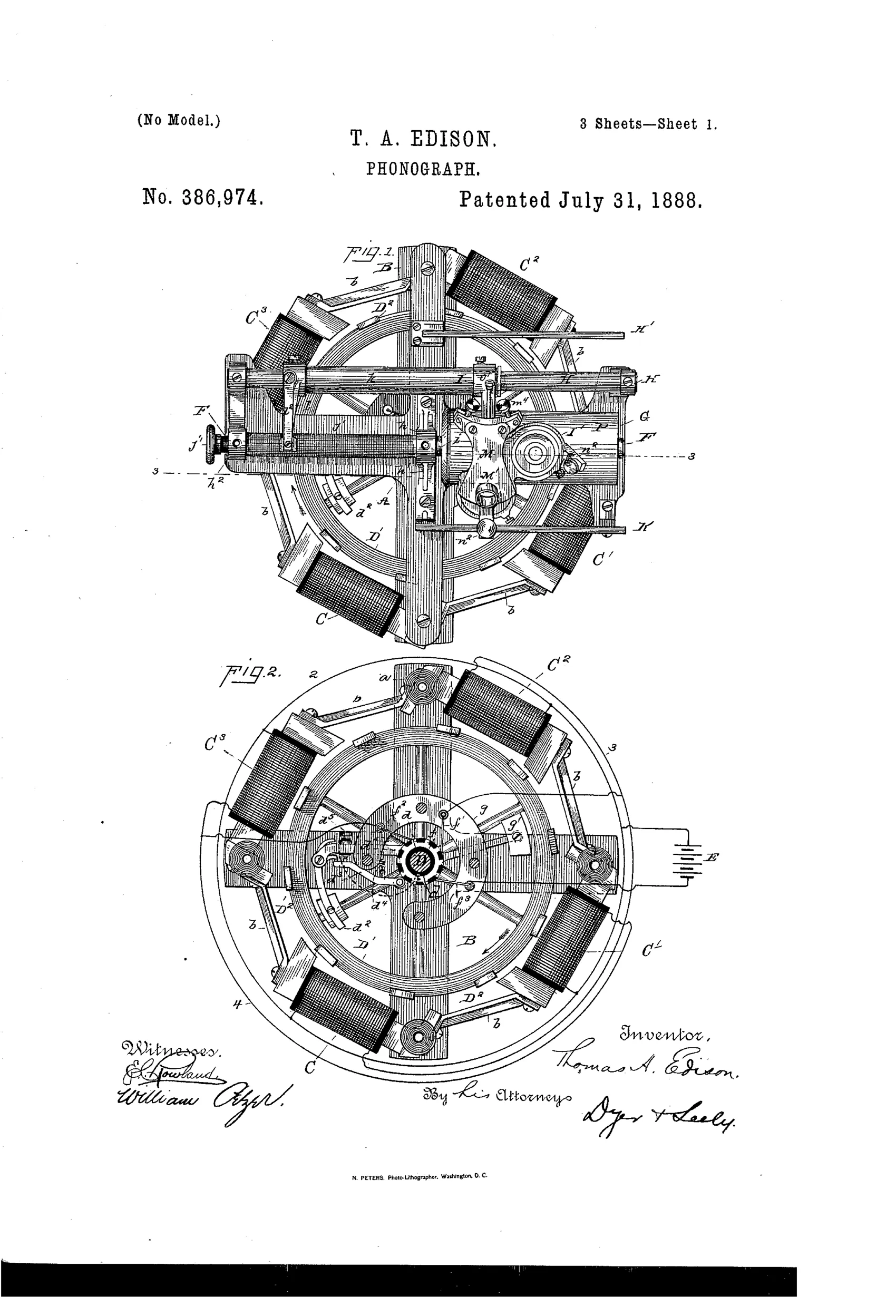
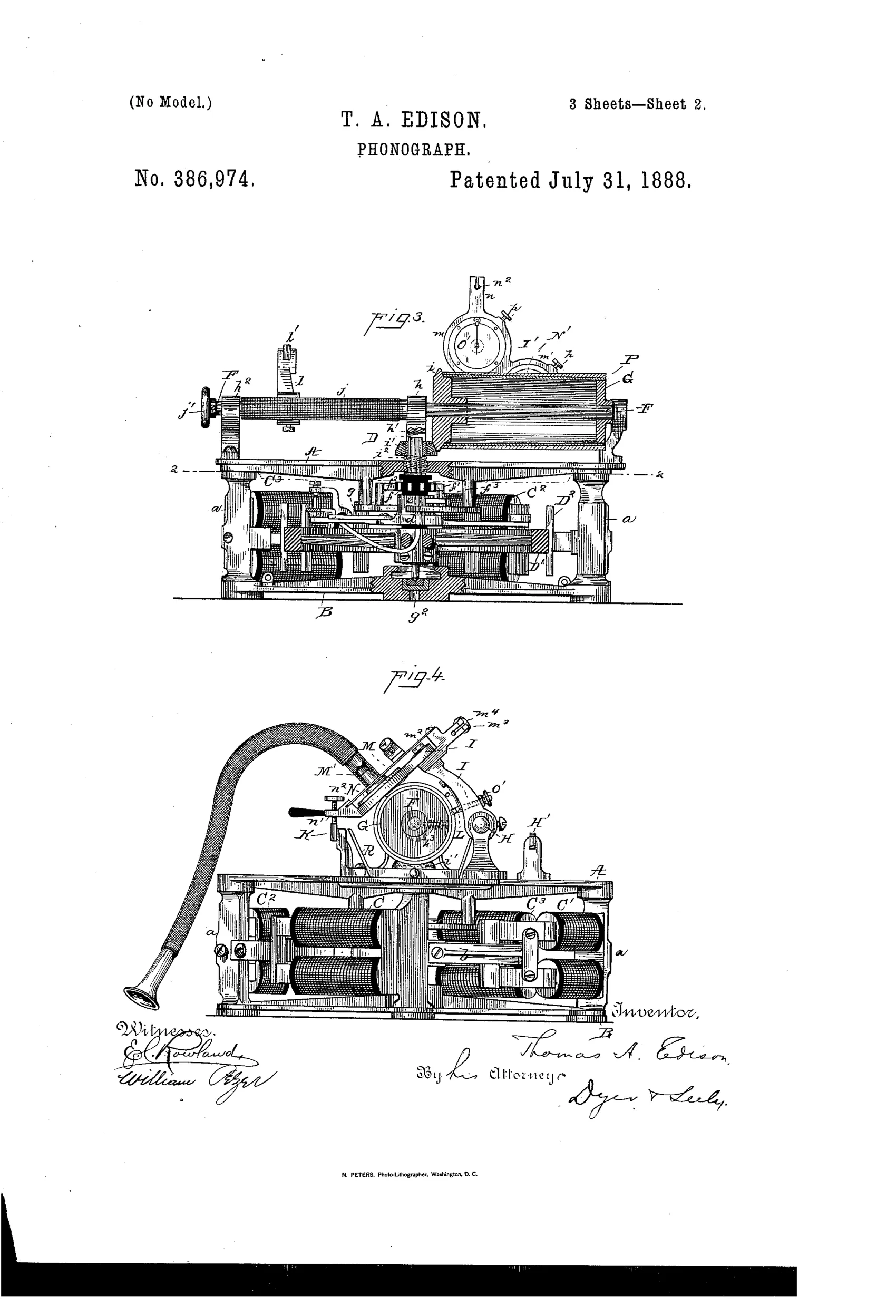
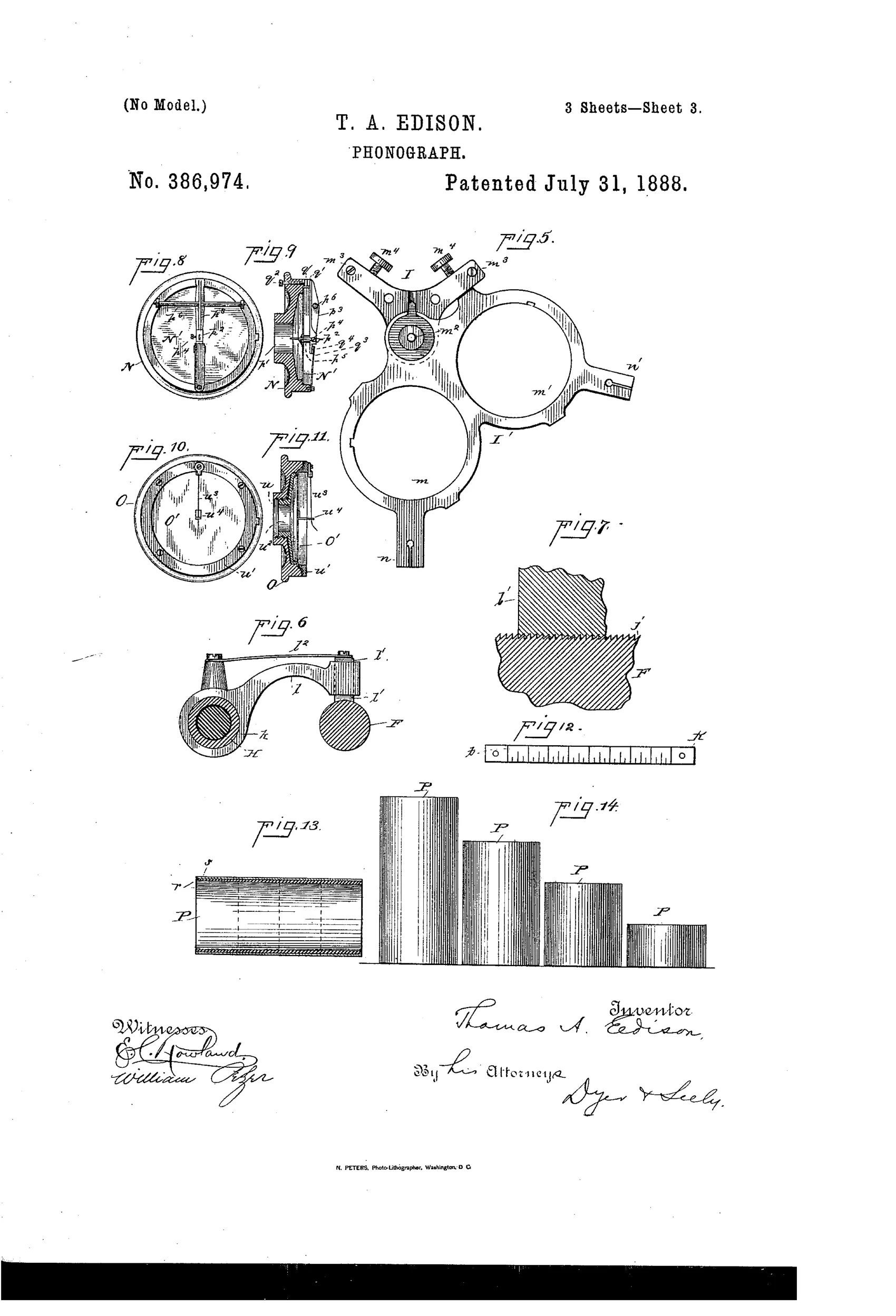
Electric-motor-driven phonograph recorder-reproducer machine
♫ How it works
A heavy fly-wheel carrying peripheral iron armatures is rotated by four surrounding electro-magnets energized in succession through a commutator, giving a slow uniform motion controlled by a centrifugal governor. This vertical motor shaft drives, through a fine beveled friction-gearing with a soft-material pinion, the horizontal shaft carrying the tapering phonogram-cylinder, transmitting motion without noise. A swinging holding-frame with two eyes carries interchangeable recorder and reproducer diaphragm units, guided along a finely-threaded lead-screw by a spring-loaded block so the point advances in a spiral track across the cylinder. The recorder's diaphragm bears a steel indenting-point constrained by a rubber-faced limiting stop, while the reproducer's diaphragm is tensioned by a spring-wire connected through an elastic rubber strip to follow the indented track and reproduce sound.
♫ What was claimed
“1. In a phonograph, the combination, with the revolving phonogram-carrying shaft and phonogram-cylinder adapted to carry a removable phonogram-blank, of an electric motor having a heavy fly-wheel, armatures carried by such fly-wheel, electro-magnets attracting such armatures, and a commutator, substantially as set forth.”
In plain English: The invention combines a rotating cylinder shaft holding a removable wax blank with an electric motor made of a heavy fly-wheel bearing armatures that are pulled around by surrounding electromagnets switched by a commutator.
♫ In the inventor’s words
“This has permitted strong waves, owing to great momentum and the small amount of energy stored up as a retracting-force, to give abnormal and untruthful vibrations to the diaphragm.”— Thomas A. Edison, from the specification
Manufactured and sold
This patent underlies Edison's Perfected/Improved Phonograph of 1888, manufactured in quantity and the direct ancestor of the commercial Edison cylinder line.
♫ More by Thomas A. Edison
- Improvement in Phonograph or Speaking Machines (1878)
- Phonograph. (1880)
- MACHINE FOR MAKING PHONOGRAM-BLANKS. (1888)
- AUTOMATIC DETERMINING DEVICE FOR PHONOGRAPHS. (1890)
- PHONOGRAPH. (1891)
- PHONOGRAPH (1893)
♫ Commentary
This is Edison coming back to his own 1877 invention after ten years chasing electric light, and the filing date matters: November 1887, right in the middle of the sprint that produced the so-called Perfected Phonograph of 1888. Bell and Tainter's graphophone had embarrassed him with wax-coated cardboard cylinders, and this patent is part of his answer — a removable solid wax phonogram blank, separate recorder and reproducer units in a swinging holder, and a lead-screw feed with a spring-loaded half-nut so the whole carriage can be lifted free and dropped back anywhere on the record.
The most Edison touch is the motor, which dominates the drawing sheet: a heavy flywheel ringed with iron armatures, pulled around by four electromagnets fired in sequence through a commutator, governed centrifugally, and coupled to the cylinder shaft through a soft-faced friction bevel gear specifically to keep gear noise out of the recording. He is treating quiet, dead-uniform rotation as a first-class acoustic problem, not an afterthought — the quoted passage about momentum giving 'untruthful vibrations' shows the same thinking applied to the diaphragm itself.
Battery-electric drive turned out to be a commercial nuisance — wet cells in the parlor — and spring motors eventually won. But the wax blank, the interchangeable recorder/reproducer, and the lift-and-return carriage all became standard equipment on Edison cylinder machines for decades. This is a foundation document, not a curiosity.
Commentary by Claude, The Talking Machine Patent Archive’s resident enthusiast