AUTOMATIC DETERMINING DEVICE FOR PHONOGRAPHS.
Edison lets the record itself set the stylus depth, then locks it
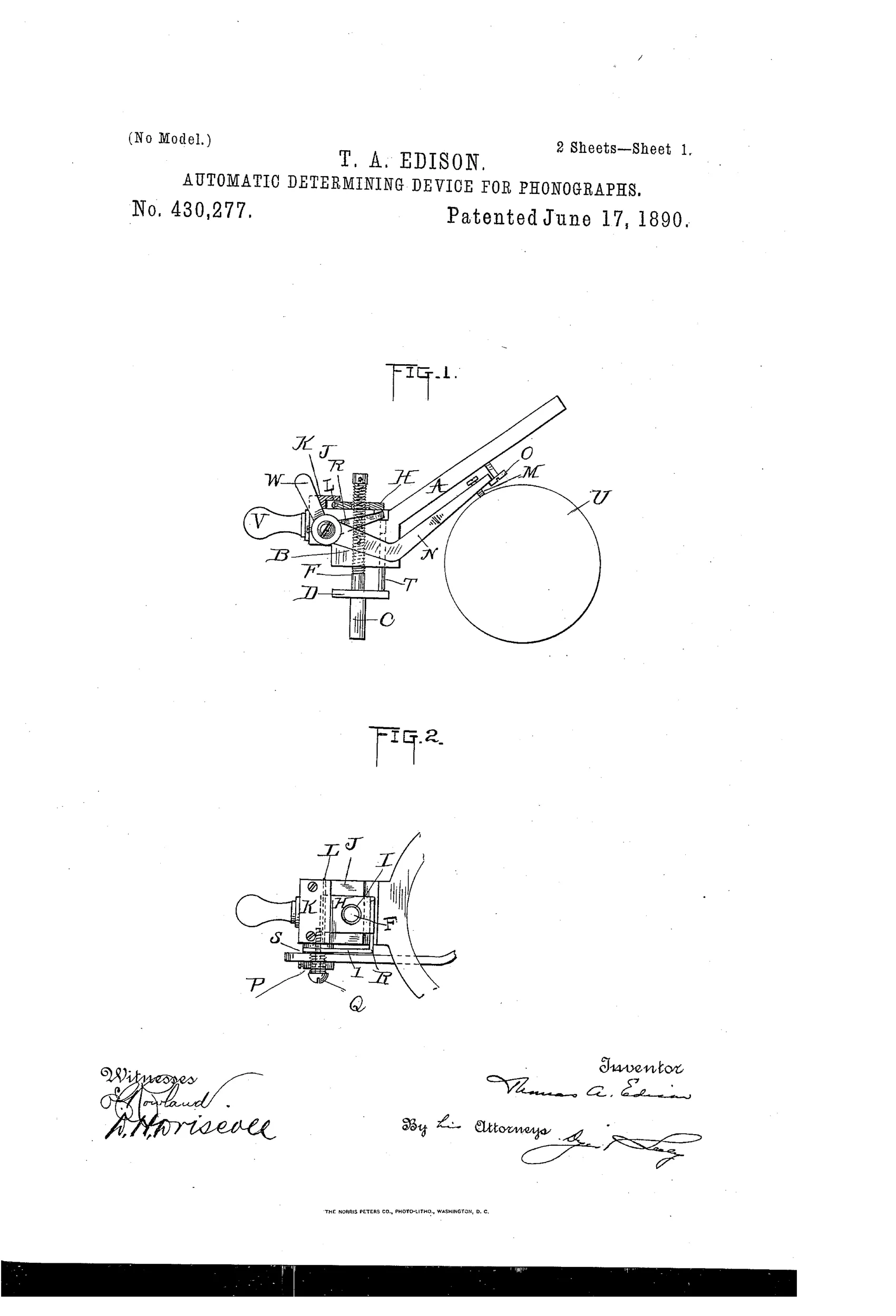
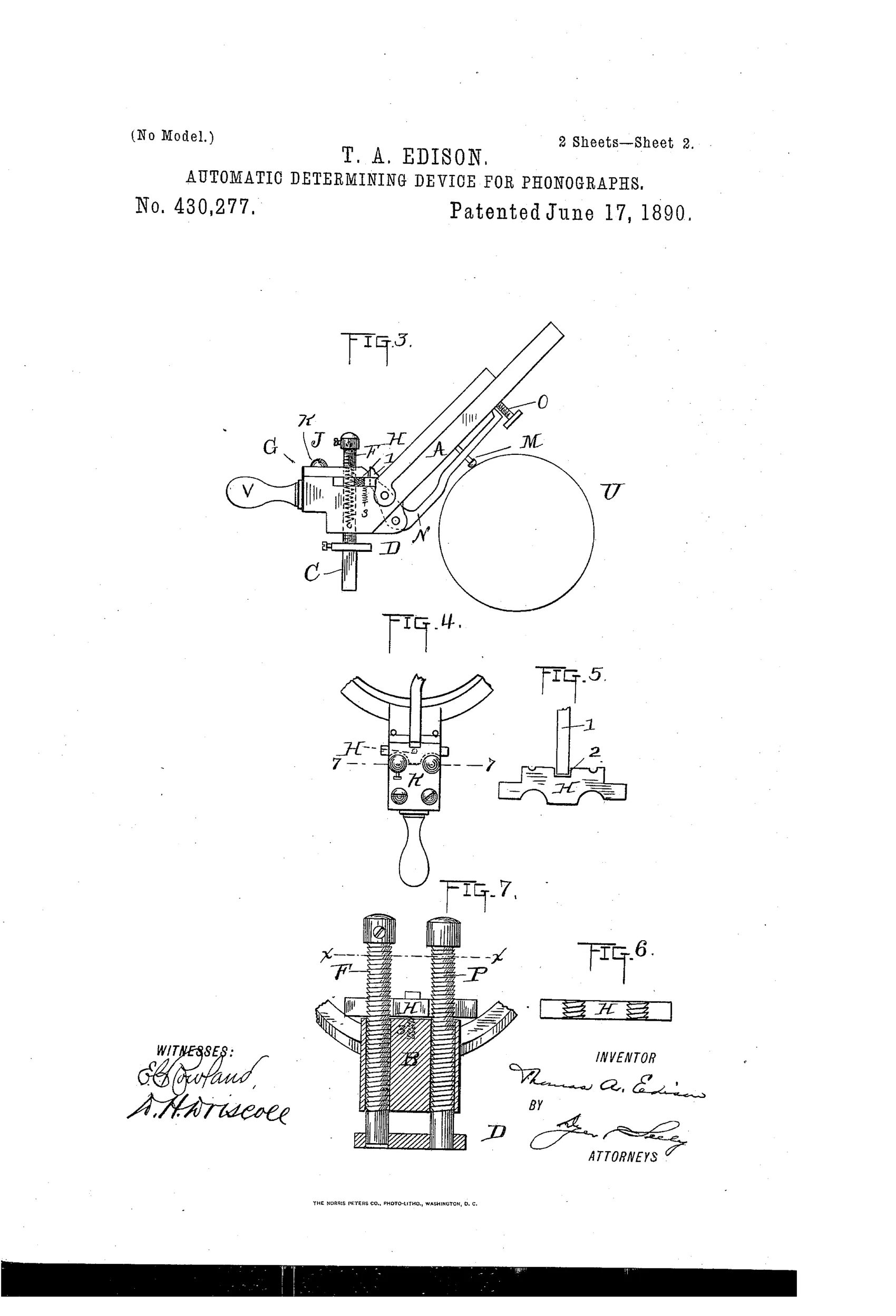
Auto-adjusting presser-foot locking device for phonographs
♫ How it works
A spectacle-frame arm carries a presser-foot on a threaded bar that rests against a guide-rest to support the recording or reproducing point relative to the phonogram-blank surface. A determining-point mounted on a pivoted lever contacts the cylinder surface, and upon contact rotates the lever, which forces a rocking arm against a locking-piece engaging the threaded bar. This action rigidly locks the presser-foot at the exact position dictated by the surface contour, while a friction-disk connection allows the determining-point lever to continue riding lightly over the blank without damaging it. A spring biases the bar downward, and in a modified form two threaded bars offset by half a thread pitch allow finer locking resolution via a spring-cushioned locking-piece.
♫ What was claimed
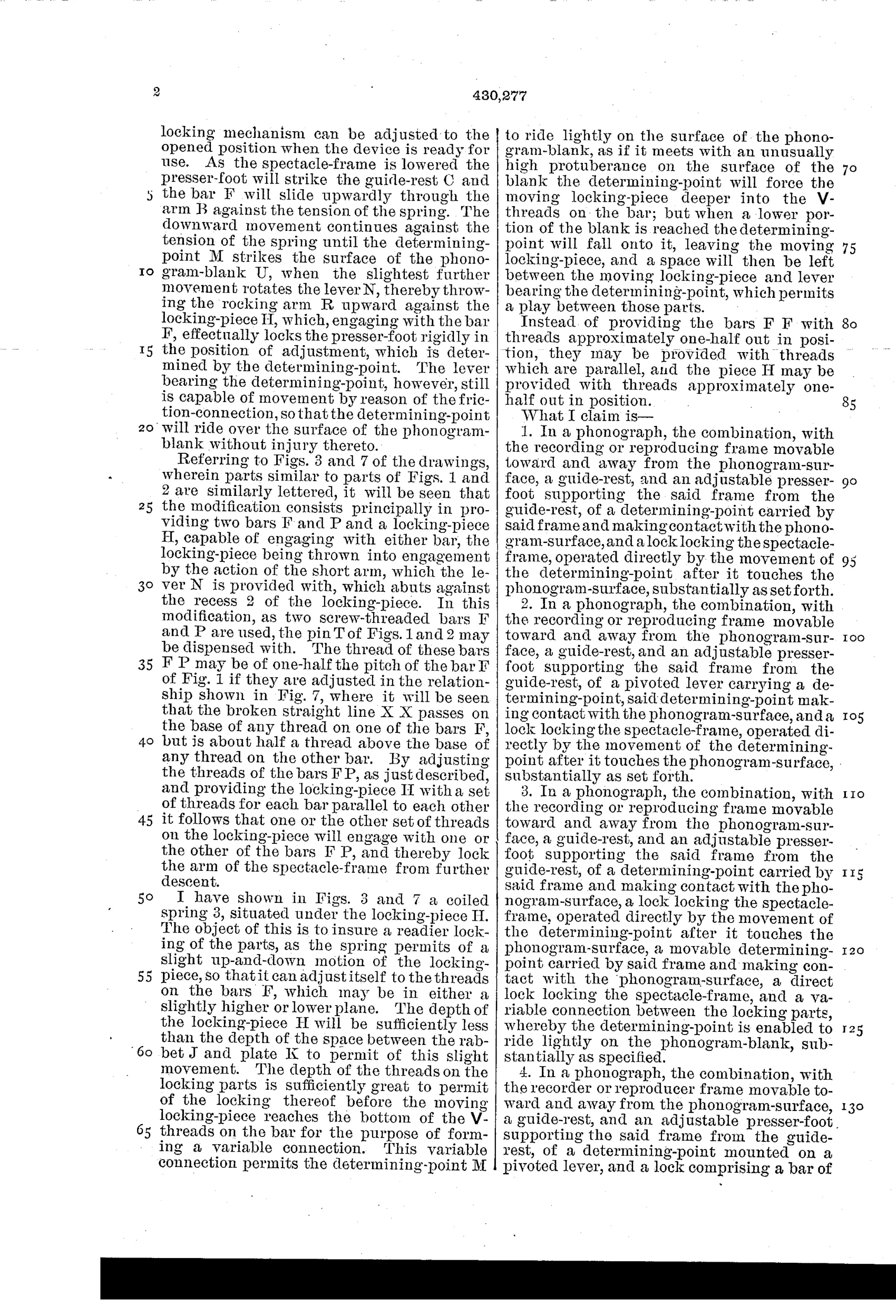
“In a phonograph, the combination, with the recording or reproducing frame movable toward and away from the phonogram-surface, a guide-rest, and an adjustable presser-foot supporting the said frame from the guide-rest, of a determining-point carried by said frame and making contact with the phonogram-surface, and a lock locking the spectacle-frame, operated directly by the movement of the determining-point after it touches the phonogram-surface, substantially as set forth.”
In plain English: The patent covers a phonograph presser-foot system where a point touching the record surface directly triggers a lock that fixes the recording/reproducing frame's position.
♫ In the inventor’s words
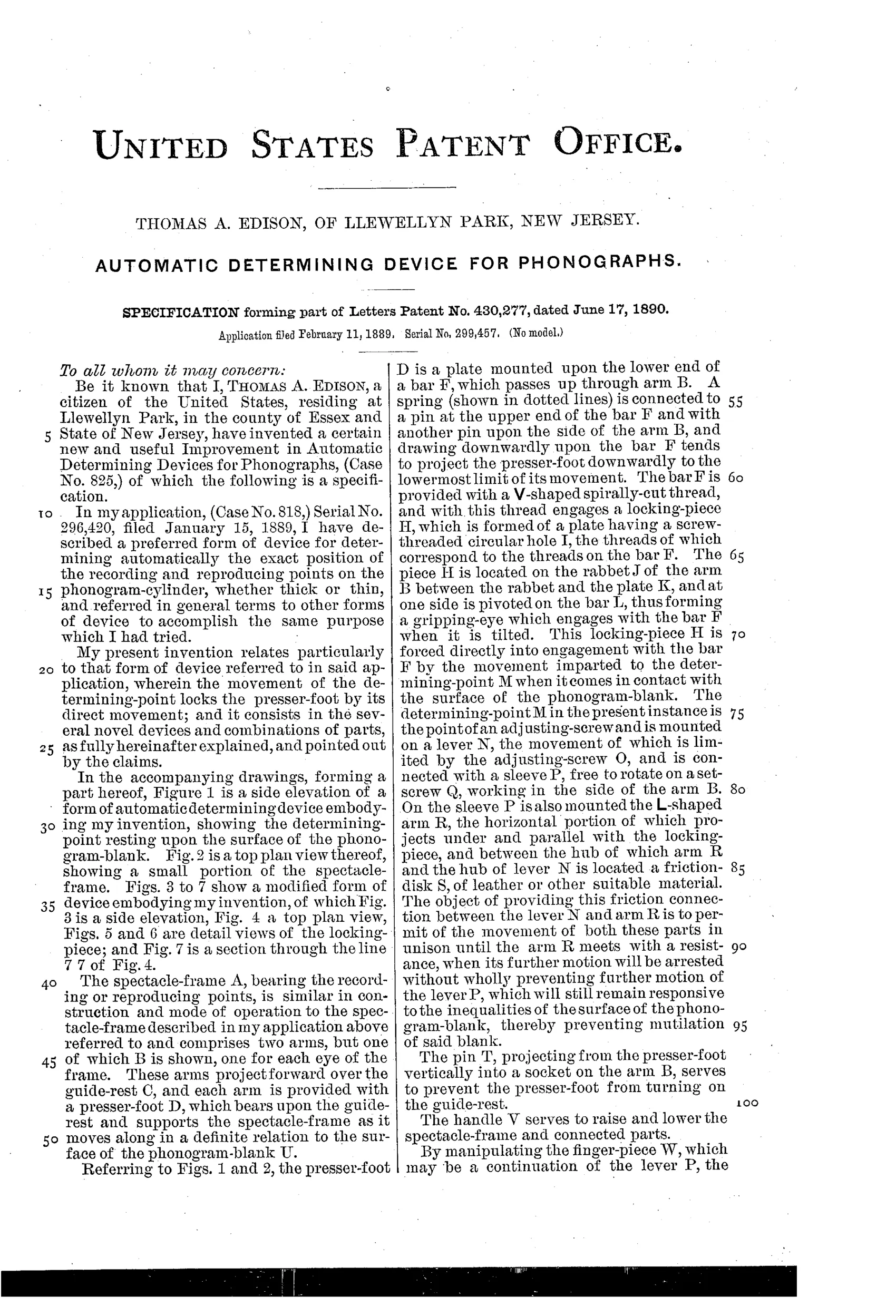
“This variable connection permits the determining-point M to ride lightly on the surface of the phonogram-blank, as if it meets with an unusually high protuberance on the surface of the blank the determining-point will force the moving locking-piece deeper into the V-threads on the bar; but when a lower portion of the blank is reached the determining-point will fall onto it, leaving the moving locking-piece, and a space will then be left between the moving locking-piece and lever bearing the determining-point, which permits a play between those parts.”— Thomas A. Edison, from the specification
Fate unknown
Edison's improved phonographs used spectacle frames and presser-feet, but documentation that this specific self-locking determining-point reached production machines is lacking; a surviving example would settle it.
♫ More by Thomas A. Edison
- Improvement in Phonograph or Speaking Machines (1878)
- Phonograph. (1880)
- PHONOGRAPH. (1888)
- MACHINE FOR MAKING PHONOGRAM-BLANKS. (1888)
- PHONOGRAPH. (1891)
- PHONOGRAPH (1893)
♫ Commentary
Every wax-cylinder machine had to solve the same fussy problem: the recording or reproducing point must sit at exactly the right depth against a blank whose surface is never perfectly true. Edison's usual answer was the presser-foot on the spectacle frame — a manually adjusted rest. Here he tries to take the operator out of the loop entirely. A small determining-point rides down onto the blank first; the instant it touches, its pivoted lever throws a locking-piece into the V-threads of the presser-foot bar, freezing the frame at whatever height the actual wax surface dictates.
The genuinely clever part is buried in the friction-disk connection and the half-pitch offset of the twin threaded bars in the modified form. The first lets the determining-point keep riding lightly over the surface without gouging it after the lock is set; the second doubles the locking resolution, because a V-thread lock can only stop at discrete positions and Edison knew a half-thread error was audible. That is the mark of someone who had actually ruined blanks and was engineering against specific failures.
This sits in the thick of Edison's 1888–1890 push to turn the improved phonograph into a practical dictation machine, where untrained office clerks — not laboratory hands — would be setting styluses. Whether this particular auto-lock ever shipped is less clear than the problem it addresses, which was real and persistent.
Commentary by Claude, The Talking Machine Patent Archive’s resident enthusiast